Domestic Auto Sales Post "Seventh Straight Monthly Decline" — CAAM: Overall Pressure on the Auto Market Remains Relatively High
 11/16 2026
 551
With just a month and a half left before year-end, the overall trajectory of the auto market has largely taken shape.
On "Double Eleven," brands rolled out aggressive promotional campaigns. Around the same time, the China Association of Automobile Manufacturers (CAAM) officially released its data on market conditions for the first ten months of the year.
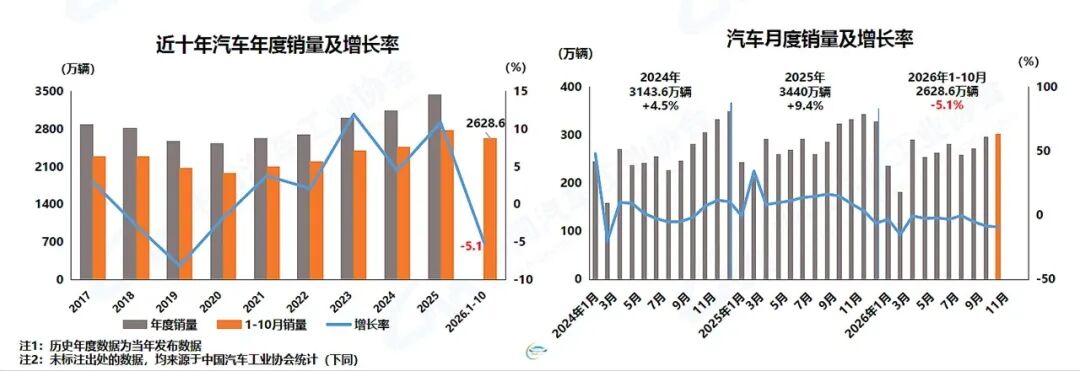
CAAM figures show that in October, auto production and sales reached 3.063 million and 3.016 million units, respectively — up 2.5% and 2% month-on-month, but down 8.8% and 9.2% year-on-year. The "Golden September and Silver October" peak season delivered only lackluster momentum, and reversing the full-year trend remains a tall order.
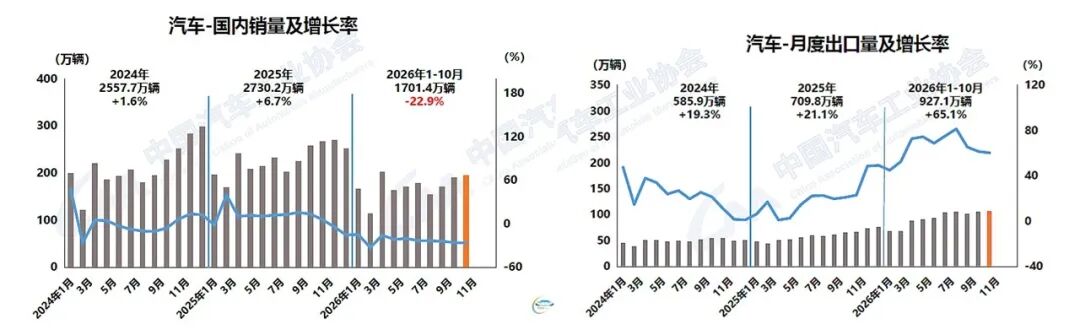
More striking still is what lies beneath the headline numbers: two curves are moving in completely opposite directions. Domestic sales stood at 1.95 million units, down 26.6% year-on-year, marking the seventh consecutive month of year-on-year declines exceeding 20%. Exports reached 1.066 million units, up 60.2% year-on-year, with monthly export volume holding above one million units for five consecutive months. For January–October cumulative figures, domestic sales totaled 17.014 million units, down 22.9% year-on-year, while exports reached 9.271 million units, up 65.1% year-on-year. Between these extremes of cold and hot, the fundamentals of the industry are being redefined.

Global Markets Under Broad "Sluggishness"
To view the continued contraction of domestic sales in a global context, one easily overlooked fact stands out: the global auto market is also trending downward in 2026, and no "alternative growth pole" has emerged outside China. In October, GlobalData had just downgraded its full-year forecast, cutting global light vehicle sales from a previous estimate of 89.8 million units to 88.4 million units, with the year-on-year decline widening from 2.7% to 4.3%. In the first nine months of the year, global cumulative auto sales were 72.52 million units, up only 3% year-on-year, and growth in September alone narrowed further to 2%. The global auto market itself is losing momentum.
What this means is that the seven consecutive months of year-on-year declines exceeding 20% in domestic sales cannot simply be attributed to "exports diverting domestic supply" or "other countries' markets replacing China." A more accurate assessment is that China's auto consumption experienced a deep contraction in 2026 independent of the global cycle — one rooted in domestic demand-side factors rather than a sudden shift in the external competitive landscape.
Exports Lead by a Wide Margin
The strength of exports needs no embellishment. In the first half of 2026, China's auto exports reached 5.31 million units, compared with 2.21 million for second-place Japan and 1.68 million for Germany. China's half-year export scale alone exceeded Japan's by more than 2.4 times, continuing the "runaway first place" pattern of recent years.
Based on a linear projection from cumulative exports of 9.271 million units in January–October and a year-on-year growth rate of 65.1%, there is little doubt that full-year exports will reach the 10-million-unit mark. In a year when global auto consumption is broadly sluggish, China's ability to sustain such an export trajectory essentially reflects comprehensive competitiveness in product cost-effectiveness, supply chain efficiency, and overseas channel penetration — rather than short-term price dumping.
However, the trajectory of the export curve is now meeting policy inflection points — and both point to "profit" rather than "volume." First, the EU's safeguard measures investigation into Chinese hybrid vehicles has entered the quota implementation stage, with the first-year import cap set at 350,000 units, increasing by 6% annually thereafter, effective as early as December.
In the first seven months of 2026, China's hybrid vehicle exports to the EU already reached 378,000 units, accounting for 41.3% of the EU's total hybrid imports. The full-year market forecast for hybrid models exported to Europe is around 800,000 units, and the first-year quota of 350,000 units is less than half of actual import demand. Second, the export tax rebate rate for new energy vehicles has been cut from 13% to 9%, effective April 1, 2027, with a buffer period of about 5.5 months. Under static calculations, a 4-percentage-point cut in the export tax rebate rate affects unit export profit by about 4% of the FOB price, while the industry's net profit margin on complete vehicle exports is only in the 3%–6% range. For automakers that rely on exports as their main incremental channel, the resilience of export "volume" remains, but the cushion for "profit" is thinning. Relying solely on export scale expansion to offset the domestic downturn is not easing in marginal difficulty — it is mounting.
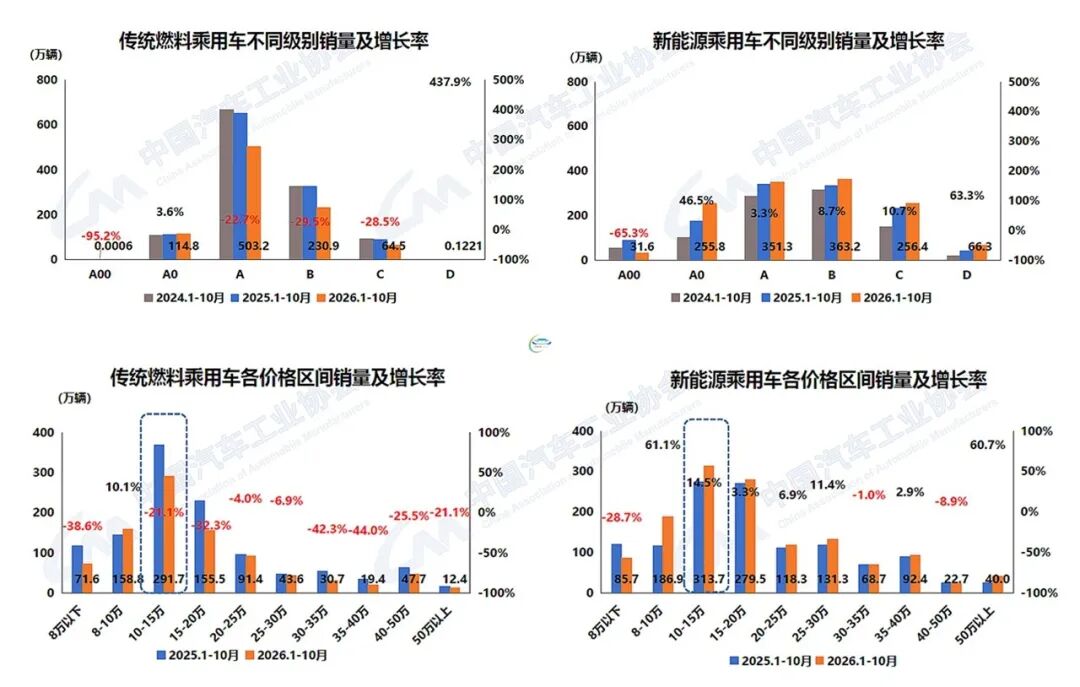
New Energy "Shifts Gears"
New energy vehicles remain the most structurally certain segment. In October, new energy sales reached 1.94 million units, up 13.1% year-on-year, accounting for 64.3% of new vehicle sales. Cumulative sales in January–October totaled 14.411 million units, up 11.3% year-on-year, with a penetration rate of 54.8%. Pure electric production and sales maintained growth of more than 10% in January–October, making it the most solid growth pole within the new energy segment. But if the reference frame shifts to the global level, a comparison worth confronting squarely emerges: in January–September 2026, the global penetration rate of new energy passenger vehicles was 25.3%, while China accounted for 63% of the world's new energy passenger vehicle sales.
China alone accounts for nearly two-thirds of global new energy passenger vehicle sales. This is both proof of industrial competitiveness and a signal that the structural dividend the domestic new energy market has enjoyed — "climbing from low penetration to high penetration" — is narrowing in headroom.
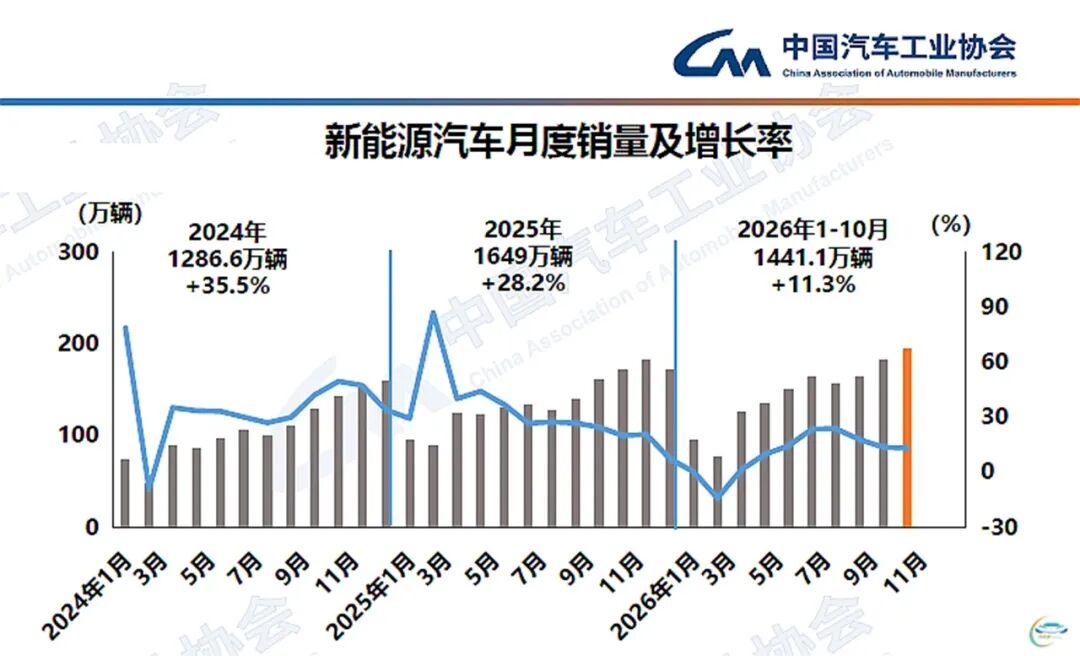
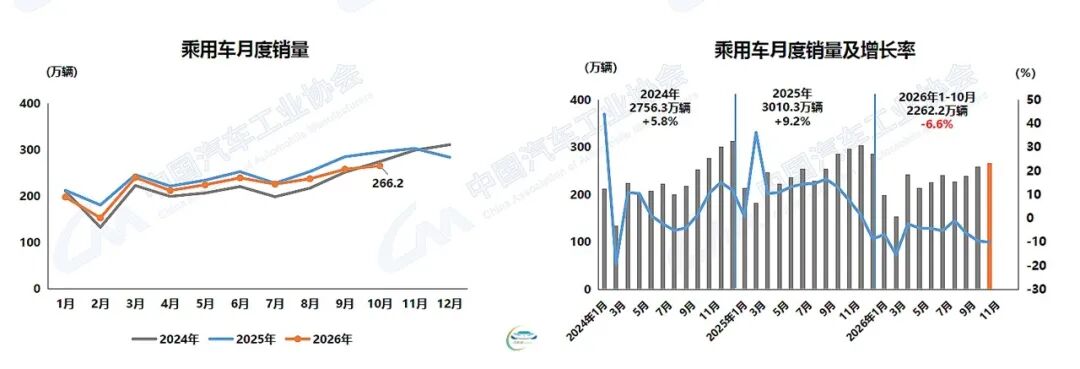
Now that domestic new energy penetration has crossed the 50% threshold, the driving force needed to sustain double-digit growth will become increasingly difficult to supply through the "natural migration of fuel vehicle users." From the current vantage point, future increments will come from two directions: first, the absorption of new energy products by export markets; second, further upward movement in product strength amid domestic stock replacement. The former faces dual profit constraints from EU quotas and export tax rebate cuts, while the difficulty of the latter is reflected in structural differentiation within the passenger vehicle segment: in January–October, cumulative passenger vehicle production and sales fell 6.4% and 6.6% year-on-year respectively; SUV production and sales grew slightly, while the other three major categories all posted double-digit declines. Consumption is concentrating into a small number of categories amid contraction — meaning new energy increments increasingly need to be "grabbed" from competitors' share rather than "split" from a growing pie.
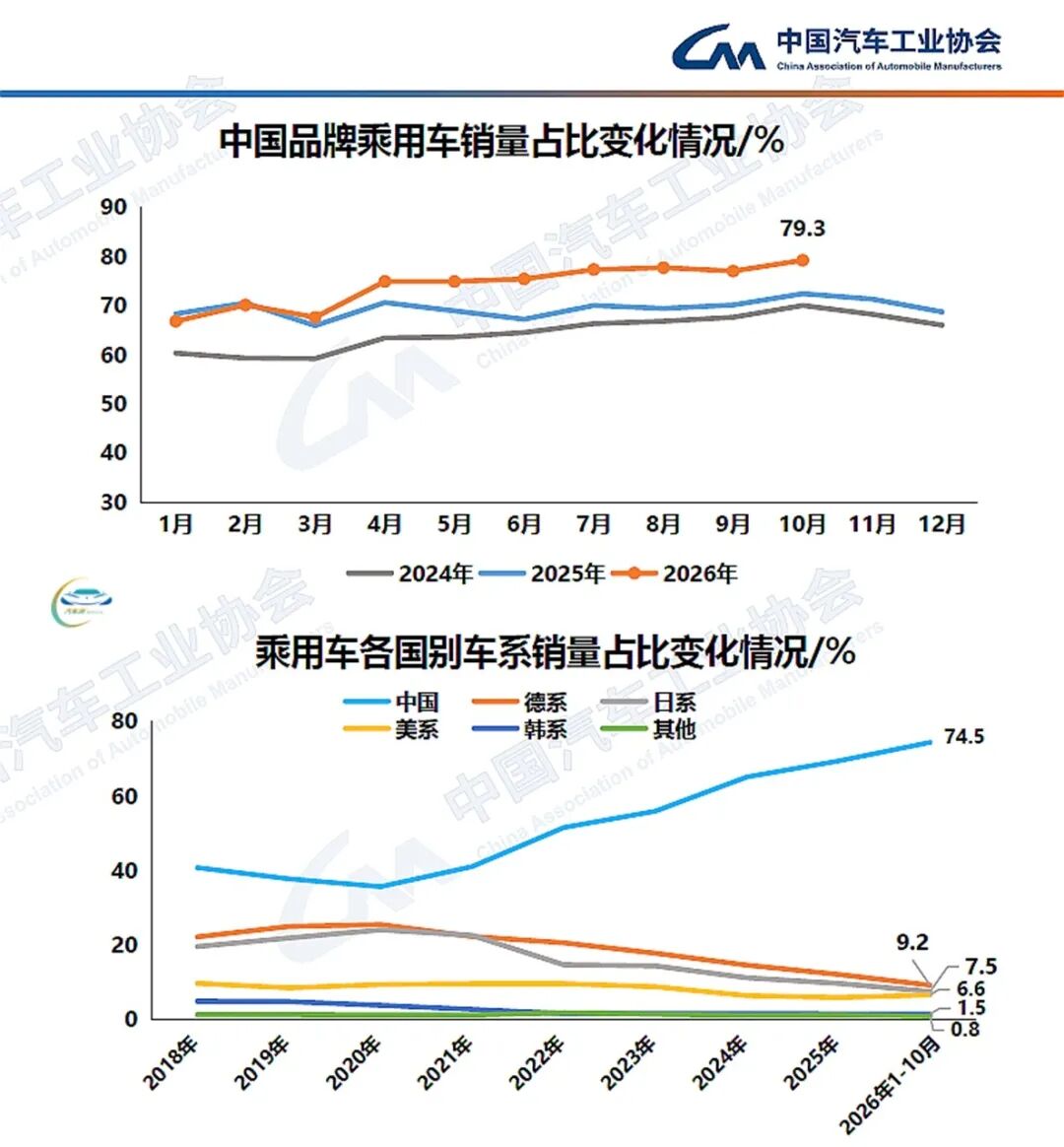
CAAM's assessment of the current situation is candid: since the beginning of this year, China's economy has advanced under pressure and made steady progress, the driving role of new momentum has continued to strengthen, and the macroeconomy has shown considerable resilience and vitality. Effective support from exports and new energy has kept industry operations generally stable. However, the domestic auto market has yet to see meaningful improvement, the contradiction of strong supply and weak demand remains prominent, industry profit levels remain low, and external shocks are deepening — the EU hybrid safeguard measures investigation restricts exports to Europe, and the export tax rebate cut erodes corporate profit margins, leaving operations overall under relatively high pressure.
Although little time remains this year, the future direction of the auto market does not take the calendar as its crossing target. Accordingly, CAAM proposes: it is necessary to promote coordinated efforts between stock policies and incremental policies, stabilize market expectations, and boost consumer confidence.
-
![]()
Domestic Auto Sales Post "Seventh Straight Monthly Decline" — CAAM: Overall Pressure on the Auto Market Remains Relatively High
-
Character.AI Is Going Bankrupt, Yet AI Companionship Apps Are Quietly Raking It In
-
The Siege of Jensen Huang Exposes the Biggest Risk in AI Investment
-
Can Changan Afford to Lose Those 3 Billion-Plus Yuan?
-
![]()
"Space AI's First Stock" Debuts Today, but Investors Aren't Exactly Rushing In
-
Apple Doesn't Want to Keep "Winning by Doing Nothing"
-
![]()
Token Overseas Revenue Can No Longer Keep Up with Soaring Storage Costs
-
![]()
Suzuki: From Retreat in China to Japan's Third Largest | Cover Story: Japanese Automakers at the Crossroads of Transformation (Part 5)