How Air Freshness Is Integrated into C-AHI Assessment: Automotive-Grade CO? Sensors Become a Key Element of Healthy Cockpits
 11/16 2026
 415
The 2026 C-AHI Healthy Cockpit Evaluation System has recently been implemented, and cabin air quality has since evolved from a conventional marketing bonus attribute into a unified industry assessment metric. According to the "Fresh Air Index" evaluation specification issued by the China Automotive Engineering Research Institute, cabin air quality is quantitatively assessed on a 100-point scale, with a newly added "in-vehicle air freshness" evaluation dimension incorporated into the core assessment scope.

In the new air quality scoring system, in-vehicle air freshness accounts for 15% of the weight—equivalent to 7.5 points of the total score—among which the single item of CO? dynamic equilibrium concentration accounts for 70% of the weight and is the core scoring item in this section. Excessive CO? concentration in the cabin directly causes air turbidity and triggers discomfort such as stuffiness and drowsiness among drivers and passengers, making it undoubtedly a key factor affecting the C-AHI healthy cockpit score.
C-AHI Scoring Rules: CO? Is a Key Indicator That Can Be Proactively Optimized
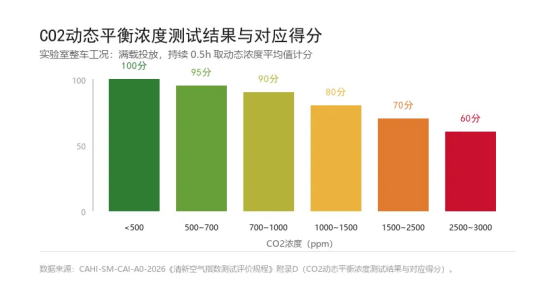
The new regulation adopts a real-vehicle full-vehicle assessment method, simulating a full-load vehicle operating condition and continuously monitoring the average CO? concentration in the cabin for half an hour to complete scoring: 500 ppm and below is the full-score standard, 2500–3000 ppm earns only 60 points, and excessive concentration directly lowers the vehicle's overall air quality and healthy cockpit composite score.
Among indicators related to cabin air quality, interior materials, production processes, and other factors are factory-fixed parameters that cannot be adjusted later. Only in-cabin CO? concentration can be adjusted in real time through the air conditioning fresh air system, making it one of the few core indicators that automakers can proactively optimize in response to the C-AHI assessment—and accurate, stable CO? monitoring is the prerequisite for effective regulation.
Cubic Sensor and Instrument's CO? Sensors Meet the New Assessment with Automotive-Grade Precision
Targeting actual operating conditions such as complex in-vehicle temperature changes and driving interference, as well as the stringent quantitative assessment standards of C-AHI, Cubic Sensor and Instrument's automotive-grade CO? sensors adopt the mature NDIR detection principle, effectively addressing issues of traditional sensors such as insufficient precision, large temperature drift, delayed response, and short service life, and fully adapting to scenarios of routine in-vehicle monitoring and the new regulatory assessment.

1. High Precision and Fast Response
Equipped with a 0–10000 ppm range and 1 ppm ultra-high resolution, detection accuracy of ±(50 ppm + 5% of reading), T90 response time ≤25 s, and data refresh ≤1 s, it can capture subtle fluctuations in in-cabin CO? concentration in real time and meet the precision requirements of the new regulatory assessment.
2. Full Temperature Range and High Stability
Adapted to the full vehicle limit temperature range of -40℃ to 85℃, and through full-range calibration + intelligent self-calibration technology, it offsets data deviations caused by temperature and driving conditions, is maintenance-free throughout the device's full life cycle, and outputs stable and reliable data.
3. Long Life and Low Power Consumption
A 15-year design life matches the full service cycle of the vehicle, and a quiescent current <100 μA can meet the installation requirements of low-power operation in new energy vehicle models.
4. Easy Integration and Mass Production
Standard LIN automotive dedicated output, IP54 protection rating, support for 9–16 VDC wide-voltage power supply, compatibility with mainstream in-vehicle electronic control systems, and suitability for automakers' front-loading large-scale mass production installation.
Cubic Sensor and Instrument's Healthy Cockpit Solution Provides On-Demand Ventilation to Safeguard a Healthy and Comfortable Cockpit
Real-time sensor monitoring data can be linked with the vehicle's air conditioning fresh air system to dynamically adjust ventilation volume based on in-cabin CO? concentration and stabilize in-vehicle air freshness. At the same time, the device supports a locked-vehicle occupant reminder function, which can accurately identify persons or pets left in the vehicle through CO? concentration changes and trigger an alarm via the vehicle body to avoid potential safety risks.
Cubic Sensor and Instrument has a mature full-chain front-loading solution for cabin air quality. The monitoring end covers core air indicators such as CO?, PM2.5, TVOC, and odors, and is paired with fragrance, negative ion, and plasma purification equipment to form a complete closed loop of "monitoring + optimization," helping automakers smoothly pass the 2026 C-AHI cabin air quality assessment and implement standardized, compliant healthy cockpit configurations.
-
![]()
How Air Freshness Is Integrated into C-AHI Assessment: Automotive-Grade CO? Sensors Become a Key Element of Healthy Cockpits
-
![]()
Robot Vacuum Makers Go Global: After Taking the Top Market Share, Where Did the Money Go?
-
![]()
From "Baidu It" to "Doubao It" — A Change in More Than Method
-
![]()
Huang Steps Down: Nvidia Loses Its Soul—So Why Should Chinese Assets Pay the Price?
-
![]()
Secures Nearly 100 Million Yuan in Financing! How Does This Company Integrate Optics into Packaging?
-
Production Set to Begin Early Next Year: Lanyu Vision's 4.5-Million-Square-Meter New Plant Successfully Capped
-
![]()
It's Almost Over! October China Fuel Vehicle Sales Released: Sales of Numerous Classic Family Sedans Plummet
-
Car Quality Network: Q3 Service Complaints Jump 55.6% QoQ, with Transaction Segment Driving the Surge