JieJie Microelectronics Bets Another 1.5 Billion Yuan on High-Voltage Chips: The Ambition Behind the Layout
 11/18 2026
 348
Author: Ren Tianqin
Editor: Wang Yimo
Automotive-grade power chip capacity expansion: commercialization still awaits validation
JieJie Microelectronics (300623.SZ) has launched a fresh round of production line investment.
On November 16, the company announced that its wholly owned subsidiary, JieJie Microelectronics (Nantong) Technology Co., Ltd. ("Nantong Technology"), plans to invest 1.5 billion yuan to build an automotive-grade high-power semiconductor device chip R&D and testing production line. With existing capacity gradually coming on stream and performance continuing to grow, this investment pushes the business further into high-withstand-voltage power devices—and places new demands on the company's technical capabilities and capital allocation.
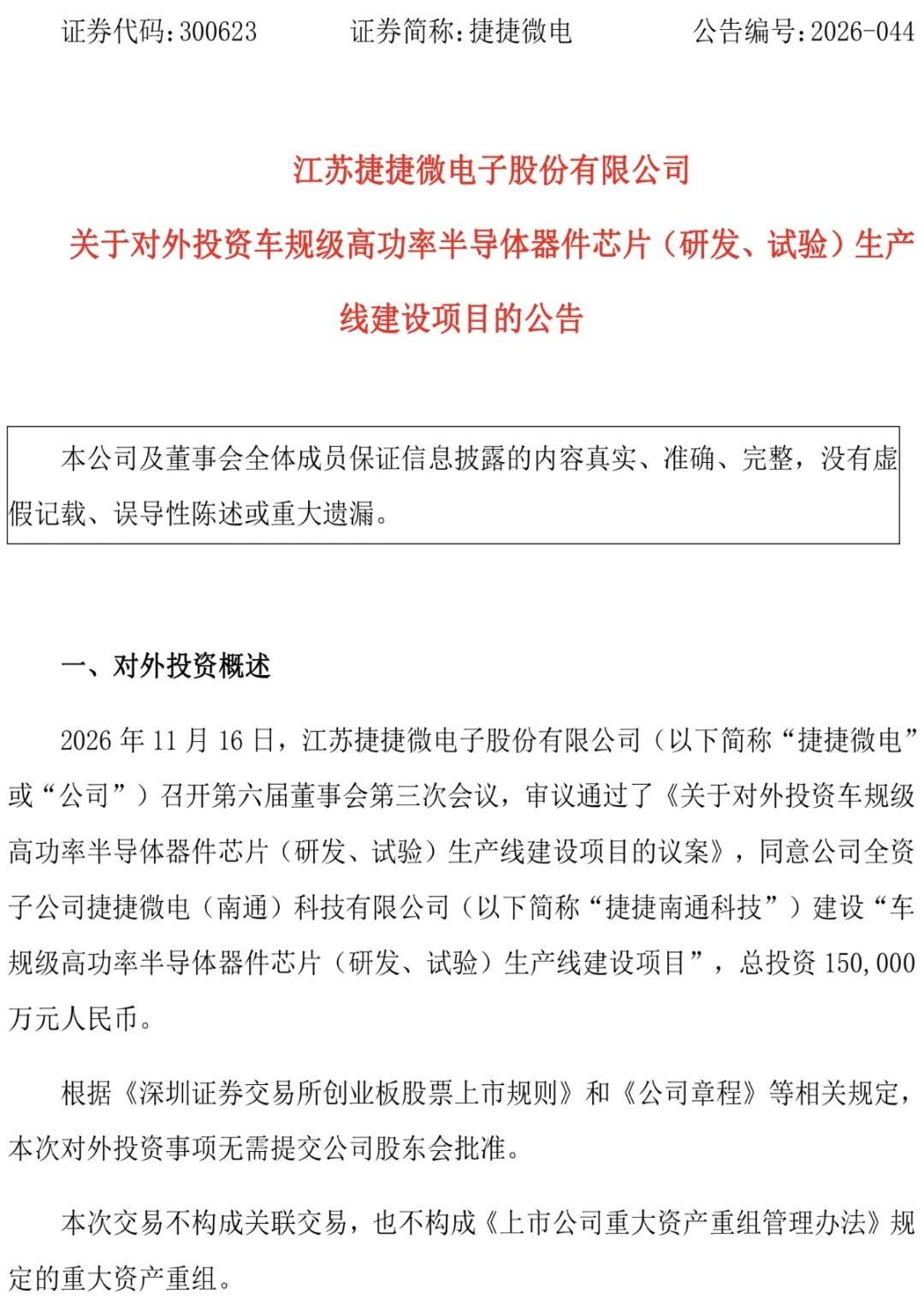
Image source: JieJie Microelectronics announcement
1.5 Billion Yuan for a New Production Line
According to the announcement, the project has a total construction period of three years. It will build 50,000 square meters of factory buildings and supporting facilities—including 10,000 square meters of Class 1,000 cleanroom space—and purchase 150 sets of production and testing equipment, forming an integrated IDM line covering chip R&D, design, test verification, wafer manufacturing, and testing.
Of the 1.5 billion yuan investment, equipment and secondary configuration engineering account for 1 billion yuan; civil engineering for 200 million yuan; cleanroom engineering and primary configuration systems for 200 million yuan; and the remainder for initial working capital and construction-period interest.
The project's main products are 1200V, 2300V, and 3300V automotive-grade MOSFET high-power devices and power modules, targeting applications such as new energy vehicle electronic control systems, photovoltaic inverters, energy storage, charging piles, industrial variable-frequency drives, and computing power supplies.
JieJie Microelectronics' traditional strengths have centered on thyristors, protection devices, diodes, and low- and medium-voltage MOSFETs. Extending into higher voltage levels places tougher demands on chip structure, manufacturing processes, material performance, and reliability.
The announcement, however, has not yet disclosed the new line's specific material route, wafer specifications, planned monthly capacity, or expected return rate. How large a commercial scale the project ultimately achieves will depend on product R&D, automotive-grade certification, and mass production progress.
Performance Growth Underpins the Investment
JieJie Microelectronics' stepped-up investment is closely tied to the operational improvement of its existing business.
In the first three quarters of 2026, JieJie Microelectronics posted operating revenue of 3.479 billion yuan, up 39.09% year on year; net profit attributable to shareholders of the listed company was 592 million yuan, up 70.76% year on year; and net profit attributable to shareholders after deducting non-recurring gains and losses was 590 million yuan, up 70.57%.
Growth accelerated further in the third quarter, with single-quarter operating revenue of 1.366 billion yuan, up 51.55% year on year, and net profit attributable to shareholders of 295 million yuan, up 194.44%.
Cash flow also improved. In the first three quarters, net cash flow from operating activities reached 1.043 billion yuan, up 77.28% year on year. As of the end of September, the monetary funds balance stood at approximately 811 million yuan.
This performance reflects earlier capacity buildouts gradually entering the harvest phase.
In its 2026 semi-annual report, JieJie Microelectronics disclosed that the three major construction projects undertaken by Nantong Technology have reached production and entered large-scale mass production, including a project with an annual output of 600,000 8-inch power semiconductor chips.
In terms of the subsidiary's operating results, Nantong Technology achieved operating revenue of 1.328 billion yuan and net profit of 162 million yuan in 2025; in the first half of 2026, it posted operating revenue of 856 million yuan and net profit of 122 million yuan.
As production line utilization improves, fixed asset investment is gradually converted into revenue, and economies of scale begin to show in profitability.
But semiconductor manufacturing is a classically capital-intensive industry. Building a new production line requires not only upfront equipment investment but also subsequent commissioning, process optimization, yield improvement, and customer verification.
The 1.5 billion yuan investment is equivalent to roughly 2.5 times the company's net profit attributable to shareholders in the first three quarters of 2026. Project funding is planned to be secured through own funds, bank fixed asset loans, special industrial financing, and other methods.
Improving profitability in existing businesses provides a funding base for the new project. But for JieJie Microelectronics, balancing existing production line operations, technological R&D, and new capital expenditures remains a challenge it will need to address over the next three years.
High-Voltage Market Tests the Technology
From the perspective of downstream demand, the development of new energy vehicles, energy storage, and industrial power supplies offers broad application space for power semiconductors.
Data from the China Association of Automobile Manufacturers shows that from January to October 2026, China's new energy vehicle sales reached 14.411 million units, up 11.3% year on year, with new energy vehicles accounting for 54.8% of total vehicle sales.
As new energy vehicle electric drive systems, charging facilities, and energy storage equipment move toward higher efficiency and power density, power devices play an ever more important role in power conversion, loss control, and system reliability.
In fact, products at different voltage levels correspond to different market demands and technical thresholds.
Take 3300V products as an example: Infineon has launched silicon carbide MOSFET modules for energy storage, photovoltaics, and traction systems. International manufacturers have long-standing accumulated expertise in high-voltage device reliability, module packaging, and customer applications.
For JieJie Microelectronics, entering this market cannot rely solely on raising device withstand voltage levels; it also needs to strike a balance among conduction loss, switching efficiency, thermal management, long-term reliability, and manufacturing cost.
Especially in the automotive field, power devices must undergo strict reliability verification and meet the quality requirements of automakers and Tier 1 suppliers. Whether products can enter customer supply chains often depends on long-term test results and actual application performance.
JieJie Microelectronics already has a certain automotive-grade business foundation. The company previously disclosed that in the first half of 2026, automotive-grade MOSFET sales increased by nearly 10% year on year, while sales of other automotive-grade devices such as diodes rose by more than 30% year on year. Some MOSFET products have also entered the fields of AI computing power and server applications.
These businesses provide technical accumulation and customer resources for the company's expansion into high-voltage products, but new products still need to complete independent process verification and market introduction.
Another issue worth noting is capacity utilization.
This investment is to build a production line integrating R&D, testing, and manufacturing. From product development to stable mass production, high-voltage power devices must go through stages such as process finalization, reliability testing, customer certification, and yield improvement.
Even if product R&D is completed, whether continuous orders can be secured and reasonable capacity utilization achieved will still directly affect the project's investment return.
For JieJie Microelectronics, the gradual ramp-up of its previous 8-inch power semiconductor production line has already driven revenue and profit growth. This extension into high-voltage power devices means the company is beginning to face a product market with higher technical requirements and potentially longer customer verification cycles.
Over the next three years, the construction progress of this new production line, product certification results, customer introduction, and mass production costs will become important indicators for observing the project's value.
Expanding from low- and medium-voltage devices to high-voltage power devices is an important step in JieJie Microelectronics' product mix adjustment. Whether the 1.5 billion yuan investment can be converted into a new source of profit will ultimately still need to be verified by product performance, order scale, and actual delivery capability.
-
Will the Fangchengbao Titan 9 Go on Sale Tomorrow? Is the Predicted Official Price Range of 300,000–380,000 Yuan Accurate?
-
Top 10 Fastest-Growing and Most Profitable Companies in the Token Export Sector
-
![]()
JieJie Microelectronics Bets Another 1.5 Billion Yuan on High-Voltage Chips: The Ambition Behind the Layout
-
![]()
Phone Prices Are Rising Across the Board—So Why Is Apple the Only One Selling More?
-
Forecasting the Official Launch Price Range of the iCAR V25 from V23 and V27 Sales Trends
-
![]()
In the AI Era, Tokens Are This Small Chinese City's "New Local Specialty"
-
![]()
Global Smartphone Shipments to Decline for Second Consecutive Year, Yet Apple's iPhone Defies the Trend with Year-over-Year Growth: Consumers Increasingly Favor Huawei and Apple
-
![]()
$69 Open-Source Box Bridges Bluetooth, Serial Ports, and Vintage Stereos to Your Smart Home