$69 Open-Source Box Bridges Bluetooth, Serial Ports, and Vintage Stereos to Your Smart Home
 11/18 2026
 410
Nabu Casa has launched the $69 Home Assistant Connect Aux-2, cramming a Bluetooth proxy, serial ports, and an audio jack into a box the size of a deck of cards. Everything it does, you could build yourself; what you're really paying for is the time you save.
Nabu Casa is the commercial arm of the Open Home Foundation, the organization behind the open-source smart home platform Home Assistant. This week the company released the Connect Aux-2, a multi-function hub for bringing non-smart devices into the smart home. After testing it for a few days, this author found it as easy to use as expected—but surprisingly easy to set up. That's been Home Assistant's recent theme: lowering the barrier to entry.
At $69 and roughly the size of a deck of cards, the Aux-2 clearly isn't winning on performance—its entire value lies in interface density. For users used to turnkey ecosystems, this kind of product usually isn't worth a second look; but the organizational model behind it—"a shared open-source foundation, with each company selling its own hardware"—is more worth examining than the box itself.
Six interfaces in one box
The spec sheet lists 2.4GHz Wi-Fi, Bluetooth, Ethernet, USB-A, USB-C, a digital/analog audio jack, a Grove port for sensors, buttons, and indicator lights, and a pair of RS-232 serial ports. Bluetooth bridges nearby devices into Home Assistant; the USB port accepts Nabu Casa's Z-Wave or Zigbee antennas, solving the old problem of poor hub placement and insufficient wireless coverage; the serial ports control legacy devices like TVs, AV receivers, and solar inverters; and the audio jack connects to an amplifier or powered speakers to stream music into vintage stereos.
None of these functions were built from scratch. The Aux-2 runs on ESPHome, an open platform for building DIY smart home devices with cheap, flexible ESP boards, and the box directly reuses existing Home Assistant and ESPHome integrations. The serial integration was built earlier this year, while Music Assistant and SendSpin, which drive audio output, are still under active development. In other words, the software foundation already existed—Nabu Casa just put it in a plug-and-play enclosure.
The author's fridge and a speaker that sat idle for five years
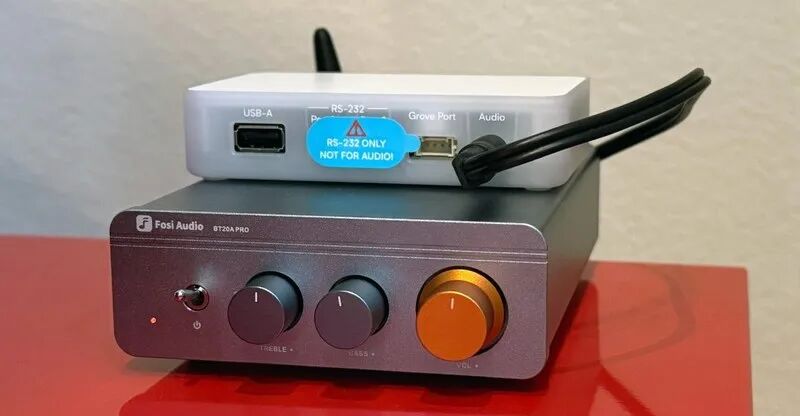
Image source: The Verge
The author has Home Assistant running at home, but over the years it never became his primary platform due to friction and time costs, leaving him with a mix of Google Home, Apple Home, and a few devices that exist only in Home Assistant. Two specific needs finally put the Aux-2 to work. First, the refrigerator in his Texas garage—his kids occasionally forget to close the door, and he wanted advance warning. He'd previously used an Aqara temperature sensor with a discontinued Zigbee receiver; the sensor in the garage fridge dropped off constantly, button batteries drained quickly, and with no display he had to place a separate cheap hygrometer inside to check the temperature. Switching to a Govee Bluetooth hygrometer requires a Bluetooth proxy—which the Aux-2 happens to have.
Second, the in-wall speakers in the living room hadn't been used once in the five years since they were installed. The author went back and forth weighing a Wiim Amp, a stereo amplifier, a cheap Bluetooth amp, and a four-Sonos-speaker setup—and ultimately bought nothing. This time the setup was simpler than expected: connect USB-C to a computer, flash the firmware in the browser, enter Wi-Fi credentials, unplug it, move it to the media cabinet, and power it up—USB-C or Ethernet power both work—and the rest is done in the Home Assistant interface. After the system prompted installation of ESPHome, it automatically discovered the box; enabling the Bluetooth proxy took a few clicks, and the Govee sensor, batteries installed, appeared on its own, holding a connection through three walls and a refrigerator. The audio side took longer, mainly to hook up the amplifier and install Music Assistant—less than half an hour in total. This component runs on Home Assistant hardware and can stream from Spotify, YouTube Music, and local files, outputting to Sonos, Wiim, AirPlay, Google Cast, and other devices—though each requires separate configuration.
There's nothing it does that DIY can't
The author states upfront: everything the Aux-2 can do can be done with an ESP32 board and some accessories, possibly even cheaper. Apollo Automation's Cast-1 sells for $35 and supports the music casting and Bluetooth proxy he actually used. Three years ago he bought three ESP32s for $16, intending to build a Bluetooth proxy, an LED controller, a soil sensor, or a media player—and never touched a single one.
But he doesn't see that as a downside; rather, he says, that's the whole point. The ecosystem is built on open principles: both Nabu Casa and Apollo fund the Open Home Foundation, which develops Home Assistant, ESPHome, SendSpin, and Music Assistant; the two companies each sell hardware that's easier to use than DIY, and neither stops users from building their own—they actively encourage it. Competing hardware products running on the same open-source foundation is a structure rarely seen in consumer electronics.
Open-source hardware sells saved time
Closed ecosystems retain users through compatibility lists and device certification—Apple Home, Google Home, and Amazon Alexa all follow this logic. What the open camp can win over is precisely the long-tail devices outside those lists: old amplifiers, serial-controlled TVs, solar inverters, Bluetooth-only thermometers. The Aux-2 packages these interfaces for $69, cutting time costs rather than hardware costs—a common path for open-source projects evolving from hobbyist tools into consumer products. For domestic smart home manufacturers, Matter and Thread solve cross-brand connectivity, while products like the Aux-2 solve the connection of existing non-smart devices; the two operate on different layers, and conflating them easily overestimates the former's coverage.
What really bears watching is the foundation's funding structure: two hardware companies jointly fund an open-source organization, then sell their own boxes on the same foundation. Whether this "shared foundation plus hardware competition" model can be sustained long-term will shape the industry landscape more than any single model's specs. The current limitations are clearly stated too: the SendSpin standard is still in development, the author couldn't get cross-protocol speaker grouping working, he hasn't yet tested serial control, and both Music Assistant and the serial integration are under active development. Those who buy this box are partly paying for software that isn't finished yet.
Today's Quote
"What open-source hardware really prices is not the number of interfaces, but the three years the user didn't lift a finger. Turning 'can do' into 'already installed' is far harder than adding two more ports."
Follow [De Gaohang Zhiqinglang] for three hardcore tech deep-dives a day—understand the industry and the national fortunes behind technology.
-
Forecasting the Official Launch Price Range of the iCAR V25 from V23 and V27 Sales Trends
-
![]()
In the AI Era, Tokens Are This Small Chinese City's "New Local Specialty"
-
![]()
Global Smartphone Shipments to Decline for Second Consecutive Year, Yet Apple's iPhone Defies the Trend with Year-over-Year Growth: Consumers Increasingly Favor Huawei and Apple
-
![]()
$69 Open-Source Box Bridges Bluetooth, Serial Ports, and Vintage Stereos to Your Smart Home
-
![]()
321, Go Token: Who's Grabbing the "Recharge Entry Point" of the AI Era
-
![]()
Why Is Apple the Only One Selling More Despite Industry-Wide Price Hikes?
-
![]()
Slashing Prices While Imposing Quotas: The AI Large-Model War Has Already Switched Tracks
-
![]()
XPeng Reports 870 Million Yuan Net Loss in Q3 — Who Ate the Profit?