In the AI Era, Tokens Are This Small Chinese City's "New Local Specialty"
 11/18 2026
 500
Produced by: #MarketValueFinance
You may not realize that the AI you're using right now might have its computing foundation rooted in barren land where cattle and sheep once roamed.
The world's largest single AI computing power facility is located in Ulanqab. China's first batch of 10,000-GPU-level intelligent computing bases was built in Zhongwei, Ningxia. The domestic intelligent computing cluster highland rose in Gui'an, Guizhou. And the token factory serving the world emerged in Qingyang, Gansu. These places sit either at the edge of deserts, on grasslands beyond the Great Wall, or deep in mountain gullies.
Strong winds and intense sunlight are the norm here. Yet it is precisely these desolate places that hold the AI industry's most critical rigid demand: electricity.
PART 01 China's No.1 Computing Power City
Take Ulanqab as an example. A decade ago, this city on the Gobi grassland was still a place where "the wind blows and grass bends low, revealing cattle and sheep." It was once known as the "Capital of Chinese Potatoes," the "Capital of Chinese Grassland Yogurt," and the "Capital of Chinese Oats." Now it has earned a new title: "Capital of Tokens," becoming an AI computing power hub where major tech giants arrive one after another to deploy their computing infrastructure.
Look at the mountains here—they're covered with wind turbines. The turbines on the ridges whistle and spin, while photovoltaic panels at the foot of the mountains quietly absorb sunlight and transmit it to the base through dedicated high-voltage lines, working alongside the main power grid to keep data rooms running around the clock. The main roads in the high-tech park are named, quite literally, Alibaba Avenue and Apple Avenue.
People often say that the endgame of AI is electricity. Seeing this, you can easily grasp what that means. Many large data centers here are equipped with dedicated power generation facilities, and many power companies even enter the field directly—building computing power parks and then leasing them to leading internet companies.
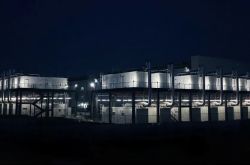
The most typical example is the Envision Ulanqab Star River Base, built by Envision Energy. It is currently the world's largest single AI computing power facility and is also called China's version of "Stargate." Eighty percent of the park's electricity comes from direct supply from Envision's own wind farm. The wind turbine blades—each over one hundred meters long—are manufactured independently by Envision Energy. This wind farm has more than 30 turbines in total, and its output can support the 200-plus-megawatt load of the data center park 190 kilometers away—roughly equivalent to the annual electricity consumption of 600,000 Chinese households.
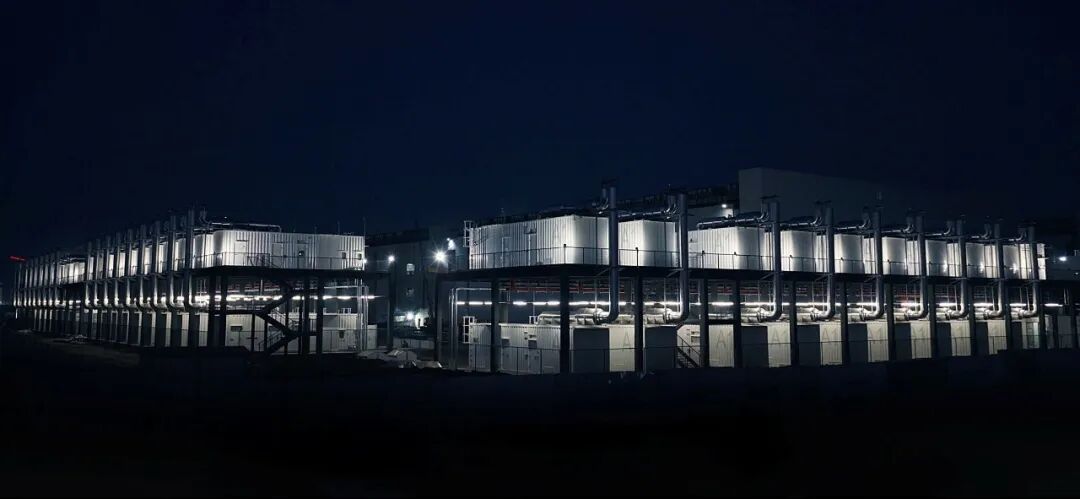
Envision Ulanqab Star River Base
The base is also equipped with 4-hour battery energy storage. Why is storage indispensable? The shortcoming of wind power is unstable output—generation depends on the weather and fluctuates greatly. But computing centers need a stable power supply 24/7. Energy storage batteries are like giant power banks: they store electricity when the wind is strong and discharge it when there is none, smoothing out the fluctuations.
The data room is equipped with a cold water circulation cooling system. Cold water carries away heat from the servers, and after the hot water exchanges heat and cools down, it circulates back. Ulanqab also has a unique natural advantage: only June, July, and August have average temperatures exceeding 15°C throughout the year, making it a natural cold source—highly friendly to data centers. The entire power supply architecture, energy storage system, and cooling solution are all uniformly designed and integrated by Envision Energy.
A ten-minute drive from Envision's computing power park is the Zhongjin Data Ulanqab Zero-Carbon Computing Power Base. It too is equipped with a dedicated power supply solution: the China Energy Engineering North China Institute and Tianjin Electric Power Construction jointly provide power support, specifically supporting the construction of a 200,000-kilowatt wind farm, a 100,000-kilowatt photovoltaic station, and 45,000-kilowatt energy storage facilities.
PART 02 In the AI Era, Small Cities Face a Major Reshuffling
The core advantage attracting computing centers to cluster here is, above all, electricity prices. Green electricity in Ulanqab costs just over 0.4 yuan per kilowatt-hour, while the national average for large industrial electricity is around 0.5 yuan or more. Beyond electricity prices, local land and labor costs are also far lower than in megacities such as Beijing, Shanghai, Guangzhou, and Shenzhen.
This site-selection logic also applies to data center clusters such as Zhongwei in Ningxia, Gui'an in Guizhou, and Qingyang in Gansu. The core conditions boil down to three points: low electricity prices, suitable temperatures, and low land costs.
In the past, domestic internet industry resources were highly concentrated in Beijing, Shanghai, Guangzhou, and Shenzhen. After the AI computing power wave arrived, these sparsely populated places have ushered in opportunities for industrial reshuffling—and their golden decade is arriving.
For local residents, this means new employment opportunities, and people naturally welcome it. For local governments, the arrival of computing power brings incremental tax revenue and is a rare industrial opportunity. On the other side of the ocean, American companies are likewise moving large data centers to rural areas—but the situation is completely different.
PART 03 Americans: No Matter How Hot AI Gets, Don't Build It Next to My House
The most representative example is the AI data center in Abilene, Texas, USA. It is the "genuine" "Stargate." Construction began in June 2024. This computing center carries about 1.019 million equivalent H100 GPUs, with an IT power supply capacity of 824 megawatts. Its planned capacity is comparable to the Envision Star River Base in Ulanqab.
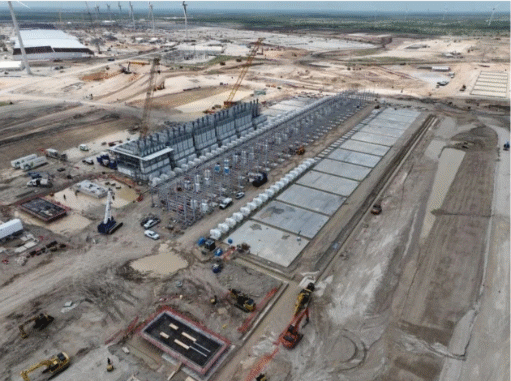
The AI data center under construction in Abilene, Texas, USA
To retain the project, the Abilene City Council offered an 85% property tax abatement, but residents' resistance continues unabated. Abilene was originally a western Eden where cowboys lived, with per capita annual income of just over $30,000—equivalent to about 17,000 yuan per month. Although that's not high income in the United States, local prices and housing costs are relatively low, making it a place with a high cost of living性价比.
Now, one of the largest AI data center parks in the United States is being built here, with about 6,000 construction workers pouring in. Persistent infrastructure noise, bright lights at night, and rapidly rising rents have become residents' most concentrated complaints. Local residents keep protesting: "No matter how hot AI gets, don't build it next to my house." "Our tiny pure land on earth has now become a living hell."
The same kind of computing power park is welcomed with open arms in China but met with protests in the United States. Because of this, the U.S. analysis firm SemiAnalysis, after visiting the Ulanqab computing power park, exclaimed "shocking": the cost of the first batch of facilities at the Envision Ulanqab Star River Base is only about one-fifth that of similar U.S. projects.
The battle between China and the U.S. in AI computing power has only just begun. Who will win at the starting line?
END
Disclaimer (scroll up and down to view all)
MarketValue Finance hereby declares that all information and content we provide are objectively compiled and analyzed based on publicly available materials, but we cannot guarantee the absolute accuracy, completeness, and timeliness of such information. Any views, analyses, and conclusions contained in this article are solely the independent opinions of MarketValue Finance based on a specific point in time and do not represent any investment advice or strategy. Financial markets involve risks, and investors shall bear full responsibility for any decisions made accordingly. If you have any questions about the content of this publication or find any omissions, please contact us directly through our official backend channels, and we will verify and handle them as soon as possible.
-
Forecasting the Official Launch Price Range of the iCAR V25 from V23 and V27 Sales Trends
-
![]()
In the AI Era, Tokens Are This Small Chinese City's "New Local Specialty"
-
![]()
Global Smartphone Shipments to Decline for Second Consecutive Year, Yet Apple's iPhone Defies the Trend with Year-over-Year Growth: Consumers Increasingly Favor Huawei and Apple
-
![]()
$69 Open-Source Box Bridges Bluetooth, Serial Ports, and Vintage Stereos to Your Smart Home
-
![]()
321, Go Token: Who's Grabbing the "Recharge Entry Point" of the AI Era
-
![]()
Why Is Apple the Only One Selling More Despite Industry-Wide Price Hikes?
-
![]()
Slashing Prices While Imposing Quotas: The AI Large-Model War Has Already Switched Tracks
-
![]()
XPeng Reports 870 Million Yuan Net Loss in Q3 — Who Ate the Profit?