Is the 'Polarization Purity' of Light Calculable?
 09/30 2026
 327
327
Abstract: In practical scenarios, most light beams exhibit non-ideal polarization states, rendering polarization purity a crucial parameter in optical design and testing. This article offers a detailed exposition of three standardized polarization purity calculation tools—Degree of Polarization (DoP), Polarization Purity (PP), and Polarization Purity Index (IPPs)—each tailored to different engineering contexts. It elucidates the applicable boundaries and core principles of each algorithm. Polarization purity boasts a mature and quantifiable mathematical framework, with standardized measurement protocols firmly established in both academic and engineering spheres.
The market is replete with various optical calculation tools, each serving distinct purposes and catering to different precision levels and application scenarios. The technical challenge lies not in the inability to perform calculations but in accurately matching algorithms to the corresponding physical phenomena and engineering requirements. Light, being a quintessential transverse wave, has its directional vibration differences precisely described by the concept of 'polarization'.
However, in real-world settings, ideal fully polarized light is a rarity. Scattered light, transmitted stray light, and depolarized light from media all exhibit non-pure polarization states. These disordered polarization states are not undefined; the field of optical metrology has already established a comprehensive quantification system to accurately gauge the degree of polarization purity.
How Polarization States Are Described—From Jones Vectors to Stokes Parameters
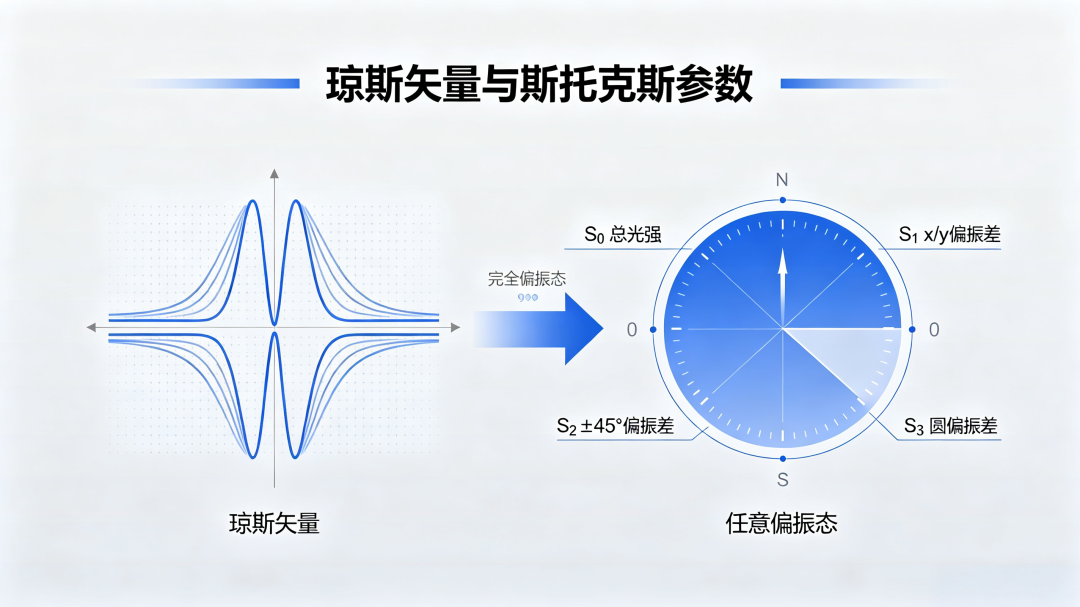
The cornerstone for accurately calculating polarization purity lies in a complete and standardized description of the light's polarization state. The Jones vector, applicable solely to fully polarized light, defines the light field state through the amplitude and phase difference of two orthogonal electric field components: E = A·exp{i(ωt−kz+δ)}.
Stokes parameters, on the other hand, offer greater versatility, encompassing any polarization state with four core parameters: S0 (total intensity), S1 (x/y polarization difference), S2 (±45° polarization difference), and S3 (circular polarization difference).
Degree of Polarization (DoP)—The Most Fundamental 'Purity' Metric
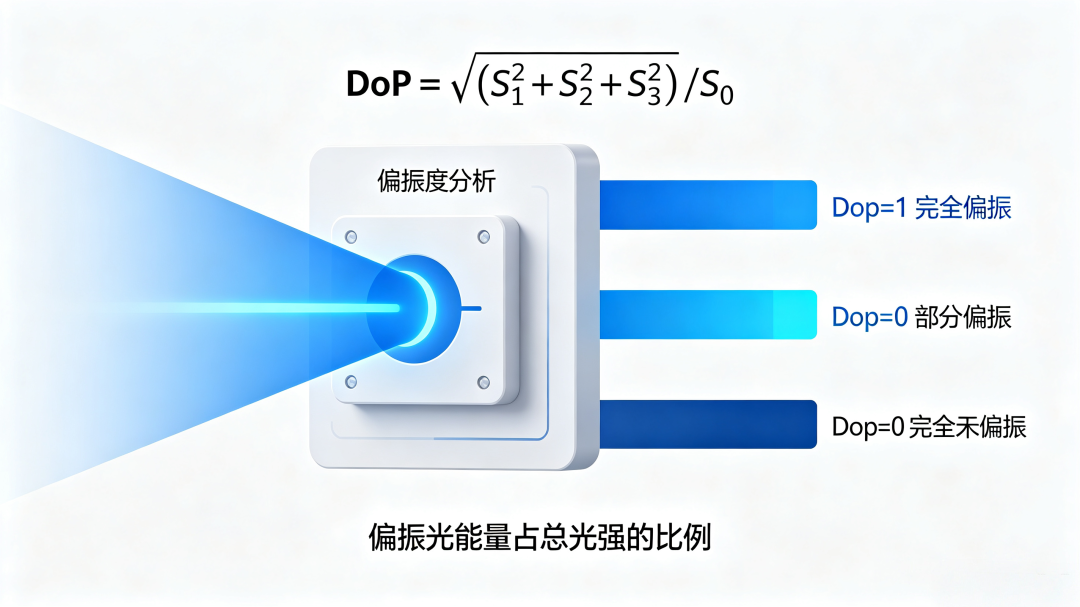
Based on Stokes parameters, the industry-standard basic purity metric, the Degree of Polarization (DoP), is calculated using a fixed formula: DoP = √(S1² + S2² + S3²) / S0.
Its physical definition is clear and intuitive: DoP=1 signifies fully polarized light, DoP=0 denotes completely unpolarized light, and values between 0 and 1 represent various partially polarized light states.
Essentially, DoP can be intuitively understood as the proportion of polarized light energy within the total intensity, making it suitable for basic engineering scenarios where only the overall proportion of polarized components needs quantification.
Polarization Purity (PP)—A More Refined 'Targeted Purity' Metric
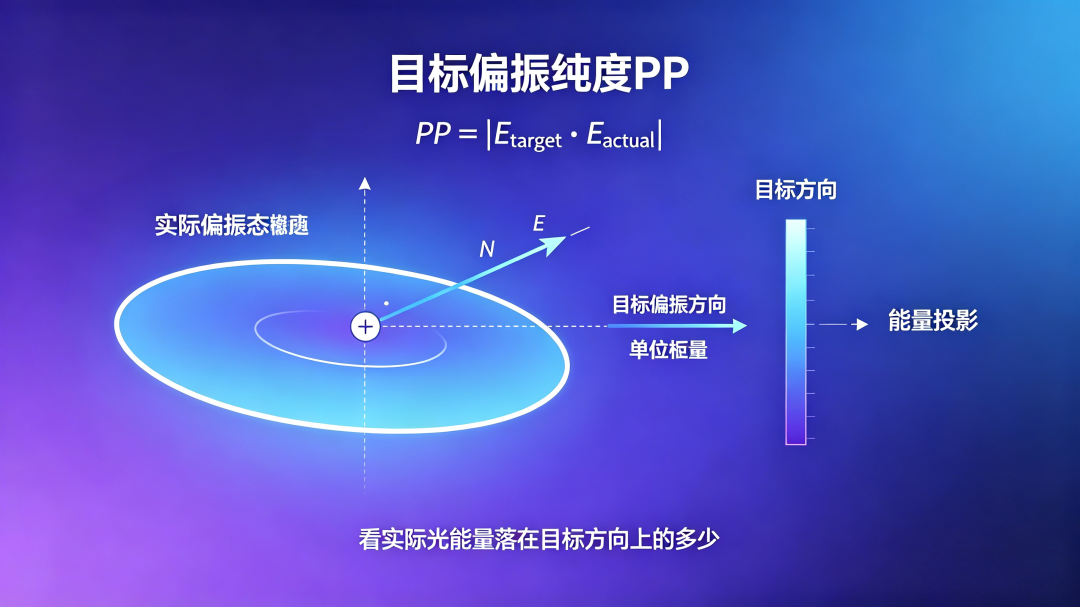
While DoP provides the overall proportion of polarized light, it falls short in defining the precise direction of polarization, making it difficult to meet directional engineering precision requirements. Polarization Purity (PP), however, zeroes in on the target dimension with the core formula: PP = |E_target · E_actual|.
By taking the dot product and modulus of the target polarization unit vector and the actual electric field vector, it accurately quantifies the energy projection of the actual light field in the preset target polarization direction.
Combined with DoP, the effective intensity proportion in the target direction can be further calculated: I_PS = 1/2 + DoP·(PP − 1/2), specifically tailored for directional polarization precision testing scenarios.
Polarization Purity Index (IPPs)—A 'Holographic Portrait' of Depolarizing Media
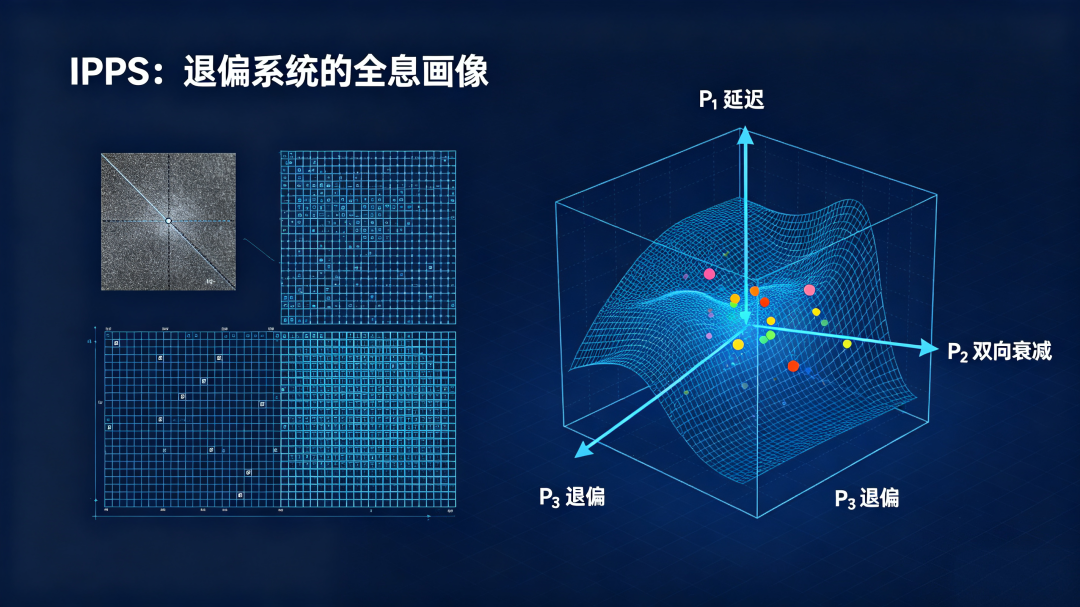
DoP and PP are limited to characterizing the overall polarization characteristics of light beams and cannot describe the differential depolarization effects caused by scattering or transmission media. The Polarization Purity Index (IPPs), derived from the Mueller matrix, comprises three independent parameters—Pδ, Pχ, and Pυ—corresponding to the medium's retardation characteristics, bidirectional attenuation characteristics, and depolarization characteristics, respectively.
These three parameters can construct a dedicated polarization purity space, where each coordinate point corresponds to a unique depolarization system.
This system can comprehensively characterize the spatial distribution differences in polarization and finds wide application in high-precision scenarios such as biological cancer imaging, target detection, and optical communication.
How Is It Calculated?—Taking Radially Polarized Light as an Example
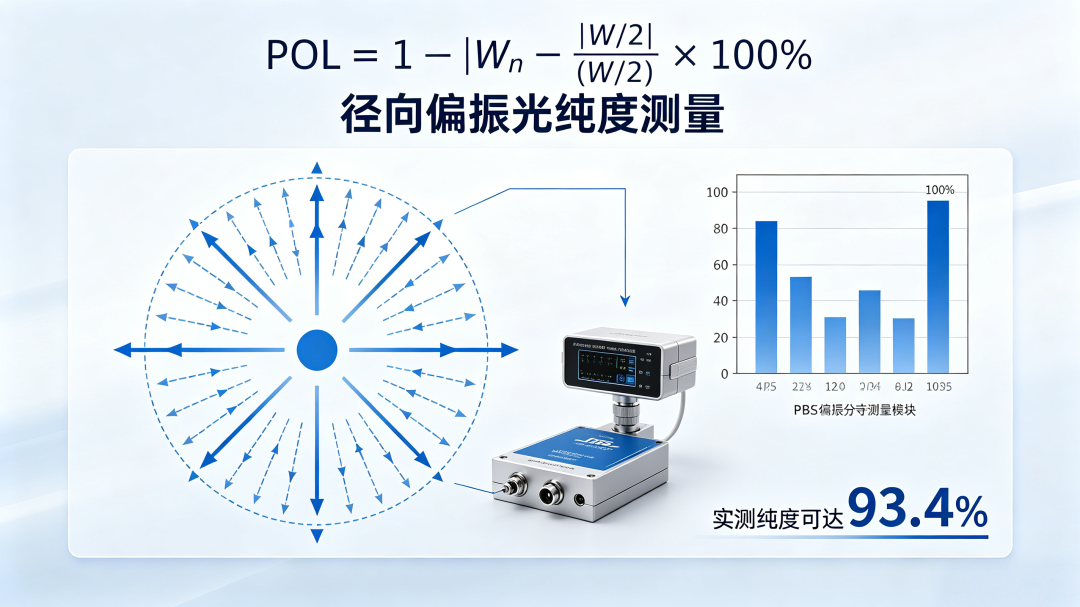
Polarization purity is not merely a theoretical construct; it can be measured and quantified using optical devices. Taking radially polarized light as an example, the industry-standard PBS measurement method can swiftly calculate purity with the core formula: POL = [1 − |W⊥ − W∥/2| / (W/2)] × 100%. Here, W represents the total beam power, while W⊥ and W∥ denote the measured powers in the corresponding polarization directions. In practice, the purity of radially polarized light can reach 93.4%.
This method is equally applicable to AR waveguide testing, quantifying polarization non-uniformity and purity degradation caused by grating coupling deviations. Conclusion Polarization purity possesses a complete, mature, and implementable quantitative mathematical framework that eschews subjective judgment. The three core tools have clear divisions of labor: DoP for overall polarized light proportion statistics, PP for targeted directional polarization precision testing, and IPPs for characterizing medium depolarization and spatial polarization characteristics.
From basic physics research to AR optical design and precision testing, polarization has evolved from a qualitative concept into a quantifiable and standardizable core engineering parameter.
Interactive Topic: Is polarization purity a parameter that necessitates quantitative evaluation in your AR optical design or testing work? What method are you currently employing? Feel free to leave a comment and share your insights.
— AR Andy | Focused on the waveguide and AR microdisplay sectors, delving deep into the underlying logic of the optical industry.
【Risk Disclaimer】This article is intended for industry optical science popularization. The calculation methods and technical principles mentioned are general-purpose public optical metrology standards, meant solely for technical learning and industry communication, and do not constitute the sole basis for specialized product design and testing.
-
![]()
Dongfeng's Independent Brands Make Significant Strides
-
![]()
Breaking News: Next-Gen AI Model Release Scrapped! OpenAI Pulls the Plug
-
![]()
Two Chinese Women Close a $55 Billion Deal, with Employees Set to Share in $5.5 Billion
-
![]()
Geely Acquires 30% Stake in NIO Energy: NIO and Geely Strike a Deal on Charging and Battery Swap Transaction Restructuring, Paving the Way for Industry-Wide Standardization?
-
Hongmeng Zhixing Launches a Vehicle Directly Targeting Xiaomi YU7!
-
![]()
AUDI's European Presence: Sparking Anxiety and Redefining Global Market Strategies
-
![]()
Ideal i9: Is It the "Fireman" for Ideal?
-
Pharmaceutical Giant Doubles Down on AI