Polarization of Light: The ‘Sense of Direction’ in the Realm of Transverse Waves
 10/08 2026
 381
381
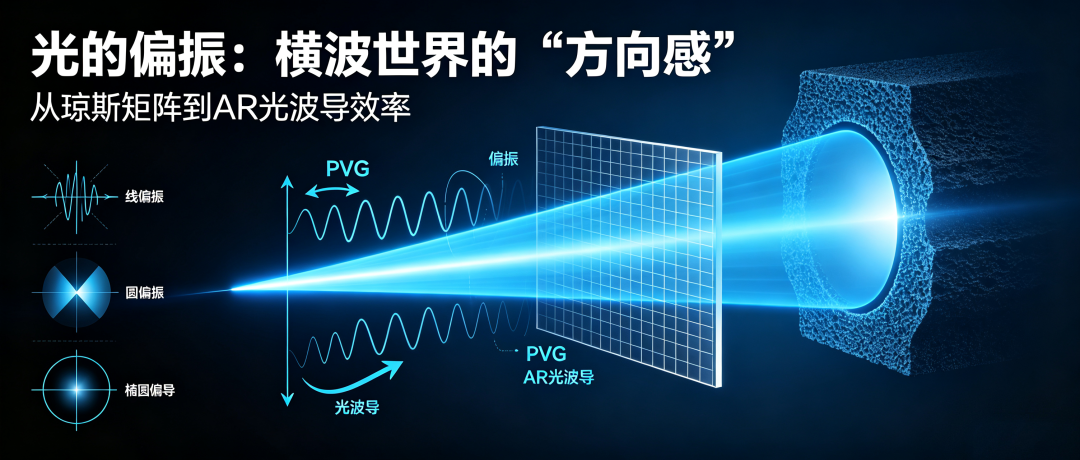
Abstract: Polarization is a directional attribute inherent to transverse waves and a fundamental characteristic that differentiates light waves from longitudinal waves.
This article simply breaks down the three basic forms of polarization—linear, circular, and elliptical—introduces the Jones matrix method for calculating polarization transformations, and, through industrial case studies involving PVG gratings and the APC effect, thoroughly elucidates the pivotal role of polarization management in enhancing the efficiency and uniformity of AR optical waveguides.
Polarization is a fundamental directional property of light, defining the orientation of the electric field vector’s oscillation within a plane perpendicular to the direction of wave propagation.
Linear, circular, and elliptical polarizations represent the three primary forms of light polarization, with the Jones matrix serving as a standardized mathematical framework for accurately describing transformations in polarization states.
In the realm of AR optical waveguides, polarization management is no longer a mere optional enhancement; it directly dictates the performance limits in terms of optical efficiency and image uniformity. A comprehensive grasp of polarization principles is indispensable for designing truly effective optical waveguides.
Light, as a quintessential transverse wave, exhibits electric and magnetic fields oscillating solely in orthogonal planes perpendicular to the direction of propagation. This unique ‘direction of oscillation’ constitutes the polarization of light and serves as its exclusive directional attribute.
The oscillation directions of photons emanating from natural light sources are random and disordered, lacking any fixed polarization patterns. However, upon being filtered by polarizers, reflected at optical interfaces, or modulated through scattering in media, light attains stable and controllable polarization states.
Today, in the field of AR optical waveguide technology, refined polarization management has emerged as a cornerstone for overcoming system energy efficiency bottlenecks.
What is Polarization?—The ‘Directional Attribute’ of Transverse Waves
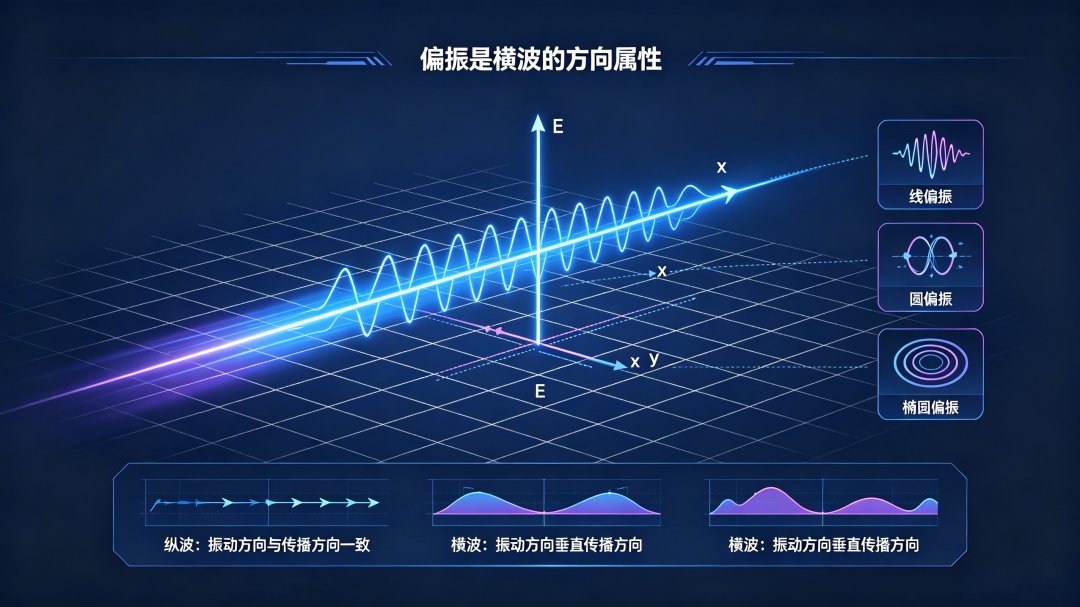
Polarization is a key distinguishing feature of transverse waves from longitudinal waves. Common sound waves, being longitudinal, exhibit a vibration direction of the medium that aligns entirely with the propagation direction, leaving no room for variation in vibration direction and thus no concept of polarization.
Light waves, as transverse waves, possess electric and magnetic field vectors that oscillate consistently within a plane perpendicular to the direction of light propagation. The orientation of the electric field vector’s oscillation is what we define as the polarization state.
Within the plane perpendicular to propagation, the electric field vector E can be resolved into two orthogonal components, x and y. The relative amplitudes and phase disparities between these two components directly determine the polarization form of light.
The industry categorizes polarized light into three primary forms: linear polarization (where the phase difference between components is 0 or π, resulting in the electric field oscillating along a fixed direction), circular polarization (where component amplitudes are equal with a phase difference of π/2, causing the electric field vector to rotate continuously), and elliptical polarization (which lies between the two, characterized by unequal amplitudes or non-standard phase differences).
How to Describe Polarization States?—The Jones Matrix
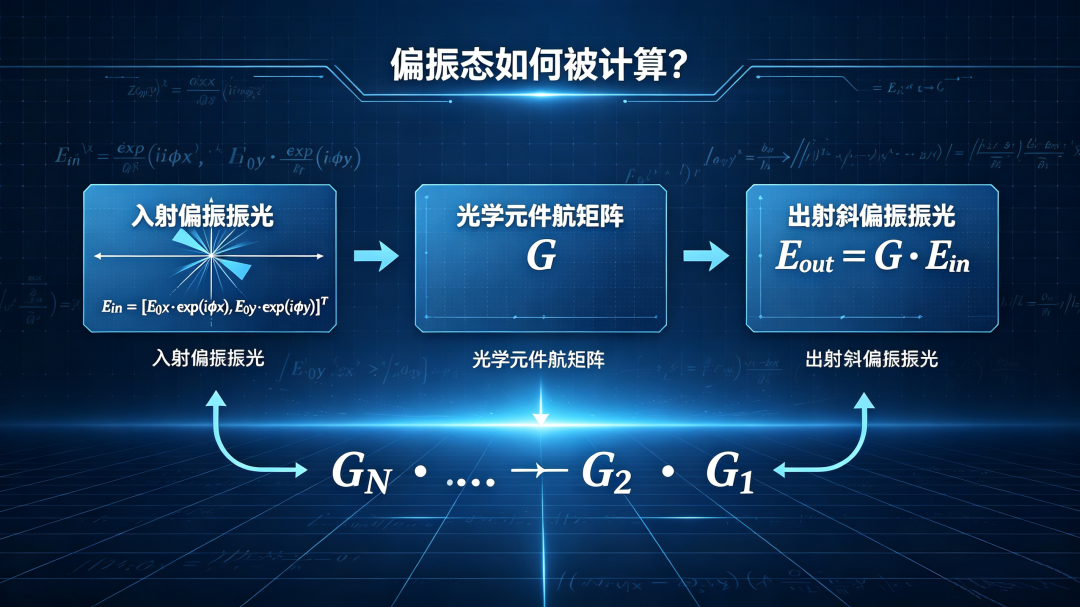
For fully polarized light, the Jones vector stands as an industry-standard tool for precise modeling, representing a 2×1 dimensional complex vector that fully captures the core information regarding the amplitudes and phases of the electric fields in the x and y directions.
If light propagates along the z-axis, the complex amplitudes of the orthogonal components can be standardized as: E = [Ex·exp(iφx), Ey·exp(iφy)]^T.
The amplitude ratio and phase difference between the two components ultimately dictate the geometric shape and rotation direction of the polarization state.
When polarized light traverses optical elements such as polarizers, wave plates, and beam splitters, the element’s capacity to modulate the polarized light can be quantitatively characterized by a 2×2 Jones matrix.
By performing matrix operations between the incident polarized light and the element matrix, the polarization state of the outgoing light can be accurately determined, with the core formula being: E_out = G · E_in.
For complex optical paths involving multiple devices connected in series, the overall polarization transformation effect is the sequential multiplication of the Jones matrices of each element: E_out = G_N · ... · G · G · E_in.
Important Note: The Jones matrix is exclusively applicable to fully polarized light. Modeling and analysis of partially polarized or unpolarized light necessitate reliance on the Mueller matrix and Stokes parameters.
Why is Polarization Management Becoming a Key Variable in AR Optical Waveguides?
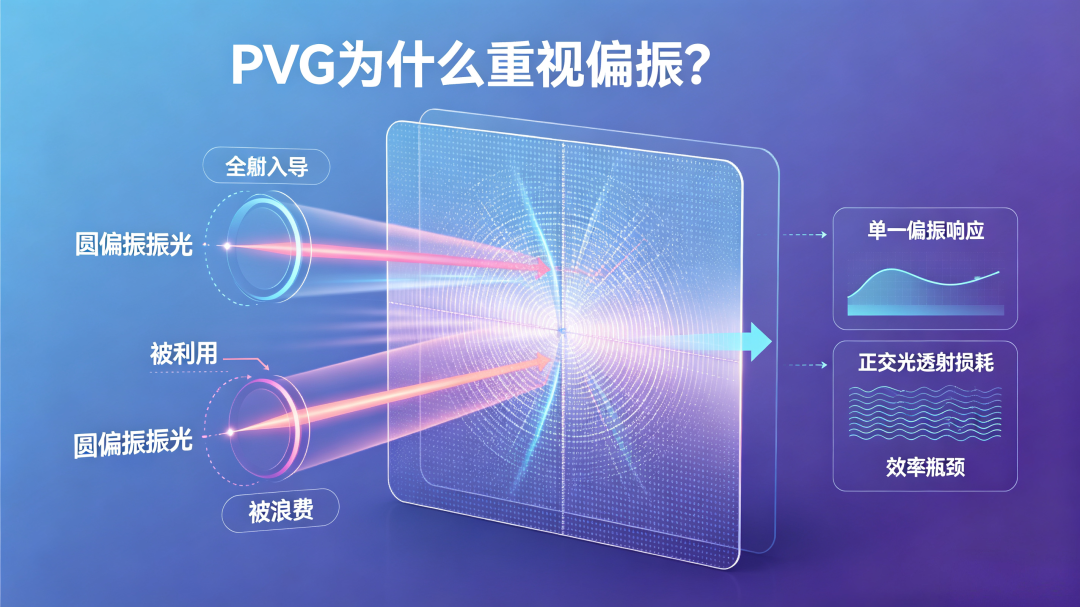
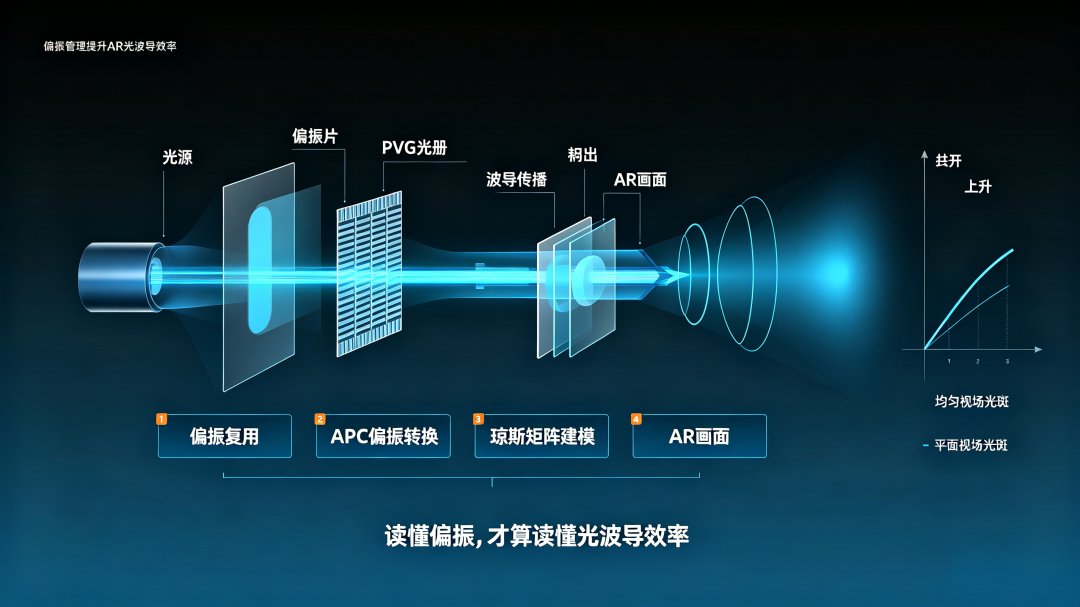
The core industrial value of polarization management is fully realized in the PVG polarization volume holographic grating architecture.
PVG, prepared through liquid crystal photoalignment processes, offers industrial advantages such as low cost, high yield, and ease of mass production, making it the mainstream core solution for current consumer-grade AR optical waveguides. However, this device harbors inherent optical flaws: it is solely sensitive to a single chiral circularly polarized light, with orthogonally chiral circularly polarized light being directly transmitted and wasted, significantly constraining the system’s optical efficiency in AR optical waveguides.
Addressing this industry pain point, research published by the Chen En’guo team (Lin Zijian et al., 2024) from Fuzhou University in Liquid Crystals and Displays 39(5):646 (DOI 10.37188/CJLCD.2024-0036) demonstrates that by architecturally multiplexing left- and right-handed circularly polarized light, the limitation of single-polarization response can be overcome.
Compared to traditional single-polarization response schemes, this architecture achieves a 48.8% improvement in image uniformity, a 34.1% increase in overall optical uniformity, and an overall 1.2-fold enhancement in the optical efficiency of the optical waveguide.
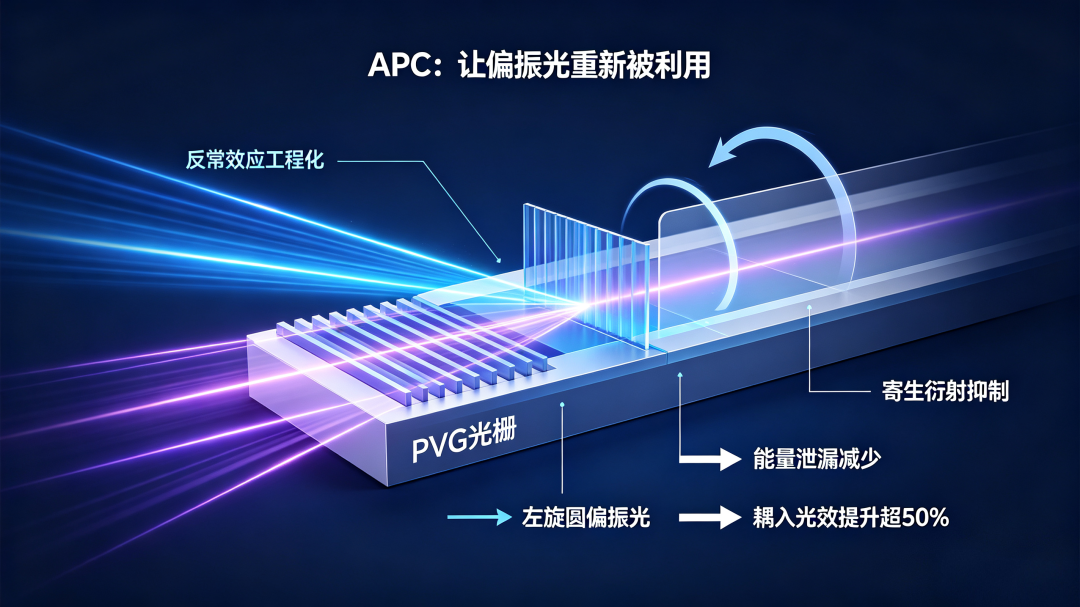
Gudong Intelligence publicly announced a key technological breakthrough in May 2026, successfully engineering the anomalous polarization conversion (APC) effect (data source: Gudong Intelligence’s May 2026 external technical announcement, corroborated and published simultaneously by multiple industry technology media outlets).
The core technical principle involves leveraging the equivalent wave plate characteristics generated when the PVG deviates from the Bragg diffraction condition to actively regulate the polarization state of light undergoing total internal reflection within the waveguide, achieving dynamic conversion of orthogonally circularly polarized light and effectively suppressing energy leakage caused by parasitic diffraction. The measured effects are substantial, ultimately achieving over a 50% increase in coupling efficiency and approximately a 20% improvement in FOV image brightness uniformity, truly accomplishing full-domain efficient reuse of polarized light.
Several Polarization Concepts AR Optical Waveguide Engineers Must Master
Combining the current iterative advancements in AR optical waveguide frontier technologies, three core polarization concepts are essential foundations for optical design, directly dictating the upper limits of optical path optimization: circular polarization sensitivity and orthogonal waste: This represents the most fundamental inherent optical characteristic of PVG gratings.
PVG can only respond to a single left-handed or right-handed circularly polarized light, with orthogonally chiral light unable to complete diffraction coupling and being directly transmitted, resulting in optical energy loss.
This is the core cause of the low energy efficiency in traditional PVG optical waveguides and the core breakthrough point for industry polarization optimization.
Polarization multiplexing: Through collaborative design of dual optical paths for left- and right-handed circularly polarized light, originally wasted orthogonally polarized light is activated, simultaneously achieving exit pupil expansion and optimization of image brightness uniformity.
Gudong Intelligence’s single-layer double-sided PVG scheme, iteratively disclosed in July 2026, relies on this core logic, achieving a performance breakthrough of a 45° wide field of view with just a single substrate hardware.
Anomalous polarization conversion (APC): A unique special optical effect exclusive to PVG, it can actively convert polarization chirality during the total internal reflection transmission of light, physically addressing the industry pain points of single-polarization response and energy leakage in traditional PVG, serving as the core underlying technological mechanism for achieving efficient performance improvements in the current AR optical waveguide industry.
Conclusion Polarization has never been an abstract and obscure physical concept confined to textbooks; rather, it is the cornerstone of optical design in AR optical waveguides.
From discerning basic polarization forms, performing precise mathematical operations with the Jones matrix, to understanding the natural polarization selectivity of PVG gratings and the active polarization regulation of the APC effect, the entire set of polarization optics logic continuously supports iterative breakthroughs in the efficiency and image quality of AR optical waveguides.
Grasping polarization is truly understanding the performance limits and optimization directions of AR optical waveguides.
Interactive Topic: In your AR optics work, is polarization management the most challenging aspect for you, or have you already found a mature solution? Feel free to leave a comment and share.
— AR Andy | Focused on the optical waveguide and AR microdisplay sectors, deeply dissecting the underlying logic of the optical industry
[Risk Disclaimer] This article is intended for industry optics popularization purposes. The relevant principles, technical mechanisms, and industrial data are all sourced from publicly available academic research and industrial technological achievements, intended solely for technical learning and industry communication, and do not constitute a basis for product design, process iteration, or mass production selection.
-
![]()
Polarization of Light: The ‘Sense of Direction’ in the Realm of Transverse Waves
-
![]()
Polarizer, Wave Plate, and Polarized Light Path Design: The Essential Framework of Polarization Optical Systems
-
![]()
JAC Motors’ Stock Price Rockets for Three Days Straight: Is the ‘Huawei Partnership’ Being Treated as a Cash Cow?
-
![]()
What Does China's Motorcycle Industry Still Lack After 7 Billion Views?
-
![]()
Yijing’s First Car Hits the Market: Timing, Location, and Target Audience—How to Get Them Right?
-
![]()
Volkswagen Lays Off 100,000 Employees but Builds Three Battery Factories in Europe with Gotion High-Tech
-
![]()
GAC Group: Pioneering Integration Among Domestic Automakers
-
![]()
Huawei and Seres Forge Alliance: A Strategic 'Remarriage'!