RayNeo Slims Down, Huawei Builds Ecosystem, XREAL Launches in Quick Succession: Chinese AI Glasses Makers Gain Momentum
 11/12 2026
 450
Consumer Finance Eye
Depth | Consumption | Value
See more, know more
>>>>
Market watchers have long observed a rule for consumer electronics categories: for a new category to truly take off, two forces must converge at the same moment—"policy incentives providing the money, and products providing the reason."
AI glasses appear to have hit exactly that window. On one side, the first AI glasses co-developed by Samsung and Google have entered pre-sale; on the other, after smart glasses were included in the national subsidy program, Beijing has doubled down with a local policy that expands the scenarios and supporting incentives for subsidies.
Once dismissed as a category that "gathers dust right after the novelty wears off," AI glasses are now being pushed onto the fast track. And in this race, domestic brands such as RayNeo and XREAL appear to have already readied their chips to take on the international heavyweights.
01■
Subsidies and Debuts Converge on AI Glasses
As early as the end of last year, smart glasses were included in the national subsidy program for new digital purchases. Eligible smart glasses receive a subsidy of 15% of the final selling price after all discounts, capped at 500 yuan per unit, with a unit price not exceeding 6,000 yuan. For the first time, smart glasses were officially grouped alongside mobile phones, tablets, and smartwatches as the "four major items" of the national digital purchase subsidy.
Another notable development: at the end of October, the Beijing Municipal Bureau of Commerce released its "Guidelines for Policies to Promote Smart Glasses Consumption," introducing seven support measures. On top of existing national subsidies, the guidelines encourage and support enterprises to open retail stores in Beijing—Asia's first stores, China's first stores, Beijing's first stores, flagship stores, and innovative concept stores. Qualifying enterprises receive a one-time reward of up to 1 million yuan, and the guidelines support companies in holding new product debut and first-show events in Beijing. Clearly, Beijing has deployed a combined approach—"from selling products to building scenarios"—as the city races to capture a new sales channel.
Meanwhile, the first AI glasses jointly created by Samsung and Google opened pre-sale on November 12 and will officially launch in December. The product runs on Google's generative AI model Gemini, with Gentle Monster and Warby Parker contributing frame designs. It is a lightweight visual AI glasses focused on voice Q&A, real-time translation, and environmental recognition.
The market signal is unmistakable: the world's top-tier players have all identified AI glasses as the "next must-win entry point."
The domestic market is accelerating too. Beijing's Suning Zhongta Store, for example, has set up a smart glasses zone stocked with products from Qwen, RayNeo, Xiaomi, Huawei, and others. Leveraging one-stop services—offline experience, explanation, and verification—combined with multiple discounts from national subsidies and Double 11 promotions, the store has attracted many consumers.
Subsidies have given consumers a reason to "give it a try," while promotions such as Double 11 and Beijing's special incentive policies have provided better implementation scenarios for products. The distance for this new category—from "wanting to try" to "actually buying"—is being shortened as never before.
02■
On What Basis Can Domestic Brands
Capture Scale Demand Ahead of the Giants?
China's supply chain advantages are obvious in this competition. Reducing optical waveguide prices from the ten-thousand-yuan level to consumer-friendly levels, fitting low-power SoCs into glasses temples—most of the companies achieving these are Chinese. The same holds for whole-device assembly and optical module production lines, which are heavily concentrated in China.
Analysts suggest that the ultimate winner in AI glasses may not be the one with the best laboratory parameters, but the one that can bend the cost curve and organize the supply chain.
In fact, even before the Samsung-Google AI glasses went on pre-sale, Shanghai-based XREAL, together with Google, released the world's first split-type spatial computing XR glasses equipped with Android XR, integrating optical see-through, the Google Play mobile app ecosystem, and Gemini multimodal AI capabilities. Chinese enterprises are no longer mere contract manufacturers; they are actively participating in core technology and product definition when cooperating with international giants such as Google.
According to data from market research firm Omdia, Meta has become the world's largest manufacturer of AI glasses over the past few years. Last year, its shipments reached 7.4 million units, accounting for 85.2% of the entire market—an increase of 281.3% compared with 2024. Even in the first half of this year, the company still maintained a global market share of more than 80%. Meanwhile, Apple is also planning to launch its first-generation smart glasses by the end of 2026.
In terms of shipment share, giants like Meta do dominate and "crush" other manufacturers, but Chinese companies are not without opportunities. As more and more large companies join this race, they will rapidly educate consumers on "what AI glasses are and what convenience they can bring." Those Chinese enterprises with advantages in cost-effectiveness, user experience, and technological iteration can catch the first wave of truly meaningful scale demand after the giants have built category awareness.
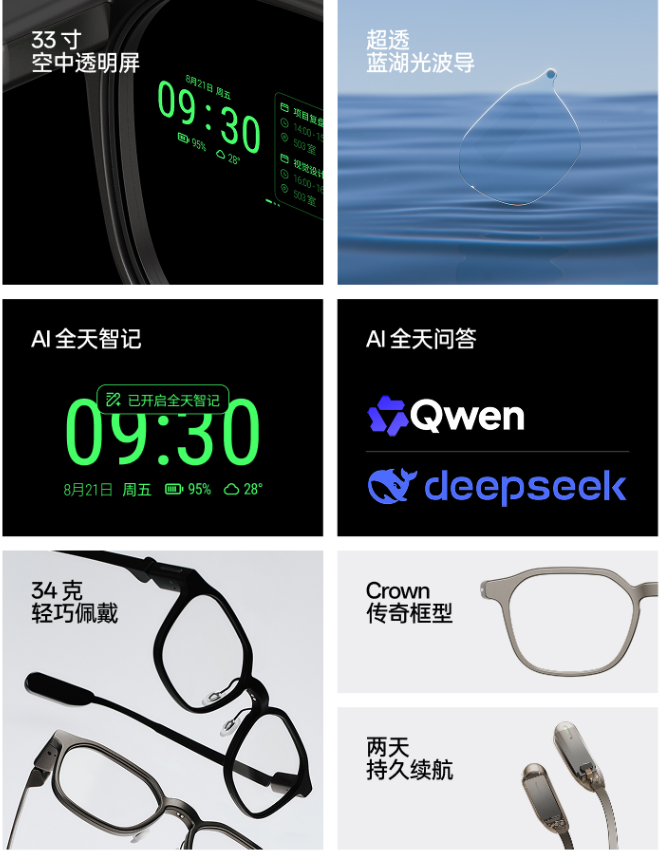
Source: Screenshot from RayNeo Smart Glasses official website
03■
Chinese Manufacturers Bet Against the Cycle on the Next Battle for AI Glasses
In the third quarter of this year, products under RayNeo accounted for 34% of China's consumer AI/AR glasses market. Noteworthy is the iO AI glasses it launched in August, which—with a lightweight body of only 34 grams—broke the weight limit for "all-day wear." The product initially supports models such as DeepSeek V4 Pro and Qwen 3.7 Max, and will later add Kimi K3 and RayNeo's self-developed RayNeo AI large model. RayNeo's key move is actually shifting industry competition from "flashier parameters" to "allowing people to wear it out every day"—undoubtedly a more long-term strategic choice.
At the industry level, the display-free AI glasses market in the third quarter is undergoing a phased correction, with overall industry growth converging. Nevertheless, at the end of October, RayNeo still unveiled its fourth-generation binocular full-color AI glasses iO+, betting on the full-color Micro LED optical waveguide route; another manufacturer, XREAL, likewise launched two heavyweight new products—XREAL 1 Pro+ and XREAL AURA—in quick succession at the end of October. This kind of counter-cyclical increase in R&D and new products—daring to bet on the next generation during a market correction—is precisely the biggest difference between "long-termists" and "opportunists," and the most praiseworthy aspect of Chinese manufacturers' management.
In addition, manufacturers such as Huawei and Xiaomi are also accelerating the construction of their own "moats." Huawei, leveraging the HarmonyOS device ecosystem and localized AI computing power, is expanding rapidly in display-free AI glasses, and on October 22 added functions such as parking lot QR code payment and head-motion payment/head-motion control payment through OTA. Xiaomi, meanwhile, continues to scale up relying on mobile phone channels and cost-effectiveness; Qwen is taking a second leap with its large-model capabilities.
From these angles, the leaders of various manufacturers likely all understand that future AI glasses will not just be a hardware device, but an extension of "ecosystem collaboration." Whoever can truly link AI glasses with their other products will have a deeper moat.

04■
The Real Test for AI Glasses Has Only Just Begun
IDC predicted last year that China's AI glasses shipments would reach 4.915 million units in 2026; but in this year's quarterly tracking, it lowered this figure to "expected shipments of 4.508 million units."
However, according to Omdia data, in the first half of this year, retail sales in China's smart glasses market were only 1.012 million units. That is to say, to achieve IDC's forecast, the Chinese market would need to sell more than 3.5 million AI glasses in the second half of the year—3.5 times that of the first half. The subsidies and other policy support mentioned above can indeed generate considerable heat, but whether this heat can ultimately turn into sustained sales is the key to whether the scale-up inflection point for AI glasses can arrive.
At present, the most important issue is that many consumers often buy AI glasses with a "try something new" mentality. After receiving the glasses, will they wear them out every day, or will they put them in a drawer to "gather dust" after two weeks? First-sale data is indeed important, but repurchase rate and average daily usage duration are probably the key factors determining the life or death of this category.
Industry discussions have raised expectations that global AI glasses shipments will head toward 15 million units in 2026. And in the domestic consumer AI/AR market, driven by the continued effects of Double 11 and Double 12 promotions and national subsidy policies, fourth-quarter sales are expected to hit a new high.
However, no matter how optimistic market expectations are, AI glasses are currently in a stage of transition from "product validation" to "rapid volume growth." For the leaders of major manufacturers, whether they can turn "one-time impulse purchases" into "an indispensable daily habit" is the most severe question facing them.
Overall, in the competition over AI glasses, Chinese manufacturers actually have quite obvious advantages: they lack neither supply chains nor technological positioning. Moreover, the strategic paths of manufacturers' leaders are also very bold. While others compete on discounts and parameters, they decisively compete on weight, ecosystem, and next-generation optical waveguides. These Chinese manufacturers share the same goal: they value not only first-sale rankings, but also whether users will casually put on their products before going out every day thereafter.
#AI glasses #smart glasses #national subsidy #RayNeo #XREAL
-
![]()
Fines Incoming: Universities Can't Curb AI Cheating, So Regulators Step In
-
![]()
RayNeo Slims Down, Huawei Builds Ecosystem, XREAL Launches in Quick Succession: Chinese AI Glasses Makers Gain Momentum
-
![]()
OpenAI Enters the Oilfield, Stepping into Palantir's Territory | iAnalysys Insights
-
Toyota's Counterattack
-
![]()
Jiuzhang Cloud's IPO: Can Computing Power Metrics Determine Pricing Power?
-
Cerebras' Stock Plunged 77% Within Six Months of Going Public—What Happened to Nvidia's "Challenger"?
-
![]()
01.AI Sets Up Headquarters in Hangzhou
-
![]()
The Three German Auto Giants Have All Stalled—What Exactly Happened to Them?