Dispersion Isn't Just "Rainbow Fringing" — It Determines Whether Diffractive Optical Waveguides Can Achieve Full Color
 11/19 2026
 499
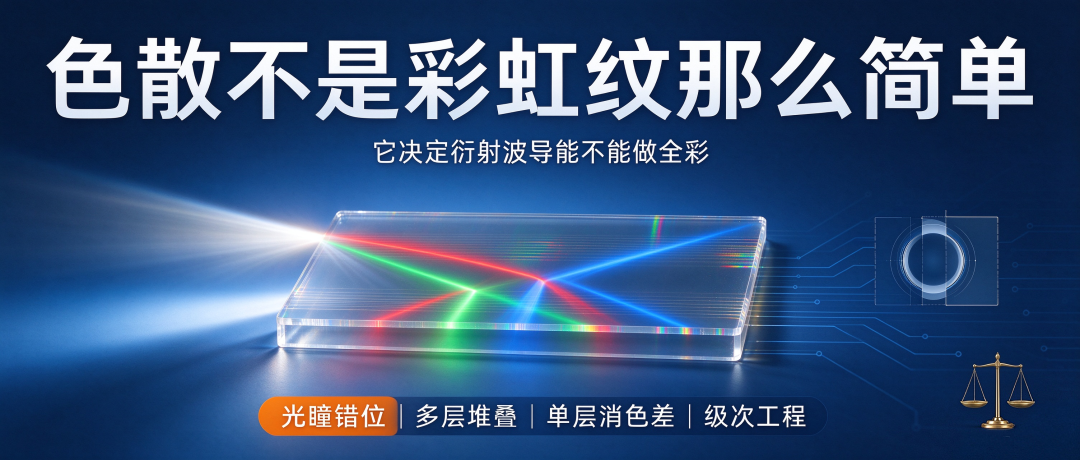
Abstract: Dispersion in diffractive waveguides is not merely the rainbow fringing visible to the naked eye; the deeper problem lies in the misalignment of the diffraction trajectories of the three RGB colors, which causes pupil separation and color non-uniformity.
The three full-color approaches — multilayer stacking, single-layer achromatization, and diffraction-order engineering — each carry corresponding engineering costs, and no zero-cost optimal solution exists.
When the topic of dispersion in diffractive optical waveguides comes up, many people's first reaction is rainbow fringing.
Rainbow fringing is indeed a phenomenon brought about by dispersion, but it is not the most troublesome problem. The core contradiction that truly blocks the deployment of full-color AR is that red, green, and blue light each travel their own separate paths inside the waveguide.
Dispersion determines whether the three RGB colors can land at the same exit pupil position, maintain consistent out-coupling density, and be uniformly delivered to the human eye. If this cannot be achieved, full color is nothing but empty talk.
The Physical Root of Dispersion — the "Wavelength Dependence" in the Grating Equation
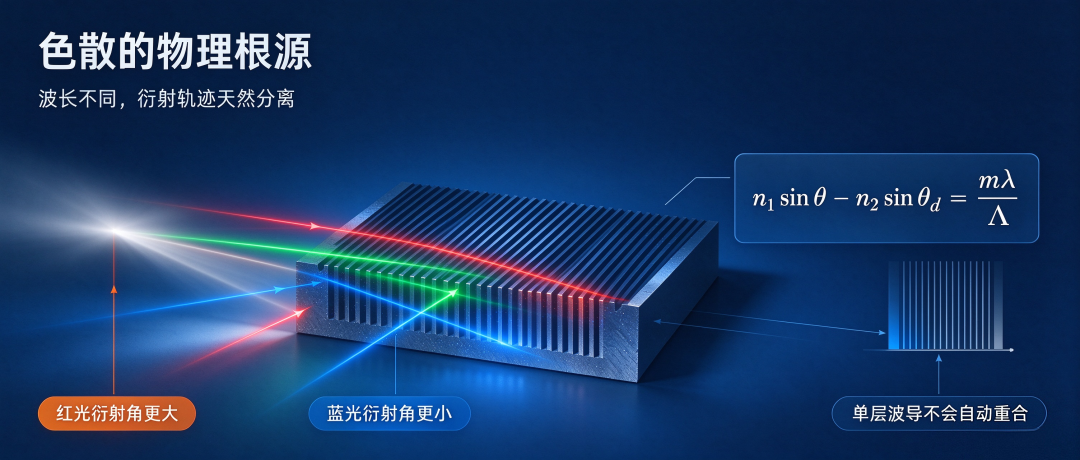
The root of dispersion in diffractive optical waveguides lies in the grating equation.

The wavelength λ appears on the right side of the equation. With the same incident angle and the same grating period, red light and blue light inherently have different diffraction angles. The longer the wavelength, the larger the diffraction angle.
After a beam of white light enters the in-coupling grating, the three RGB colors enter the waveguide at three different angles and propagate along three independent trajectories.
Under a single-layer waveguide structure, these three optical paths will not coincide on their own. The grating equation admits no exceptions. As long as a diffraction grating is used for optical in-coupling, the angular difference caused by wavelength is a physically inevitable result.
The Real Engineering Consequence of Dispersion — Not "Color Shift," but "Pupil Misalignment"

On the surface, dispersion brings rainbow fringing and color cast in the image. But in engineering deployment, what is more damaging is pupil mismatch.
Because the three RGB colors propagate at different angles, in the exit pupil expansion region, their replication periods and exit pupil densities all fail to match.
The exit pupil positions of red and blue light are offset, so some areas in the eyebox are reddish and others are bluish, and color uniformity collapses outright. In two-dimensional pupil expansion structures, this problem is further amplified.
In conventional first-order diffraction schemes, the azimuth angle deviation of the RGB channels can reach up to ±11.31°.
The pupils of the three colors gradually spread apart in the pupil expansion array, and in severe cases they completely separate. What the user perceives is not slight color cast, but the image color changing as they turn their head.
This problem is far more difficult to handle than rainbow fringing, and software algorithms are basically unable to remedy it.
Full-Color Path One — Multilayer Stacking: Trading "Division of Labor" for "Volume"
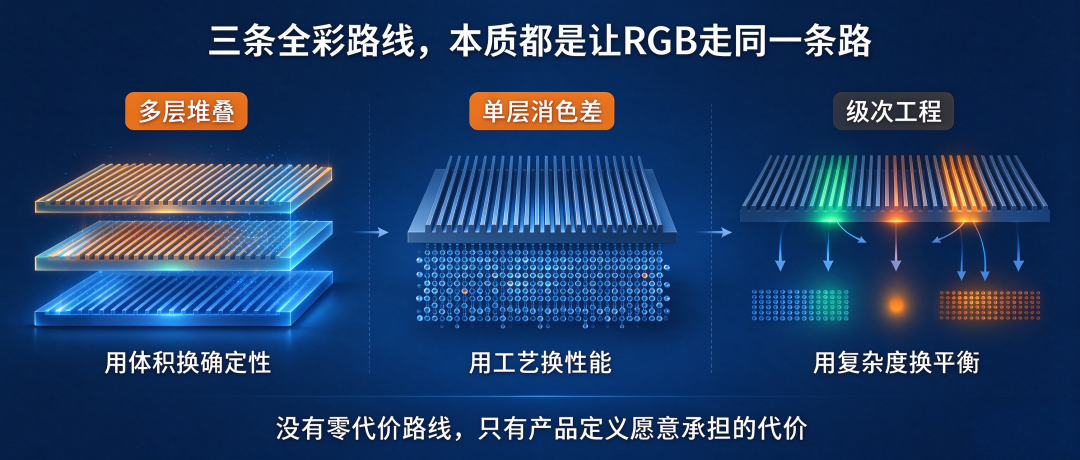
The simplest and most straightforward solution is division of labor: place red, green, and blue in three separate waveguide layers, with each layer responsible for only one color.
The grating period of each layer is optimized separately for the corresponding wavelength, dispersion is confined within each single layer, and the three colors finally superimpose at the exit pupil position.
To prevent inter-layer color crosstalk, filters and DBR distributed Bragg reflectors must be added between the waveguides. The DBR blocks stray-colored light, and the filters absorb off-color light, ensuring that each layer carries only a single color.
The logic of this scheme is simple, and the final result is stable and controllable. The cost is also direct: thickness and weight double outright. With three substrates stacked plus the accompanying filter structures, the entire waveguide becomes thicker and costs rise.
For consumer AR glasses that pursue thinness and lightness, this is a very hard cost to accept.
Full-Color Path Two — Single-Layer Achromatization: Trading "Design" for "Process Difficulty"
The second route attempts to achieve achromatization within a single waveguide.
The core idea: assign different diffraction orders to RGB so that the product of order and wavelength is equal:

For example: 663 nm red light uses +4 order, 530 nm green light uses +5 order, and 442 nm blue light uses +6 order, and all three products are close to 2650.
This set of orders is not chosen arbitrarily. The RGB wavelength ratio is about 1.5:1.2:1, and the orders are assigned in inverse proportion to the wavelength to offset the diffraction angle deviation caused by wavelength differences.
The metasurface waveguide scheme published in Nature in 2025 achieved a single-layer 45° full-color FOV based on this principle, with performance far surpassing conventional couplers.
In the latest IEEE research in 2026, genetic algorithms were used to optimize high-order gratings, reducing the RGB azimuth angle deviation from ±11.31° to near 0°, with in-coupling efficiency reaching about 31%.
The difficulty lies on the process side. High-order diffraction places extremely high demands on grating morphology precision, and metasurfaces combined with electron beam lithography and etching cost far more than conventional nanoimprinting. The principle is elegant, but the barrier to mass production is very high.
Full-Color Path Three — Diffraction-Order Engineering Coordinated with Filtering
The third scheme sits between the previous two: a single-layer or double-layer structure combined with order engineering + filters, seeking a balance between performance and complexity.
In many patent schemes, the transition grating region is made into a light-splitting region: high diffraction efficiency for short-wavelength blue light and low diffraction efficiency for long-wavelength red light, so light of different colors is split here and enters the corresponding exit pupil channels separately.
There are also designs with gradient-period and composite-period gratings to adapt to a broadband spectrum within a single layer. However, the diffraction efficiency of this scheme is unstable, generally fluctuating in the 15%–35% range.
This route is essentially a compromise. It does not pursue theoretically perfect achromatization, but relies on optical design to keep dispersion within a range acceptable to the human eye.
The cost is a sharp increase in design difficulty: efficiency, FOV, and color uniformity constrain one another, and optimizing one metric often drags down the other two.
Closing Remarks: Dispersion Is Not Equal to Rainbow Fringing
It is the first physical threshold that diffractive optical waveguides must cross to achieve full color.
Multilayer stacking trades thickness and weight for stable results; single-layer achromatization trades extremely high process difficulty for a thin and light form factor; the order-coordination scheme trades complex design for overall balance.
No route is without cost. Competition in full-color waveguides, put plainly, is about choosing which metric you are willing to compromise on in the face of the physical constraint of dispersion. Which path you ultimately choose depends entirely on your product definition.
Interactive Topic: In your full-color waveguide scheme, is the dispersion problem handled by multilayer stacking, single-layer achromatization, or algorithmic compensation? Feel free to leave a comment about your choice and the corresponding engineering cost.
[Risk Note] The principles and literature data in this article come from public Nature and IEEE preprints and industry patents. Actual measurement results differ across manufacturers' process platforms and material systems; capacity, yield, and cost are only general industry references and do not represent the delivery specifications of any specific manufacturer.
—— AR Andy | Focused on the optical waveguide and AR micro-display track, providing in-depth analysis of the underlying logic of the optical industry
-
![]()
Dispersion Isn't Just "Rainbow Fringing" — It Determines Whether Diffractive Optical Waveguides Can Achieve Full Color
-
![]()
Beware! ChatGPT and Gemini Fail: Major AI Models Are Frantically Pushing Fake Shopping Websites
-
![]()
Voyah and Luxeed: Building Cars Under Their Own Names — and Owning the Responsibility That Comes With It
-
![]()
Market Value Down 86%, Revenue Up 30%: Can Generative AI Help SenseTime Reclaim Its Peak?
-
![]()
AI Hasn't Produced Fully Automated Ransomware—but It Has Lowered the Barrier to a Single Person
-
![]()
Pony.ai's Q3 Net Loss Doubles, but the Loss Isn't the Real Problem
-
![]()
Tencent Refuses to Settle for Mediocrity
-
![]()
Rumors of Shangjie Leaving HIMA Resurface—Is "Going Solo" Really Necessary for Shangjie? | Mingjing Pro