Rather Than Competing in the Robotaxi Market, Has Shandong Made Unmanned Delivery Vehicles a 'Provincial Benchmark'?
 09/10 2026
 665
665
Introduction
Every morning, three red unmanned delivery vehicles depart punctually from beside Guoliang Roast Chicken on Xi'er Road, Zhangdian District, Zibo, heading to various stores to make deliveries.
Around the same time, unmanned vehicles in Qingdao roll out from sorting centers, transporting parcels to township service stations tens of kilometers away.
In Shandong, the first region to commercialize L4 autonomous driving has prioritized freight over passenger transport.
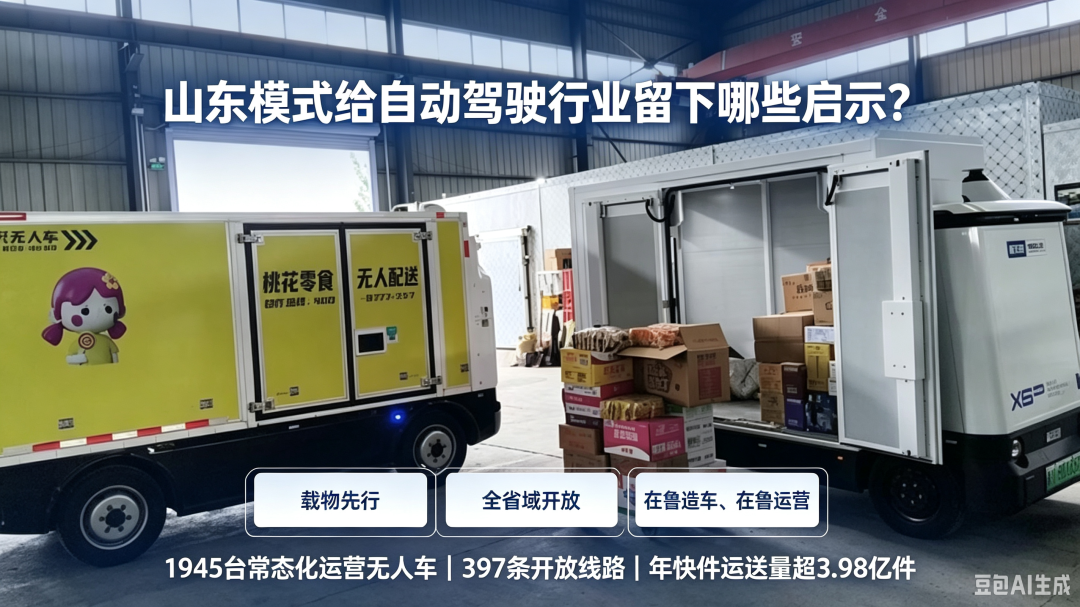
As of May this year, Shandong has publicly launched a cumulative total of 397 routes, with delivery companies deploying 1,945 unmanned vehicles in regular operation. The annual volume of mail and express deliveries is projected to exceed 398 million items, placing Shandong at the forefront nationwide in terms of application scale.
Unmanned Vehicle Insights (WeChat Official Account: Unmanned Vehicle Insights) posits that Shandong is pioneering China's first provincial-scale model for unmanned vehicle applications.
(For further reading, please click: "Cost Reduction by 37.5%! When Cold Fresh Meat Meets Unmanned Vehicles, 'Shuanghui Logistics + Neolix' Rewrites the Cold Chain Delivery Ledger")
I. Shifting Focus: The Unmanned Vehicle Race Prioritizes 'Usability, Affordability, and Scalability' Over 'Technological Prowess'
When it comes to autonomous driving, public attention tends to fixate on passenger-carrying Robotaxis, with comparisons focusing on algorithms, LiDAR specifications, and the pursuit of cutting-edge technological advancements.
However, Shandong offers a distinct approach: L4 autonomous driving commercialization need not commence with passenger transport; freight represents the swiftest pathway to real-world implementation.
Here, success is gauged not by algorithmic sophistication but by three key metrics: the breadth of network coverage, the affordability of operational costs, and the ability to effectively serve real commercial scenarios.
A set of compelling data underscores Shandong's scale of implementation: As of May 2026, the province has publicly launched 397 routes, with 1,945 unmanned vehicles in regular operation by delivery companies.
Neolix in Qingdao has deployed 1,200 L4 unmanned delivery vehicles, handling a peak of 6,500 daily orders and amassing over 40 million kilometers in total mileage—a scale surpassing Waymo's deployment in San Francisco.
In Linyi, renowned as the logistics hub, the number of unmanned vehicles has exceeded 1,000, ranking second nationwide in scale and covering diverse scenarios such as express delivery transit, supermarket shuttling, medical transportation, and security patrols.
Mr. Xu, a pipe merchant in Zibo Industrial Park, has conducted practical calculations. Previously, he required dedicated personnel to deliver goods to customers, and during peak periods, even the boss had to assist. After introducing unmanned vehicles, the daily electricity cost per vehicle is merely around 20 yuan, resulting in annual labor cost savings of seven to eight hundred thousand yuan.
Frontline couriers also benefit. Couriers at the Zibo outlet of STO Express reported that with unmanned vehicles handling round-trip transportation between the outlet and delivery points, couriers no longer need to make repeated trips, enabling them to focus on customer interactions and actually increasing their piece-rate earnings.
II. Scenario Expansion: From Express Delivery to a Diverse Array of 'New Roles'
Many assume that unmanned vehicles are solely for parcel delivery.
In Shandong, the business scope of unmanned vehicles is rapidly expanding, infiltrating various facets of urban life and industrial production.
In Zibo, in addition to express and supermarket deliveries, unmanned recycling vehicles have been deployed in over 20 residential communities.
At the Linyi Agricultural Wholesale Market, which peaks in activity at 3 a.m., recruiting nighttime workers is challenging and labor costs are high. The 24/7 operational capability of unmanned vehicles perfectly fills the gap in nighttime logistics, supporting the overnight circulation of fresh produce and fast-moving consumer goods.
Industrial parks have also carved out unique application spaces:
Rizhao Steel has purchased 26 unmanned vehicles for worker meal deliveries within the factory premises.
Yongfeng Steel utilizes unmanned vehicles to transport chemical reagents and experimental samples, mitigating the safety risks associated with manual handling.
The Hedong Public Security Bureau in Linyi has deployed police unmanned vehicles for highway patrols and traffic monitoring.
The primary obstacle to unmanned vehicle deployment was previously road access rights, with fragmented regional policies often leading to situations where vehicles could operate in one area but were banned in another.
On July 1, 2026, the Ministry of Public Security's "Safety Traffic Regulations for Road Testing and Demonstration Applications of Intelligent Connected Vehicles" officially took effect, establishing China's first unified national operational standards for all categories of unmanned vehicles. This marked a pivotal moment, transitioning unmanned vehicles from scattered pilot projects to large-scale operations.
Shandong, however, had already laid the groundwork, with 15 cities introducing dedicated policies for unmanned vehicle road operations. Qingdao has adopted a negative list management approach, allowing unrestricted access except for prohibited routes.
III. Industrial Transformation: From 'Importing Vehicles into Shandong' to 'Building and Iterating Vehicles Locally'
Initially, Shandong was the nation's foremost consumer market for unmanned vehicles: Companies from other regions produced complete vehicles and shipped them to Shandong for testing and operations—a model known as 'importing vehicles into Shandong.'
Today, Shandong is undergoing a transformation, constructing a comprehensive industrial closed loop encompassing 'R&D—complete vehicle manufacturing—core components—operational services,' enabling vehicle production, operation, and iteration all within the province.
On April 26, 2026, Jiushi Intelligence's Qufu Smart Manufacturing Base officially commenced production, marking Jiushi's first dedicated vehicle production base in China.
The base plans for an annual production capacity of 5,000 units in a single shift, covering multiple vehicle types including logistics delivery, security patrols, and urban cleaning.
In Qingdao, Neolix is constructing a Smart Driving Town, attracting supporting enterprises such as automatic wheel and non-pneumatic tire manufacturers, as well as local battery suppliers, centered around unmanned vehicles.
In Zibo, Shuntai Automobile is extending its traditional specialized vehicle manufacturing to intelligent forklifts, achieving operational precision of 1 centimeter for unmanned forklifts.
Market demand, in turn, drives the growth of local manufacturing capabilities. Operational pain points related to road conditions and scenarios encountered during operations can be directly fed back to local factories for hardware iteration, forming a positive cycle of scenario-driven operations and manufacturing advancements.
According to the plan, by 2027, Shandong will deploy over 15,000 low-speed unmanned vehicles across the province, establishing the nation's first provincial-scale application model and creating a distinctive brand for autonomous driving.
This is not merely about pursuing vehicle numbers; it represents a complete commercial logic: moving away from reliance on government subsidies to sustain demonstration operations, and instead achieving commercial viability to make unmanned vehicles a profitable standardized transportation force.
IV. Insights from the Shandong Model for the Autonomous Driving Industry
The domestic autonomous driving industry has long been ensnared in a cycle: heavily investing resources in passenger-carrying Robotaxis, which demand extremely high technical standards yet remain far from profitability, with many projects stuck in the demonstration phase.
The Shandong model provides an alternative, actionable answer: It is not necessary to pursue fully automated passenger transport in one fell swoop. Instead, starting with end-of-line freight applications and relying on real demand from local logistics, industrial, and urban services, the focus should be on first achieving commercial viability and then feeding back into technological iteration.
It offers two layers of insight to the industry.
First, the value of autonomous driving is not solely measured by 'passenger transport.' Industrial parks, agricultural wholesale markets, communities, and campuses—these B-end scenarios have substantial, urgent real-world needs, with clearer error tolerance boundaries and easier cost model viability.
Second, the industrialization of autonomous driving cannot rely solely on technology companies acting alone. It requires open road access policies from local governments, manufacturing industries to absorb production capacity, and local enterprises to explore application scenarios. Only through multi-party collaboration can test vehicles be transformed into normalized urban transportation forces.
Conclusion
Unmanned Vehicle Insights (WeChat Official Account: Unmanned Vehicle Insights) believes:
Once 15,000 unmanned vehicles are fully deployed by 2027, the nation's first provincial-scale unmanned transportation network will officially take shape. This complete, replicable 'Shandong Model,' from production to operation, can then be directly packaged and exported to all provinces across the country. This effectively advances the timeline for large-scale autonomous driving adoption by at least three years.
What do you think?
References:
#UnmannedVehicleInsights #AutonomousDriving #SelfDriving #UnmannedVehicles
-
![]()
Annual Production Capacity in Phase I to Hit 50,000 Units! Weijing Optics Unveils Mudanjiang Production Base
-
![]()
Net Profit Loss Shrinks by 35.52% in First Three Quarters of 2026, Yet Costar’s Stability Remains Elusive
-
![]()
Massive Exchange Losses! Lens Technology’s Profits Plummet in First Three Quarters—Will the iPhone Duo Mark a New Turning Point?
-
![]()
2026 World Intelligent Connected Vehicles Conference: Transitioning from Spec Benchmarking to Safety Benchmarking, the Industry Steps into a New Era of Regulatory Oversight
-
![]()
Hundreds of Billions Fully Invested in AI, Yet No Returns in Sight
-
![]()
ByteDance's Automotive Ambitions Come to the Fore
-
![]()
$12.9 Billion: Nvidia Buys an 'Insurance Policy'
-
![]()
iPhone Duo: Is It a Thorn in Ternus's Side?