Liang Wenfeng Pours 40 Billion Yuan into Ulanqab, as AI Titans Flock to the Region
 10/13 2026
 572
572
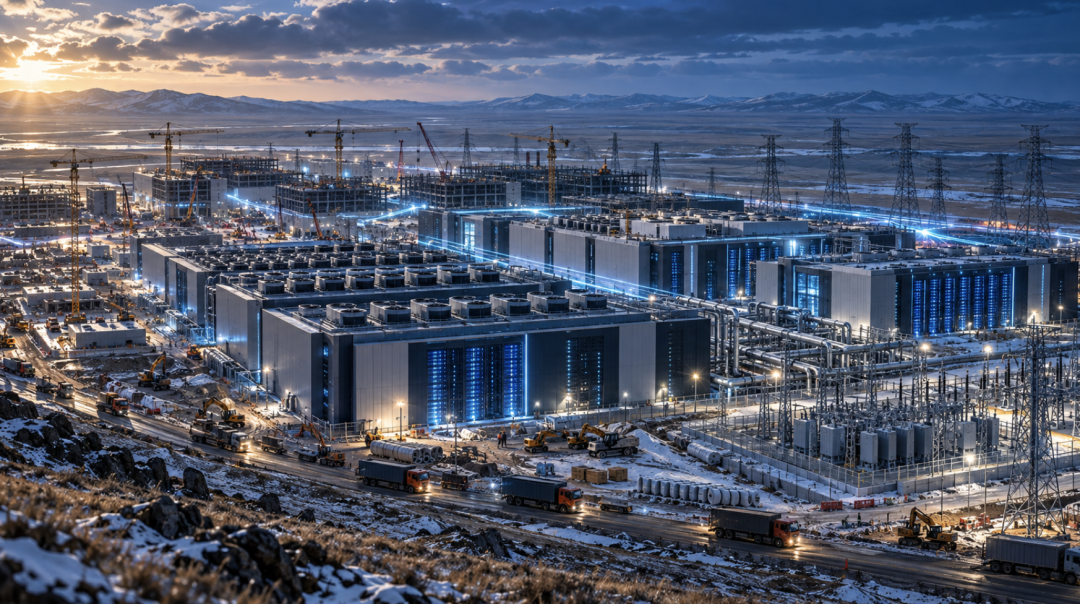
Cover | Graphic by Pencil News
Inner Mongolia's Ulanqab Emerges as a Hotbed for China's AI Infrastructure
In August this year, Ulanqab, a city with a permanent population of just over a million, inked 12 intelligent computing projects in rapid succession. According to incomplete statistics, confirmed planned investments have surpassed 130 billion yuan. Five disclosed intelligent computing centers boast a combined planned power capacity of 6.3GW.
But the spending spree doesn't end there. GDS Holdings is set to invest over 30 billion yuan locally in the next five years, while DeepSeek has plans to construct a large-scale data center in Inner Mongolia, deploying at least 160,000 Huawei AI chips.
This northern town, once synonymous with potatoes, has suddenly found itself at the epicenter of China's AI race.
Why Ulanqab? More importantly, with hundreds of billions of yuan pouring in, who stands to gain?
- 01 - Arrival of Huawei, Alibaba, and DeepSeek
Ulanqab has been abuzz with activity lately.
According to an October 12 report by Xinhua Daily Telegraph, 22 computing projects are currently under construction in the local Chahar High-Tech Zone, employing nearly 30,000 workers. At noon, boxed meal and fruit stalls spring up around the construction sites, and the evening rush hour traffic can even cause congestion in this small city.
The most striking development is the ever-expanding roster of participating companies.
In late August, 21Vianet, Chindata Group, China Unicom Cloud Data, GLP, and Huayi Cloud signed centralized agreements in Jining District, Ulanqab, planning intelligent computing centers with capacities of 2GW, 1GW, 1.5GW, 1.3GW, and 0.5GW, respectively.
That same month, energy company Envision's Xinghe Base became operational, with the entire park planning a 2GW capacity. Originally known for wind turbines, energy storage, and energy systems, Envision has now ventured into building its own "Token factories." Established IDC companies like GDS Holdings and 21Vianet continue to ramp up their investments.
More intriguingly, clients who previously only rented computing power are now getting directly involved.
DeepSeek has also set its sights on Ulanqab. According to informed sources, this AI unicorn plans to build a GW-scale data center locally, deploying at least 160,000 Huawei Ascend 950DT chips. Based on the latest quoted prices disclosed by media, the nominal procurement cost for these chips alone exceeds 40 billion yuan, not including supporting facilities like server rooms and power infrastructure.
As early as April, DeepSeek had posted job listings for senior data center operation and maintenance engineers in the area, offering salaries up to 30,000 yuan per month. A large model team recruiting not in Beijing or Hangzhou, but on the vast Inner Mongolian grasslands.
In fact, Ulanqab's ties with major internet companies predate this AI boom.
In 2013, Huawei made the first move. By 2016, Huawei Cloud's first-phase data center became operational, initially housing over 1,500 server racks for government clouds, data storage, and other services. Subsequently, companies like Alibaba, Kuaishou, and UCloud joined in.
In 2022, XPeng Motors and Alibaba Cloud established their autonomous driving intelligent computing center "Fuyao" here. XPeng disclosed that this 600PFLOPS center reduced core model training time from seven days to under one hour.
First came data storage and cloud computing companies; then autonomous driving firms; now large model companies. Each technological wave has brought new clients to the same server rooms.
Yang Zhi from Zhiyun Data told Pencil News that computing power sellers fall into two categories: those with "hard assets" (GPUs and server rooms) and those with "craftsmanship" (customer understanding, scheduling capabilities, and utilization improvement). "Those with hard assets earn relatively stable, long-term profits, while those with craftsmanship earn through negotiation. These two types are mutually complementary. In the long run, only those with both hard assets and craftsmanship can earn premiums and sustainable profits."
The current investment boom in Ulanqab represents various companies vying for their own "hard assets."
- 02 - Why This Small City?
Viewing Ulanqab as a massive computing power factory, its greatest advantage lies not in chips but in electricity.
This city has long relied on electricity for its livelihood. By 2025, the local ferroalloy industry is expected to exceed 100 billion yuan in output value, with traditional submerged arc furnaces being major electricity consumers. Now, more and more power is being supplied to servers. While the electricity-consuming equipment in industrial plants has changed, so have the clients Ulanqab competes for.
AI servers must operate 24/7. Apart from purchasing expensive chips, the most consistent bill is for electricity—to power the servers and cool the server rooms. The larger the scale, the more significant the electricity price differences become.
According to data provided by the Inner Mongolia Industry and Information Technology Department to Xinhua Daily Telegraph, the average delivered price of green electricity for local data centers is approximately 0.35-0.38 yuan per kWh.
Let's do some simple math: If a park has an average power load of 1 million kW and operates continuously throughout the year, it consumes about 8.76 billion kWh. Saving 5 cents per kWh would result in annual savings of about 438 million yuan. While actual project loads will vary, it's clear why major clients obsess over every cent.
Ulanqab has another natural advantage: cold temperatures. About 10 months of the year allow for outdoor low-temperature-assisted cooling, reducing air conditioning costs. Abundant wind and solar resources also facilitate the construction of direct green power supply projects.
But China has other places with cheap electricity and cold weather. Ulanqab's additional trump card is its proximity to Beijing.
A two-hour high-speed train ride from Beijing, engineers from large model companies requiring frequent server debugging and cluster management can easily make day trips. For training and storage tasks that don't require constant local data presence, dedicated lines can transmit computing needs to server rooms on the grasslands.
These combined conditions make Ulanqab more attractive to major clients than many western computing power cities.
More importantly, over a decade of accumulation is creating barriers to entry: Huawei arrived first, bringing server rooms, fiber optics, and operations personnel; Alibaba, Kuaishou, and XPeng followed, upgrading power supply, cooling, and networking; with more projects, subsequent companies can build and deliver faster.
A company building a server room can start from scratch—finding land, connecting power, and laying fiber—but cannot replicate a mature industrial cluster.
This is why competition now focuses on more than just electricity prices. 21Vianet's project in Ulanqab broke ground in March 2024 and completed its first delivery in October the same year; Alibaba Cloud's new modular data center locally reduced delivery cycles to about 100 days, according to National Business Daily.
AI companies are eager to launch products—having server rooms delivered months earlier could mean months of additional computing power sales.
This small city, once competing on land and electricity prices, now competes on speed and customer resources.
- 03 - After 130 Billion, Who Will Actually Profit?
Behind this investment boom lie two completely different sets of accounts.
The first is project-based. A Goldman Sachs report in August this year showed that as of end-June, Ulanqab had committed data center capacities of about 12.5GW in operation, under construction, and planned—roughly ten times the actual operational capacity of 1.2GW expected by 2025.
The second is operational.
Ulanqab's published data shows: In 2025, the city's computing industry revenue was 6.835 billion yuan, with tax revenue of 368 million yuan. In the first half of 2026, computing industry revenue reached 3.66 billion yuan, with data centers consuming 3.267 billion kWh of electricity, up 89.52% year-on-year.
Hundreds of billions in project signing amounts correspond to annual industry revenues in the tens of billions.
However, for a city, more server rooms don't necessarily mean more profits retained locally.
Third-party IDC companies typically build server rooms, configure power and cooling systems, then rent racks to cloud providers or internet giants. Some servers are purchased by clients themselves, with models, chips, and the final Tokens sold belonging to the clients. The locality often earns rack rental fees, electricity bills, operations income, and some taxes—but not necessarily the most lucrative parts of the AI supply chain.
Liu Huansuo, deputy director of the Ulanqab Big Data Administration Bureau, admitted to Xinhua Daily Telegraph that relying solely on low electricity and land prices risks becoming mere "server room landlords" earning hard money.
Another challenge is whether the built computing power will actually find buyers.
One thousand GPUs scattered across different server rooms hold different value from one thousand GPUs with high-speed connections capable of continuous operation for months. Chip models, networking, software systems, and scheduling capabilities determine whether they can truly support large model training and inference.
Currently, various players are addressing their weaknesses. IDC companies are expanding into green power and computing power scheduling; energy companies like Envision are building their own data centers; Alibaba is covering everything from chips and cloud platforms to server rooms. All are competing for the same prize: converting every kWh of electricity into more, cheaper computing services that people actually buy.
Ulanqab itself wants to move beyond just collecting rent. The city has proposed building a "Token Capital," attempting to advance from renting server racks to computing power scheduling, Token trading, and AI applications.
Whether this succeeds depends on real orders, chip supplies, and server room utilization rates. Building power stations doesn't guarantee server delivery on schedule; filling server rooms doesn't guarantee long-term client payments.
Over a decade ago, Ulanqab retained Huawei's servers by offering cheap electricity and proximity to Beijing. Today, with DeepSeek and other large model companies arriving on the grasslands, the city has secured its ticket to the next round of AI infrastructure competition.
But the 130 billion yuan in signing agreements is just the opening act. The real test will come in a few years—whether the servers here operate at full capacity and how much profit from Token sales remains locally.
This article does not constitute any investment advice.
-
![]()
China’s Auto Show Offensive in Paris: More Than Just Bigger Booths
-
The Dark Side of the Moon Advances to the Final Round
-
Apple's iPhone Air 2 Arrives: Will It Overcome First-Gen Flaws to Become a "Legendary Device"?
-
![]()
Zunjie Pedal Passes Third-Party Inspection, JAC's Stock Price Rockets
-
![]()
Dongchedi Reacts to Zunjie: Static and Dynamic Loading Are Distinct! Expert Insights Provided
-
![]()
Dealer Service Operation Capability | Scale Does Not Equal Profitability: Three Profit Trumps for Group After-sales Breakthrough
-
Chinese Automakers Step Up Global Foray: From Paris Auto Show to European Factories
-
![]()
Liang Wenfeng Pours 40 Billion Yuan into Ulanqab, as AI Titans Flock to the Region