Comparison of Industrial Strength Among China's Top-Tier Quantum Technology Cities: Hefei, Beijing, Shanghai, and Shenzhen
 10/22 2026
 561
Introduction
Quantum technology is reaching a critical point of transition from laboratory research to industrialization. The year 2026 is known as the 'IPO the first year ' for China's domestic quantum technology sector: the number of financing rounds in the sector increased from 13 in 2023 to 49 in the first eight months of 2026, with billion-yuan-level financing rising from 2 to 23 rounds. In the first half of 2026, global financing in the quantum computing sector exceeded $8 billion, surpassing the total for the entire year of 2025.
In this race, Hefei, Beijing, Shanghai, and Shenzhen constitute the first tier of China's quantum industry. This analysis is based on the industrial benchmarking of these four cities using the Huoshi Xinglan Industrial Intelligence Desktop Platform.
01 Quantum Technology Industrial Chain Map
The quantum technology industrial chain map generated by the Huoshi Xinglan Industrial Intelligence Desktop Platform is organized into four major segments: upstream, midstream, downstream, and support systems, encompassing a total of 1,029 industrial nodes. By hierarchy, there are 4 primary segments, 7 secondary sectors, 60 tertiary directions, 251 quaternary nodes, 648 quinary nodes, and 62 senary nodes.
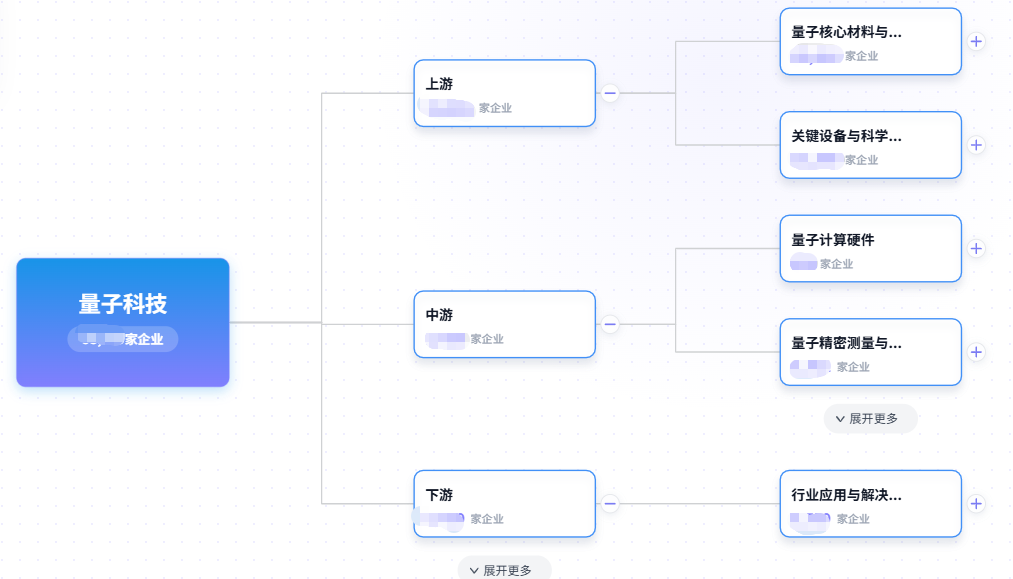 Figure: Quantum Technology Industrial Chain Map Source: Huoshi Xinglan Industrial Intelligence
The four primary segments are as follows: The upstream segment is divided into two major sectors: quantum core materials and components, and key equipment and scientific instruments. The midstream segment consists of three major sectors: quantum computing hardware, quantum precision measurement and sensing, and quantum optoelectronic devices and communication interfaces. The downstream segment focuses on industry applications and solutions, applied to specific scenarios such as finance, energy and power, resource exploration and geological surveys, transportation navigation and timekeeping, government and defense security communications, and metrology calibration and scientific research services. The support system includes nodes such as national strategic scientific and technological forces and research platforms, standard systems and measurement benchmarks, intellectual property Layout (layout) and operations, talent cultivation and discipline construction, capital supply and industrial organization, and industrial statistics and intelligence assessment.
02 Comparison of Industrial Strength
1. Policy: Hefei Excels in 'Early' and 'Comprehensive,' While Beijing, Shanghai, and Shenzhen Shine in 'Specifics'
Hefei is the first city in China to release a three-year action plan for quantum industry development, with advantages not in having the highest individual funding amounts but in being the earliest, having the most complete chain, and maintaining the strongest continuity. Beijing and Shanghai have higher single-point funding intensity—Shanghai Xuhui provides up to 100 million yuan in support for common technology platforms, while Beijing Economic and Technological Development Zone offers a 1:1 matching fund for major research projects, with a maximum of 30 million yuan. Shenzhen focuses on positioning rather than quantification: its '15th Five-Year Plan' proposal lists quantum technology as a new growth point, aiming to become 'a backbone of strategic emerging industries within 10 to 15 years'—a timeline indicating that its policies are still in the early cultivation stage.
Table: Key Policies of the Four Cities
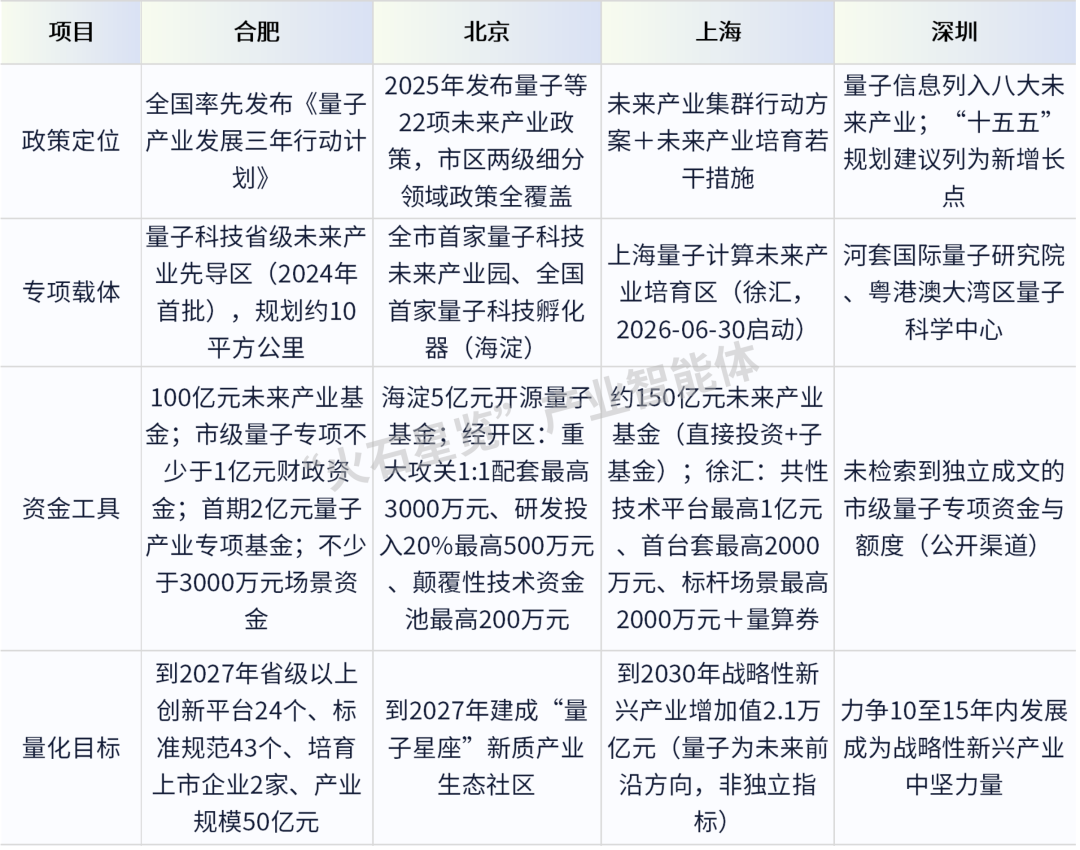
If cited, please indicate the source: Huoshi Create · Huoshi Xinglan Industrial Intelligence
2. Industrial Capacity: Hefei's 'Closed Loop' vs. Beijing's 'Comprehensive Roadmap'
Hefei is the only city in China to form a 'national laboratory—leading complete machine (complete machine)—two Sci-Tech innovation board (Science and Technology Innovation Board) listed companies—central enterprise headquarters' closed loop. The combined market capitalization of QuantumCTek and CIQTEK is approximately 68.8 billion yuan, with Origin Quantum nearing a 3 billion yuan Pre-IPO round, and China Telecom Quantum Group also registered in Hefei. All three companies rank among the top 20 quantum enterprises globally.
Beijing's strength lies in the depth of its research platforms and the diversity of its technological routes. The Beijing Academy of Quantum Information Sciences, founded in 2017 and led by Mayor Xue Qikun, has teams working on all six major routes: superconducting, ion trap, quantum dot, topological, semiconductor, and quantum direct communication. Beijing also holds the second-highest global ranking in the 2025 Future Industry Development Index.
Shanghai and Shenzhen have highly concentrated industrial capacities centered around single star enterprises: Shanghai's Turing Quantum has a valuation exceeding 7 billion yuan and is the first quantum direct investment project of the National Venture Capital Guidance Fund's Yangtze River Delta Fund. Shenzhen's SpinQ Technology completed a combined 1.6 billion yuan in Series C+ and D financing within six months, becoming Shenzhen's first quantum computing unicorn.
Table: Urban Industrial Capacity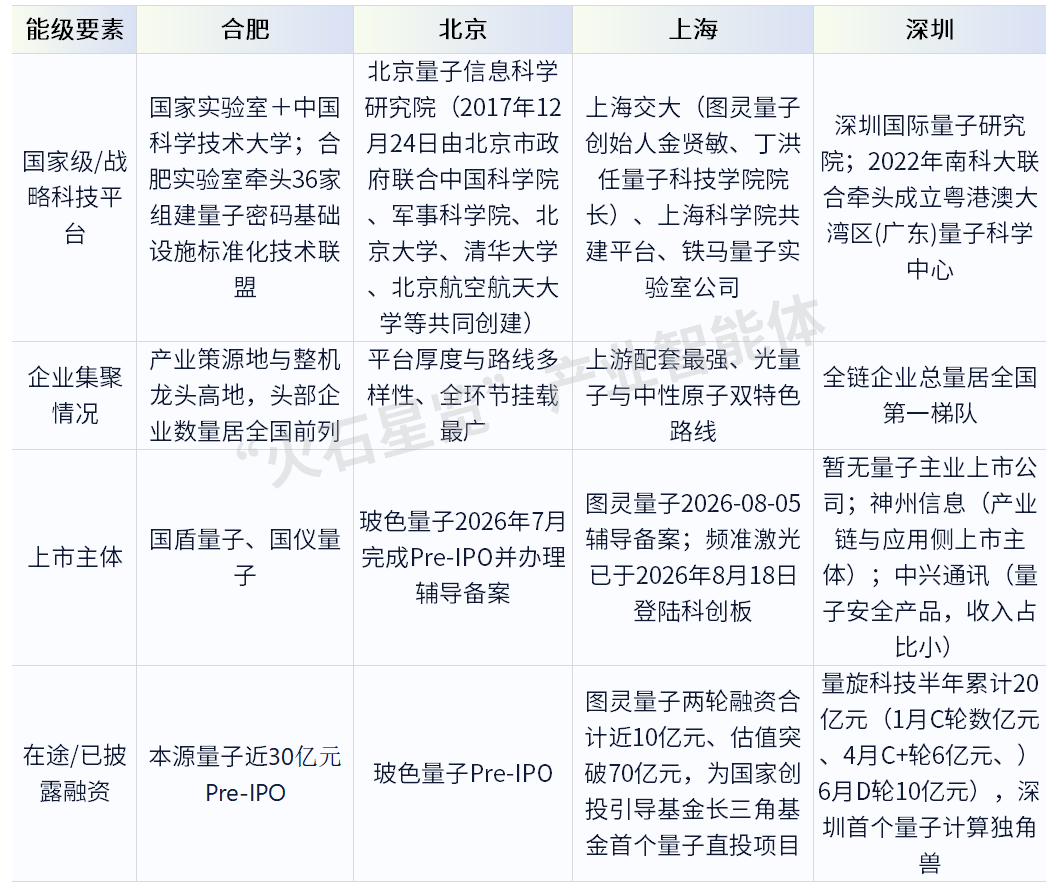 If cited, please indicate the source: Huoshi Create · Huoshi Xinglan Industrial Intelligence
3. Industrial Structure: Four Distinct Agglomeration Patterns
Based on enterprise data mapped to the industrial chain nodes, the four cities exhibit different agglomeration patterns:
Hefei: Few but Core. While the total number of enterprises across the entire chain is lower than in the other three cities, Hefei has a presence in the three most critical areas: superconducting complete machines, quantum measurement complete machines, and quantum communication complete machines with QKD networking. Its core enterprises rank among the top. Upstream, it has achieved international orders for dilution refrigerators and launched the nation's first quantum chip production line. This represents a vertically integrated agglomeration.
Beijing: Comprehensive and Balanced. It leads in multiple midstream segments, including measurement, optoelectronic devices, and computing hardware, which aligns with the multi-route layout of its research platforms.
Shanghai: Strong Upstream. It has the highest concentration of upstream enterprises among the four cities, with clear route differentiation—focusing on photonic quantum chips and neutral atom complete machines, and setting a world record for a 2024-atom defect-free array.
Shenzhen: Broad but Thin. It ranks among the top nationwide in the total number of enterprises across the entire chain, with relatively high concentration in quantum measurement and sensing links. However, it lacks sufficient quantum computing hardware and downstream applications, with its complete machine capabilities concentrated in SpinQ Technology alone, forming a broad peripheral support agglomeration.
4. Development Stage: Four Cities at Different Maturity Levels
Based on the Technology Readiness Level (TRL) coordinates (quantum communication TRL6-8 > superconducting computing hardware TRL6 > ion trap TRL5 > neutral atom and photonic quantum TRL4), the four cities are at different maturity levels:
Hefei is in the Large scale delivery (scaled delivery) + capitalization realization phase. By 2026, Hefei's quantum technology industry revenue has exceeded 6 billion yuan; it has built the nation's largest quantum metropolitan area network; and 'Origin Wukong' has served over 690,000 tasks across 163 countries and regions.
Beijing is in the incubation scaling + multi-route verification phase. The nation's first quantum technology incubator has incubation (incubated), introduced, and newly registered 15 enterprises within a year of its establishment; Weici Technology's liquid-helium-free brain magnetography and heart magnetography have been installed in over 20 hospitals nationwide, serving over 80,000 patients.
Shanghai is in the ecosystem construction phase. The Quantum Computing Future Industry Cultivation Zone was launched in Xuhui on June 30, 2026, with 26 initial enterprises.
Shenzhen is in the market verification + overseas delivery phase. SpinQ Technology delivered multiple 'Ursa Major' complete machines in 2025, serving over 200 universities in more than 40 countries; in October 2026, it co-established the Guangdong-Hong Kong-Macao Greater Bay Area Quantum-Supercomputing-AI Integrated Computing Center.
Hefei is the industrial origin and leading hub for complete machines, Beijing is the national strategic scientific and technological force and originator of all routes, Shanghai pursues a 'capital + differentiated routes' approach, and Shenzhen follows a 'marketization + overseas expansion' strategy. Overall, the relationship among the four cities is closer to a collaborative division of labor than a zero-sum competition.
Quantum technology as a whole is still in its cultivation phase. Quantum communication is ready for large-scale deployment, precision measurement is advancing point by point, but breakthroughs in large-scale general-purpose quantum computing will still take considerable time. The sector is not yet finalized, and the leading enterprise landscape is not locked in, presenting a window of opportunity for industrial recruitment. Using the industrial chain map with thousands of nodes as a base, the Huoshi Xinglan Industrial Intelligence Desktop Platform structures enterprises by segment, enabling search, viewing, and comparison. This allows recruitment departments to identify gaps and screen targets according to the map, transforming 'broad net casting' into 'precision fishing.'
-
BMW Faces Surge of 40,000 Employees Seeking Resignation: Maximum Compensation Hits €4.87 Million, Overloading Internal Systems
-
Anthropic Unveils New Governance Framework: Redefining Capital Rules for AI Companies
-
Flying Complaints and Instant Sellouts: Why the iPhone Continues to Fly Off the Shelves Despite Criticism
-
![]()
Comparison of Industrial Strength Among China's Top-Tier Quantum Technology Cities: Hefei, Beijing, Shanghai, and Shenzhen
-
![]()
In the Lead-up to an IPO, What Has XREAL Been Up To These Past Six Months?
-
Can DeepSeek's 100 Billion Funding and MiniMax's HK Stock Debut Flop Sustain Big Models Until Profitability?
-
Xiaomi and VIVO Witness Decline in Overseas Sales Share, OPPO Sees Notable Rise
-
![]()
The Moat of Palantir Lies in Two Decades of Architectural Evolution