The Moat of Palantir Lies in Two Decades of Architectural Evolution
 10/22 2026
 392
Abstract
Palantir's technological history can be reinterpreted as a continuously evolving dual-layer architecture: In its early phase (2003-2020), centered around Gotham and Foundry, it established a data fusion layer capable of accommodating incomplete, multi-source, and chaotic data through dynamic ontology and data cluster mechanisms. In its later phase (post-2023), marked by the AIP platform, it integrated large models into this system, supplementing the long-missing cognitive interaction layer.
The data fusion layer addresses how to ingest and organize real-world data, while the cognitive interaction layer enables more users to invoke, modify, and drive the system using natural language.
This article traces the intellectual origins of this architecture, analyzes the technical mechanisms of dynamic ontology and data cluster patents, explains how incomplete information is transformed into relationships, risk variables, and bases for action. Using AIP and operational data, it illustrates why large models amplify Palantir's existing capabilities and further argues that Palantir's competitiveness lies not in a specific algorithm or model but in the combination of dynamic ontology, data fusion, relational network deduction, fine-grained permissions, Action, Write-back, and FDE field calibration.
The core thesis of this article is that Palantir's growth in the era of large models stems not from suddenly acquiring new foundational capabilities after integrating large models but because large models complement the cognitive interaction layer of its existing data fusion system, enabling a complex system long operated by experts and FDEs to be used with lower barriers and higher frequency.
I. Introduction: A Misunderstood Company
Palantir has long been misread through two dominant narratives. One is the media narrative that labels it a 'mysterious big data company,' emphasizing counterterrorism, intelligence, and surveillance. The other is the Wall Street narrative of an 'expensive consulting firm' that deploys FDEs, uses project-based delivery, and lacks scalability.
Neither narrative hits the mark. Palantir's true story is architectural evolution: It spent over a decade building a data fusion layer (Data Fusion Layer) capable of accommodating the incomplete data of the real world. After the explosion of large models in 2023, it provided a cognitive interaction layer (Cognitive Interaction Layer) that can drive these foundational capabilities using natural language.
This article unfolds along the Main storyline (main thread) of 'early data fusion layer / later cognitive interaction layer': First, it traces the intellectual origins of this architecture's abandonment of 'perfect data.' It then analyzes how dynamic ontology (Dynamic Ontology) and data clusters (Data Clusters) accommodate, organize, and utilize chaotic signals. Next, it explains why early Palantir lacked a cognitive interaction layer and how AIP and large models filled this gap. Finally, it returns to business growth and competitive barriers, arguing that what is truly difficult to replicate is not a patented concept but the long-term integration of ontology, execution, security, organization, and FDEs.
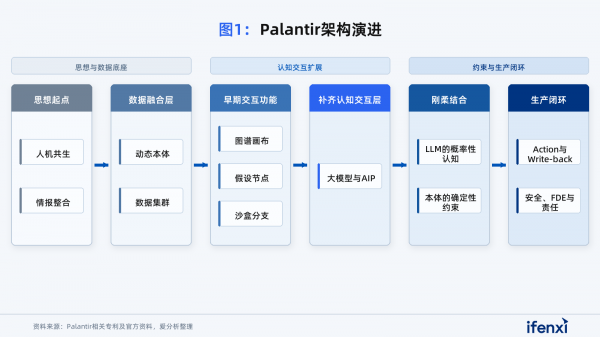
Figure 1: Palantir's Architectural Evolution
II. Intellectual Lineage: Where Does the Idea of Abandoning 'Perfect Data' Come From?
Palantir's early work in counterterrorism centered on abandoning traditional IT systems' demand for 'perfect data' and instead building a foundational architecture capable of processing incomplete, ambiguous, and highly chaotic information. This approach stemmed from the combined influence of three types of practices.
2.1 Human-Machine Symbiosis: Machines Handle Scale, Humans Handle Judgment
As co-founder and former CTO of PayPal, Max Levchin led the construction of PayPal's early anti-fraud technology. The team faced a dilemma: Pure algorithms were easily reverse-engineered and bypassed by attackers, while pure manual review could not handle massive data volumes. The solution was to let machines process large-scale, noisy data combinations while leaving final pattern recognition, boundary judgments, and decision-making to humans.
This human-machine symbiosis does not equate to 'machines handle low-level work, humans handle high-level work' but acknowledges their distinct advantages: Machines excel at continuous traversal and computation, while humans are better at judging anomalies, formulating hypotheses, and bearing consequences from incomplete information. Palantir inherited this philosophy and later amplified this division of labor in intelligence and enterprise scenarios.
2.2 From Anti-Fraud to Intelligence Integration
After 9/11, Peter Thiel and Palantir's early team brought PayPal's data integration experience in anti-fraud to national security: Intelligence leads did not lack existence but were scattered across different agencies, systems, and data sources, unable to be connected in time. Like tracking money laundering, linking scattered data points and mapping hidden relational networks became the vision of Palantir's early Gotham platform.
This vision implied a judgment entirely different from traditional enterprise software: Data value lies not just in accurate recording but in whether relationships between different objects, events, and behaviors can be discovered, validated, and translated into actions.
2.3 From Architectural Philosophy to Ontology Engineering
Thiel proposed the problem to solve, while engineers needed to address how to implement it. Early core members like Nathan Gettings and Stephen Cohen participated in building Gotham and related system architectures. Subsequently, the inventors of the dynamic ontology patent engineered it, translating core issues like accommodating incomplete data and maintaining business semantics amid change into objects, properties, parsers, and validators.
Thus, Palantir's early architecture did not simply centralize more data into a single database but redefined how data enters, is organized, and is used within the system: The real world can be incomplete, but the system must retain sufficiently stable business relationships and action constraints.
III. Data Fusion Layer I: How Dynamic Ontology Accommodates Chaotic Data
The first problem solved by the dynamic ontology patent (US7962495B2, filed in 2006, granted in 2011) is how the system can continue to ingest data amid continuously changing, non-unified, and largely missing real-world inputs without being constrained by fixed schemas (data structures).
To clarify, the following patents illustrate Palantir's early technological philosophy and mechanisms, including dynamic ontology and data clusters, but do not equate to the complete implementations of current Foundry, Gotham, or Ontology products.
3.1 The Problem of Fixed Schemas
Traditional relational databases typically fix schemas during system construction. Any structural changes may affect tables, fields, applications, and downstream processes, often requiring database administrator intervention. For businesses with clear rules like financial accounting or payroll, this rigidity helps ensure consistency. However, for intelligence analysis, complex investigations, and sudden operations, real-world objects and relationships often only gradually emerge after data entry.
If the system requires input data to be cleansed into a unified standard first, many marginal leads are discarded before entering the system. The issue lies not in insufficiently clean data but in the system mistaking the inherent uncertainty of reality for input errors.
3.2 Decoupling Business Logic from Physical Storage
The core design of dynamic ontology is to manage business semantics and underlying storage separately. Users can define and adjust objects and properties via Object Type and Property Type editors without reconstructing the underlying database each time.
Objects like people, vehicles, and events can have their own properties and relationships. When business questions change, analysts can add new object types, property types, or relational edges, incorporating new analytical frameworks into the existing data system. This transforms ontology from a one-time-designed database structure into a semantic layer that evolves continuously with actual investigations and business changes.
3.3 Parsers and Validators: Accept First, Then Verify
Dynamic ontology does not abandon structural constraints but allows messy inputs while retaining necessary rule checks before data enters the business system.
This design replaces the hard rule of 'data must be neat first' with a more flexible one: The system accepts data as much as possible first, then verifies it at semantic and business boundaries.
3.4 From Syntactic Decoupling to Analyst Modeling
The significance of dynamic ontology lies not just in accommodating more data formats but in transferring some modeling authority from database administrators and backend development teams to frontline analysts. Analysts can adjust ontologies, configure parsers, and observe how data reorganizes based on new objects and relationships emerging during investigations.
This means analysts no longer need to force reality into pre-designed tables but can directly participate in defining objects, properties, and relationships.
3.5 Example: How Incomplete Leads Form Relational Networks
Take counter-IED (Improvised Explosive Device) operations as an example. Inputs may include non-standard patrol logs, damaged receipts, blurry license plates, and verbal leads. Traditional systems might retain only standardizable fields, while dynamic ontology allows analysts to first define objects and relationships like makers, fund transfers, and suppliers, then attach leads to corresponding objects.
A single lead may not prove much, but when multiple sources point to the same location, person, account, or transactional relationship, the system can initiate investigations along the relational network. The key lies not in each data point being perfect but in the system's ability to retain incomplete information and provide more leads through subsequent correlations.
IV. Data Fusion Layer II: How Data Clusters Enable Automatic Relationship Growth
While dynamic ontology addresses how to ingest dirty data, the data cluster patent (US8788405B1, granted in 2014) further addresses how to make relationships automatically emerge.
4.1 From Initial Leads to Clusters
The data cluster mechanism typically begins with an initial lead (Seed), such as a suspicious account, phone number, or transaction record. Based on predefined clustering strategies and data-binding rules, the system retrieves objects related to the initial lead from different data sources.
Results from a previous search can become inputs for the next: An account points to its owner, the owner to a phone, the phone to call recipients, and the recipients to other accounts. Thus, clusters are not the result of a one-time query but relational networks that expand continuously along rules.
When two clusters share an entity or attribute, the Resolver (entity resolution and merging mechanism) can fuse them into a larger cluster. The Scoring Strategy then scores clusters based on aggregated features like account balances, transaction frequencies, and relationship counts, prioritizing the most noteworthy networks for analysts.
4.2 Solidifying Investigative Processes as System Mechanisms
The data cluster mechanism corresponds to several cognitive actions in human investigations:
This mechanism differs significantly from traditional databases: Databases excel at answering 'what is a field?' while data clusters attempt to answer deeper questions: What else is this object related to, and what do these relationships collectively imply?
V. Mechanism Integration: From Chaotic Signals to Business Variables
In reality, there are massive inputs from emails, logs, sensors, and manual records that are incomplete or non-uniform in format—collectively termed 'chaotic signals.' Dynamic ontology handles ingesting and mounting these inputs, while data clusters handle relational expansion. Combined, chaotic signals no longer just passively store but participate in subsequent searches, fusions, scorings, deductions, and actions.
5.1 Five Ways to Use Chaotic Signals
First, as search springboards. An incomplete phone number, vague location, or partial alias, once mounted on an object, can become inputs for the next global relational search, driving cluster growth.
Second, as media for entity fusion. Similar numbers, aliases, locations, or device features across data sources can serve as bases for Resolver to identify overlapping entities. Multiple weak signals mutually corroborating can sometimes be more valuable than a single high-confidence field.
Third, as aggregated features for risk assessment. The system does not require each signal to be absolutely reliable but reduces single-point noise impact through aggregation of multiple relationships and attributes, pushing more noteworthy clusters to analysts.
Fourth, as external events impacting business constraints. Unstructured information about port strikes, supplier delays, or equipment anomalies can be mounted on cargo ships, suppliers, or equipment objects and propagated along relational networks to observe impacts on safety stock, production throughput, or delivery commitments.
Fifth, as decision contexts for human-machine collaboration. Analysts not only view relationships and results but can also revisit raw evidence, retain hypotheses, compare branches, and trigger Actions subject to permission and rule checks when necessary.
We summarize this process as transforming 'noise' into 'variables': Chaotic signals can serve as search springboards, fusion triggers, scoring factors, deduction perturbations, or action decision contexts.
5.2 Complete Linkage Examples Across Three Scenarios
In counterterrorism intelligence, locations and numbers from non-standard text messages can be parsed and mounted on suspect objects, then used as initial leads to retrieve communication records and associated personnel. In financial anti-fraud, incomplete device features can collide with similar features in another investigation cluster, triggering cluster fusion and risk scoring. In supply chains, information about rainstorms or road closures in supplier emails can become risk events, propagating along relationships involving suppliers, components, production lines, and customer orders.
The common mechanism across these scenarios: Parsers handle ingesting incomplete inputs, graphs and business rules organize, filter, and constrain these inputs, and Actions translate analytical results into controllable actions.
5.3 How Noise Is Controlled
Accommodating chaotic data inevitably introduces noise risks. The system must avoid connecting all nodes via weak signals, causing the graph to lose decision-making value.
Early noise resistance mechanisms include three layers: Post-parsing validators intercept obvious errors; genuine signals mutually corroborate across multiple relationships, while isolated noise often fails to form large clusters; the Scoring Strategy deprioritizes clusters composed of single weak signals, avoiding expert attention overload.
After large model integration, contextual understanding further aids in identifying metaphors, irony, and semantic ambiguities, also suggesting severing nodes with excessive connections but lacking exclusive evidence. However, large models should not have unconditional authority to delete signals, especially concerning critical infrastructure, core accounts, or high-risk actions. Combinations of low confidence and high potential impact should trigger human arbitration, retaining shadow nodes, branch sandboxes, and complete audit trails.
VI. Application Landscape: Palantir Solves Gray Decision-Making Problems
This architecture initially served counterterrorism and intelligence before gradually extending to enterprise scenarios like supply chains, finance, and healthcare. However, the core problem remains unchanged: How to form judgments amid incomplete information and rigid business constraints, then translate those judgments into controlled actions.
Enterprise operations can be broadly categorized into two types of business scenarios.
One type consists of rigid processes such as financial compliance, standardized manufacturing, payroll, and attendance. Traditional enterprise systems like SAP and Oracle have established mature rules, fields, and approval processes in these areas. These systems require reality to conform to rules, with advantages including stability, auditability, and repeatability.
The other type includes scenarios such as supply chain disruptions, strategic resource scheduling, complex manufacturing anomalies, intelligence analysis, and cross-departmental operational decision-making. Their common characteristics are: information comes from multiple systems and organizations, inputs are often non-standard fields, impacts propagate along complex relationships, and ultimately, someone must decide whether to take action. We refer to these scenarios—where trade-offs must be made under incomplete information and humans decide whether to act—as 'gray decisions.'
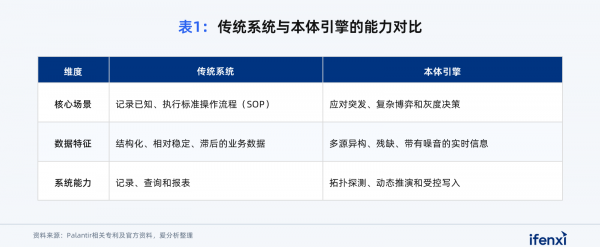
Table 1: Capability Comparison Between Traditional Systems and Ontology Engines
Palantir's value lies not in replacing all rigid systems but in mounting external changes onto a rigid business framework. This rigid business framework refers to constraints such as inventory, capacity, permissions, and processes that cannot be arbitrarily breached. Based on this, the system understands how an ambiguous external risk propagates along suppliers, materials, production lines, and customer orders, and proposes or executes responses within safety boundaries.
Thus, Palantir truly enters the most valuable and hardest-to-standardize part of enterprises: where uncertain information collides with deterministic constraints. Systems that handle only rigid processes excel at accounting and execution; systems capable of accommodating gray information, completing reasoning, and supporting actions begin to possess operational-level intelligence.
VII. Cognitive Interaction Layer: What Early Palantir Lacked
While dynamic ontology solved data and structural problems, it did not address how to interact. Early systems still relied on professionals configuring objects, attributes, and parsing logic through graphical user interfaces (GUIs), regular expressions, and code modules.
In reality, intelligence analysis and corporate decision-making are filled with assumptions, doubts, and intuition. Analysts might say, 'I suspect these two names are the same person,' or, 'Treat this one-way account as a new investigation target.' However, early systems could not directly understand such natural language expressions; users had to translate judgments into object definitions, query conditions, and graph operations.
Palantir once bridged this gap with graph canvases and workspaces:
Hypothetical nodes: Allow analysts to create virtual objects not yet in the database and associate real data with them;
Analysis state tracking: Save the process of analysts hiding, zooming, and arranging data, enabling shared and replayable reasoning;
Sandboxes and branches: Allow analysts to build hypotheses around weak leads and conduct reasoning without polluting master data.
These designs show that Palantir recognized early on that enterprise systems need not only record objective facts but also carry human reasoning states. However, before large models became widespread, users still needed to learn heavy graph and configuration tools, imposing high human requirements and creating a clear barrier in the cognitive interaction layer.
VIII. AIP and Large Models: Completing the Cognitive Interaction Layer
8.1 Large Models as More Universal Semantic Parsers
The emergence of large models eliminates the need for systems to rely on manually written rules to exhaustively enumerate information expression differences. Whether inputs come from handwritten notes, emails, patrol jargon, or business users' natural language, large models can first complete semantic understanding, then map results to objects, attributes, relationships, or query conditions in the target ontology.
This natural language interaction method allows users to directly describe business problems they wish to find, compare, or reason about, without first learning underlying configuration languages. Large models then translate intentions into structured operations executable by the system, greatly reducing human requirements and interaction costs.
8.2 Why Large Models Cannot Replace Ontology Engines
Large models lower interaction barriers but cannot replace ontologies, relationships, and execution systems for the following reasons:
Probability cannot replace certainty: Large models cannot judge whether a transaction truly occurred in an account based on linguistic probability; they must invoke underlying data binding and query capabilities.
Language understanding cannot replace business semantics: Models can understand word associations but do not inherently possess the real meanings of time, permissions, responsibilities, and physical constraints in corporate business.
Natural language cannot replace controlled writes: When models suggest switching suppliers, allocating materials, or changing production plans, ontologies, permissions, and approval mechanisms must determine whether corresponding Actions are allowed.
Generative capabilities cannot replace precise aggregation and entity resolution: Large-scale financial summation, relationship traversal, and entity disambiguation still require deterministic computation and Resolvers.
Thus, large models are better understood as flexible cognitive and interaction entry points rather than the ultimate foundation for enterprise operations.
8.3 How AIP Changes Palantir's Usage
Before AIP, Palantir's complex capabilities were primarily driven by professional users and FDEs. Natural language questions from frontline commanders or corporate executives needed translation into graph operations, query paths, and business rules, creating high usage barriers and long deployment cycles.
After AIP integrates large models with ontology and Action mechanisms, business users can directly ask questions like: If we cut ties with Supplier A, what's the delivery default risk in Europe next quarter? What are the alternatives? The system's key is not generating plausible-sounding answers but converting questions into traceable data queries, relationship reasoning, and controlled Action recommendations.
This explains Palantir's structural changes after 2023: rather than being replaced by large models, its underlying ontology and data fusion capabilities became even more critical. Capabilities previously precipitate ed in the platform and FDE experience began to be invoked by more users through natural interactions.
8.4 Business Performance: Commercial Manifestations of Architectural Completion
Palantir's financial data and operating metrics for three consecutive fiscal years starting in FY2023 provide operational context for observing product and interaction changes:
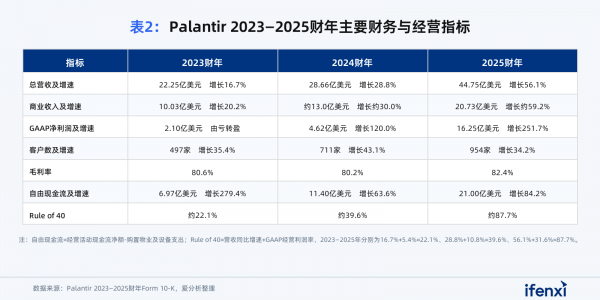
Table 2: Palantir's Key Financial and Operating Metrics for FY2023-2025
These data alone cannot prove that large models drove growth, but combined with product and interaction changes, they support a cautious but reasonable judgment: AIP lowered the usage barrier for complex platforms, enabling Palantir's existing ontology, data, and FDE capabilities to achieve stronger software leverage.
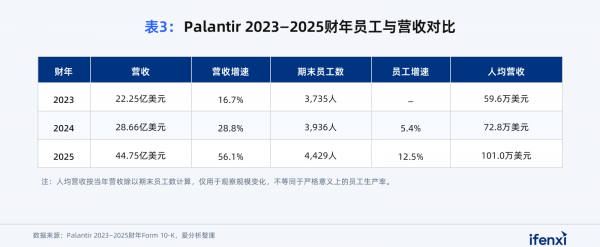
Table 3: Palantir's Employee Count vs. Revenue for FY2023-2025
From 2023–2025, Palantir's revenue and employee count both grew, but revenue growth outpaced employee growth, boosting revenue per employee. This supports judgments about platform reuse and enhanced software leverage, but employee and revenue data alone cannot prove that growth came entirely from AIP or large models.
IX. Replication Dilemma: Why Palantir Is Hard to Copy
The basic concepts of dynamic ontology and data clustering are not incomprehensible; what's truly hard to replicate is how this technology embeds in complex businesses over the long term and assumes responsibility from data to action.
9.1 Architectural Barriers: From Recording Systems to Business Relationship Networks
Traditional ERPs, CRMs, and data lakes typically record materials, customers, transactions, and logs separately. Palantir attempts to incorporate people, machines, organizations, events, and external disturbances into a single object network with attributes and relationships.
It does not require all inputs to be cleansed into perfect data but separates the parsing layer from rigid business frameworks: supplier emails, equipment anomalies, and weather warnings can serve as dynamic signals mounted on corresponding objects; production line throughput, safety stock, and approval permissions constitute rigid constraints that cannot be arbitrarily breached.
The core change is not just replacing data lakes with graph databases but altering the system's fundamental understanding of business objects, relationships, and actions. For companies that have built product systems and engineering cultures around 'cleanse data before ingestion,' this shift represents not just adding a module but an architectural change.
9.2 Write-Back Barriers: From Read-Only Analysis to Controlled Execution of Actions
Connecting incomplete data into graphs and creating visual dashboards is relatively easy; the real challenge is whether the system can generate an Action at the ontology layer and safely write it back to ERPs or other business systems after permission, rule, approval, and impact analysis.
For example, when the system identifies that supplier delays may halt production lines, it cannot just display risks but must compare impacts of Actions like reallocating materials, switching suppliers, or reducing line speed, especially on other orders, inventory, and financial constraints. After Action execution, it must record: who proposed it, who approved it, based on what evidence, and with what results.
Between read-only graphs and writable ontologies lie fine-grained permissions, entity provenance, business rules, and responsibility auditing. Without this closed loop, the platform remains an analysis tool rather than an operational business system.
9.3 Security and Responsibility Barriers
When AI generates only a report, errors may manifest as cognitive misdirection with limited negative impact; when AI writes a production instruction, allocation order, or account operation through systems, errors become real business or financial consequences.
Thus, enterprise AI must address not just model accuracy but also: who can see what, who can execute what, which actions require approval, how to review evidence, how to revoke or compensate, and who bears responsibility for losses. Palantir's ontology, permission, and Action frameworks matter precisely because they translate business responsibilities into objects, rules, and audit records in the system.
9.4 FDE Barriers: From Translating Needs to Calibrating Ontologies
FDEs are not traditional software configuration and implementation consultants but individuals who enter customers' real business environments, using code, business judgment, and product capabilities to jointly adjust ontologies. FDEs must understand customers' objects, relationships, permissions, exceptions, and organizational constraints, then feed this experience back into products and platforms.
This model has long been costly and contradicts the low-marginal-cost commercial logic of standardized SaaS, but precisely this process of continuously engaging with real business friction has given Palantir modeling experience and capabilities for complex scenarios.
Large models will reduce some FDE translation work but will not automatically eliminate business calibration and responsibility judgments. As Agents can generate more configurations, FDEs will likely shift from translating customer problems into graph operations to higher-order 'auditing and adjudicating Agent modifications to ontologies.' We call this role 'ontology calibrators,' referring to those responsible for checking whether ontology modifications comply with customers' business, permission, and responsibility boundaries.
9.5 Barriers Arise from Combinations, Not Single Technologies
What's truly hard to replicate is not a single technology but the combination of dynamic ontology, multi-source data fusion, topological reasoning, fine-grained permissions, Action and Write-Back, FDE on-site calibration, and organizational responsibility with business processes.
Alone, any single component in this combination is insufficient to form a Palantir-style enterprise AI closed loop (closed loop).
X. Concluding Discussion: Three Questions Left by the Dual-Layer Architecture
10.1 Will Large Models Replace Ontologies?
Their divisions of labor differ. Large models understand natural language, generate structures, and propose candidate paths; ontologies define business objects, relationships, and constraints; underlying data systems handle deterministic queries; permissions and Actions restrict recommendations to executable scopes. The division between ontologies and large models illustrates that flexible cognition must build on rigid business structures.
10.2 Will FDEs Be Replaced by Agents?
FDEs' translation functions will be partially automated: large models can generate parsing rules, query paths, and preliminary ontology configurations from samples. However, implicit constraints, organizational politics, responsibility boundaries, and exception handling in customer businesses still require human judgment. FDEs' focus will shift from operational configuration to ontology calibration, anomaly judgment, and business implementation.
10.3 Who Bears Responsibility for Actions After Write-Back?
The ultimate challenge for enterprise AI is whether recommendations can become controllable, auditable, and accountable actions. Machines can handle scale, traverse relationships, and propose solutions, but humans must still authorize high-risk Actions and bear decision consequences. The deeper automation goes, the more systems must explicitly retain human adjudication, branch reasoning, and responsibility tracing.
XI. Conclusion: From Data Fusion to Cognitive Interaction
11.1 Palantir's Three-Layer Core Capabilities
Palantir's capabilities can be understood at three levels.
First, cognitive philosophy: Accept reality's chaos and incompleteness. Palantir does not require all information to be cleansed into structured tables but uses dynamic ontology, parsers, and validators to let real-world fragments enter a still-controllable business structure.
Second, computational architecture: From isolated reports to topological reasoning. Starting with initial clues, it automatically grows associated clusters, forms context through entity fusion and Scoring Strategy, then lets external flexible signals collide with internal rigid business constraints.
Third, system positioning: Human-machine symbiosis and bidirectional writing. Machines handle large-scale traversal, computation, and semantic parsing; humans provide hypotheses, common sense, boundary judgments, and final authorization. The system does not just display results but also writes approved Actions back to real business systems after safety verification.
11.2 A Clear Evolutionary Path
Palantir's two decades can be summarized as an architectural arc:
Thus, Palantir's moat has never been a single algorithm or product component but an architectural philosophy: acknowledging that the world is fundamentally chaotic and incomplete, not forcing reality to conform to tables, but building a sufficiently flexible yet sufficiently resilient business network to catch real-world fragments, then letting intelligence form judgments and act constrainedly within the network.
11.3 Bidirectional Implications for Enterprise AI
Enterprise AI cannot stably enter real businesses with large models alone—it lacks certainty, permissions, and responsibility. With only ontologies but no cognitive interaction layer, systems can serve only a few experts—they lack natural interaction and scalable usage methods. The former lacks determinism, permissions, and responsibility; the latter lacks natural interaction and scalable usage.
Palantir's case shows that what enterprise AI truly needs is not simply smarter models plus bigger data but Flexible cognition (flexible cognition) built on Rigid business structure (rigid business structures), with final actions incorporated into permission, audit, and responsibility systems.
Writing Notes: This article was organized, refined, and reconstructed from a long conversation about Palantir's technological philosophy led by Thundersoft Chief Scientist Zou Pengcheng. Question-and-answer threads from the conversation were preserved as argumentative skeletons, then academically rewritten, structurally rearranged, and strengthened with public data verification. Due to space constraints, Chapter 10 'Flanking and Disruptors: Who Can Approach Palantir' and simplified Chapter 11 'Discussion: Twelve Open Questions' from the original conversation were omitted. Public data in the text is current as of September 2026; financial table data is current as of FY2025.
-
![]()
In the Lead-up to an IPO, What Has XREAL Been Up To These Past Six Months?
-
Xiaomi and VIVO Witness Decline in Overseas Sales Share, OPPO Sees Notable Rise
-
![]()
The Moat of Palantir Lies in Two Decades of Architectural Evolution
-
![]()
Tesla: Over-promising on 'Futuristic' Plans, Delayed Execution - Can the Auto Business Hold the Fort?
-
![]()
Has the Overall Landscape of Battery Swapping Evolved? NIO Took Eight Years to 'Flourish', While CATL Achieved 'Success' in Just Two
-
![]()
From Technical Chery to AI Chery, Yaoguang 2035 Provides the Answer
-
The Year 2026 Taken Over by AI: More Tools, More Confusion
-
![]()
From 'Africa's Top Player' to Just Another Contender in Africa