Lei Jun, Despite Wealth Halving, Provides Houses for Xiaomi Staff
 10/29 2026
 421

Produced by Leida Finance | Text by Zhou Hui | Edited by Meng Shuai
According to the newly released <2026 Hurun China Rich List>, Xiaomi founder Lei Jun ranks 17th. Despite his wealth shrinking by 48% from last year, his net worth still stands at an impressive 169 billion yuan.
Today, this billionaire is creating a true-to-life "Mi Home" for his employees. On October 24, Chen Bo, General Manager of Xiaomi's Ecosystem Chain, announced in a Weibo video that the Xiaomi Wuhan Optics Valley Mengxiangjia project would commence sales the following day.
As Xiaomi Group's inaugural residential community for employee purchase, the Optics Valley Mengxiangjia project comprises three 18-story low-rise buildings and one 33-story high-rise, offering a variety of unit sizes from 110 to 143 square meters.
Filing information indicates that the project's average price is approximately 13,885 yuan per square meter, about 1,200 to 2,400 yuan less than surrounding new properties and several thousand yuan lower than some secondary market properties.
Notably, this isn't Xiaomi's first venture into providing housing benefits to employees. Previously, Xiaomi has completed 12 employee apartment buildings in Beijing, Nanjing, and Wuhan, offering over 4,200 units.
From apartments renting for a thousand yuan to residences costing millions, Xiaomi's expanding employee housing benefits may reflect the intensifying competition for talent, with tech giants now competing in the housing sector.
However, Xiaomi is currently facing performance pressures. According to its latest financial report, the company achieved revenue of 208.063 billion yuan in the first half of this year, an 8.44% decrease year-on-year, and recorded a net profit attributable to shareholders of 14.186 billion yuan, a 37.86% drop from the same period last year.
In the second quarter, Xiaomi's two major business segments—smartphones, smart electric vehicles, and AI innovation—faced challenges, with declining shipments and widening operating losses.
Xiaomi Offers Houses to Employees, Genuine "Mi Home" Arrives in Wuhan Optics Valley
On October 24, Chen Bo, General Manager of Xiaomi's Ecosystem Chain, announced in a Weibo video that the Xiaomi Wuhan Optics Valley Mengxiangjia project would start sales the next day.
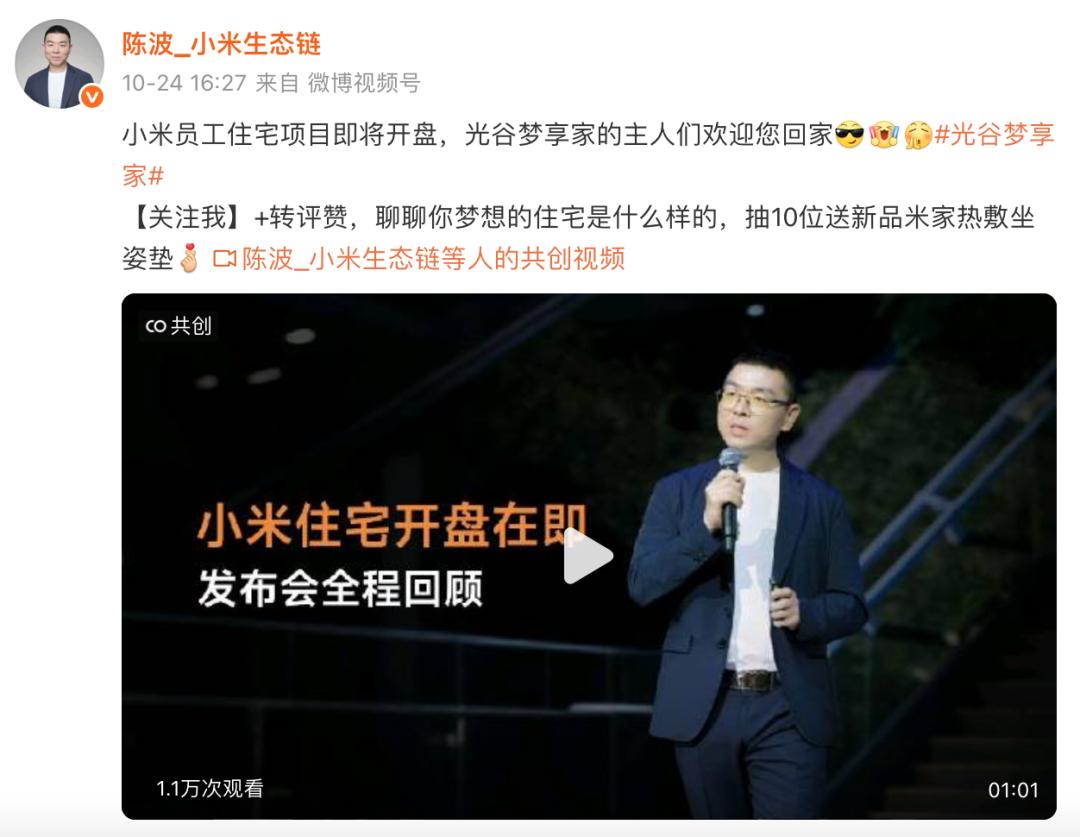
Leida Finance notes that this marks Xiaomi's first employee residential project in Wuhan and the first residential community for employee sales within Xiaomi Group.
In the video, Chen Bo introduced that the Optics Valley Mengxiangjia project consists of three 18-story low-rise buildings and one 33-story high-rise, totaling 297 units. It offers a variety of unit sizes, including 110-square-meter three-bedroom, two-bathroom compact units, 122 to 125-square-meter medium units, and 143-square-meter large units with 16-square-meter hanging gardens.
The entire project adheres to fourth-generation residential standards, with a plot ratio of 2.0, featuring hanging gardens and weather-protected corridors. The community includes recreational facilities such as a gym, yoga studio, healing space, billiard room, and reception hall.
Geographically, the project is near Xiaomi's Wuhan Tech Park, close to amenities like the Optics Valley Central Ecological Corridor Baozixi Park and Wuhan Children's Hospital Optics Valley Branch. Additionally, the project will include community commerce tailored to Xiaomi employees' needs, with centralized recruitment and operation.
Filing information from Wufangtong and Beike Zhaofang indicates that the project's average price is 13,885 yuan per square meter, about 1,200 to 2,400 yuan per square meter lower than surrounding new properties and several thousand yuan less than some secondary market properties.
Building 1, a 33-story main three-bedroom building, has an average price of approximately 13,609 yuan per square meter, with total prices ranging from about 1.388 million to 1.8 million yuan.
Buildings 2, 3, and 4, which are low-rise products, have average prices ranging from 13,884 yuan per square meter to 13,892 yuan per square meter, with total prices ranging from about 1.83 million to 2.13 million yuan.
According to National Business Daily, the Wuhan Optics Valley Mengxiangjia project was acquired by Xiaomi Group's affiliated company, Mikongjian Wuhan Information Technology Co., Ltd., in June 2021 for a base price of 303 million yuan, securing the Wuhan P (2021) 073 plot. At that time, the transaction floor price was 8,326.92 yuan per square meter.
The transfer documents stipulated that the bidder must commit to introducing an internet headquarters or regional headquarters focused on smartphones, smart hardware, and IoT platforms if they win the plot, with a total project investment of no less than 8 billion yuan.
Additionally, the homes sold must be to formal employees affiliated with Xiaomi Group (employees with labor contracts with Xiaomi Group's subsidiaries and social security contributions paid by these companies), with oversight implemented by the Wuhan Optics Valley Central City Construction Service Center designated by the East Lake High-Tech Development Zone Management Committee.
Therefore, the Wuhan Optics Valley Mengxiangjia project is exclusively available for purchase by Xiaomi employees. Market sources suggest that the internal price for Xiaomi employees for this project is expected to be around 12,000 yuan per square meter.
From Thousand-Yuan Apartments to Million-Yuan Residences, Lei Jun Builds a Talent Competition "Affordable Housing Network"
Beyond the Optics Valley Mengxiangjia project, Xiaomi has also developed youth apartments in multiple locations as part of its employee housing benefits.
In July of this year, the Xiaomi Wuhan Tech Park Youth Apartments officially opened for occupancy. Operated by Vanke's long-term rental apartment brand, Boyu, the apartments consist of three buildings with a total construction area of 50,000 square meters, covering 960 main units of 26-square-meter studios and 30 units of 30-square-meter studios.
All rooms can accommodate up to two people and are equipped with independent bathrooms. The apartments feature Xiaomi and ecosystem chain products such as air conditioners, washing machines, refrigerators, water heaters, and smart door locks.
On the first floor of the apartments, Xiaomi has planned 24-hour convenience stores, barber shops, SF Express stations, and other convenient commercial facilities. The public areas include shared kitchens, billiard rooms, small gyms, reading areas, board game areas, and audio-visual rooms, all open to residents free of charge.
In terms of pricing, according to Hubei Daily, the average monthly rent for the Wuhan Xiaomi Youth Apartments is about 1,099 yuan, with a minimum of 949 yuan, including centralized heating and internet. In the same area, a one-bedroom apartment typically rents for around 1,600 yuan per month.
According to public information, Xiaomi's layout of youth apartments dates back to 2021. In August of that year, Xiaomi officially established Mi Apartment (Beijing) Commercial Operation Management Co., Ltd.
At the time, Wang Hua, then General Manager of Xiaomi Group's Public Relations Department, stated that Xiaomi's employee apartments were primarily intended to alleviate the pressure of difficult, distant, and expensive rentals for employees, especially fresh graduates, as a measure to enhance employee happiness.
Tianyancha information shows that the company is wholly owned by Xiaomi Communication Technology Co., Ltd. and has since been renamed Mixingchen (Beijing) Housing Rental Co., Ltd.
In July of last year, Xiaomi took the lead in simultaneously launching youth apartments in Beijing and Nanjing, with a rental standard of 1,999 yuan per month. The recently opened Wuhan Youth Apartments mark the third youth apartment project launched nationwide by Xiaomi and its largest to date.
According to Xiaomi founder, Chairman, and CEO Lei Jun, Xiaomi has completed a total of 12 employee apartment buildings, offering over 4,200 units.
Some believe that from providing youth apartments with monthly rents of a thousand yuan to constructing million-yuan residential communities for employees, Xiaomi's series of housing benefits essentially represent a competitive strategy aimed at attracting core talent.
Xiaomi's interim report shows that as of June 30 this year, Xiaomi had approximately 52,900 full-time employees, an increase of 3,855 from the same period last year. Among them, the number of R&D personnel grew by 10.25% year-on-year to about 25,000.
As Xiaomi's "second headquarters," Wuhan Optics Valley has seen a continuous rise in the number of Xiaomi employees since the company's establishment there in 2017.
According to the official WeChat account "China Optics Valley," Xiaomi currently employs about 8,000 people in Wuhan, with R&D personnel accounting for over 60%, aiming to build a 10,000-person R&D center.
Currently, Wuhan has become Xiaomi's largest R&D and smart manufacturing base outside its Beijing headquarters, as well as an important hub for implementing its "Smart Living for People, Vehicles, and Homes" strategy.
China Urban News points out that tech giants' "talent competition" has now extended into the housing sector. Among them, JD.com has made early and significant investments in employee housing, spending 7 billion yuan in Beijing alone to create nearly 5,000 comfortable, fully-equipped apartments for young talent that are ready for occupancy.
Another internet giant, Tencent, has also planned over 4,000 fully-furnished talent apartments within its "Penguin Island," featuring "small but exquisite" units ranging from 20 to 35 square meters, with rents just 60% of those for similar apartments in the surrounding area.
Revenue and Net Profit Decline in the First Half, Two Major Pillars Face Challenges
Amid continuous expansion of employee housing benefits, Xiaomi is facing certain performance pressures.
In August of this year, Xiaomi released its interim results, showing a "decline in both revenue and profit": During the reporting period, the company achieved revenue of 208.063 billion yuan, an 8.44% decrease year-on-year, and recorded a net profit attributable to shareholders of 14.186 billion yuan, a 37.86% drop from the same period last year.
According to Xiaomi's financial report, its revenue primarily consists of smartphone×AIoT, smart electric vehicles, and AI innovation businesses. However, both of these performance "drivers" are now facing significant challenges.
In the second quarter of this year, Xiaomi's smartphone×AIoT segment achieved revenue of 84 billion yuan, an 11.3% decrease year-on-year. Among them, the smartphone business contributed 42.1 billion yuan in revenue, a 7.5% decrease from 45.5 billion yuan in the same period last year.
Xiaomi stated that the revenue decline was mainly due to a drop in smartphone shipments, partially offset by an increase in the average selling price (ASP) of smartphones.
According to Omdia data, despite Xiaomi's smartphone shipments ranking among the top three globally for 24 consecutive quarters, the decline is evident.
In the second quarter of 2026, Xiaomi's smartphone shipments fell 26.5% year-on-year to 31.2 million units, primarily due to product matrix optimization, reduced shipments of mid-to-low-end smartphones, and weak global demand caused by continued increases in core component prices.
Additionally, affected by factors such as rising core component prices, the gross profit margin of Xiaomi's smartphone business declined from 11.5% in the second quarter of 2025 to 8.5% in the second quarter of 2026.
During the same period, revenue from IoT and consumer lifestyle products under Xiaomi's smartphone×AIoT segment was approximately 31.3 billion yuan, a 19.2% decrease year-on-year. Internet service revenue was 9 billion yuan, a 0.6% decrease year-on-year, while revenue from other related businesses increased by 16.3% year-on-year to 1.6 billion yuan.
In terms of automotive business, in the second quarter of this year, Xiaomi delivered a total of 104,200 new vehicles, a 28.2% increase year-on-year, primarily due to increased deliveries of the Xiaomi YU7 series, partially offset by decreased deliveries of the Xiaomi SU7 Ultra.
On September 7, Lei Jun revealed that Xiaomi's cumulative vehicle deliveries had exceeded 800,000 units. That same month, Xiaomi held its autumn flagship product launch event, officially introducing four range-extended SUV models under the Pengcheng series, with over 10,000 units delivered in the first month.
Driven by sales growth, Xiaomi's smart electric vehicle revenue in the second quarter increased from 20.6 billion yuan in the second quarter of 2025 to 23.9 billion yuan, an approximately 15.9% increase year-on-year.
However, profitability remains unfavorable. In the second quarter of this year, the gross profit margin of Xiaomi's smart electric vehicle and AI innovation business segment was 19.2%, a 7.2 percentage point decrease year-on-year, primarily due to a decreased proportion of Xiaomi SU7 Ultra deliveries, rising core component prices, and increased costs related to AI businesses.
Additionally, Xiaomi disclosed that in the second quarter of this year, its smart electric vehicle and AI innovation business segment recorded an operating loss of 2.6 billion yuan, compared to an operating loss of 300 million yuan in the same period last year, with the loss expanding more than sevenfold year-on-year.
With both the smartphone, smart electric vehicle, and AI innovation business segments under pressure, Xiaomi has chosen to continue increasing its investment in AI.
In March of this year, Lei Jun stated at the China Development Forum that Xiaomi's cumulative R&D investment over the past five years has exceeded 100 billion yuan, with plans to exceed 200 billion yuan in the next five years.
According to the plan, Xiaomi intends to invest over 60 billion yuan in AI over the next three years, with R&D and capital investments in AI exceeding 16 billion yuan this year.
In the final analysis, the competition in the realm of AI will essentially hinge on the contest for talent. Luo Fuli, who is currently in charge of Xiaomi's MiMo large - scale model, is a technical specialist who was "headhunted" by Lei Jun with considerable resources.
Publicly available information reveals that Luo Fuli has previously held positions at Alibaba's DAMO Academy and DeepSeek, which has earned her the moniker of "AI Talent."
According to LatePost, on September 22, Luo Fuli was promoted to the top - tier level—Level 22—within Xiaomi's job - level framework.
As the employee housing benefits continue to expand, will Lei Jun be able to retain and draw in more talent to assist the company in achieving further breakthroughs? Leida Finance will keep a close watch on the developments.
-
MG: Divergent Fates in Domestic and Overseas Markets—MG4 Fuels 70% of China Sales, While Leading European Market as China’s Top Exporter
-
![]()
Over 400 Jobs Slashed! Apple Trims Down Traditional Operations as New CEO Sets Sights on AI
-
![]()
Starting from 3149 Yuan! iQOO Neo12 Review: Is Active Cooling a Game-Changer for Gamers?
-
![]()
Is There a New Breakthrough in Robot Training? Google’s Genie 4 Unveiled, Ushering in Real-Time Interaction for World Models
-
![]()
Lei Jun, Despite Wealth Halving, Provides Houses for Xiaomi Staff
-
![]()
This AI Is Learning to Emulate Human Work Patterns: A Real-World Test of Doubao’s Enhanced Work Capabilities
-
Technology-Centric Kimi Encounters Hurdles in Global Expansion
-
Could the Three-Row, All-Electric Flagship SUV BMW iX7, Equipped with an 8K Giant Screen and Produced in North America, Become a Bestseller?