Is ChatGPT Destined to Follow in the Footsteps of 'Ant Afu'?
 01/09 2026
 548
548

Article by She Zongming
Just as benchmarking is a tacit homage to the benchmarked entity, following suit implicitly acknowledges the pioneer's strengths.
Only pioneers can pave the way for subsequent entrants to "cross the river by feeling the stones," using them as stepping stones.
Ant Afu, a recent sensation in AI-driven health applications, has become a frequently utilized "stone" in this context.
On January 8th, numerous media outlets reported that the new iteration of Ant Afu had amassed over 30 million monthly active users within just a month of its launch, with daily medical consultations surpassing 10 million.
On the same day, OpenAI made a significant announcement—the official rollout of the ChatGPT Health feature.
Both are ventures in the AI + healthcare sector, and their coincidental "collision" on the same day naturally led to a side-by-side comparison. Subsequently, many netizens, both domestically and internationally, humorously dubbed ChatGPT as the American counterpart of "Ant Afu."
Interestingly, just last month, Meta was exposed to covertly "distilling" knowledge from Alibaba's Tongyi Qianwen large model, prompting many to jest that "American AI is taking cues from Chinese AI." Now, with OpenAI introducing ChatGPT Health, the jests have resurfaced, with many mocking that "American AI is once again paying homage to Chinese AI."
While these jests provide amusement, the facts speak volumes: when Silicon Valley giants, at the forefront of the technological wave, begin to emulate Chinese companies' innovations at the application level, the competitive landscape is undoubtedly shifting. As the focus of the Sino-US AI competition transitions from technological R&D to industrial implementation, China's AI industry's multiple advantages, accumulated in the application realm, are being validated through this "transoceanic tribute."
01
In terms of AI business strategy, tech companies with keen market insights often converge at the pain points of the general public.
In recent years, numerous tech companies have been actively venturing into the "AI + healthcare" arena. Baidu's upgrade of its Baidu Health AI Assistant to the Wenxin Health Assistant and JD Health's continuous enhancement of "AI Jingyi's" evidence-based capabilities serve as prime examples.
Various indicators suggest that, driven by the rigid demand stemming from the mismatch between the supply and demand of high-quality medical resources, the healthcare sector has emerged as a hotbed for AI application competition.
OpenAI revealed in a report that over 230 million people worldwide seek health and fitness advice from ChatGPT each week, with approximately 40 million Americans relying on it as their daily "personal doctor." Medical consultations constitute over 5% of ChatGPT's total global message volume.
Against this backdrop, OpenAI's foray into the AI + healthcare sector is hardly surprising.
However, AI health applications exhibit significant variations. On the surface, both ChatGPT Health and Ant Afu position themselves as "AI health assistants," capable of answering health inquiries, connecting to smart devices, and generating diet and exercise plans. Yet, a closer examination reveals substantial differences in their core competencies and ecological niches.
ChatGPT Health is positioned as an AI-powered "personal health advisor," whereas Ant Afu offers a more comprehensive suite of functionalities to its users.
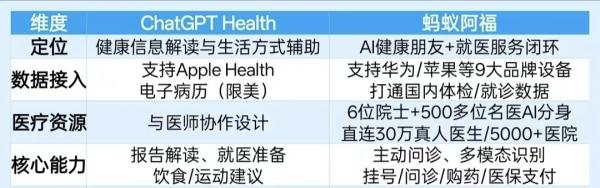
▲There are notable disparities in the core capabilities and product positioning between ChatGPT Health and Ant Afu.
Does that sound a bit abstract? Fear not; let's clarify with an example.
If you inquire of ChatGPT Health, "What should I do if my child has a fever?" it might provide pediatric consultation recommendations and a list of nearby hospitals.
Conversely, if you pose the same question to Ant Afu, in addition to offering recommendations, it can directly connect you with online pediatricians, facilitate appointment bookings, arrange for medication delivery to your doorstep, and even process medical insurance payments through Alipay.
The former focuses on integrating user vital sign data and providing ongoing advice to address long-tail needs such as "how to prevent illness" and "how to lead a healthier life," while the latter excels at solving full-chain problems and catering to rigid needs like "what to do when sick."
These differences stem from the distinct internet healthcare ecosystems in China and the United States, as well as the varying technological focuses of companies in both nations.
02
Fidji Simo, CEO of OpenAI's Application Business, recounted how, while hospitalized for kidney stones, ChatGPT alerted her that the standard antibiotics prescribed by her doctor might trigger a recurrence of her previous severe infection.
This incident underscores the core value of ChatGPT Health: leveraging data integration to uncover hidden risks that human doctors might overlook.
High data standardization and a mature SaaS ecosystem are hallmarks of the healthcare system in Western countries. In the United States, patient medical data is typically stored in electronic medical record systems like Epic and Cerner, fitness data is managed by Apple and Fitbit, and nutrition data is handled by MyFitnessPal.
After gaining access to b.well, the largest medical data platform in the United States, ChatGPT Health can integrate data scattered across these SaaS tools, harness AI capabilities to mine the interconnected value of the data, and provide services such as answering health questions and interpreting medical reports.
However, constrained by the high costs and fragmented nature of the U.S. healthcare system, it cannot establish direct connections with offline hospitals and diagnostic institutions. When users require in-depth medical services, ChatGPT Health is limited to providing "recommendations" and cannot facilitate online appointment bookings, virtual consultations, or medication deliveries.
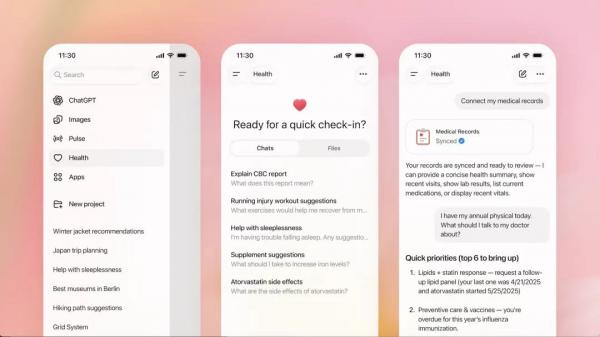
▲The services currently offered by ChatGPT Health primarily encompass answering health questions and interpreting medical reports.
In contrast, Ant Afu's functionalities extend beyond consultations. Its core architecture is built on three functional modules: health Q&A, health companionship, and health services. The seamless, full-link service experience, from consultation to diagnosis and treatment to fulfillment, caters to users' preference for "one-stop solutions." This has partially contributed to the exponential growth in Ant Afu's monthly active users.
This is closely tied to the foundation of the healthcare ecosystem. Unlike the fragmented healthcare system in the United States, China's internet healthcare sector has developed a deep integration of "online + offline" systems over the years. This enables Chinese AI health applications to seamlessly integrate AI capabilities with a vast network of offline medical resources, establishing a complete process from consultation, triage, and prescription transfer to medication delivery. AI can thus evolve from an auxiliary tool into a service connection hub.
This is also directly related to the technological focus of companies. Silicon Valley companies tend to prioritize technological capabilities and then seek application scenarios. OpenAI's recent move is a "vertical transformation" driven by user demand. Chinese companies, on the other hand, target pain points in people's livelihoods and explore solutions. AI applications like Ant Afu are not derivative functions of general-purpose models but are designed from the outset to meet user needs and provide comprehensive solutions.
03
Rather than viewing the sequential positions of ChatGPT Health and Ant Afu as mere "individual performances" of two AI applications, it is more insightful to examine them within the broader context of AI industry applications. They actually serve as footnotes to China's AI industry taking the lead in applications.
China's leadership in application innovation largely stems from its keen ability to capture and swiftly respond to scenario-based demands.
From an industrial development perspective, many Chinese AI companies demonstrate strategic foresight by accurately grasping the "value of technological implementation." While Silicon Valley giants continue to pursue ever-larger model parameters, many Chinese companies emphasize solving practical problems and have early on embedded AI technologies into industrial scenarios, grounding them in reality.
It is reported that ChatGPT Health took nearly two years to launch due to the need to transform its general architecture, establish medical data isolation mechanisms, and coordinate global doctor resources.
In contrast, Ant Afu focused on local scenarios and promptly anchored its AI application in the medical field.
In China, the development of "AI + healthcare" is supported by a solid foundation and momentum. Firstly, China's accelerating aging population and surge in chronic diseases have increased healthcare demands. Secondly, structural pain points such as unclear hierarchical diagnosis and treatment systems, scarce and uneven distribution of high-quality medical resources, and complex patient care pathways persist. Additionally, mobile payments and internet healthcare have cultivated mature user habits.
Perhaps recognizing these factors, Ant Afu's predecessor, AQ, was positioned from its inception as a vertical application tailored for health scenarios.
Such insights, combined with China's advantages in AI application innovation, can generate significant momentum for breakthroughs in AI applications.
These advantages include the talent and technological transformation conditions brought about by a large engineering workforce and strong engineering capabilities, as well as an innovation testing ground provided by a vast market.
04
At CES 2026 a few days ago, Jensen Huang stated that Chinese entrepreneurs, engineers, technical experts, and AI researchers are among the best in the world. Half a year ago, he also mentioned in an interview with CCTV that China leads globally in AI models, engineering talent, and industrial applications.
The engineer dividend and strong engineering capabilities serve as crucial leverage points for shortening the timeline of transforming technological development into practical solutions.
In the context of AI + healthcare, while model capabilities are important, significant efforts must also be devoted to interface integration, medical resource access, doctor training, compliance reviews, and user experience optimization. The priority lies in combining model capabilities with vertical demands to create usable and practical products. In this regard, the advantages of talent and engineering depth become evident.
Take ChatGPT Health as an example. Despite being backed by OpenAI's advanced large model, its data access is limited to the United States, reliance on the iOS ecosystem, and incomplete integration of functional modules pose practical constraints to its large-scale application.
In contrast, Ant Afu has rapidly iterated its products, starting from health Q&A functions, integrating data from smart devices (already connected to devices from ten major brands, including Apple, Huawei, OPPO, vivo, and Yuwell), to accessing medical resources nationwide. It has completed 12 major functional upgrades within six months of its launch.
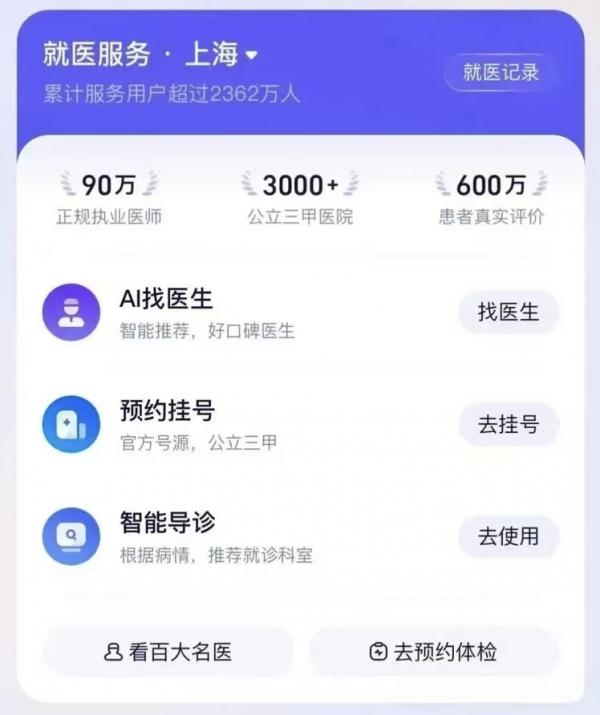
▲Ant Afu integrates many practical functions, including appointment bookings and intelligent triage.
The innovation testing ground formed by a vast market provides a natural breeding ground for Chinese AI applications.
China's population of 1.4 billion corresponds to enormous market demand and diverse industrial scenarios. User needs vary across identities, regions, and age groups, presenting a multifaceted landscape.
Such diverse needs offer Chinese AI applications broad scenario adaptation opportunities and coverage, as well as greater support for a virtuous cycle of "research and development - implementation - feedback - optimization."
Although ChatGPT Health boasts 230 million weekly active consulting users, this data is scattered in unstructured conversations, lacking dedicated labeling and feedback loops for health scenarios.
With scenario advantages and policy support (the "AI Plus" initiative and the "Healthy China" strategy), the vitality of AI application innovation is naturally surging.
05
In essence, ChatGPT Health following Ant Afu's path reflects a role reversal in the AI competition landscape, from "followers" to "co-runners."
For many years, the success of Chinese internet companies was often overshadowed by the "time machine theory," with "Copy to China" being a revered mantra. In recent years, Chinese internet companies have increasingly exported technological and model innovations overseas, leading to a growing phenomenon of "Copy from China."
Now, OpenAI's follow-up of Chinese AI applications marks China's AI transitioning from following to running alongside and even leading in certain aspects.
This brings forth a revelation: in the AI competition, the depth of application innovation is as crucial as the intensity of technological innovation in determining victory. Leveraging advantages such as strategic foresight, engineering capabilities, and market conditions, Chinese companies can continuously validate Jensen Huang's assertion.
The tide is turning. Chinese companies at the forefront can confidently ride the waves—after all, the focus of the AI competition will ultimately shift towards application implementation, and many of the best applications are right here in China.
-
![]()
Registered Capital Slashed to 372 Million Yuan! Yutong Optical Finalizes Industrial and Commercial Change Registration
-
![]()
Zhuque-3 Successfully Lands, and 'Time Traveler' Secures Another ¥100 Million in Funding: China's Commercial Space Industry Experiences a 'Dynamic August'
-
![]()
Autohome Faces a Shrinking Window of Opportunity
-
![]()
Even a Titan Like Musk Has Faced Setbacks in Fulfilling Promises
-
![]()
AI Office: The End of the Racing Era, Context Becomes the Key to Success
-
![]()
Domestic Vehicle Chassis Revolution ②: The Steering Wheel Remains, But Mechanical Connections in the Steering System Are Decreasing
-
![]()
Exploring MiniMax Design: Can Video Editing Be as Simple as Speaking?
-
![]()
Why Can SenseTime Achieve Profitability While CloudWalk Still Faces Challenges, Despite Both Adopting Large Models?