AI Kept Busy During the Spring Festival with New Launches, Red Packets, and CCTV Gala Appearances
 02/11 2026
 532
532

Image generated by Doubao AI
Who Will Win the 'Spring Festival Season'?
Written by / Li Xuanqi
Edited by / Chen Dengxin
Layout by / Annalee
Whenever the Spring Festival approaches, major internet companies are already bustling with activity. However, unlike previous years when e-commerce platforms competed in the 'New Year Goods Festival' and short-video platforms vied for 'traffic,' this year's Spring Festival saw major AI applications taking center stage in the fray.
First came news that ByteDance's Volcano Engine had become the exclusive AI cloud partner for the 2026 CCTV Spring Festival Gala. Subsequently, Tencent's 'Yuanbao' and Alibaba's 'Qianwen' launched red packet giveaways and hospitality plans. Moreover, the iterative updates of AI large models kicked off even earlier, with DeepSeek and Kimi releasing new models on the same day, along with updates from several domestic model products...
Suddenly, giving out red packets, appearing on the CCTV Gala, and showcasing technology became standard moves for AI applications to welcome the Lunar New Year. This festival, steeped in Chinese tradition, is rapidly being shaped into a critical 'battleground' for testing AI product strength and vying for the next generation of user access points. A grand 'Spring Festival season' drama centered around AI applications, technology, scenarios, and emotions has begun.
'Heart-Winning Tactics': Spending Money to Capture Traffic
Looking back to 2015, Alipay officially launched its red packet feature, partnering with numerous enterprises and leveraging Weibo for promotional efforts. However, it ultimately lost out to WeChat, which became the red packet interactive partner for the CCTV Gala, distributing 500 million yuan in cash red packets through its 'shake' feature. The excitement of this red packet war perhaps far surpassed that of the gala's programs that year.
Since then, giving out red packets during the Spring Festival has become a tried-and-true tactic for major internet companies to vie for traffic. In recent years, as the fervor among internet giants has subsided, so too has public enthusiasm for red packet wars. Yet, AI applications have reignited this battle, attempting to 'win over' more users with 'heart-winning tactics.'
First, Tencent's AI assistant 'Yuanbao' announced a New Year event starting on February 1st, distributing a total of 1 billion yuan in cash red packets. Users could experience new AI features and grab red packets through the Yuanbao App, with prizes of up to 10,000 yuan. After the announcement, Ma Huateng openly stated, 'We hope to recreate the success of WeChat's red packets back in the day.'
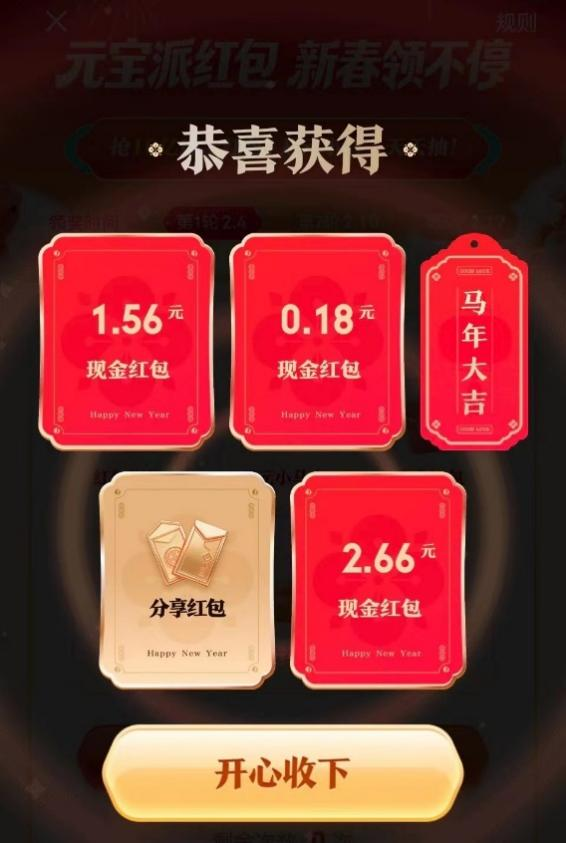
On February 1st, Tencent's 'Yuanbao: Share 1 Billion' event officially kicked off, running from February 1st to February 17th. It featured two core gameplay elements: 'Main Venue Red Packet Draws' and 'Blessing Red Packets,' with users having the chance to win up to 10,000 yuan in cash red packets.
According to reports, in the main venue, users received five daily draw opportunities and could earn over 40 additional draws by completing tasks, with chances to win cash red packets, 10,000 yuan cash cards, red packet expansion cards, shared red packets, surprise rewards, New Year blessings, and other types of red packets.
On February 2nd, Alibaba's 'Qianwen' followed suit, announcing a 3 billion yuan 'Spring Festival Hospitality Plan' to treat everyone to food, drinks, and entertainment for free. It was reported that Alibaba's entire ecosystem, including Taobao Deals, Fliggy, Damai, Hema, Tmall Supermarket, and Alipay, would participate in this plan.
Zinc Scale noticed that on social platforms like Xiaohongshu and Weibo, content related to grabbing red packets with Yuanbao emerged after February 1st, with many posts seeking 'team-ups' and 'assistance.' Indeed, numerous netizens mentioned, 'I downloaded Yuanbao just for the red packets.'
Notably, on the morning of February 2nd, many users found that Tencent's AI large model application 'Yuanbao' frequently displayed 'generation paused.' Tencent promptly responded, attributing it to a sudden surge in traffic causing temporary instability in some services, which had since been resolved.
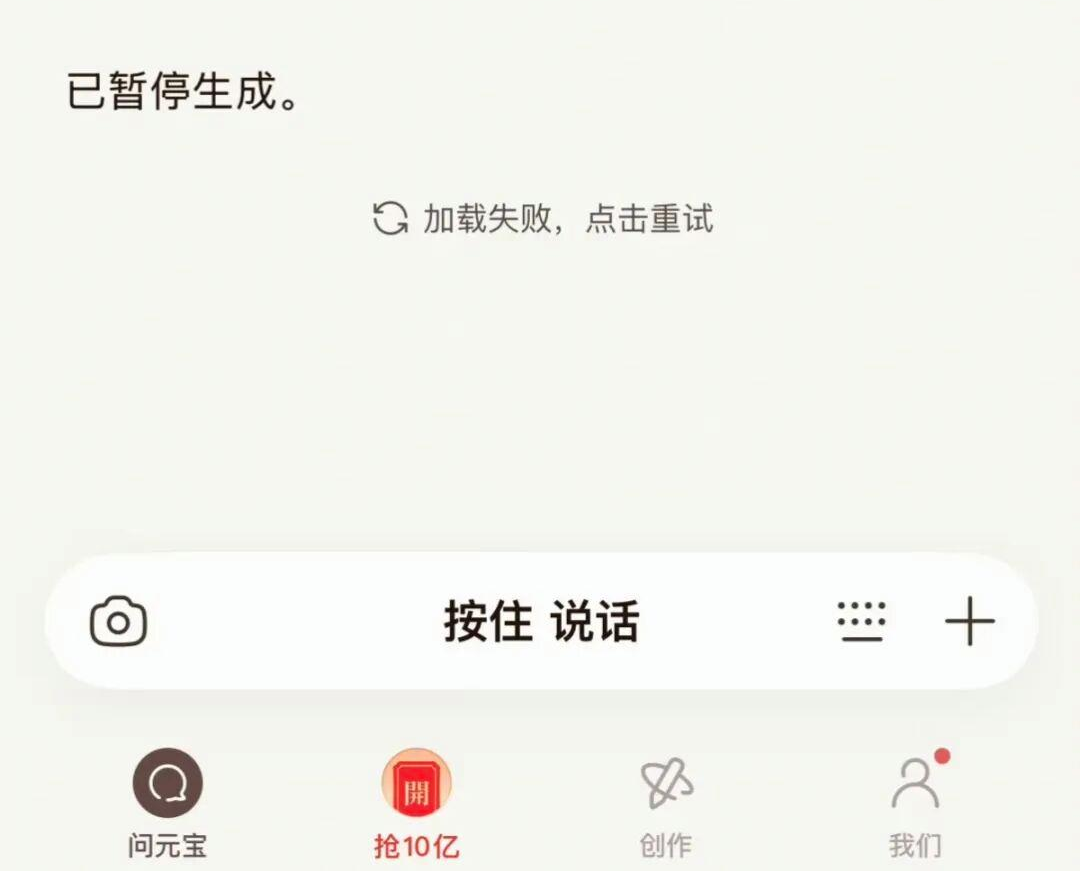
Additionally, as Tencent Yuanbao's 'Spring Festival Red Packets' went viral across multiple social platforms, it sparked controversy over its sharing mechanism. In response, Tencent issued an internal letter stating that the basic logic of Yuanbao's Spring Festival red packets was 'threshold-free collection,' allowing users to obtain basic red packets without completing tasks like assistance or card collection, fundamentally differing from the 'induced sharing' model that platforms have long cracked down on.
On February 6th, Qianwen officially released the first wave of benefits from its 3 billion yuan 'free order' campaign. According to Qianwen's data, within just nine hours of the event's launch, orders exceeded 10 million. On February 8th, several netizens posted that Qianwen's free milk tea orders were so popular that the app crashed. Many users reported being unable to place orders normally, with the system repeatedly reminding them, 'Due to high participation in Qianwen's free orders, we are continuously optimizing experience stability. The validity period of free order cards has been extended to February 28th.'
While Tencent Yuanbao and Alibaba Qianwen chose to spend money to capture traffic, ByteDance opted to make its mark on the CCTV Gala. This marked ByteDance's third significant collaboration with the CCTV Gala, following two previous partnerships with Douyin.
However, this time, it was not the familiar Doubao representing ByteDance but its AI cloud service platform, Volcano Engine. On December 28, 2025, China Media Group announced that ByteDance's Volcano Engine had become the exclusive AI cloud partner for the '2026 Spring Festival Gala.'
Zinc Scale noticed that shortly after the announcement, Volcano Engine's official website prominently displayed 'Exclusive AI Cloud Partner for the CCTV Gala' and launched a 'Volcano Engine AI Lights Up the Chinese New Year' flash sale event. Products on offer included the Doubao large model, Doubao video generation model, Doubao image creation model, and more.
Clearly, this 'new red packet war' ignited by AI seems to be replicating the frenzy and competition of the early mobile internet era while quietly rewriting the underlying logic of competition. A decade ago, red packets served as a 'connector' for payment gateways and social relationships; a decade later, they have become 'experience vouchers' for AI capabilities and ecosystem services.
On the surface, giants are vying for user downloads and daily active users, but at their core, they are testing whether AI technology can truly integrate into high-frequency scenarios and become daily habits. Whether AI applications can take up the baton as 'national-level tools' may become clear in the new year.
'Arms Race': Betting on New Models
If 'Yuanbao and its peers' opted for 'heart-winning tactics,' then 'DeepSeek and its peers' have chosen an 'arms race.' Beneath the excitement of red packets and the CCTV Gala, a more fundamental and far-reaching competition has never ceased, even starting earlier and intensifying.
A year ago during the Spring Festival, DeepSeek became a global 'trending topic,' dominating the new year. During the 2025 Spring Festival, DeepSeek surpassed 20 million daily active users in 20 days, becoming the fastest application to reach 30 million daily actives, far exceeding ChatGPT's early growth rate and topping download charts in both China and the U.S. This seemed to serve as a 'stimulant,' prompting AI products like Doubao, Tencent Yuanbao, Qianwen, and Kimi to accelerate their development.
A year later, can major AI applications replicate this 'miracle'?
In late January, DeepSeek and Kimi, two leading domestic large models, 'raced ahead' before the Spring Festival, releasing significant open-source updates on the same day, focusing on critical upgrades to document processing efficiency and complex task execution capabilities.
DeepSeek-OCR 2, a new-generation optical character recognition system launched by the DeepSeek team, introduced the so-called 'Causal Flow Logic.' Its core concept is to enable AI not just to 'scan text' but to truly understand image content in a human-like visual logic.
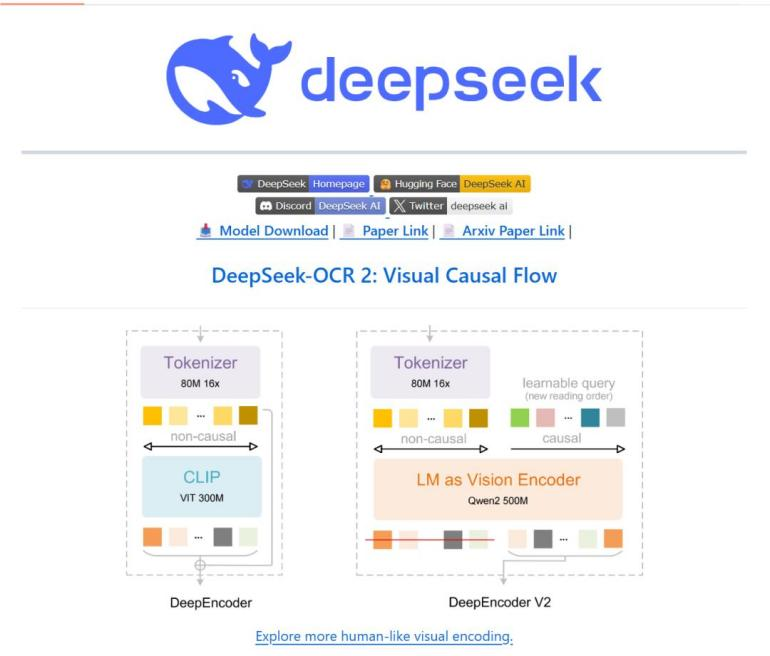
Simply put, previous models read images from top-left to bottom-right in a carpet-like scan, whereas DeepSeek-OCR 2 can understand structures and read step-by-step according to them. This new visual understanding mode allows DeepSeek-OCR 2 to better comprehend complex layouts, formulas, and tables.
Notably, this marked DeepSeek's third technological update in January 2026: early in the month, it refined the technical details of the R1 paper; mid-month, it open-sourced the Engram memory module; and at the end of the month, it launched OCR 2... During the Spring Festival, DeepSeek is also set to release its V4 large model, with its programming capabilities expected to rival and surpass closed-source models like Claude and GPT series.
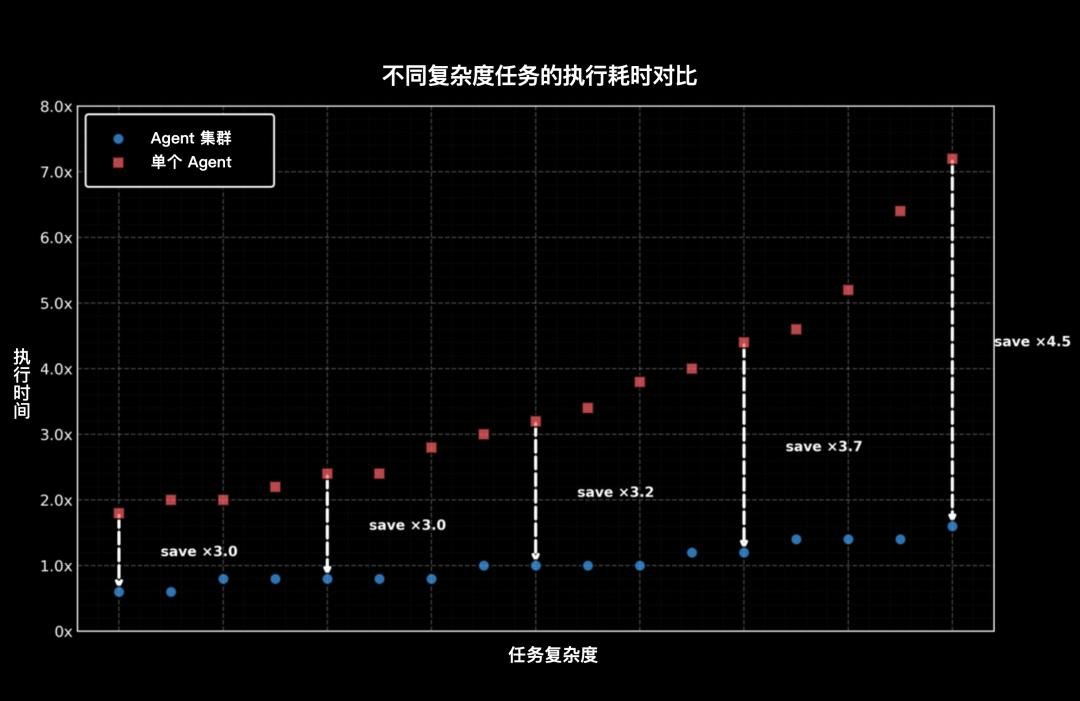
Meanwhile, Kimi K2.5 targeted another core pain point of AI adoption: the inability to handle complex tasks. K2.5 enables AI to transition from a 'question-answering machine' to a 'task executor' by enhancing ultra-long context memory, multimodal understanding, and agent clustering capabilities. For example, marketing teams can use AI to simultaneously integrate 10 competitive reports, break down research tasks, and generate PPT outlines without repeated manual information supplementation.
Furthermore, in this Kimi K2.5 update, the Kimi research team reconstructed the reinforcement learning infrastructure, exploring new possibilities through optimized training algorithms and introducing Agent clusters, evolving Agents from individual breakthroughs to clustered operations. With Agent clusters, users can deploy a group of 'analysts' to conduct market research on 100 companies simultaneously, mobilize a 'language expert team' to translate 300 pages of documents, or send different 'researchers' to summarize five cross-disciplinary papers, boosting efficiency more than tenfold.
Moreover, Alibaba released its flagship reasoning model, Qwen3-Max-Thinking—Alibaba's largest and most capable reasoning model to date, with over a trillion total parameters and 36T Tokens of pre-training data. MiniMax (Xiru Technology) introduced the Music2.5 music generation model, announcing breakthroughs in two major AI music technology challenges and sparking a surge in Hong Kong-listed AI stocks. Kuaishou announced the launch of its next-generation video generation model, Kling 3.0 series, currently in advanced beta testing. This series includes Image 3.0, Video 3.0, and Video 3.0 Omni...
Perhaps users may come for a red packet or a CCTV Gala interaction, but what determines whether they stay is AI's ability to truly understand their complex, ambiguous, and context-laden needs and provide useful, reliable, and creative responses. The massive, diverse, and immediate user demands during the Spring Festival peak serve as an excellent 'training ground' to test and refine these capabilities.
This 'Spring Festival season' extravaganza will eventually conclude, but it has undoubtedly ignited the beginning of AI competition. Victory is not determined in a single moment; only those who can continuously deliver on the value of intelligence after the excitement subsides will truly win the next decade.
-
![]()
Silicon-Based OLED Pioneer Unveils Financial Results: H1 Shipments Outpace Entire 2025 Volume
-
![]()
AI's First "Lost Summer"
-
![]()
Zeiss Makes Another €2.2 Million Bet: Will Eye Tracking Be the Next Big Thing in the Smart Glasses Industry?
-
![]()
RUNTO Ranking | Global Top TV ODM Factories' Shipment Figures for July 2026
-
![]()
Dealer Service Operational Prowess | How After-Sales Managers Can Harness Efficiency and Expertise to Secure Trust in the New Energy Era
-
![]()
Xiaohongshu: Navigating Through the AI Anxiety Storm
-
The Foundation of AI is Being Built
-
![]()
Huawei and Apple Embrace Change, Samsung Steps Back: Is Variable Aperture Technology a Game-Changer?