Three Major Trends Shaping the Future of Embodied AI in 2026
 02/13 2026
 776
776

Author | Mao Xinru
If keywords like 'still far', 'gap', 'benchmark-chasing', and 'lack of standards' dominate a roundtable discussion on embodied AI, would you consider it bearish?
The answer is quite the opposite.
Over the past two years, embodied AI has rapidly expanded from an academic concept to the most crowded track in the primary market.
Funding has reached new heights, humanoid robots have appeared on the Spring Festival Gala, and even a backflip has generated a brief trending topic.
However, the reality is that after deploying models and hardware in real-world settings, researchers find a significant gap remains before large-scale applications can be achieved. This gap is increasingly recognized by more people.
Industry trends now show that more players are focusing not on pursuing general-purpose generalization but on identifying scenarios where commercial closed loops can be achieved and expanding their advantages in these areas.
At this roundtable hosted by Yuanli Lingji, Professor Wang Yu from Tsinghua University, Wang Zhongyuan, Dean of the Beijing Academy of Artificial Intelligence (BAAI), Jiang Daxin, CEO of Jieyue Xingchen, Gao Jiyang, CEO of Xinghaitu, and Tang Wenbin, CEO of Yuanli Lingji, gathered together, representing the full spectrum of embodied AI participants from academia to industry, from model brains to physical bodies.
A profound viewpoint emerged from the roundtable: 2026 will not be the 'ChatGPT moment' for embodied AI, but it is likely to be a watershed year where the industry shifts from enthusiastic narratives to rational, in-depth development.
Meanwhile, the roundtable clearly outlined three core trends for the development of embodied AI in 2026.
From Demo to Scalable Commercial Closed Loops
The development of embodied AI has largely remained at the demo and simulation testing stages, with most players pursuing full-scenario generalization. While this technological ideal is ambitious, the reality is that most robots still face the awkward (awkwardness) of being unable to leave the lab or perform practical tasks.
At the roundtable, a consensus emerged: full-scenario generalization for embodied AI is not feasible in the short term.
The core development direction for the industry in 2026 will involve temporarily setting aside the vision of full-scenario generalization and instead focusing on specific closed or semi-closed scenarios to achieve scalable closed loops in technology, data, and commerce.
From a technical perspective, the generalization capabilities of embodied AI face multi-dimensional challenges, making full-scenario implementation unrealistic.
Jiang Daxin, CEO of Jieyue Xingchen, believes that generalization in embodied AI should encompass three core dimensions: scenario generalization, task generalization, and objective generalization. Scenarios can be classified as closed, semi-closed, or fully open, while tasks include navigation, grasping, and household chores.
The difficulty of generalization varies greatly across these dimensions. Currently, the industry lacks a unified definition of the 'ChatGPT moment' for embodied AI, making achieving zero-shot generalization across all dimensions even more challenging.
Compared to large language models, which only need to process virtual linguistic information, embodied AI requires the integration of computer vision, motion control, environmental perception, and other multi-domain technologies, resulting in exponentially higher technical complexity. Full-scenario autonomous adaptation is unlikely to be achieved in the short term.
Therefore, solving problems in single scenarios first and then gradually exploring generalization has become a core consensus for the industry in 2026.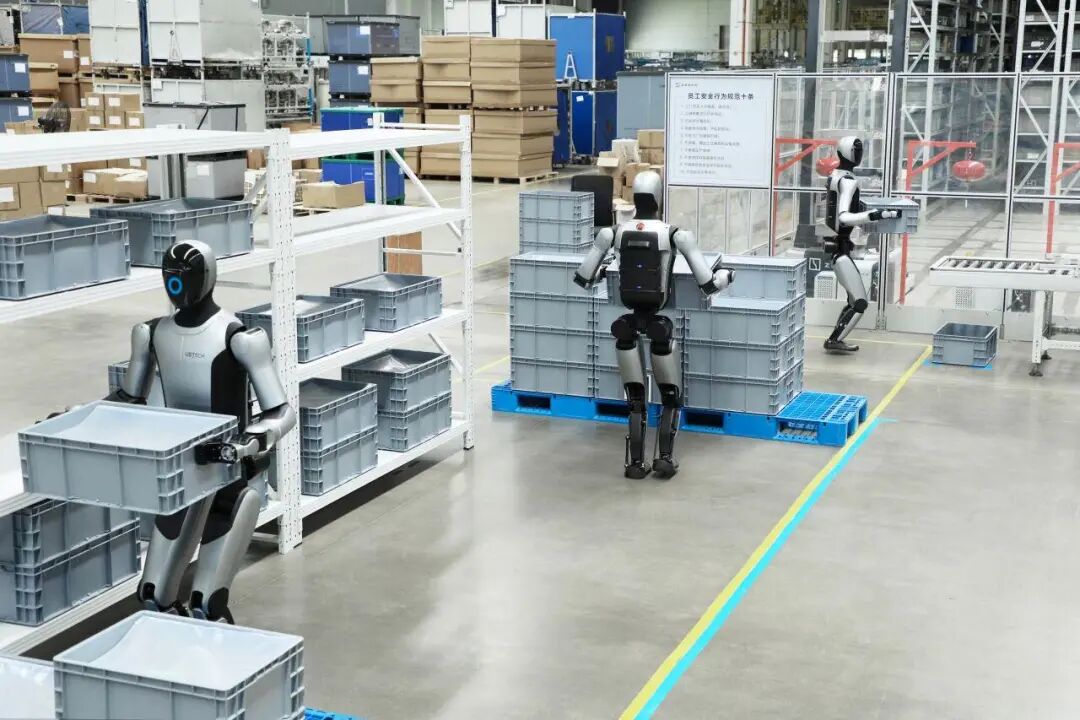
Wang Zhongyuan, Dean of BAAI, believes that the most realistic path now is to use VLA + reinforcement learning to address individual real-world scenarios effectively, enabling robots to perform tasks first, then accumulate more data in real-world operations to form a data closed loop, and finally tackle generalization issues.
This approach avoids the technical misconception of generalizing for the sake of generalization, using data closed loops as a bridge between single-scenario deployment and full-scenario generalization. Meanwhile, continuous operation in single scenarios is the only way to accumulate real-world data.
From a commercial perspective, scalability, sustainability, and calculable ROI have also become core criteria for evaluating embodied AI deployment in 2026.
Based on his understanding of the 'ChatGPT moment' for embodied AI, Tang Wenbin, co-founder of Yuanli Lingji, set a goal for 2026: achieving continuous operation of 1,000 robots in a single scenario.
Gao Jiyang, founder of Xinghaitu, is even more ambitious, believing that the entire industry needs to see clear productivity growth, with single-scenario shipments reaching tens of thousands within two years. In terms of deployment scenarios, closed or semi-closed environments such as industrial logistics and manufacturing will become core sectors for embodied AI in 2026.
Currently, embodied AI has preliminary deployment conditions in scenarios like warehouses and factories for tasks such as screw tightening. These scenarios feature controlled environments, single tasks, and few interference factors, effectively reducing the perception and operational difficulties for robots and making it easier to achieve data closed loops and ROI calculations.
Compared to open scenarios like household services, industrial settings have lower tolerance for robot errors but clearer scenario boundaries and significant demand for industrial upgrading, making them ideal entry points for embodied AI to move from labs to industry.
Although hardware still faces issues like continuous stability, safety, and battery life, these can be mitigated in closed scenarios through environmental adaptation and equipment modifications, sufficient to support normalized robot operations.
In 2026, the embodied AI industry will officially enter the first year of single-scenario deployment. Whoever can first achieve scalable and sustainable operations in specific scenarios will set the benchmark for industry development.
Unified Evaluation Systems and Technical Standards
The development of AI relies on standards and evaluation systems. The rapid iteration of large language models has benefited, to some extent, from well-established evaluation systems and relatively unified technical standards.
As a hybrid field integrating software models, hardware entities, and physical interactions, embodied AI is still in a developmental stage characterized by a lack of evaluation systems, fragmented technical standards, and an immature open-source ecosystem.
This has become a core bottleneck restricting the industry's transition from demos to large-scale deployment.
Since 2025, more researchers from industry and academia have been seeking standards for embodied AI, as evidenced by initiatives like Yuanli Lingji's Robochallenge and Shanghai Jiao Tong University's open-source evaluation dataset GM-100.
After the wild growth of 2025, normalizing real-world evaluations, unifying technical standards, and systematizing the open-source ecosystem will become inevitable trends in 2026 to address foundational gaps in industry development.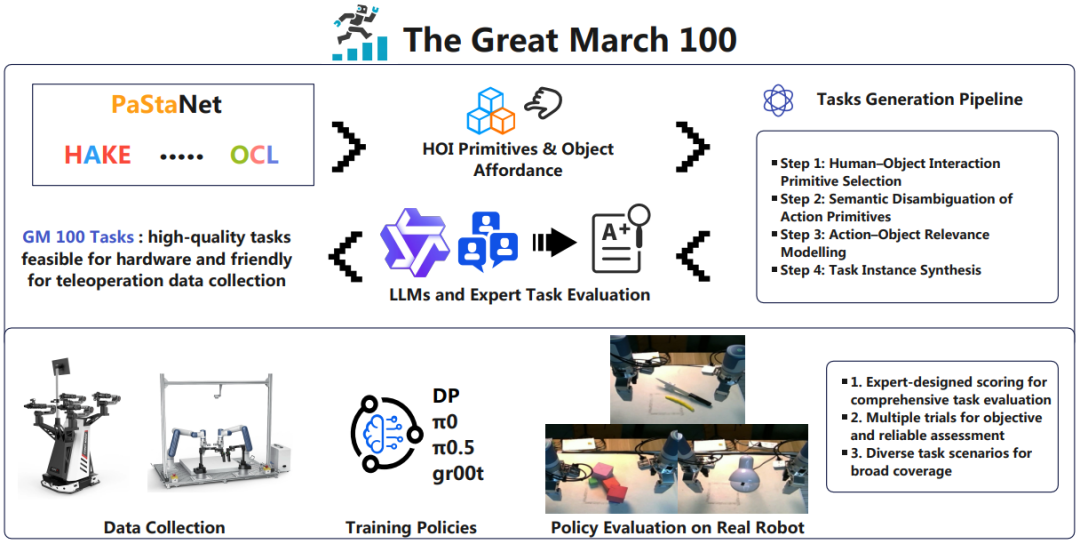
First, real-world, large-scale hardware evaluation systems will become the industry norm, with platforms like RoboChallenge leading the construction of industry evaluation standards.
Currently, evaluations of embodied AI are mostly conducted in simulated environments. Existing benchmarks like LIBERO, SimplerEnv, and RoboTwin are small-scale and limited in scenario diversity, with many evaluation scores already approaching perfection.
However, these scores do not reflect the robots' actual capabilities in the real physical world. Only real-world, large-scale hardware evaluations can guide the industry toward rapid and positive development.
Second, the unification of technical standards for embodied AI will be prioritized, with core standards such as model outputs and data formats reaching industry consensus.
The current fragmentation of standards in the embodied AI industry is evident in multiple areas: inconsistent hardware interfaces, varying data collection formats, and divergent model output logics. These issues prevent interoperability of technical achievements and make model validation difficult, significantly reducing industry R&D efficiency.
While model open-sourcing is actively pursued domestically and internationally, deployment and reproduction remain challenging.
The key issue lies in the lack of unified standards, with data categories, formats, and even code varying widely. Such fragmentation traps the industry in isolated R&D efforts and restricts large-scale deployment of embodied AI.
In 2026, substantive breakthroughs are expected, with the formulation of technical standards for embodied AI formally entering the industry agenda.
In late 2025, the Standardization Technical Committee for Humanoid Robots and Embodied AI under the Ministry of Industry and Information Technology was officially established, comprising academics and industry professionals. Leveraging their practical experience, the committee will define standards for embodied AI model outputs.
Model output standards will address core issues of model validation and technical interoperability, enabling sharing and iteration of R&D outcomes across the industry.
As single-scenario scalable deployments progress, standards for hardware interfaces and data collection will also gradually reach industry consensus, driving the industry from fragmentation toward collaboration.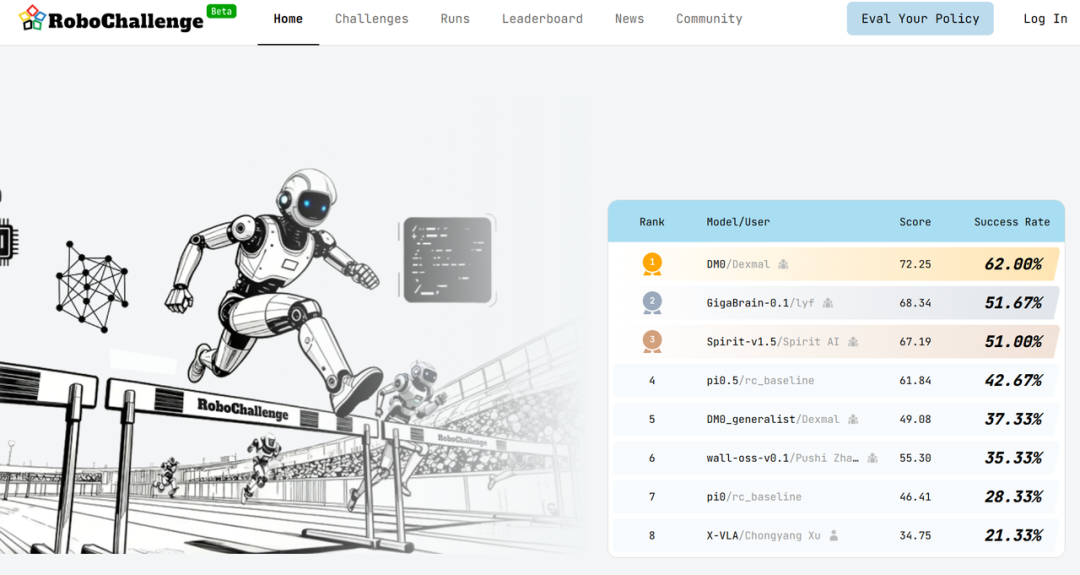
Finally, a full-chain open-source ecosystem will gradually take shape, becoming a core driver of technological innovation in the industry.
Open-source ecosystems have been instrumental in the rapid development of AI technologies, such as the proliferation of large language models and the dominance of the Transformer architecture.
As a more technically complex field, embodied AI requires even greater support from open-source ecosystems to enable SMEs and research institutions to build upon existing foundations.
In the future, platforms like Robochallenge may evolve into public-interest entities, creating a fully open-source ecosystem encompassing frameworks, hardware, data, and applications/evaluations.
Currently, the open-source ecosystem for embodied AI has seen initial development at the algorithmic level. Relying on open-source communities, leading companies like Physical Intelligence in the U.S. have completed algorithm dissemination within 2-3 months of open-sourcing.
In 2026, open-sourcing in embodied AI will extend from algorithms to hardware, data, and evaluations. Leading institutions like Yuanli Lingji and BAAI will also increase their open-source efforts, lowering R&D barriers and accelerating technological innovation.
In summary, the unification of evaluation systems and technical standards is a necessary prerequisite for embodied AI to transition from technological exploration to industrial deployment.
With the improvement of real-world evaluation platforms, the formulation of core standards for embodied AI, and the construction of a full-chain open-source ecosystem, the industry will overcome development challenges posed by the lack of standards and evaluations, providing solid foundational support for scalable commercial closed loops.
Deep Industry-Academia-Research Integration to Enhance China's Overall Competitiveness
Embodied AI is not a stage exclusively for enterprises; technological exploration by academia and practical deployment by industry are both indispensable. In the industry competition led by China and the U.S., it is widely acknowledged that the U.S. holds an advantage in algorithms and 'brains,' while China excels in supply chains and production capacity.
Therefore, the next stage for Chinese players to enhance their core competitiveness lies in continuously expanding their supply chain advantages while promoting industry-academia-research collaboration to form a virtuous cycle where academic exploration drives industrial deployment, which in turn feeds back into academic research.
Professor Wang Yu from Tsinghua University noted that while the U.S. started earlier in model R&D and data accumulation, China's overall investment in the embodied AI industrial chain now far exceeds that of the U.S.
China's well-established industrial and supply chains can extend the scope of application openness more broadly. Combined with increased investment in models and applications, China may achieve faster breakthroughs in embodied AI ahead of the U.S.
Compared to the U.S. Super Bowl's focus on technological demonstrations of large language models, China's Spring Festival Gala has become an important stage for showcasing robotics technologies, reflecting the different priorities in AI development between the two countries.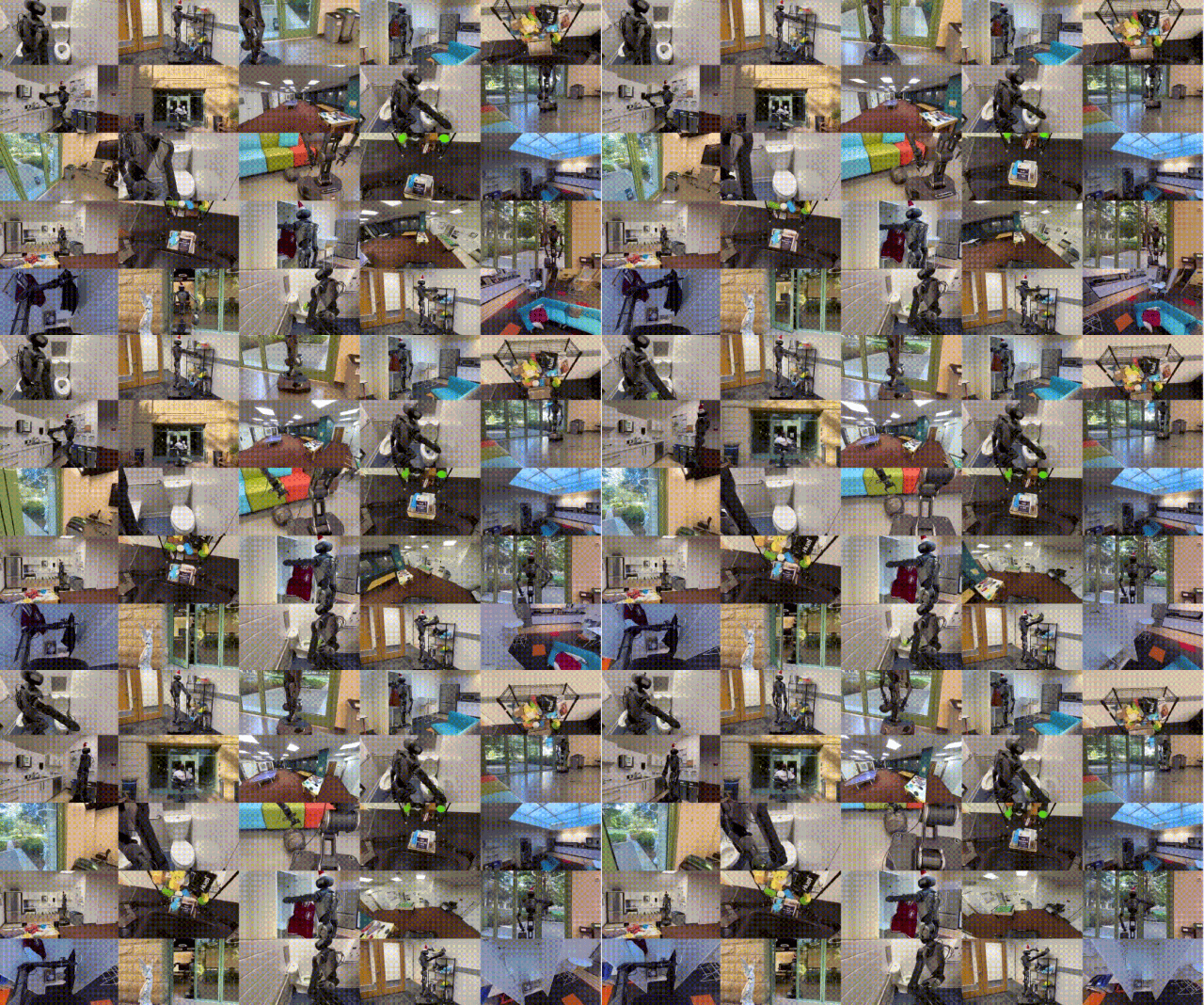
Second, China's industry-academia-research collaboration is becoming increasingly tight, forming a virtuous cycle where industrial challenges drive academic research, which in turn solves industrial pain points. This is another core advantage for China's embodied AI development.
In the past, China's AI development suffered from a disconnect between academia and industry, with academia focusing on paper publications and industry on commercial deployment, lacking effective communication and collaboration.
Now, China's academic and industrial sectors are increasing their interactions, truly promoting deep industry-academia-research integration.
This integration is evident in multiple ways: Industrial deployment pain points have become research directions for academia, while academic technological exploration provides innovative ideas for industry. For example, models released by BAAI like RoboBrain and RoboBrain-X, as well as industry-academia-research co-built evaluation platforms like RoboChallenge, have achieved technology, hardware, and data sharing. In 2026, industry-academia-research integration in China's embodied AI will further become normalized and institutionalized.
Universities and research institutions will serve as R&D centers for industry, while industry will act as scenario validation centers for universities and research institutions. Their collaborative innovation will drive rapid iteration and deployment of embodied AI technologies.
The collaboration between industry players, such as Jieyue Xingchen and Yuanli Lingji, will continue to increase and further extend to academia, forming a broader industry-university-research influence.
Based on this, the overall competitiveness of Chinese embodied AI players will achieve a comprehensive upgrade, with the potential to take the lead in achieving large-scale commercialization of embodied AI in the global competition. 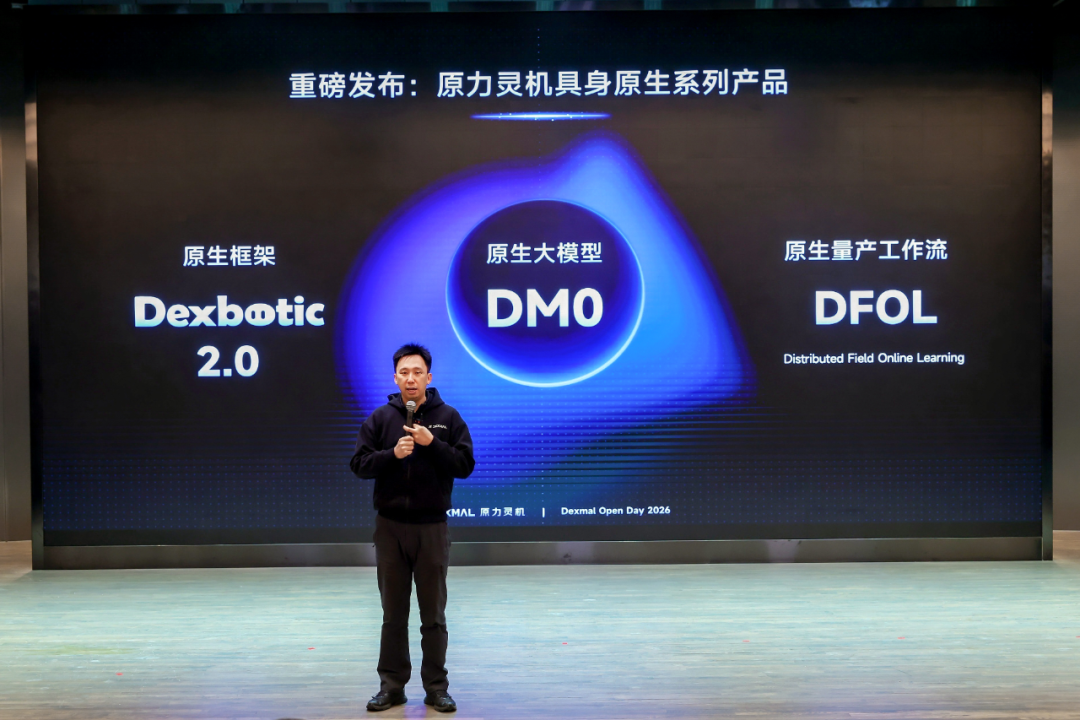
The DM0 model is jointly trained by Yuanli Lingji and Jieyue Xingchen. In addition, as Xinghaitu, which has already achieved mass production and delivery of software and hardware products, its founder, Gao Jiyang, stated that China's overall machine and supply chain have undergone significant changes after two years of preparation.
The reliability and consistency issues of the supply chain and components have been significantly improved. The accumulation of real machine data has also gradually advanced with the deployment of overall machines, forming a positive cycle in the industrial chain of supply chain-data-algorithm.
It can be said that 2026 will be a critical year for Chinese embodied AI players to enhance their global competitiveness: the deep integration of industry, academia, and research will address the core technological pain points of embodied AI. The supply chain advantages will drive the large-scale implementation of technology. Rich industrial scenarios will provide broad development space for embodied AI. The combination of these three factors will enable China to occupy a favorable position in the global competition for embodied AI, with the potential to usher in China's embodied AI ChatGPT moment ahead of others.
2026 will most likely not be a year of miracles for embodied AI but rather a year when players in the field must thoroughly invest in hard work.
Rational development and pragmatic implementation will become the true main themes.
As evaluations shift from simulation to real machines, scenarios retreat from generalization to verticality, and competition turns from model worship to ROI calculations, the industry will also need to undergo a disillusionment where dreams meet reality.
After all, in the marathon of embodied AI, the industry as a whole has only run one kilometer.
-
![]()
Who’s Sounding the Alarm on ‘Rushed Vehicles’?
-
![]()
Over 5.3 Billion Yuan in Losses Over Three and a Half Years! Can Yonyou Reverse Its Fortunes Through Streamlining and AI Transformation?
-
![]()
Baidu AI Adopts Free Model: A Strategic Maneuver in Traffic and Monetization
-
![]()
Silicon-Based OLED Pioneer Unveils Financial Results: H1 Shipments Outpace Entire 2025 Volume
-
![]()
AI's First "Lost Summer"
-
![]()
Zeiss Makes Another €2.2 Million Bet: Will Eye Tracking Be the Next Big Thing in the Smart Glasses Industry?
-
![]()
RUNTO Ranking | Global Top TV ODM Factories' Shipment Figures for July 2026
-
![]()
Dealer Service Operational Prowess | How After-Sales Managers Can Harness Efficiency and Expertise to Secure Trust in the New Energy Era