OpenClaw: An Experimental Product Made Famous by 'Vibe' but Exposed by 'Experience' | An Industry Report Everyone Can Understand
 02/27 2026
 646
646
Recently, OpenClaw has exploded in popularity.
Its 'fame' doesn't stem from how truly useful it is, but rather because its narrative system precisely hit the long-held fantasy of a 'personal AI assistant,' rapidly creating new concepts through 'Vibe Coding.'
It validated the potential for further upgrades in the 'proactive, automated, and personalized' AI agent track, despite drawing significant criticism and controversy.

I. The Explosion: A Victory of 'Concept First'
1.1 It Tapped into Humanity's Long-Held Fantasy of Personal AI Assistants
The idea of virtual assistants has been popular for decades, with related products emerging periodically. However, they've always lacked sufficient intelligence to achieve widespread adoption.
Many people hope for the early arrival of an all-powerful digital avatar that can handle scheduling, work summaries, late-night creative tasks, and study plans—freeing them from repetitive and inefficient chores.
In other words, everyone desire s (Note: ' desire s' should be 'desires') to be like a boss with a secretary at their beck and call. With a single instruction, the virtual assistant automatically completes various tasks, liberating them from repetitive and inefficient work.
Traditional AI tools are passive, only responding when asked. In contrast, OpenClaw is a proactive AI agent that can automatically browse the web, write and send emails, arrange schedules, and even shop online without supervision. It also possesses persistent memory, recalling user preferences from weeks ago.
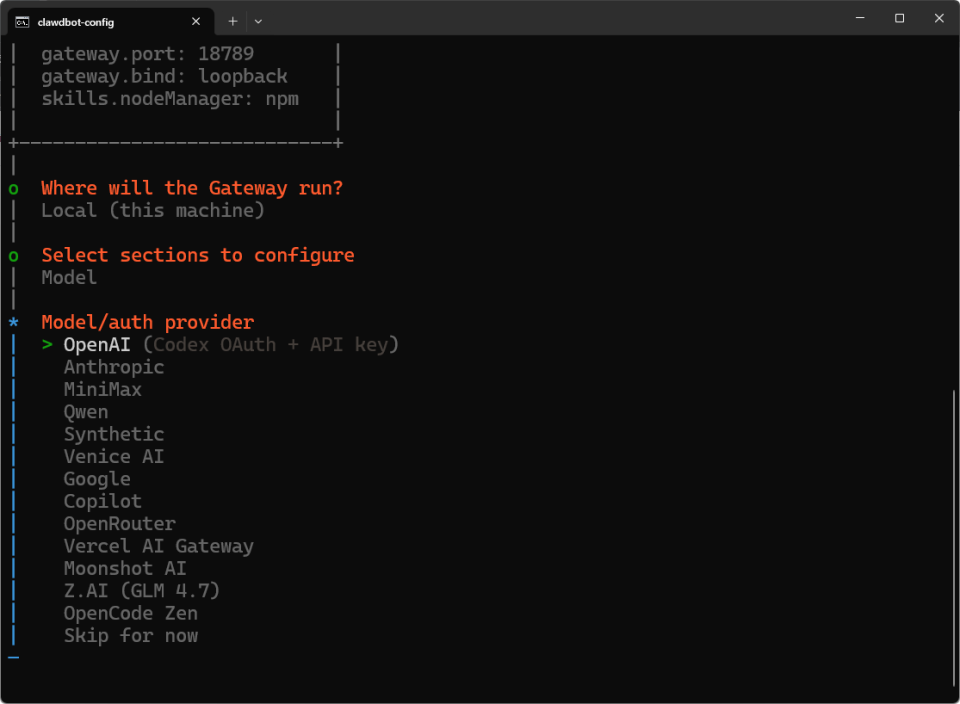
Currently supported large models by OpenClaw (Image source: OpenClaw configuration interface)
All of this has been widely praised by supporters, who call it 'AI with real hands and brains.'
Even more eye-catching is its AI social platform, Moltbook, which allows OpenClaw agents to interact with each other. This has led to dazzling 'emergent behaviors' like debates, reflections, and even the creation of 'virtual religions.'
This near-sci-fi scenario has further amplified its buzz, sparking increasing discussions.
1.2 Vibe Coding: Rapid Concept Creation with Hidden Risks
OpenClaw's rapid rise to fame owes much to the underlying core concept of 'Vibe Coding' (atmosphere programming). Proposed in 2025 by former Tesla AI Director Andrej Karpathy, the concept is simple—
Developers don't need to write code line by line or fret over syntax details. By describing the desired functionality, AI can automatically generate and iteratively optimize the code. In other words, humans focus on 'what they want' without worrying about 'how to achieve it.'
The advantage of this approach is clear: speed. OpenClaw leveraged it to pile on numerous features quickly, creating a complete new AI assistant without spending extensive time refining details or debugging bugs.
However, its drawbacks are equally apparent: the lack of rigorous code debugging and logical comb, sort out, organize, arrange, streamline s (Note: ' comb, sort out, organize, arrange, streamline s' should be ' comb, sort out, organize, arrange, streamline ') often leads to functional redundancy and system chaos, laying the groundwork for OpenClaw's various flaws.
1.3 Viral Spread: Controversy and Heat Coexist
With its concept of a 'proactive AI assistant' and the sci-fi buzz generated by Moltbook, OpenClaw achieved viral spread: It garnered over 195,000 stars on GitHub, was hailed by business leaders as 'the future engine capable of independently running an entire company,' and saw over 1.6 million registered bots on Moltbook, generating over 7.5 million AI-generated posts. Discussions about it were ubiquitous, from professional tech media to ordinary social media accounts.
II. Exposure: The Halo Fades, Revealing a 'Pretty but Useless' Toy?
However, many users felt disappointed after a few days of use. OpenClaw didn't seem as useful as claimed.
2.1 Flaw One: Bloat and Redundancy, Like a Warehouse Full of Clutter
To support the narrative of a new AI assistant, OpenClaw crammed in various features, creating a cluttered 'warehouse' where finding a useful tool requires sifting through a pile of unnecessary items.
2.2 Flaw Two: Complex Operation, Difficult for Newbies to Master
Configuring OpenClaw is akin to assembling a precision instrument, unfriendly to newcomers.
After all, people aim to hire an assistant to free their hands, only to find they must first train themselves into half-engineers—a hassle.
Manually configuring API interfaces, debugging plugins, setting permissions, and learning complex operation commands... Most people lack the time and patience for this.
Moreover, a single misstep can render the entire system inoperable. Many newbies struggle for hours without getting it to work properly.
2.3 Flaw Three: Instability, Like an Emotional Intern
If bloat and complexity are tolerable, instability is OpenClaw's most annoying flaw.
Like a highly emotional intern, you never know what it'll do. It might be writing copy one second, then suddenly freeze or malfunction the next. Sometimes it deletes data, executes commands randomly, or even leaks user system keys and other private information due to prompt injection attacks by hackers.
As one user roast s (Note: ' roast s' should be 'complains'): 'Using it to write reports, half the time is spent waiting for it to recover, and the other half fixing the mess it makes. I might as well write it myself.'
2.4 Flaw Four: Performance Black Hole, Draining Your Device
As a personal AI assistant, it should be lightweight and efficient, not consuming excessive device resources. Yet OpenClaw does the opposite, demanding significant computational power—a true performance black hole.
Many users report that their computer fans spin wildly as soon as OpenClaw is opened, slowing down noticeably. Even high-end computers overheat and become sluggish after prolonged use.
(A related topic: AI has spawned a new, global-scale energy crisis. For more, see Zhike Shushe's 'AI Has Caused an Unprecedented Energy Crisis' and 'Robot Industry Musings' on AI's energy crisis and robot value positioning.)
2.5 Essence: A Bug-Ridden Experimental Product Piled Up with 'Vibe Coding'
Overall, OpenClaw is a product of short-sightedness: using 'Vibe Coding' to rapidly pile on features and create a new AI assistant concept to attract traffic, without patiently refining the product.
In essence, it's a bug-ridden experimental product lacking rigorous technical support, smooth user experience, or reliable security guarantees. Hence, it sparked global security controversies, leading some countries' enterprises to ban employee use.
III. Value: Not Denying the Experimental Product, Nor Ignoring Its 'Pathfinder' Significance
However, we shouldn't completely dismiss OpenClaw due to its roughness and bugs. Its value lies not in 'what it can do now,' but in 'what it proves.'
3.1 It Validates a Track
OpenClaw's most valuable contribution may not be creating a great product, but proving in a striking way that what people want isn't a smarter chatbox but a proactive, automated, and personalized digital butler.
Its explosion in popularity itself demonstrates that 'proactive, automated, and personalized' AI agents are genuinely interesting to people. This track holds immense market potential and growth space.
Many call 2026 the 'Year of AI Agent Explosion' (for more on AI Agents, see Zhike Shushe's 'AI Agents: The Biggest Scam of 2025'). OpenClaw's emergence further fuels market expectations for personal AI assistants, revealing the track's possibilities to more people.
3.2 It Defines Good Product Standards Through Roughness
OpenClaw is like a rough draft, yet it concretely presents people's fantasies about personal AI assistants.
It shows that future personal AI assistants should be proactive, automated, and personalized, capable of connecting various apps and completing tasks autonomously.
Meanwhile, its flaws reverse-define the standards for excellent personal AI assistants: simplicity, stability, lightness, and security. Its shortcomings mark the minefields for future entrants.
3.3 It's a Pathfinder, Not a Successor: After Drawing the Cake, Someone Will 'Bake It'
Thus, OpenClaw is like the first person to eat a crab, telling others 'it's edible.' Through its popularity and controversy, it paves the way for subsequent products, helping more capable enterprises and developers avoid pitfalls.
In short, OpenClaw is the 'cake drawer,' sketching out a grand vision of a 'personal AI assistant' and igniting market enthusiasm. This cake will be truly 'baked' by later entrants who focus on experience and refine technology, then delivered to everyone.
IV. OpenClaw's Technical Innovations
4.1 Distributed Three-Tier Architecture
OpenClaw adopts a distributed architecture with a gateway control layer, execution node layer, and communication channel layer, combining cloud intelligence with local execution.
The gateway control layer acts as the nerve center, handling session management and security authentication. The execution node layer performs tasks on users' local devices, while the communication channel layer supports connecting multiple communication platforms.
This architecture ensures data privacy protection, low-latency execution, and offline capabilities, addressing traditional AI assistants' pain points in privacy, performance, and scalability.
4.2 Hybrid Memory System
OpenClaw's hybrid memory system achieves long-term memory and contextual understanding through a three-tier design: daily logs, long-term memory, and vector indexing.
User preferences, habits, and task histories are saved long-term, enabling the AI assistant to become increasingly intelligent over time.
Vector indexing technology allows the AI assistant to understand users' semantic intentions beyond keyword matching, improving the system's comprehension and explainability.
4.3 Deterministic Workflow Engine
The Lobster workflow engine solves the issue of improvised task orchestration in traditional AI agents, enabling deterministic task execution.
Through core features like typed pipelines, single-call execution, human-in-the-loop confirmation, and recoverable states, it ensures task reliability, security, and efficiency.
Sensitive operations can be configured to require manual confirmation, enhancing security, while recoverable states allow workflows to resume from breakpoints without re-executing the entire process.
4.4 Multi-Agent Collaboration Mode
OpenClaw employs a multi-agent collaboration mode, assigning different tasks to specialized agents for parallel execution.
The main agent handles task understanding and delegation, the exploration agent conducts code search and analysis, the planning agent designs solutions, and the execution agent carries out commands.
This mode improves task efficiency and success rates while enhancing system security through isolation.
4.5 Proactive Heartbeat System
The Heartbeat system enables the AI assistant to actively monitor system status and trigger corresponding actions.
Regular system checks, state assessments, and auto-trigger functions allow the AI assistant to proactively detect and handle system anomalies, reducing the need for manual intervention.
The system's configurability lets users adjust check rules and trigger conditions based on their needs, enhancing flexibility.
END
-
![]()
Doubao Work Unveiled! Domestic AI Leaders Fully Commit to the 'Work' Sector
-
![]()
Who’s Sounding the Alarm on ‘Rushed Vehicles’?
-
![]()
Over 5.3 Billion Yuan in Losses Over Three and a Half Years! Can Yonyou Reverse Its Fortunes Through Streamlining and AI Transformation?
-
![]()
Baidu AI Adopts Free Model: A Strategic Maneuver in Traffic and Monetization
-
![]()
Silicon-Based OLED Pioneer Unveils Financial Results: H1 Shipments Outpace Entire 2025 Volume
-
![]()
AI's First "Lost Summer"
-
![]()
Zeiss Makes Another €2.2 Million Bet: Will Eye Tracking Be the Next Big Thing in the Smart Glasses Industry?
-
![]()
RUNTO Ranking | Global Top TV ODM Factories' Shipment Figures for July 2026