3000-word In-Depth Analysis | What Makes Physical AI So Magnetic? It Has Captivated Masayoshi Son, Jensen Huang, and Justin Sun All at Once
 06/08 2026
 357
357
Recently, the term Physical AI has been generating quite a buzz. To put it modestly, this aligns perfectly with the mission of the AI.X Hardware Community since its inception: "Bringing together awesome AI physical hardware, where everything can be AI-enabled in the future (AI+X, X can be anything)." 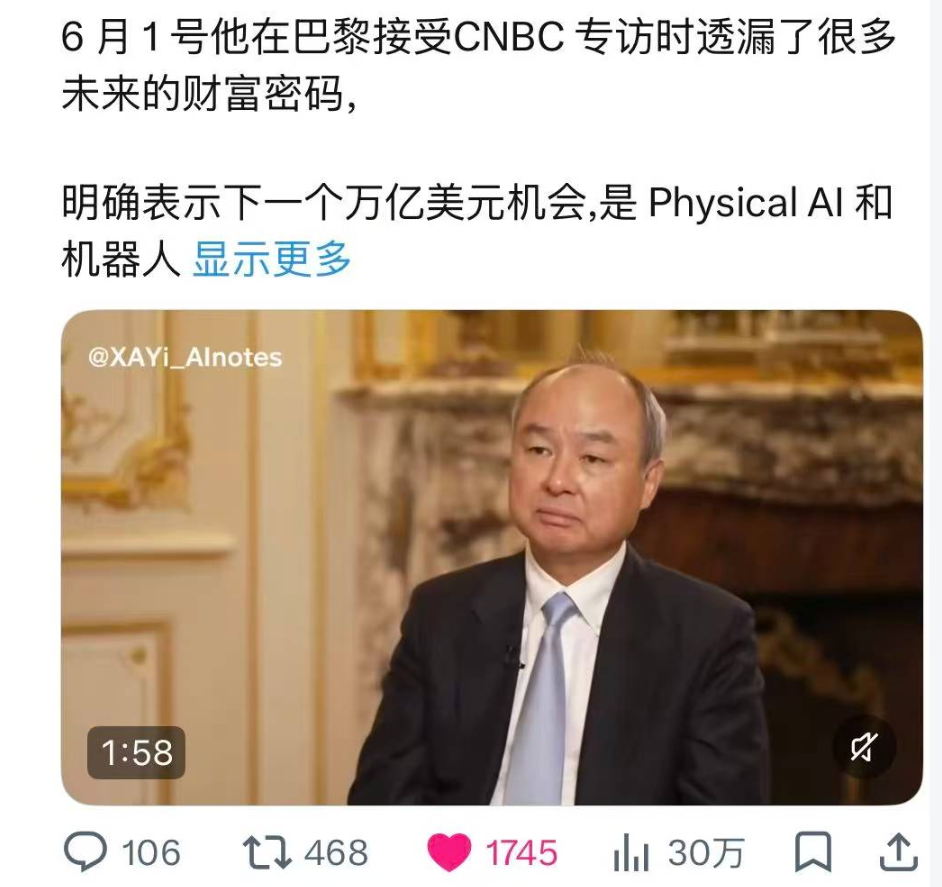
A few days ago, SoftBank CEO Masayoshi Son made it clear during an exclusive interview with CNBC Paris:
"The golden track for the next 'trillion-dollar market cap company' will be Physical AI and humanoid robots."
01 What is the difference between digital AI and physical AI?
In the interview, Son argued that for the first 50 years, AI has been solving problems in the "digital world." These AI systems can chat, write content, and draw images, but they are confined to the screens of phones and computers. They understand text, code, and pixels but lack an understanding of gravity, friction, or how the physical world operates.
Physical AI equips AI with eyes, hands, and feet, enabling it to work in the real world.
Thus, the future will see AI enter the physical world: factories, warehouses, homes, outdoor environments, etc., with robots serving as one of the carriers for Physical AI.
Below is a comparison of digital AI and Physical AI across various dimensions, highlighting differences in input, processing, output, environment, and more.
Physical AI relies on cameras, sensors, LiDAR, and other technologies to perceive the external world.

Image Source: CSDN Blog
The term Physical AI was first introduced in 2020 by Aslan Miriyev from Switzerland and Mirko Kova from Imperial College London in Nature Machine Intelligence.
In simple terms: Physical AI extends digital reasoning capabilities into the physical world, using sensors to perceive, making autonomous decisions, and employing actuator actions to directly intervene in real environments.
A technology blogger from CSDN, Dongqi Lab, offered a vivid metaphor in an article titled "Physical AI: The Leap from Understanding Language to Understanding the World."
What exactly is Physical AI? He compared digital AI and Physical AI to two different types of people: a bookworm and a doer.
Person A (Digital AI): Never left home but read ten thousand books. Ask him, "How do you drive?" and he can recite a textbook-perfect answer: steps for operating the clutch, accelerator, and steering wheel, even citing the Traffic Safety Law. But if you put him in the driver's seat, he'd likely stall three times and crash into a flower bed.
Person B (Physical AI): Grew up fixing cars on the street, crashed countless bicycles, and personally disassembled engines. Ask him, "How do you drive?" and he might not use technical terms, but he can get on the road and instinctively brake or turn the steering wheel in emergencies.
Traditional large AI models are like Person A, learning in the "symbolic world" of text, images, and code, understanding semantics and patterns.
Physical AI is like Person B, learning from data in physical simulations and the real world, understanding how objects move, collide, and interact.
The core difference lies in their data sources.
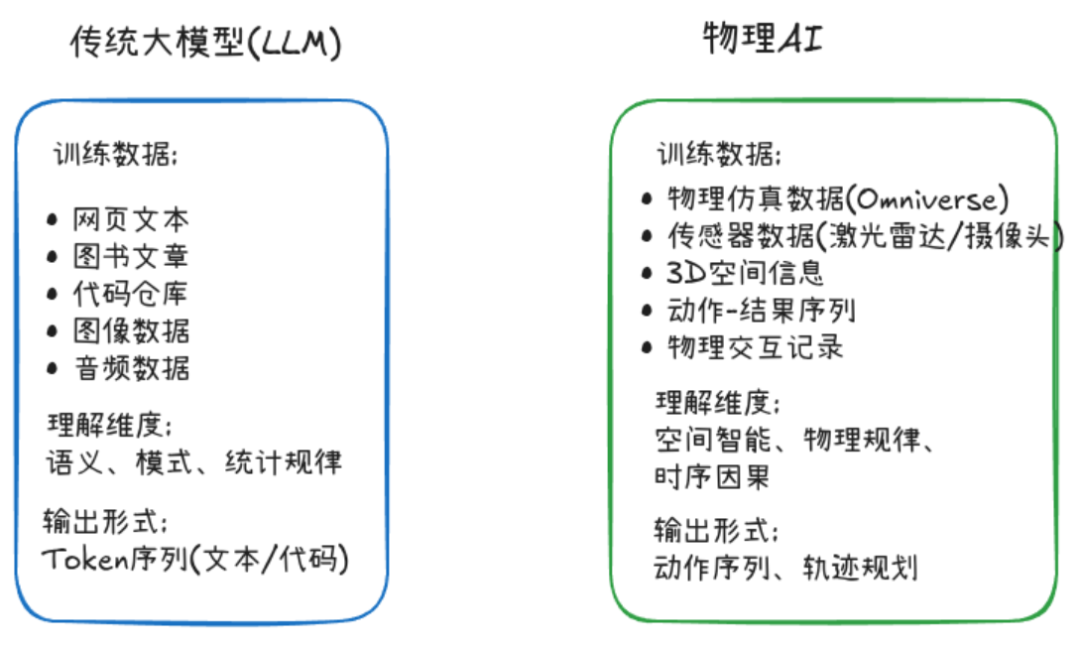
Image Source: CSDN Blog, Dongqi Lab
02 Why Are Three Leaders from Different Dimensions Betting on It Simultaneously?
Besides SoftBank's Masayoshi Son, who is extremely bullish on Physical AI, two other figures are also advocating for it: AI pioneer Jensen Huang and crypto influencer Justin Sun are actively sounding the horn.
The three represent three distinct voices from different dimensions and perspectives: Son represents capital, Huang represents industry, and Sun represents traffic.
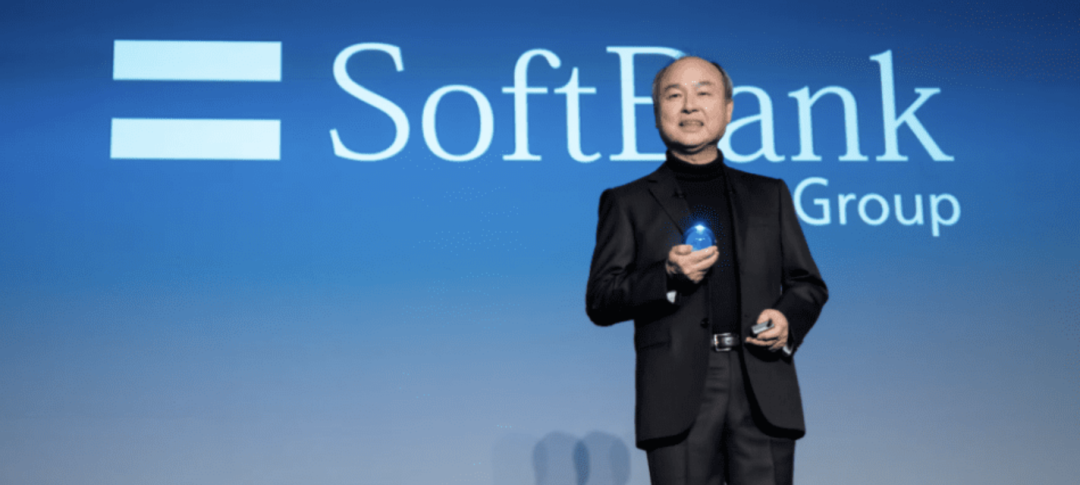
Besides explicitly stating that the golden track for the next "trillion-dollar market cap company" will be Physical AI and humanoid robots, Son also believes the scale of the entire AI revolution will be 50 times that of the internet era.
"I believe the scale of this AI revolution is more than 10 times—possibly even 50 times—that of the internet era in the 2000s."
Son's style is to either not bet or bet big. Over 40% of his Vision Fund 2's capital has shifted toward Physical AI.
In 2019, Son bet on Boston Dynamics (one of the world's top robotics companies) and now sees this direction as central to "Japan's reindustrialization" and SoftBank's turnaround strategy. He has reduced investment in pure generative AI, viewing that track (track) as too crowded. Instead, he sees Physical AI as the truly transformative direction for manufacturing and logistics.
In action, SoftBank has partnered with OpenAI on the "Stargate" project to develop U.S. AI infrastructure and announced a €75 billion investment in France to build AI data centers, with Schneider Electric and other partners joining the effort.
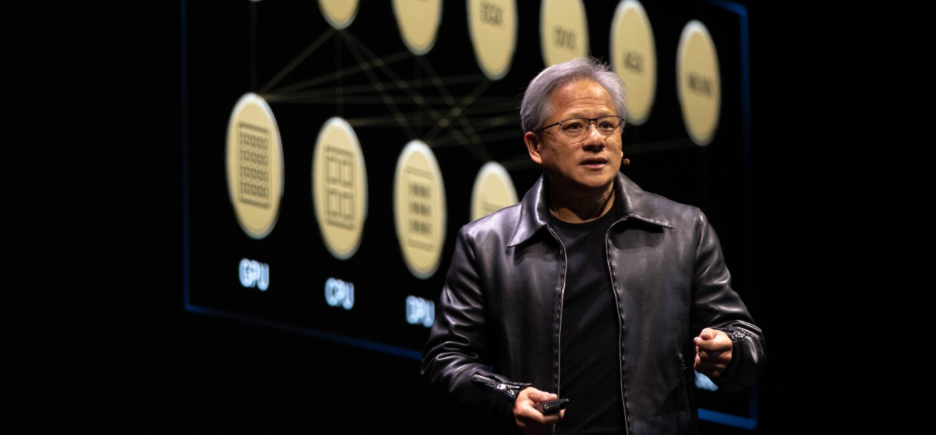
As early as 2024, Jensen Huang proposed that Physical AI would be the next era of AI.
In 2025, at the GTC conference, he outlined three major technological paradigm shifts for AI: from perceptual AI to generative AI, then to Agentic AI, and next to the Physical AI era.
By CES 2026, he further declared that the "ChatGPT moment" for Physical AI had arrived, sparking global media coverage.
He fully unveiled NVIDIA's "Full-Stack Physical AI Platform," including the Cosmos AI world model, Omniverse simulation platform, and three computational pillars:
The GB300 computing system for training, the robotic computing system for edge inference, and the dedicated computing system for simulation, forming a closed loop. The CUDA ecosystem serves as the underlying "universal language," enabling synthetic data to undergo billions of training cycles in virtual worlds before being deployed in the real world.
His goal is clear: to make AI not just exist on screens but integrate into factory floors, urban roads, and home spaces.
Huang's logic is straightforward: no matter whose robots or smart factories are running, they'll all need NVIDIA's chips and simulation platforms.

Crypto influencer Justin Sun (nicknamed "Sun the Reaper" online, a top-tier speculator) has been the loudest of the three in 2026, declaring across multiple social media platforms:
"The era of mass virtual AI dividends is over. The core opportunity for the next three years lies solely in Physical AI."
He simultaneously announced that his TRON-affiliated AI fund would rapidly expand from $100 million to $1 billion, explicitly pointing out four key tracks: embodied AI (humanoid robots), drones, spatial computing, and space exploration.
To capture public attention, Sun also spent $280 million to go to space, proving the value of the space economy.
He emphasized: "Stop chasing complete machine factories; most will 'die' in the next two years. Focus on core components like motors, reducers, lightweight materials, and rare earth magnets—that's the 'shovel seller' logic of the Physical AI era."
In the crypto circle, a popular saying goes: "You don't have to invest in Brother Sun's projects, but you must listen to Brother Sun's words."
His statements themselves are A huge attention asset (massive attention assets). His wealth accumulation process has earned him the infamous label of "crypto reaper," hence the nickname "Sun the Reaper."
This figure is highly controversial, but there's no denying he's a top trend hunter, always able to preemptively layout (position himself) and capitalize on early opportunities. Another viewpoint suggests he excels at creating concepts to attract speculators, luring more " garlic chives " (inexperienced investors) into the market.
03 What Are the Application Scenarios for Physical AI?
The era of Physical AI isn't coming—it's already here. Below are several real-world application scenarios where "AI is starting to get its hands dirty."
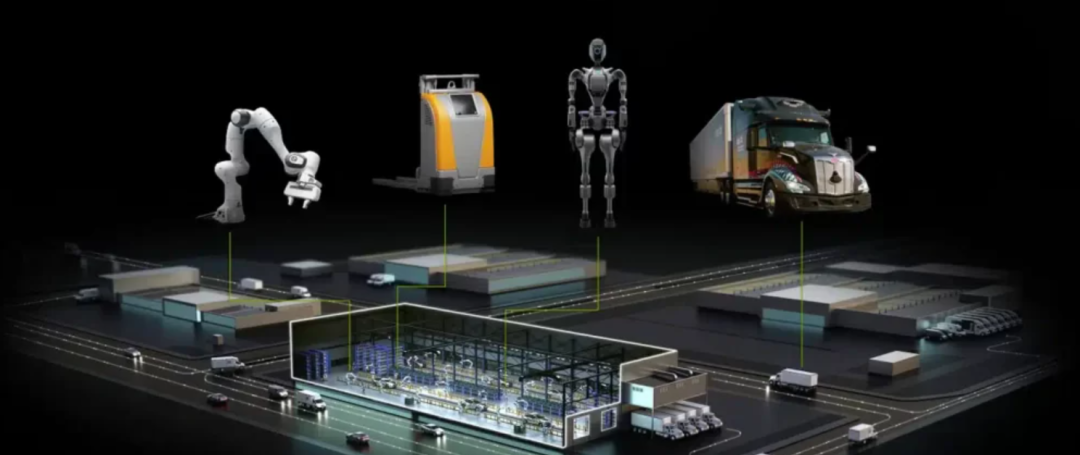
Factory Robots: In traditional factories, switching product models requires days of downtime for debugging. Physical AI-driven flexible production lines allow robots to autonomously sense part locations and calculate gripping forces. Tesla's Optimus is already screwing bolts in its factories, while Figure 03 continuously sorts items in warehouses for 30 hours.
Warehouse Logistics Robots: Sorting, transporting, and shelving goods, once reliant on manual labor, are now fully automated with Physical AI robots. They operate 10 times more efficiently than humans without fatigue or errors. Amazon's warehouses already house hundreds of thousands of logistics robots, with JD.com and SF Express rapidly deploying smart warehouses.
Autonomous Driving Resembles Seasoned Drivers: Physical AI must instantaneously understand friction changes on slippery roads, predict pedestrian behavior, and react in milliseconds. Huawei, XPENG, Li Auto, and NIO are all vying for dominance in this track (track).
Robotaxis have begun trial operations in Beijing, Guangzhou, Wuhan, and other cities. While safety officers haven't been fully eliminated yet, large-scale deployment is drawing nearer.
Medical Surgical Robots: Surgical robots perform minimally invasive procedures with precision several orders of magnitude higher than humans. The Da Vinci surgical robot system has over 8,000 installations globally, with domestic players like MicroPort and Brainlab also competing.
Household Floor-Cleaning Robots: Current floor-cleaning robots represent the "kindergarten level" of Physical AI. Future robotic butlers will fold clothes, wash dishes, move objects, and even automatically detect and call for help if an elderly person falls.
Agricultural Drones for Pesticide Spraying and Fruit-Picking Robots: Physical AI drones spray pesticides with 20 times the efficiency of manual labor; picking robots identify fruit ripeness and operate 24/7. DJI's agricultural drones already service hundreds of millions of acres globally, with this track (track) already proven viable.
Epilogue:
The essence of Physical AI is transforming AI from "talking the talk" to "walking the walk."
Over the past three years, the AI industry has burned through vast sums of money, and capital is now waking up to a reality: being smart on screens isn't enough—AI must deliver real-world productivity.
This explains why industry leaders are betting big. Physical AI isn't just a concept; it's a foundational revolution reshaping manufacturing, logistics, healthcare, and agriculture. Each successful application represents a trillion-dollar market opportunity.
Currently, digital AI has peaked or reached a saturated state, with the underlying model landscape dominated by a few giants like OpenAI, Google, Microsoft, and Anthropic. The application layer is mired in homogeneous price wars and traffic competition, with the imagination of "Chat with AI" nearing its limits.
Physical AI, however, enables AI to step out of dialog boxes and into factories, roads, kitchens, and living rooms—shifting from "answering questions" to "executing tasks."
Over the next decade, we'll evolve from "chatting with AI" to "living with AI": Chat with AI will become Live with AI.
Reference Sources:
https://www.cnbc.com/2026/06/01/softbank-masayoshi-son-ai-revolution-investment.html
https://blog.csdn.net/chendongqi2007/article/details/156733976
-
![]()
Smartphone Prices Surge Amid Manufacturer Anxiety
-
![]()
Orbbec Soars to Record Heights, Eyes Further Capital Influx of 980 Million!
-
![]()
Tongding Interconnect Sets Up Shop in Shaoguan with 800 Million Yuan in Registered Capital
-
![]()
Before Kimi’s A-Share Debut, Zhipu Aims to Secure More 'Strategic Funding'
-
![]()
Innovative Leap | Fiber-Pluggable 1470nm Laser Source: Revolutionizing Precision Laser Weeding
-
![]()
73-Day Rapid Listing: Where Does Unitree's Wang Xingxing's 'Sense of Urgency' Come From?
-
![]()
AI Project Mindverse, Backed by Meituan, Faces Data Inflation Allegations Over Its Macaron Product
-
![]()
3000-word In-Depth Analysis | What Makes Physical AI So Magnetic? It Has Captivated Masayoshi Son, Jensen Huang, and Justin Sun All at Once