Arm Empowers Robots: The Underlying Technology for Product Implementation
 03/09 2026
 664
664
Produced by Zhineng Zhixin
Robots and physical AI are currently receiving immense attention. Not only startups but also most companies across the industrial chain are seeking their positions in this new era.
From factory floors to home services, and from warehousing and logistics to healthcare and wellness, robots, combined with AI technology, will penetrate every corner of human production and life at an unprecedented pace.
In this profound industrial transformation, what role do chip technology and the underlying Arm play as the core technological foundation supporting the global intelligent upgrade of robots? Let's discuss.

Part 1: The Development of the Robot Market
When Elon Musk unveiled the Optimus robot, it seemed more like a conceptual piece. However, with NVIDIA and numerous Chinese startups driving progress, especially with the Centre for Economic Policy Research (CEPR) predicting that AI could contribute about 4% growth to global GDP—a historical significance comparable to the Industrial Revolution—the robot industry, driven by physical AI, represents a vast market.
IDC predicts that the global robot market will exceed $400 billion by 2029, with China leading at a nearly 15% compound annual growth rate, capturing nearly half of the market.
Morgan Stanley forecasts that global robot hardware sales will surge from approximately $100 billion in 2025 to $500 billion in 2030, climbing to $25 trillion by 2050. The superposition of software services and maintenance revenue will exponentially expand the overall market size.
MarketsandMarkets predicts that the semiconductor market for robots will grow from $11.23 billion in 2025 to $41.24 billion in 2030, with a compound annual growth rate of 29.7%, providing critical computing power support for the entire industry.
Robot applications across industrial, humanoid, elderly care, warehousing, and other scenarios are rapidly unlocking immense value in industries such as healthcare, manufacturing, transportation, supply chains, and mining. As a rapidly growing segment, physical AI prompts most companies to consider: What can we do in this transformation?
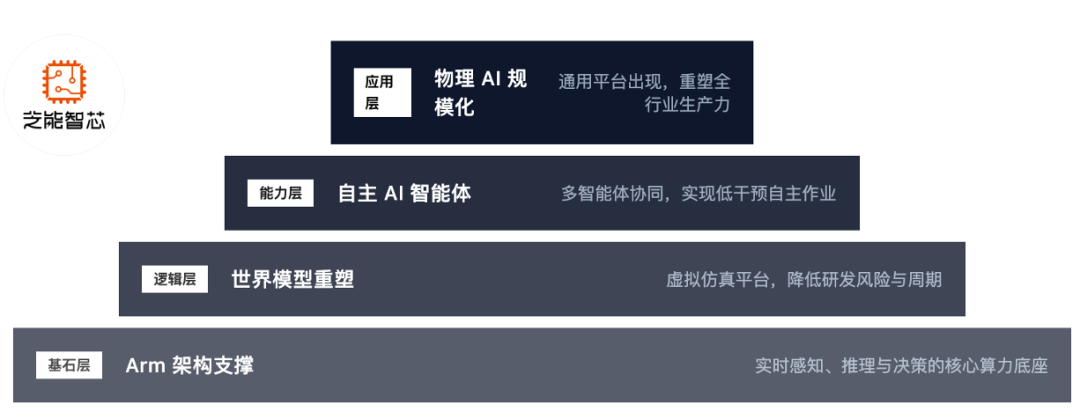
Whether in assisted/autonomous driving, where the automotive industry is increasingly converging around world model technology, physical AI and robots rely on world models. Warehouse high-fidelity simulation technology constructs virtual environments, providing robots with an 'AI simulation testing platform.'
Developers can complete training, stress testing, and iterative optimization before deployment, significantly reducing research and development risks and shortening development cycles, applicable to robot R&D validation in complex scenarios like warehousing.
AI will evolve into autonomous agents, with multi-agent orchestration technology widely applied.
Future robots will operate with limited human intervention:
◎ In industrial manufacturing scenarios, supervised AI can autonomously monitor production processes and coordinate with industrial robots;
◎ In logistics scenarios, agent systems can proactively schedule robots for restocking and path adjustments, replacing traditional scheduling response models.
The large-scale deployment of physical AI will empower the automated robot industry and reshape productivity across multiple sectors. A universal computing platform for robot automation scenarios will enhance scalability and accelerate the development and implementation of physical AI systems.
Part 2: Core Product Technologies Behind Automotive and Robotics
As the era of physical AI accelerates, automobiles are transforming from mere transportation tools into AI-defined platforms, supporting autonomous driving, AI-driven infotainment, and personalized driving experiences.
Meanwhile, robotics has entered a new chapter—humanoid robots, autonomous mobile robots (AMRs), and intelligent industrial systems will all possess real-time perception, reasoning, and decision-making capabilities.
This requires a 'safety-first' computing platform that combines exceptional computing performance, flexible scalability, and maximum energy efficiency.
Arm's strength lies in its mature automotive solutions, which can be seamlessly adapted to humanoid and industrial robots through technology reuse and scenario-specific architectures, further enhancing Arm's robust ecological synergy.
Arm processors are already widely used in various robot products and continue to collaborate deeply with global ecosystem partners. Leveraging their 'high energy efficiency + high reliability + high adaptability' technological advantages, Arm processors have become the core technological foundation for the future development of AI robots.
Arm-based computing platforms form the backbone of physical AI and robot computing power:
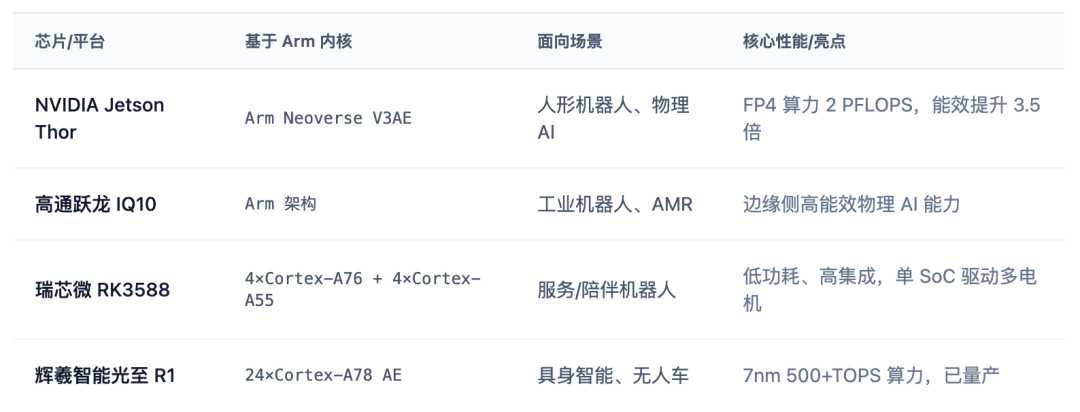
◎ NVIDIA Jetson Thor, built on the Arm Neoverse V3AE architecture, is the core computing platform for physical AI and robot iteration, focusing on real-time multi-model AI workflows. It supports robots in simultaneously performing perception, reasoning, and action execution, enabling end-to-end physical AI implementation on robotic platforms. Paired with NVIDIA Blackwell, it delivers up to 2 petaFLOPS of FP4 computing power, achieving a 7.5x performance boost and 3.5x energy efficiency improvement over Jetson Orin. The platform's CPU performance increases by 3.1x, integrating more cores and stronger GPU performance to solidify real-time control computing foundations. The Arm Neoverse V3AE excels in single-core performance and scalability, capable of loading and running multiple complex AI models. Leveraging leading performance per watt, it ensures sustainable operation of advanced AI workloads on edge robots, enabling multi-data sensor fusion, generative AI execution, and safe real-time decision-making in high-response scenarios.
◎ Qualcomm Yuelong IQ10 Series Robot Processors: During CES 2026, Qualcomm introduced the Yuelong IQ10 series, targeting high-end applications such as industrial robots, autonomous mobile robots (AMRs), and humanoid robots. Qualcomm's robot solutions, also built on the Arm architecture, deliver efficient and high-performance physical AI capabilities at the edge.
◎ Rockchip RK3588 Chip: The RK3588 features an 8-core design (4×Cortex-A76 + 4×Cortex-A55), integrating a powerful graphics processor and multimedia acceleration unit. As a high-performance, low-power general-purpose SoC, it targets AIoT, smart cockpits, robots, and industrial control scenarios. During this period, Rockchip showcased its RK3588-based robot development platform and binocular vision algorithm overseas for the first time, offering three core advantages: deeply optimized performance, highly integrated core modules, and a rapid development process. It supports the development and scenario deployment of service, educational, and companion robots.
◎ HuiXi Intelligence Guangzhi R1 Chip: Developed by HuiXi Intelligence, the Guangzhi R1 chip is optimized for embodied intelligence. Released in October 2024, it adopts a 7nm automotive-grade manufacturing process, features an 8-core SIMT architecture, and includes 24 Arm Cortex-A78 AE cores, delivering over 500 TOPS of AI computing power and over 420kDMIPS of CPU computing power. Integrated into the RISE computing platform, which achieved mass production and delivery in October 2025, the chip has been deployed in robot products like the Zhiyuan Elf G2 and validated in complex scenarios such as Jiushi Intelligence's L4-level automated logistics vehicles.
If we carefully dissect and trace the design of robots, extending from chips to robot products, we can see that multiple popular robot products are currently supported by Arm technology.
◎ Unitree Technology (featured in the Spring Festival Gala performance 'Wu BOT'): The humanoid robots H2 and G1 are equipped with NVIDIA Jetson Thor and NVIDIA Jetson Orin, respectively, both based on the Arm architecture. The H2, powered by Jetson AGX Thor, delivers up to 2070 TOPS of computing power, enabling the deployment of various embodied intelligence large models and empowering diverse work scenarios, pushing the boundaries of humanoid robots.
The G1 exhibits flexibility beyond human capabilities, with strong programming and reinforcement learning-driven abilities, enabling precise object manipulation mimicking human hands and incorporating UnifoLM (Unitree's unified large robot model).
◎ Songyan Power (featured in the 2026 Spring Festival Gala performance 'Grandma's Favorite'): The humanoid robots E1 and N2 are both built on the Jetson Orin Nano Super, based on the Arm architecture.
The E1 has completed real-world testing in multiple scenarios, demonstrating exceptional stability in performing challenging actions such as smooth dancing, jumping, and navigating complex terrains. It supports deeply customized development, quickly adapting to diverse scenarios like scientific research and education.
The N2 is the world's first robot capable of performing multiple consecutive backflips across various scenarios. With its bionic design and agile chassis, it achieves precise and controllable high-level actions like dancing, jumping, and backflips, positioning it at a high level in the industry for motion performance.
◎ Yinhe General: The Yinhe General G1 robot, unveiled at this year's Spring Festival Gala, features a wheeled chassis + folding leg integrated design.
Powered by the NVIDIA AGX Orin chip, based on the Arm architecture, it boasts strong on-device AI computing power, enabling multimodal perception, autonomous decision-making, and precise dual-arm manipulation. With agile movement and natural interaction, it is widely applicable in scenarios such as industrial logistics, home services, educational research, commercial retail, and smart healthcare.
◎ CloudDeep Technology: Transitioning from the x86 architecture to the Rockchip RK3588 chip, based on the Arm architecture, it supports robot walking, running, and other motions with its streamlined software stack, 10-watt-class low power consumption, and the ability to drive 12 motors with a single SoC, leaving performance headroom for additional functional expansions.
The Lynx M20 Pro wheeled-legged robot, designed for industrial inspections and accident scene operations, can operate stably in rugged and complex environments, breaking through the application boundaries of traditional wheeled robots.
◎ Zhiyuan Robotics (AGIBOT): Launched robots built on NVIDIA Jetson Orin/Thor, having produced 5,000 humanoid robots since its establishment in early 2024. At CES 2026, it released the full-sized humanoid robot A2, focusing on ergonomic design.
Summary
What we may not know is that the vast majority of robot systems globally currently rely on Arm architecture-based processors for intelligent decision-making, control scheduling, environmental perception, and system coordination. Therefore, when delving into robots at the chip level, we need to spend more time organizing our understanding.
-
![]()
Doubao Work Unveiled! Domestic AI Leaders Fully Commit to the 'Work' Sector
-
![]()
Who’s Sounding the Alarm on ‘Rushed Vehicles’?
-
![]()
Over 5.3 Billion Yuan in Losses Over Three and a Half Years! Can Yonyou Reverse Its Fortunes Through Streamlining and AI Transformation?
-
![]()
Baidu AI Adopts Free Model: A Strategic Maneuver in Traffic and Monetization
-
![]()
Silicon-Based OLED Pioneer Unveils Financial Results: H1 Shipments Outpace Entire 2025 Volume
-
![]()
AI's First "Lost Summer"
-
![]()
Zeiss Makes Another €2.2 Million Bet: Will Eye Tracking Be the Next Big Thing in the Smart Glasses Industry?
-
![]()
RUNTO Ranking | Global Top TV ODM Factories' Shipment Figures for July 2026