Wang Xing Sounds the 'Offensive' Horn for Meituan’s AI Once Again. What Lies Ahead?
 04/01 2026
 456
456

The Food Delivery Battle Has Subsided, but the Pressure on Meituan’s AI Intensifies.
On March 26, after Meituan released its full-year 2025 financial results, many believed that Wang Xing and Meituan had weathered the storm. Some even suggested that the food delivery war had shifted into Meituan’s “comfort zone.”
The backdrop is that in February 2025, JD.com ignited a food delivery war, which escalated further when Taobao Flash Sale joined the fray in May. According to public reports, during this period, Alibaba, JD.com, and Meituan collectively subsidized between 80 billion to 100 billion yuan.
Has Meituan truly seen the worst of it?
As the defender, Meituan appeared to withstand multi-front attacks and maintain its position. Financially, its annual revenue reached 364.9 billion yuan, marking an 8.1% year-on-year increase. Net losses stood at 23.4 billion yuan, at the more favorable end of the 23.3 billion to 24.3 billion yuan range warned of in February.
Its core local commerce business reported a fourth-quarter loss of 10 billion yuan, a significant improvement from the 14.1 billion yuan loss in the third quarter. This improvement surpassed some analysts’ expectations.
Meanwhile, Meituan’s sales and marketing expenses declined month-on-month (decreasing by 6.2% quarter-on-quarter) in the fourth quarter, while delivery service revenue grew month-on-month (increasing by 2.4% quarter-on-quarter), reversing the declining trend of previous quarters. This indicates improving operational performance on the revenue side, despite reduced subsidies. Moreover, by year-end, Meituan held 106.8 billion yuan in cash and 60.1 billion yuan in short-term investments, leaving it well-positioned.
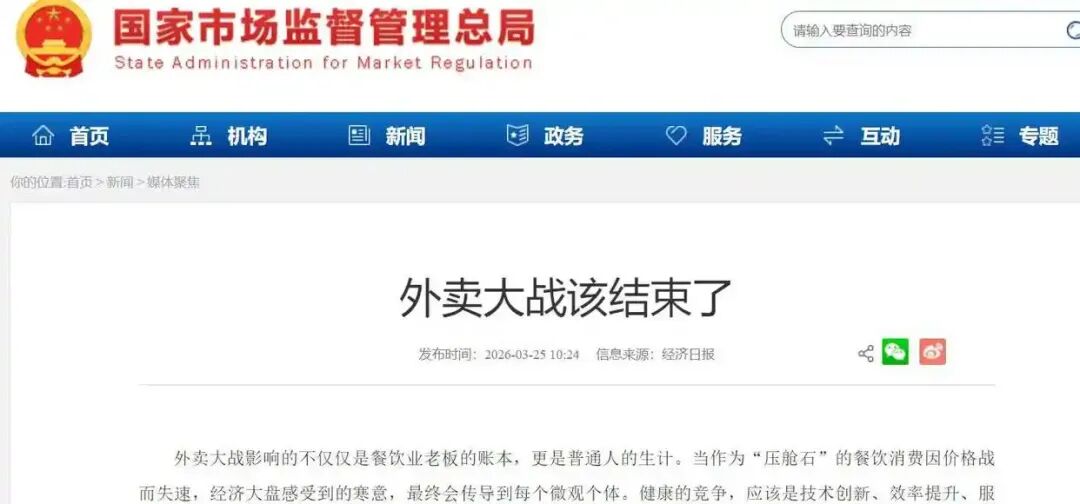 Figure: Screenshot of a commentary article
More importantly, the day before Meituan’s financial report, the State Administration for Market Regulation reposted an Economic Daily commentary titled “The Food Delivery War Should End,” criticizing how subsidy wars had dragged the catering industry into a “low-price first” trap and emphasizing that healthy competition should focus on technological innovation, efficiency improvements, and service optimization.
This move was seen as a regulatory call to halt the “involutionary” food delivery war.
These signals were interpreted as positive for Meituan, suggesting it had weathered the storm.
However, such views overlook a key fact: the food delivery war has always been an asymmetric conflict. Competitors like JD.com, Taobao Flash Sale, and Douyin are integrating peripheral businesses, constantly impacting Meituan’s core local services sector.
Moreover, regulatory guidance doesn’t mean the end of competition; it merely reshapes the rules. Meituan’s core business will continue to face pressure, let alone enter a “comfort zone.”
Furthermore, it will face an even more daunting challenge: the AI race.
Wang Xing doesn’t want Meituan to fall behind in the AI era. He has long positioned Meituan’s AI efforts as combative. During the March 2025 earnings call, he detailed Meituan’s AI strategy and industry competition, emphasizing that Meituan’s AI approach is offensive, not defensive. He even outlined a clear three-tier roadmap for Meituan’s AI strategy.
At this year’s earnings call, he reiterated the same rhetoric, setting the tone for Meituan’s AI strategy: “In the AI revolution, the only reasonable strategy is to attack, not defend.”
Perhaps to echo Wang Xing’s “offensive” AI signal, Meituan AI flexed its muscles: its self-developed large model, LongCat, has been in development for three years, with an ambitious goal of becoming an “AI-powered App.” It also proudly announced that, excluding companies with cloud computing businesses, Meituan’s AI investment scale is likely the largest among domestic enterprises.
Wang Xing intends to showcase Meituan AI’s new narrative to the market and industry. He used a metaphor to illustrate AI’s significance for Meituan: “There’s no essential difference between mobile internet and the internet, just like roses and peonies. But AI compared to the internet is like monkeys versus flowers—vastly different in scale and impact.”
He also specifically mentioned that AI Agents have had a greater impact on him than ChatGPT, “They are destined to create enormous productivity and will bring significant changes to organizations and work models.”
In the financial report, AI was elevated to an unprecedented strategic height: Meituan has launched a standalone smart life assistant app, “Xiaomei,” and opened its AI assistant, “Xiaotuan,” embedded in the Meituan app, to all users. At the technical foundation level, it integrates its self-developed multimodal LongCat series large models with open-source models. Looking ahead to 2026, Meituan’s strategic vision is to “fully embrace AI and build an all-around local life AI assistant.”
Wang Pu Zhong, CEO of Meituan’s core local commerce business, directly highlighted Meituan’s differentiated AI strategy: not competing head-on with rivals in general-purpose large models but embedding AI capabilities into its physical service network.
He stated, “We have the most comprehensive information, physical-world operational capabilities, drones, autonomous vehicles, and embodied AI.” Meituan will firmly invest in its foundational large models, developing low-inference-cost models that keep pace with industry leaders while building a physical-world data foundation and AI infrastructure with operational capabilities.
The Time for Wang Xing to “Attack” Is Running Out
Judging by the AI vision outlined by Wang Xing and Meituan, the company has secured a crucial position in the industry. As Guancha.cn evaluated, Meituan AI also has a “coherent” growth logic: leveraging AI to activate its heavy-asset network (millions of riders, hundreds of thousands of merchants, complex fulfillment chains), theoretically offering significant efficiency gains.
However, the issue lies in the fact that while this logic sounds reasonable, technological realities struggle to support it. Meituan AI’s anxiety has become more apparent as AI enters the Agent era, where competition shifts to AI’s ability to handle tasks.
Tencent Technology commented that this anxiety is also reflected in the financial report. In 2025, Meituan’s R&D spending reached 26 billion yuan, up 23.5% year-on-year, with its share of revenue increasing from 6.2% to 7.1%.
The financial report explicitly states that the primary growth driver is “increased company-wide investment in AI.” Even in the most loss-heavy Q4, quarterly R&D spending reached 7 billion yuan, up 29.7% year-on-year, showing that AI investment is accelerating rather than contracting.
Yet, increased investment hasn’t yielded proportional progress. Previously, I analyzed that Meituan AI shows a clear imbalance, being “heavy on B-side, light on C-side.” On the B-side, Meituan has launched a series of AI business assistants for catering merchants, including AI customer service, AI scheduling specialists, AI operations, and AI store managers, helping merchants reduce costs and improve efficiency.
Official data shows a 30% improvement in AI-driven site selection success rates, an 80% increase in customer service efficiency, and products like “Kangaroo Advisor” and “Kangaroo Steward” covering thousands of catering brands, generating over 100,000 reports with an 87% site selection accuracy rate.
However, progress on the C-side has been underwhelming. Meituan’s flagship standalone AI life service assistant, Xiaomei, its general-purpose AI assistant, LongCat, and its AI butler, Wen Xiaotuan, have struggled to form synergy, let alone gain widespread user recognition. Overall, Meituan’s AI approach on the C-side appears disjointed, lacking a clear strategic main storyline (core logic), with products operating in silos without coordination.
For example, Tabbit AI Browser, embroiled in plagiarism controversies, seems like a KPI-driven project outside Meituan’s main business, focused more on internal reporting than deeply integrating with core local services like food delivery and in-store experiences, failing to drive traffic or improve service closures. 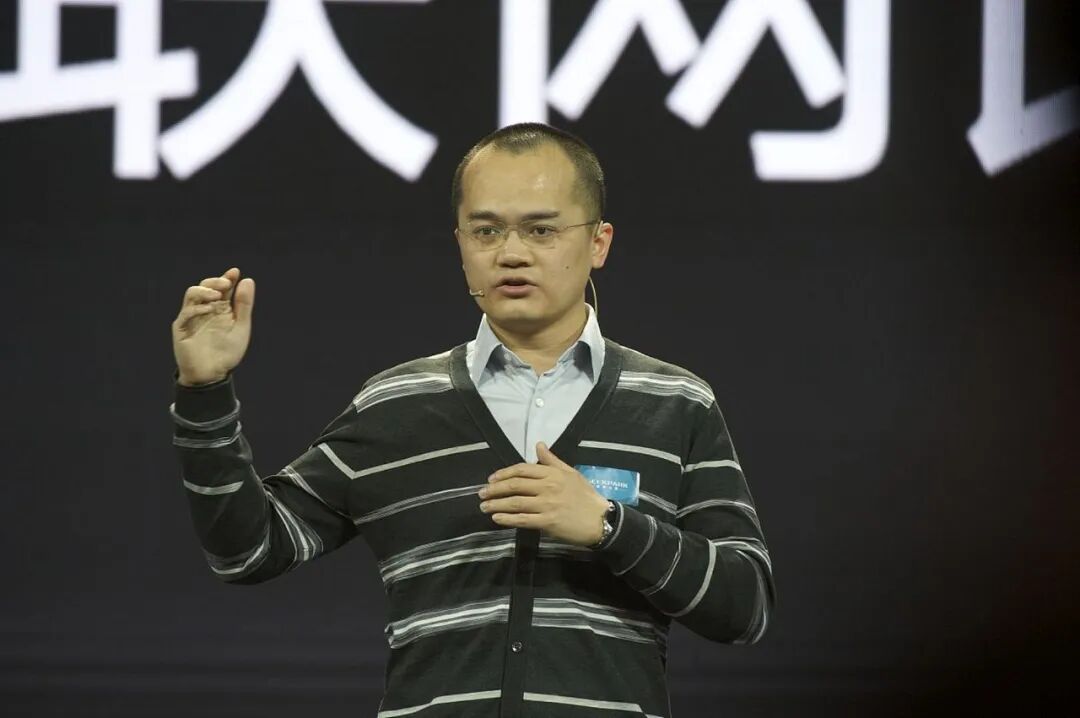
Figure: Meituan CEO Wang Xing (File Photo)
The importance of AI2C for Meituan cannot be overstated. If AI applications like Alibaba’s QianWen, ByteDance’s Doubao, WeChat’s Yuanbao, and Baidu’s Wenxin improve their AI Agents’ task-handling capabilities and become consumer decision-making gateways, Meituan risks becoming a bottom-layer “service pipeline,” losing competitive initiative, much like early telecom operators.
As seen when Doubao AI’s mobile-related functions were blocked, largely because AI bypassed app interceptions at the system level to complete service closures directly, relegating original platforms and apps to downstream “service providers,” passively isolated from users and even dependent on new AI gateway applications for traffic allocation, at their “mercy.”
This awkward situation doesn’t stem from Meituan’s unwillingness to invest in AI genuinely. Rather, after years of asymmetric warfare, Meituan has missed the strategic window to heavily invest in foundational models.
While its annual investment isn’t small, cash pressure from protracted battles in its core business has left it lagging behind peers like ByteDance and Alibaba. Media reports suggest Meituan originally planned an “AI-driven restructuring” of its core business in 2025, but the ongoing food delivery war disrupted this timeline.
Additionally, Meituan is undergoing strategic contraction. Currently, non-core businesses like hotels and Meituan Select are pausing expansion, Keeta’s internationalization in Brazil is on hold, and a 200-person team has been laid off. Internal management has shifted from “order volume growth” to “profit first,” even explicitly “banning ineffective innovation.”
Huxiu also revealed that Meituan’s S-Team recently upgraded its focus on AI and global expansion. Under the new structure, nearly every S-Team member oversees one or several key Meituan sectors. As CEO, Wang Xing now personally focuses on AI and global business.
Under this organizational tone, AI remains just one of Meituan’s “multiple funding directions.” In this context, Wang Xing’s “offensive” declaration feels more like a slogan. Ultimately, Meituan AI’s current progress cannot meet Wang Xing’s “offensive” expectations.
Wang Xing clearly understands AI as a “super gateway.” He believes the key lies in precisely understanding user needs and efficiently executing tasks. Especially in local services, where consumption scenarios are complex, merchant information is fragmented, and data remains inadequately digitized. Meanwhile, local service platforms must deeply manage fulfillment and delivery—capabilities general AI lacks.
This requires Meituan AI to possess strong task-handling abilities. However, judging by the execution effectiveness of AI applications like Wen Xiaotuan and Xiaomei, Meituan hasn’t yet established a path for AI to transition from “auxiliary Q&A” to “autonomous execution.”
This demands greater patience from Wang Xing. Currently, Meituan seems more willing to allocate resources to quick-win, implementable business expansion projects to safeguard its core physical infrastructure.
For instance, before the Lunar New Year, Meituan acquired Dingdong to strengthen its instant retail defenses—a “space-for-time” strategy to buy more time for Meituan AI’s development.
I’ve also argued that to alleviate Meituan’s AI anxiety, Wang Xing must prioritize AI even more, personally taking charge and elevating it to a “CEO-level project.” Meituan needs to clearly define its AI strategic direction and execute it more efficiently and effectively. Only by fully committing to AI can it preserve its core competitiveness.
For Meituan, it remains in the game but lacks the “all-in” resolve of its peers. That determination can only come from Wang Xing. It’s time for him to step forward again.
Now, Wang Xing has stepped up, managing AI with CEO-level intensity. Yet, he still lacks the decisiveness of the “Thousand-Group War” era, when he could abruptly halt expansion to focus resources on serving consumers. Now, he must clarify AI’s strategic main storyline (core path): continue patching up the B-side or truly concentrate firepower on conquering the C-side gateway?
For Meituan, the time to prove that “offensive” is more than a slogan is truly running out.
References:
Guancha.cn: “Meituan and Wang Xing: Are They Really Going on the Offensive in AI?”
Tencent Technology: “Wang Xing Doesn’t Want to Be Just ‘Brother Xing’ or Merely a ‘Food Delivery Guy’”
Tang Chen's Classmate: “To Ease AI Anxiety, Wang Xing Needs the Fighting Spirit of the Thousand-Group War”
-
![]()
The Allure of 'Acquisition Spree': Li Shufu's Left Turn, Xu Jiayin's Right
-
![]()
Strategic Transformation Yields Results: Phoenix Optics Reports 10.9% YoY Rise in Core Net Profit for H1 2026
-
![]()
Three Key Growth Trajectories Synergize! Crystal-Optech Reports 3.478 Billion Yuan in Revenue for H1 2026
-
![]()
Semi-Annual Report Sparks XPENG Motors Buzz
-
![]()
1.6 Billion Big Order Secured! SeeYA Technology's Revenue Soars by 287.87% in the First Half of the Year
-
![]()
Baidu's Profits Plunge by 68%: Unraveling the Mystery Behind the Numbers
-
![]()
Baidu’s Profits Tumble by 68%! Where Has All the Money Gone?
-
![]()
Hynix’s Taobao Store Shuts Down Abruptly: What Should Customers Do About Warranty Services for Memory Modules?