AI ‘Account Farmers’ Get the Boot from WeChat! It’s Time for a Serious Talk on ‘AI Writing’
 04/10 2026
 628
628
Where Are We Headed in the AI-Driven Content Era?
What would our world look like if every piece of content we encountered was crafted by AI?
As a tech media outlet that keeps a close eye on AI developments, the team at Leikeji (ID: leitech) is acutely aware of AI’s growing influence on our industry. Many of our peers have fully embraced AI, transitioning from using it merely for information searches to AI-assisted drafting, and eventually to AI-generated drafts refined by human editors. The involvement of AI in content creation is undeniably on the rise, making the process faster and more detailed, yet significantly diminishing the ‘human touch.’
Recently, WeChat’s official account platform has seen a surge in ‘fully AI-operated’ accounts. These accounts tirelessly scour the internet for information, automatically drafting, formatting, and publishing articles as soon as a new trending topic emerges. By the time human creators are still brainstorming their approach, AI-generated articles are already out in the world.
Efficient, rapid, cost-effective, and capable of driving massive traffic—it sounds like a content creator’s dream, doesn’t it? And some have already cashed in on this trend. A few days ago, an entrepreneur named ‘Cheng Qian’s Friend Circle’ shared a business plan centered around ‘a couple earning 2 million yuan annually by leveraging AI for their official account content.’
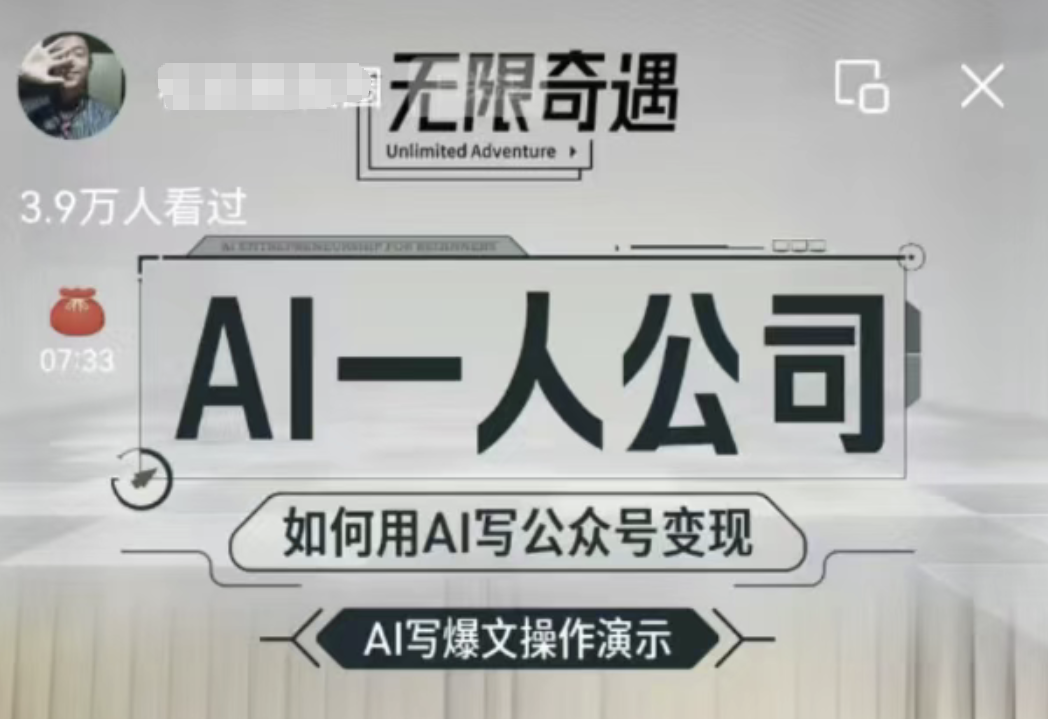
Image Source: Weibo
Leikeji (ID: leitech) delved into the details of their business plan. Essentially, it relies on AI to monitor viral articles and then mimics them to produce similar content (which is essentially plagiarism). Success hinges on striking it lucky with a ‘viral hit’ and earning advertising revenue.
According to their plan, this operation can be easily replicated (and is essentially fully AI-managed). This means even individuals without relevant skills can swiftly launch an account and start publishing on WeChat. Frankly, this is tantamount to openly declaring to WeChat, ‘I’m going to flood your platform with content.’

Image Source: Weibo
And then, WeChat cracked down—hard.
Starting on the morning of April 9th, reports began surfacing online of official accounts having all their articles from the past five days deleted due to suspected use of AI tools for creation and publication. Some accounts were even suspended outright for engaging in ‘non-human automated creation behavior.’
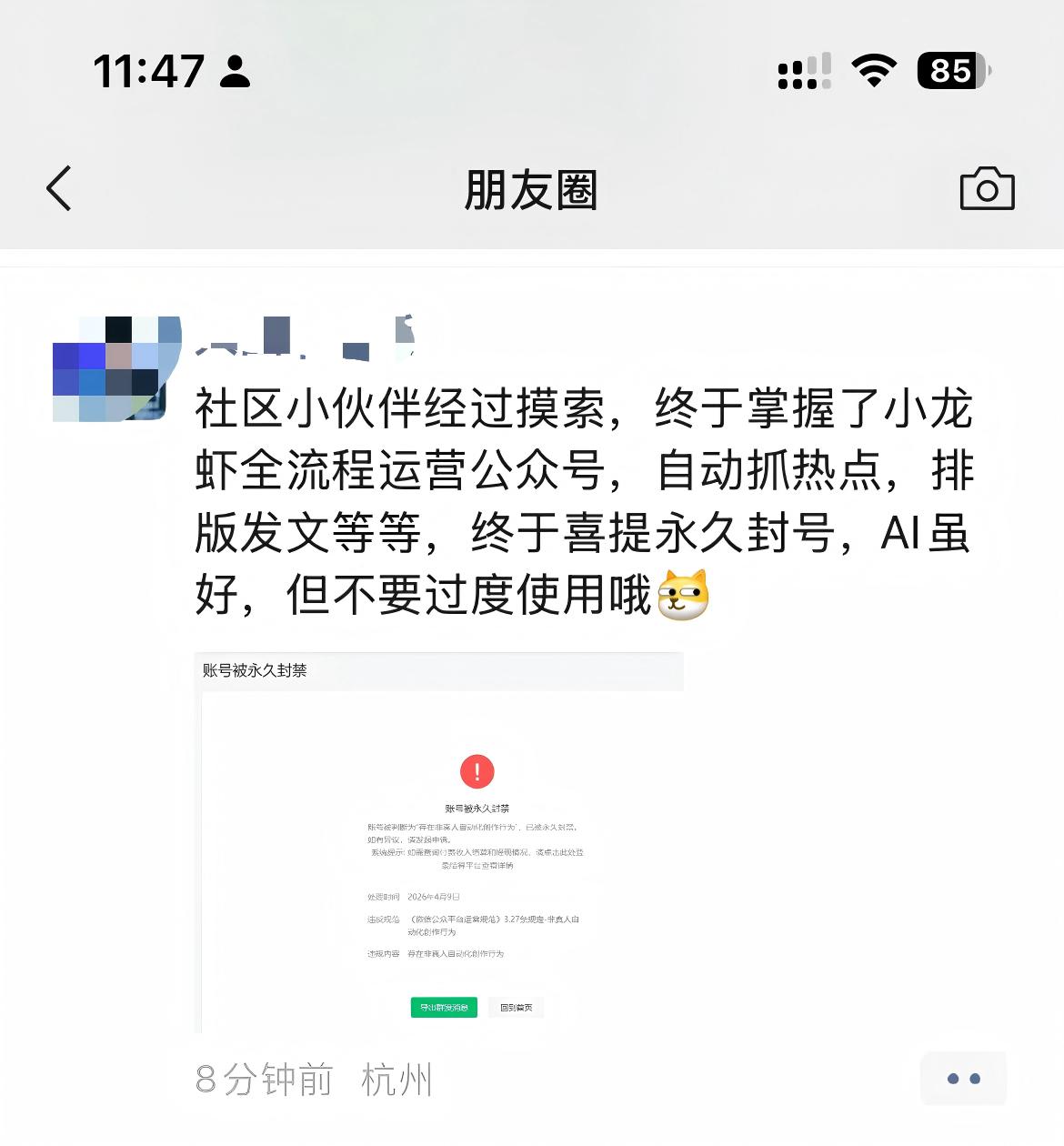
Image Source: WeChat Community
But that’s not the worst of it. One AI creator, after some trial and error, finally automated the entire management process of an official account using OpenClaw, only to be met with a permanent ban. Clearly, WeChat has a zero-tolerance policy towards fully AI-managed official accounts.
Moreover, there’s no room for appeal, as the newly added Article 3.27 in the ‘WeChat Official Account Platform Operation Norms’ explicitly states that ‘using AI, scripts, interfaces, or other automated methods to replace humans in completing content creation, publication, and other processes on official accounts and service accounts’ is a violation.
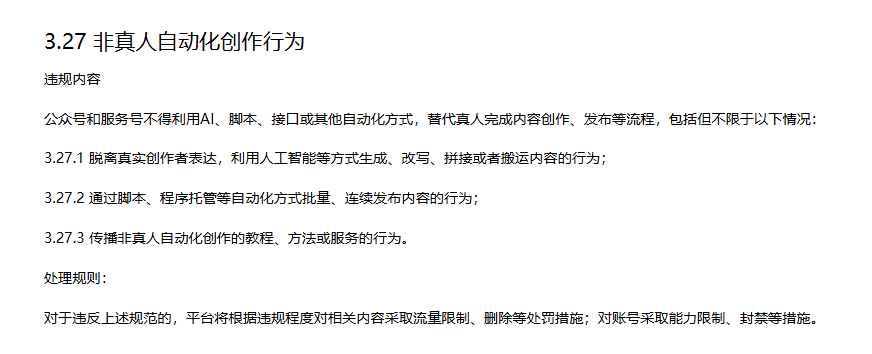
Image Source: WeChat Official Account Platform
Don’t Let ‘AI’ Dominate the Content Battlefield
To be honest, when I first learned about this, I was taken aback. I had anticipated WeChat’s intervention in AI-generated content, but not with such swiftness and decisiveness—offering a one-stop solution of deleting articles, suspending services, and banning accounts.
Of course, if you ask Leikeji (ID: leitech) for our stance on this matter, my response is, ‘It’s a commendable ban.’
Because one of Leikeji’s internal creation rules is that while AI can be utilized for information searches, typo checks, and sentence corrections, it cannot be used for direct content creation. AI can serve as an auxiliary tool, but it cannot become the ‘creator.’ This conclusion was reached by Leikeji after experimenting with AI-generated drafts.
Regular readers of our official account may recall our ‘Apple 50th Anniversary Special,’ created with AI assistance some time ago. This marked the first (and likely the last) time Leikeji (ID: leitech) fully entrusted creative control to AI, and the results were far from satisfactory.

Image Source: Leikeji
Let’s not even discuss the average readership performance of the special (which was likely throttled). The biggest flaw in the articles themselves was the lack of ‘emotion.’ While they could depict what Apple ‘did,’ they struggled to evoke ‘emotional resonance’ in readers because AI itself lacks ‘emotions.’
At this point, someone might argue, ‘That’s not true. I’ve used Doubao and chatted with her. She feels real.’ Indeed, AI is capable of displaying a ‘human touch.’ It can even use overly sweet words to make you feel good. So why can’t it do the same when writing lengthy articles?
The answer lies in ‘Temperature.’ This is a parameter that general AI large models don’t display on their web pages or software, but it can be adjusted in the developer backend. When the Temperature value is below 0.3, AI tends to produce highly certain, rigorous, and conservative content.

Image Source: Leikeji
In simpler terms, it uses ‘facts’ as the highest judgment criterion and outputs answers in concise, direct language. The ‘human touch’ emerges from AI’s ‘hallucinations,’ which generally require the Temperature parameter to be set above 0.7.
Therefore, demanding both accurate and rigorous data and conclusions while also being ‘full of human touch’ is a tall order for AI at this stage because you can’t have it ‘both ways.’
This is why readers in the digital tech circle can quickly discern whether the creator behind an article is human or AI. Authors often heighten their requirements for verifying data and facts when using AI, prompting AI to lower the Temperature in pursuit of accuracy, resulting in articles devoid of a ‘human touch.’
AI Doesn’t ‘Think,’ It Just Rearranges and Combines
Additionally, while testing AI-generated drafts in my spare time, I noticed several issues with AI articles. One is data hallucination. Even when required to strictly verify the source and authenticity of data, hallucinations and errors can still occur, such as attributing a function that Product A lacks but Product B possesses to Product A.
Another issue is the inability to accurately pinpoint the ‘key points’ that users are interested in, necessitating manual adjustment and optimization by the author. To be honest, after all this back-and-forth, it might be even more exhausting than writing an article yourself (if you’re aiming for quality). In short, AI-generated articles often resemble a seemingly sumptuous but nutritionally deficient ‘feast.’ You can see that the ‘ingredients’ are plentiful, but it’s hard to find anything truly novel.
What constitutes something truly novel? We generally refer to it as ‘thinking,’ and AI doesn’t think.
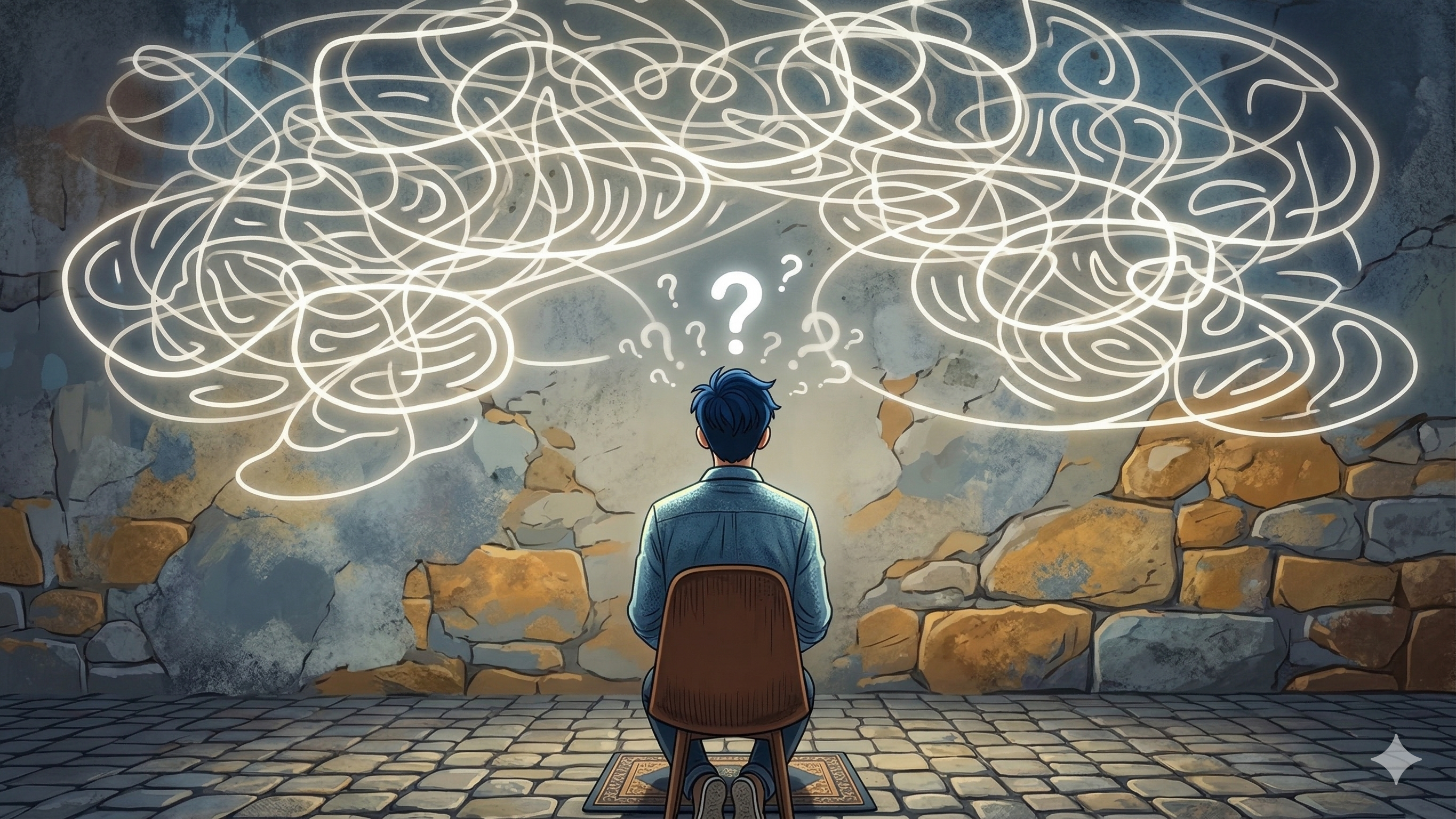
Image Source: Gemini
I’m aware that this viewpoint will be met with skepticism from many, but the fact remains that today’s AI is essentially an efficient keyword searcher. Its task is to unearth the most relevant vocabulary from databases and the internet based on the prompts you provide and then arrange these words into sentences, paragraphs, and chapters according to certain rules.
In reality, AI doesn’t comprehend what it writes. All its outputs are calculated based on existing algorithms and prompt requirements, meaning AI won’t produce anything ‘new.’ Its ‘creation’ is merely a rearrangement and processing of existing data.
Admittedly, AI’s capabilities have surpassed those of most ordinary individuals. A test report in the academic journal Scientific Reports points out that from a ‘creativity’ standpoint, AI already outperforms 90% of people (due to its mastery of ample materials and samples). However, the convergence of AI algorithms could potentially lead the global content library into a ‘similarity spiral.’
You can think of it as ‘AI generates a vast amount of content—AI content dominates—becomes the primary reference for other AIs—outputs similar content.’ Eventually, the content we encounter will gradually converge in the repetitive spiral of AI algorithms, leaving no room for diverse voices. To be honest, such a future is alarming because if humans even surrender their thinking abilities to AI, what will be left of us?

Image Source: Leikeji
This is precisely why Leikeji (ID: leitech) has always been reluctant to replace human creators with AI. We deeply understand that creators’ perspectives, thoughts, and experiences are irreplaceable by AI.
How Should We ‘Use’ AI?
From Leikeji’s (ID: leitech) perspective, the optimal role for AI among creators is as an auxiliary tool. It can assist you in swiftly summarizing data or uncovering information buried deep within the internet, but it should not be viewed as your ‘creation robot.’
Enhancing efficiency, not replacing—this is Leikeji’s stance. Remember, in the relationship between humans and AI, humans should always take the lead. Don’t let AI completely dominate your thoughts; otherwise, you’d truly be inferior to ‘AI.’
From a creator’s standpoint, how can we avoid being supplanted by AI? It’s simple: ‘Maintain thinking.’ Thinking is something that AI, at this stage and possibly in the future, will find challenging to replicate. Your perspectives, feelings, and cognitions may have flaws and may differ from the mainstream, but they are precisely the most valuable assets in an era inundated with AI-generated content.
Nowadays, various content platforms are grappling with the impact of AI-generated content. WeChat has fired the ‘first shot,’ and it’s likely that other platforms will follow suit. Some may perceive this as WeChat rejecting the ‘technological revolution,’ but the essence is actually a platform’s stand against ‘content dilution.’ If WeChat becomes inundated with AI articles, the platform’s value will plummet rapidly—a scenario neither WeChat nor its creators desire.
After all, as creators, Leikeji (ID: leitech) often witnesses our hard-earned content being ‘AI-plagiarized’ into new original articles within 30 minutes. This is not only unfair to creators but also a disregard for human value.
Leikeji (ID: leitech) still hopes that when you click on our articles, you’re not encountering views and data ‘copied’ by AI, but our genuine perspectives and thoughts as humans, from a human standpoint.
Source: Leikeji
All images in this article are sourced from the 123RF licensed image library
-
![]()
Wang Huiwen, Former Meituan Executive, Achieves 20-Fold ROI, Supports 24 AI Startups
-
![]()
Another AI Computing Power Unicorn Launches IPO! Founded by a Changjiang Scholar
-
![]()
OFILM Holdings Secures Zhongke Daojing, Marking a Significant Leap in the Optical Communication Industry!
-
What Will Be the Next Key Battleground for Large Models After AI Coding?
-
![]()
Leapmotor's Sales Soar, Yet Hidden Concerns Loom
-
![]()
China’s Action Camera Market Soars: 3.12 Million Units Sold in Six Months, DJI Secures 74% Dominance
-
![]()
Zhang Yiming: Strategic Retreat as a Path Forward
-
![]()
Exploring Charging for Some Features of QianWen App: Can It Follow the Path of Doubao?