12.7 Million New Grads Vie for Lucrative AI Roles
 04/16 2026
 418
418
Image generated by AI
Vague AI Skill Descriptions No Longer Impress Employers
Written by Li Jinlin
Edited by Li Ji
Formatted by Annalee
The peak spring recruitment season, often referred to as the 'golden period' for job seekers, is a time when talent mobility and industry demand peak annually.
This year's spring recruitment scene is dominated by keywords such as 'AI,' 'algorithms,' and 'large models.' Positions in these areas have seen explosive growth, with average monthly salaries surpassing 60,000 RMB, making them highly sought-after 'golden jobs.' Leading companies like ByteDance, Tencent, Alibaba, and Baidu have significantly ramped up their recruitment for AI-related roles, investing heavily to attract top talent.
However, amidst this AI boom, 12.7 million college graduates, along with other job seekers, are hesitant to pursue AI positions due to the high demand and steep entry barriers.
In the AI wave, some individuals seize high-paying opportunities for rapid career growth, while others are left behind by technological advancements. Across the industry, only enterprises and individuals capable of practical application can truly thrive together.
AI Talent Commands High Salaries Across Industries
As AI advertisements permeate streets and neighborhoods, short video apps on mobile phones increasingly feature AI-generated content, and people turn to AI for emotional support or medical advice at the first sign of trouble, the vision of AI becoming a household staple has finally materialized.
Yet, simultaneously, concerns about being dominated or replaced by AI are escalating daily.
'Our company has a book production project. During the last project, from sketching to revisions and coloring, the overall speed doubled. Although our workload increased, the company didn’t need to hire more employees to handle the doubled output. If AI evolves to require fewer revisions in the future, the number of employees needed might even decrease. I’m very anxious about this,' said Tao Wan, a three-year industry veteran, whose job insecurity has deepened due to AI's rapid advancement.
Zhao Zinan, a headhunter with over five years of experience, has also noticed the impact of the AI wave. Over the past year, companies across various sectors have seen a surge in demand for AI talent, with the design industry being particularly prominent. Regardless of past work experience, proficiency in AI tools for work is now a standard requirement.
'Many clients now directly recruit AIGC visual designers, requiring mastery of mainstream AIGC video workflows and the ability to handle the instability of AI-generated materials. In the gaming industry, candidates applying for front-end development roles with experience in AI NPC development often gain significant advantages,' Zhao Zinan explained.
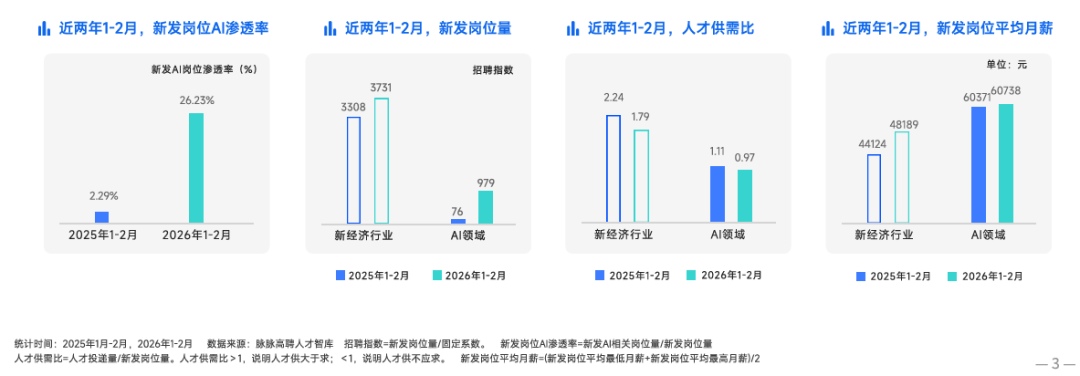
These trends are evident in this year's spring recruitment. According to data from Maimai's 'Social Recruitment – Insights into Mid-to-High-End Talent Recruitment in January-February 2026,' the number of AI positions surged nearly 12-fold year-on-year in January-February 2026, far outpacing the 12.77% growth in overall new economy sector jobs. AI positions now account for 26.23% of all new economy roles, up from just 2.29% in the same period of 2025, meaning one in every four new economy jobs is AI-related.
Source: Maimai
From an industry perspective, demand for AI positions has transcended the internet sector, permeating all industries.
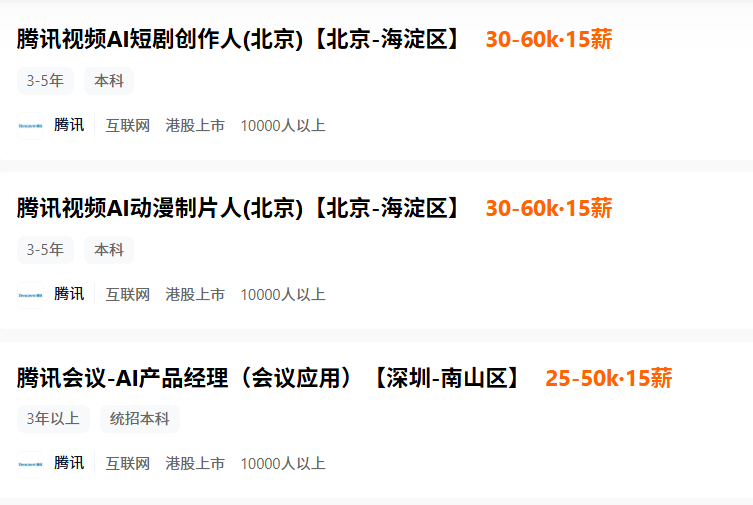
Internet giants remain the primary demanders of AI talent. ByteDance, Tencent, Alibaba, and Baidu have all expanded their recruitment for AI-related roles during the spring recruitment season, focusing on core areas like large model algorithms, AIGC, and AI security.
Ant Group officially announced the launch of its 2026 spring campus recruitment, with technical roles accounting for 85% of the positions, over 70% of which are directly related to artificial intelligence.
Meituan also launched its 'Beidou Plan,' a global recruitment initiative targeting top campus tech talent, focusing on business directions such as core local commerce, drones, autonomous vehicles, finance, and the Dianping business unit. The goal is to attract and accumulate top AI tech talent to support business development in the AI direction.
Baidu's AIDU Program has also been upgraded to a group-wide talent development initiative, attracting top talent through 'uncapped salaries + executive mentoring.'
Some AI Positions at Tencent
Beyond the internet sector, traditional industries are also experiencing explosive growth in demand for AI positions. For example, at Hunan's spring job fair, industries like home appliances, maternal and child care, and elderly care have all shown new demand for 'AI+,' creating more AI-related roles.
One Hunan-based tech company recruited smart home engineers on-site, requiring candidates to train stair-climbing floor-cleaning robots and help users equip their home appliances with 'AI brains.'
These 'AI+' roles, closely integrated with traditional industries, are continuously emerging in the job market, offering opportunities for fresh graduates.
Companies Start to Seek Experienced AI Talent
Accompanying the high demand for AI positions is their remarkably high salary levels, which have become one of the most eye-catching highlights of the spring recruitment market.
Data shows that the average monthly salary for AI positions in spring 2026 reached 60,738 RMB, about 26% higher than the new economy sector's average of 48,189 RMB, far surpassing salaries in other industries. Salaries for high-end roles have risen even further: AI scientists/heads average 137,153 RMB monthly, with annual salaries ranging from 1.2 to 2 million RMB or more; large model algorithm engineers average over 80,000 RMB monthly, with maximum annual salaries reaching 2.2 million RMB; high-performance computing engineers average 75,000 RMB monthly, with annual salaries ranging from 900,000 to 3 million RMB.
Even entry-level AI trainers and prompt engineers earn 25,000-40,000 RMB monthly, with annual salaries reaching 240,000-480,000 RMB, far exceeding typical white-collar salaries.
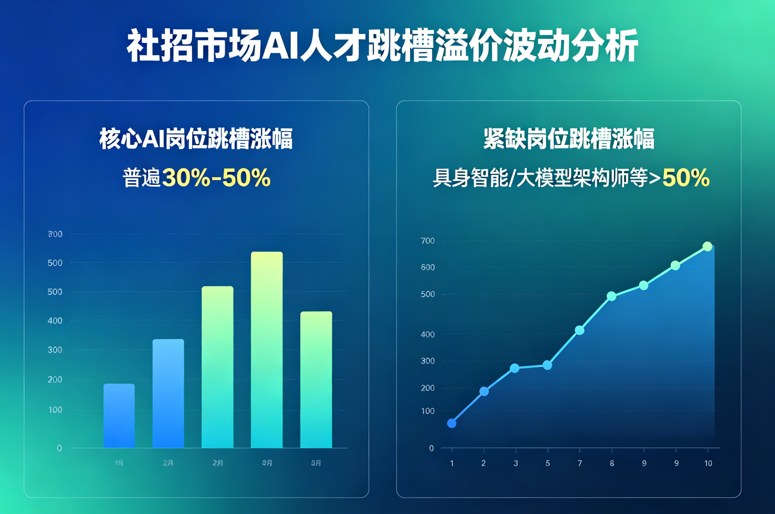
In the social recruitment market, 'job-hopping premiums' for AI talent fluctuate with market changes. Salary increases for core AI roles generally range from 30%-50%, with particularly scarce roles like embodied AI and large model architects seeing increases exceeding 50%.
However, amidst high salaries and high demand, job seekers face intensified competition pressure, with a dual squeeze of supply-demand imbalance and rising entry barriers.
From a supply-demand perspective, the talent supply-demand ratio for AI positions is just 0.97, indicating a talent shortage as there are fewer job seekers than available positions. In contrast, the new economy sector's overall talent supply-demand ratio is 1.79, nearly double that of AI roles. While this suggests less competition for AI jobs, the shortage only applies to core talent meeting the requirements.
Meanwhile, China's 2026 college graduate cohort reached 12.7 million, with about 15% majoring in AI, computer science, or related fields. However, very few graduates possess solid technical skills and practical project experience.
Thus, hiring difficulties and labor shortages coexist in the job market. On one side, countless job seekers vie to enter the AI field; on the other, companies struggle to find qualified talent despite offering high salaries. Take algorithm roles as an example: despite surging demand, many fresh graduates' resumes go unanswered, primarily due to a 'lack of practical experience' that fails to meet company requirements.
More importantly, companies' recruitment trends now show a clear shift toward seeking experienced AI talent, further raising the competitive bar for AI positions. In January-February 2026, over 70% of newly advertised AI roles required at least three years of experience, with a 19% year-on-year increase in roles requiring 3-5 years of experience. Meanwhile, roles targeting candidates with less than one year of experience shrank by about 20%.
Companies increasingly favor AI talent who can hit the ground running with ample experience, making it significantly harder for fresh graduates and newcomers to enter the AI field and more challenging for traditional industry professionals to transition.
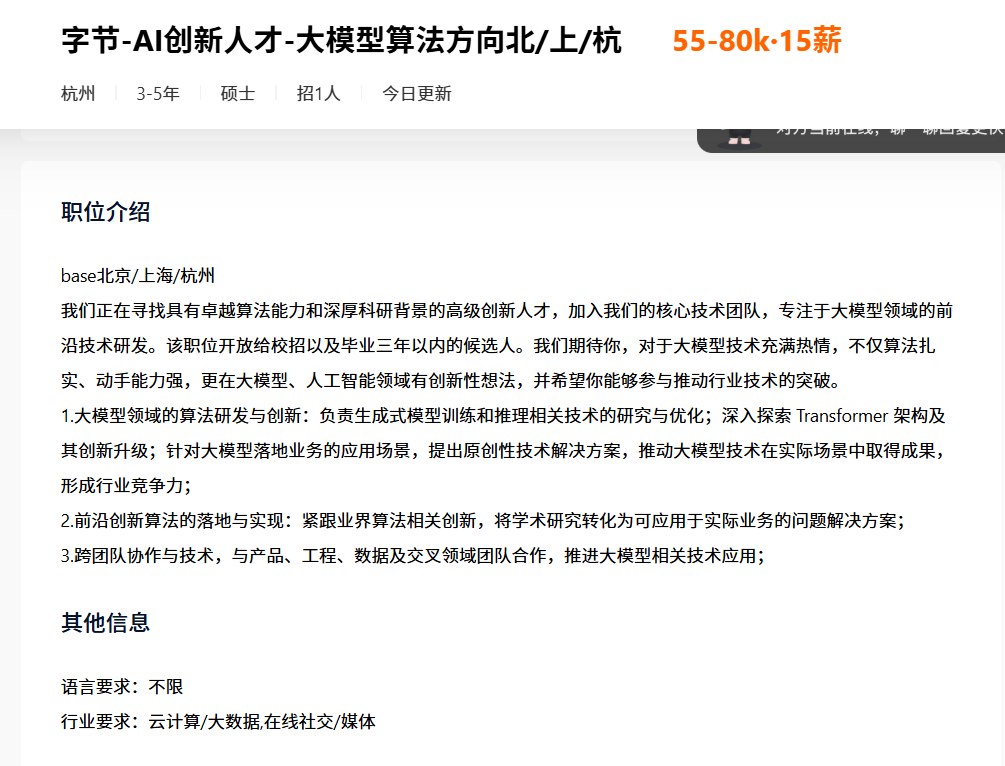
More AI Positions Are Shifting Away from Junior Roles
The professionalism and complexity of AI technology mean its entry barriers are far higher than ordinary roles. As the AI industry matures, companies' technical requirements for AI talent have evolved from mastering basic skills to possessing practical capabilities—the core reason for AI's high entry barriers.
In previous spring recruitment seasons, companies' requirements for AI talent centered on 'mastering tools like Python and TensorFlow' and 'understanding basic machine learning algorithms.' Many fresh graduates could meet these standards through short-term training. However, in the 2026 spring recruitment, such vague skill descriptions no longer impress company HR.
'Now, when screening resumes, seeing vague statements like 'proficient in TensorFlow' no longer impresses us. What truly moves us are candidates who can clearly explain how to use AI to solve specific business problems,' Zhao Zinan explained.
The high entry barriers companies set for AI talent essentially reflect their consideration of return on investment. Companies hire AI talent at high salaries primarily to enhance efficiency, reduce costs, and generate profits through AI technology. If AI talent cannot translate technology into commercial value, companies' investments will not pay off. Thus, companies prefer versatile professionals who understand business and can deliver results, even if salaries are higher, to maximize ROI.
Many job seekers only see the high salaries and active recruitment for AI roles but overlook the high entry barriers and their own skill gaps. They see industry opportunities but fail to find suitable paths to break through. In reality, the first step in navigating the AI wave is to overcome cognitive biases and recognize that the AI industry's heat does not mean it is accessible to everyone.
The 'golden period' of spring recruitment is nearing its end, but the impact of the AI wave is just beginning. In the AI era, the true 'iron rice bowl' is not a specific job but one's own core competitiveness.
-
![]()
Wang Huiwen, Former Meituan Executive, Achieves 20-Fold ROI, Supports 24 AI Startups
-
![]()
Another AI Computing Power Unicorn Launches IPO! Founded by a Changjiang Scholar
-
![]()
OFILM Holdings Secures Zhongke Daojing, Marking a Significant Leap in the Optical Communication Industry!
-
What Will Be the Next Key Battleground for Large Models After AI Coding?
-
![]()
Leapmotor's Sales Soar, Yet Hidden Concerns Loom
-
![]()
China’s Action Camera Market Soars: 3.12 Million Units Sold in Six Months, DJI Secures 74% Dominance
-
![]()
Zhang Yiming: Strategic Retreat as a Path Forward
-
![]()
Exploring Charging for Some Features of QianWen App: Can It Follow the Path of Doubao?