Musk Loses, Altman Wins, The Feud Between Brothers Has Just Begun
 05/20 2026
 627
627
OpenAI's Win Was Far From Glorious
Author|Wang Lei
Editor|Qin Zhangyong
Elon Musk, fresh off a flight from China to the U.S., found himself facing a major headache.
After nearly three years of litigation involving $150 billion and a three-week trial, he lost the case.
The jury took less than two hours to reach a verdict, citing a dramatic reason: Musk had sued too late. They ruled that his claims exceeded the statute of limitations, absolving OpenAI and other defendants of liability.
Even more surreal was that neither Musk nor Altman, the two protagonists in this epic battle, were present in court when the verdict was announced.
Furious, Musk lashed out on social media, branding the judge a "terrible radical" and accusing the court of avoiding the core issues by hiding behind "technicalities," effectively issuing a "license to loot charities."
So, without hesitation, Musk vowed to appeal.
Despite his outrage, this high-profile lawsuit has indeed reached its first interim conclusion.
01
Defeated by Time
Musk likely never expected that this $150 billion lawsuit would hinge on such a basic legal technicality.
In reality, the jury did not rule on whether OpenAI had abandoned its non-profit mission or whether Altman and Brockman had profited improperly.
The court only determined one thing: Musk had sued too late, exceeding the statute of limitations.
Musk raised three core allegations: breach of charitable trust, unjust enrichment, and Microsoft's aiding and abetting.
Under California law, the statute of limitations for breach of charitable trust is three years from the date the right holder knew or should have known of the harm and the obligor, while for unjust enrichment, it is two years.
Musk filed the lawsuit in February 2024, meaning he needed to prove that he was unaware before February 2021 that OpenAI had violated its original non-profit founding agreement.
However, OpenAI's legal team was well-prepared. During the three-week trial, OpenAI's lawyers presented a wealth of evidence, including private texts and emails, proving that Musk had known and personally participated in discussions about OpenAI's transition to a for-profit structure as early as 2017.
For instance, after OpenAI's AI defeated top Dota 2 players in the summer of 2017, Musk immediately sent an email stating, "Time to take the next step." That next step may have been discussing OpenAI's for-profit transformation.
Not only did he know about it, but he was also an active promoter of the transition, proposing to merge OpenAI with Tesla and demanding majority control of the merged entity. Evidence even revealed that Musk and Zuckerberg had exchanged texts discussing a joint acquisition of OpenAI. Thus, the jury concluded that Musk had known the relevant facts years earlier.
Moreover, OpenAI's lawyers proved a crucial fact: Musk had become aware of OpenAI's for-profit transition as early as 2021.
Musk had personally texted Altman, expressing his discomfort over OpenAI's $20 billion valuation and calling it "a wolf in sheep's clothing." The key decisions for OpenAI's formal commercialization occurred between 2019 and 2021, all conducted openly and with extensive media coverage.
Yet Musk waited until 2024 to file the lawsuit. In California, the statute of limitations is a procedural barrier—once deemed expired, the court does not need to proceed to substantive review. In other words, Musk had already lost the moment he filed the lawsuit.....
Musk explained that he still trusted Altman's promises until Microsoft's $10 billion investment in 2023 made him realize that "the for-profit arm was the dog wagging the tail." He compared it on the witness stand: "Thinking someone might steal your car is different from someone actually stealing it." In other words, if he had known their intentions earlier, he would have sued sooner.
But the jury clearly disagreed.
They ruled that Musk's lawsuit exceeded the three-year statute of limitations, making it unnecessary to adjudicate whether OpenAI had "deviated from its charitable mission." This also meant that Musk's three core allegations may not have been formally discussed by the jury.
Thus, Musk's lead attorney's first response after leaving the court was to announce an appeal.
However, presiding Judge Yvonne Gonzalez Rogers bluntly stated after the ruling, "There is substantial evidence supporting the jury's verdict."
She also told Musk's lawyers that the statute of limitations was a factual determination, making it extremely difficult to overturn on appeal. In court, she even indicated she was prepared to "dismiss on the spot" any potential appeal by Musk.
02
OpenAI's Win Was Far From Glorious
Once the ruling was announced, news spread rapidly on social media, with mixed reactions.
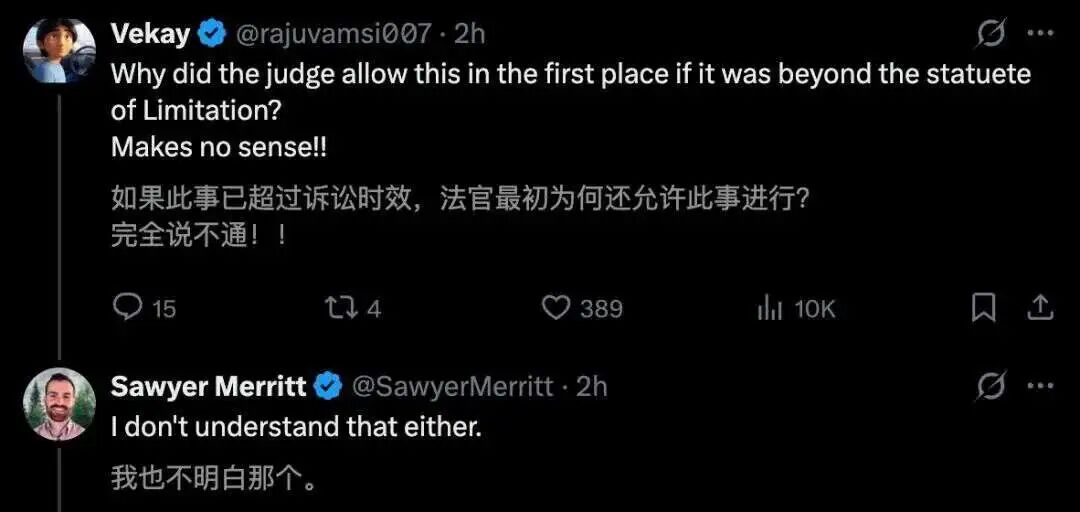
Some netizens expressed confusion, arguing that failing to consider the statute of limitations before filing seemed reckless. "If the case truly exceeded the statute of limitations, why did the judge allow it to proceed to trial? It makes no sense and seems like a waste of everyone's time and money."
Musk's supporters sharply criticized the ruling, claiming that a radical judge had let Altman off the hook after he transformed a non-profit organization meant to benefit humanity into a for-profit empire worth hundreds of billions of dollars, using "timeliness" to betray public trust.
After the verdict, Musk took to social media platform X to announce his appeal to the U.S. Ninth Circuit Court of Appeals. He criticized the jury and judge for basing their decision on "technical calendar details" rather than the "substance of the case."
He straightforward (He stated bluntly): "Overturning this legal precedent of plundering charities would be highly destructive to U.S. charitable giving," implying that the legal battle was far from over.
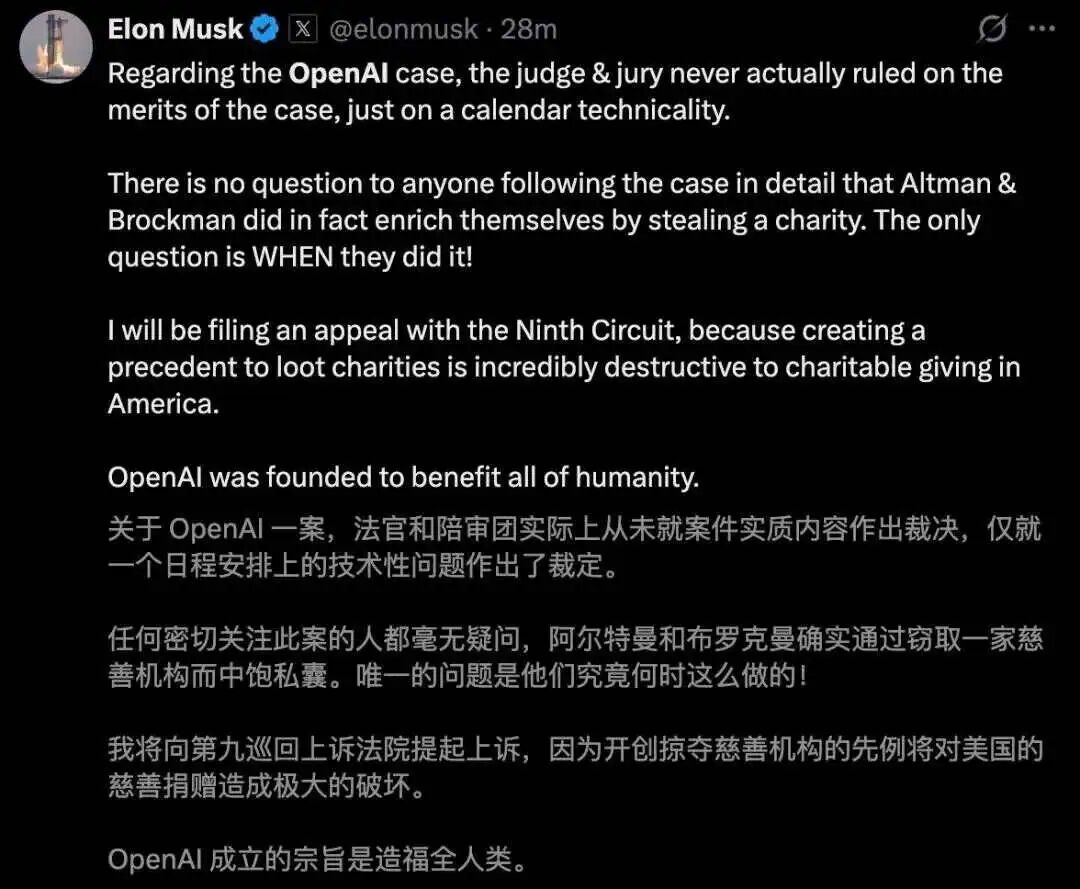
He also claimed that anyone following the case closely would have no doubt that Altman and Brockman had enriched themselves by stealing from a charity. The only question was when they did it.
In contrast, OpenAI's lead trial attorney, William Savitt, stated, "The jury's ruling confirms that this lawsuit was nothing more than a hypocritical attempt to suppress a competitor and conceal his own extremely poor predictions about OpenAI's past and future development."
A Microsoft spokesperson welcomed the ruling in a statement, saying, "The facts and timeline of this case have always been clear," and reaffirmed Microsoft's commitment to partnering with OpenAI to bring AI to users worldwide.
While OpenAI technically won, its victory was far from glorious. During the three-week trial, a trove of internal documents was disclosed, revealing turmoil and gray areas within the world's hottest AI company.
For instance, Altman lied about security clearances, was briefly ousted by the board in 2023, and there were related-party transactions with Cerebras. More subtly, when Altman was asked on the witness stand whether he was fully trustworthy, he did not give a definitive answer.
The trial also exposed the wealth accumulated by OpenAI's founders and early investors: Brockman's stake is worth nearly $30 billion, while former chief scientist Ilya Sutskever's equity is valued at around $7 billion.
Although Altman himself holds no direct shares, he owns stakes in multiple companies partnered with OpenAI, including $1.7 billion in Helion Energy, $633 million in Stripe, and roughly $25 million in Cerebras Systems.
At least for now, OpenAI has secured a significant legal victory, clearing a major hurdle for its potential trillion-dollar IPO.
03
The Game Isn't Over
To understand the feud between these tech titans, we must rewind to 2015.
In 2015, Musk, Altman, Greg Brockman, and a group of top AI researchers founded OpenAI as a non-profit organization with the ideal of preventing artificial intelligence from destroying humanity.
The logic was that as a non-profit, OpenAI could occupy the "moral high ground" in competition with giants like Google, attracting top talent and winning public trust without maximizing shareholder value.
Based on this vision, Musk donated approximately $38 million between 2016 and 2020. His lawyers emphasized that this donation was made on the explicit premise that OpenAI would develop AI "for the benefit of humanity," not to enrich anyone.
However, subsequent developments deviated entirely from his expectations. OpenAI gradually transformed into a for-profit entity, deeply aligned with Microsoft, with its valuation soaring to $852 billion (approximately 5.8 trillion yuan), becoming a global AI super-unicorn.
In 2018, Musk left the board, citing conflicts of interest with Tesla's business. In 2023, he founded his own AI company, xAI, and launched the Grok model, directly competing with OpenAI.
In 2024, Musk accused OpenAI of "stealing a charity" by abandoning its original public-interest mission. He also alleged that they had tricked him into donating $38 million, only to betray his trust. Thus, he sued OpenAI and Microsoft, demanding that they uphold the original public-interest agreement.
In this lawsuit, Musk sought over $150 billion (approximately 1.02 trillion yuan) in damages from OpenAI and Microsoft. His demands were: not a penny for himself, with all damages going to OpenAI's charitable arm.
He also demanded that OpenAI return to its non-profit status, remove Altman and Brockman from their positions, and oust Altman from the board.
Perhaps no one expected such a high-profile $150 billion lawsuit to end so abruptly due to the statute of limitations. Of course, Musk will not back down easily—he still has cards to play.
Musk's lawsuit also includes antitrust allegations against OpenAI and Microsoft, claiming they established a monopoly through cooperation and that OpenAI had pressured investors not to fund rival AI startups, directly harming his xAI.
Presiding Judge Rogers chose to split the case into multiple phases, with the antitrust claims scheduled for the next phase.
The feud between these two billionaire titans is far from over.
-
![]()
AI Titans Are All in the Red: Time for Intelligent Driving Car Buyers to Reassess?
-
![]()
In the Next Decade of Joint Ventures, Honda Should Move Away from 'Stubbornness'
-
![]()
Operating Profit Plummets by 57%! What Caused Tesla’s Profitability to Decline in Q2?
-
![]()
Starting at 12,999 Yuan! Samsung’s Pioneering Wide Foldable Phone Unveiled: Sleek, Lightweight, and Ushering in a New Era for Android Foldables
-
![]()
Seven Bankruptcies Fail to Topple It! Aston Martin Raises £550 Million to Keep Afloat
-
![]()
Weichai's 'Triple Leap': From Diesel Engine Manufacturer to a 400 Billion Yuan Powerhouse
-
![]()
Tesla’s Financial Acumen Outshines Even Huawei’s
-
![]()
ChinaJoy 2026 Preview Roundup: AI Smartphones, AI PCs, and Robots Take Center Stage, Far Beyond Gaming!