iQIYI Struggles Amid Mounting Losses
 05/20 2026
 483
483
Quarterly losses soar to a four-year peak.
Author: He Jian
Editor: Wang Bin
Cover: iQIYI
Long-form video platforms are in a tight spot, and iQIYI, lacking robust support, faces even steeper challenges.
On May 18, prior to the U.S. stock market's opening, iQIYI unveiled its financial results for the first quarter of 2026, revealing a return to a loss-making state, as expected.
During that quarter, iQIYI's revenue reached 6.23 billion yuan, marking a 13% year-on-year decrease. Under non-GAAP accounting, its net loss for the quarter stood at 234 million yuan, reversing from a profit to a loss year-on-year and representing the largest quarterly loss in four years.
The past year has been arduous for iQIYI. After experiencing its first quarterly loss in the fourth quarter of 2024, both its revenue and profit declined in the first three quarters of 2025. Annual revenue dropped by 7% year-on-year, and non-GAAP net profit plummeted by 81%. Without a brief recovery in the fourth quarter of the previous year, iQIYI might not have sustained its four consecutive years of operational profitability.
In the first quarter of this year, iQIYI persisted in its cost-cutting and efficiency-enhancing measures. Sales and management expenses decreased by 20% year-on-year, while R&D expenses fell by 2% year-on-year. However, content costs remained high at 3.74 billion yuan, experiencing only a slight 1% year-on-year decrease.
On the cost front, there was little room for further reductions, while revenue continued to decline. During the quarter, iQIYI's membership service revenue decreased by 5% year-on-year, advertising revenue by 7% year-on-year, content distribution revenue by 43% year-on-year, and other revenue by 49% year-on-year. All business segments declined, leading to a 13% year-on-year drop in iQIYI's revenue for the quarter, the largest decline in a year.
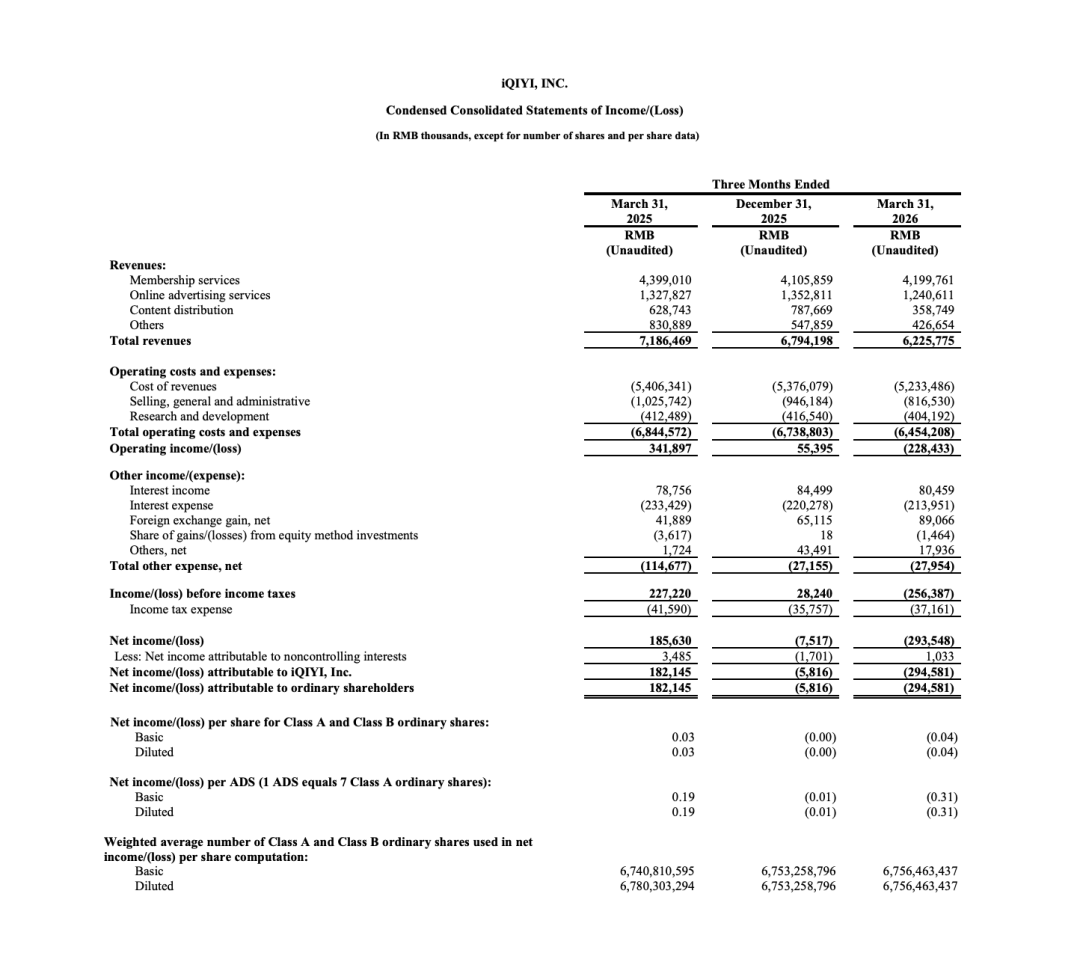
iQIYI's Financial Report for the First Quarter of 2026
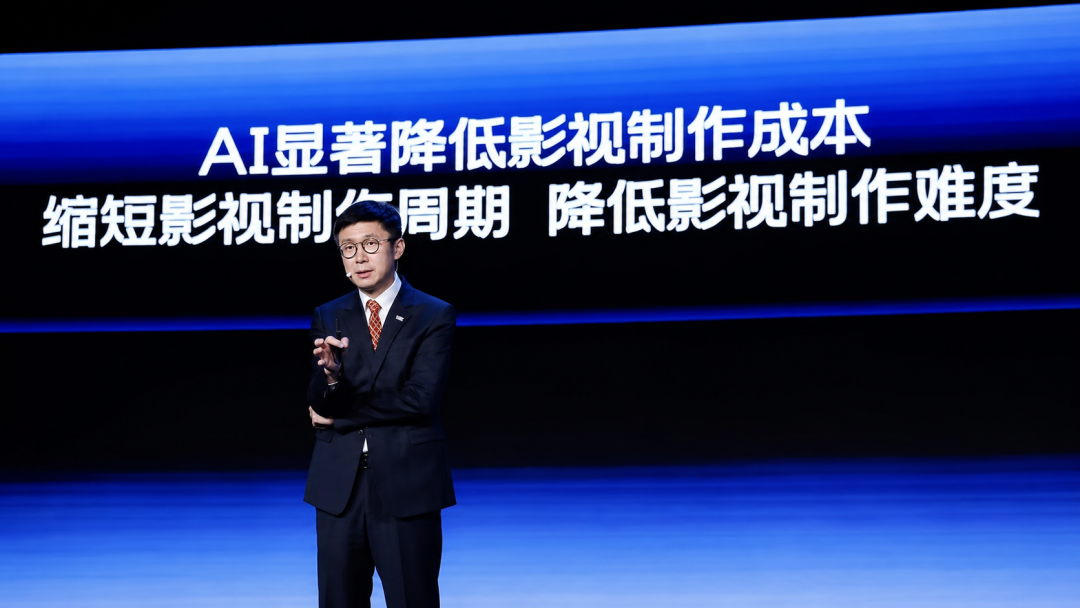
During the financial report conference call that evening, even Gong Yu's opening remarks seemed somewhat subdued. He reiterated his consistent stance since the beginning of the year, emphasizing that high-quality content remains the cornerstone of iQIYI and that they will leverage AI to foster new growth opportunities.
In April this year, iQIYI's AI video platform, Nado Pro, officially commenced commercial operations. Gong Yu disclosed during the conference call that Nado Pro already boasts over ten thousand active creators. He believes that AI will significantly reduce content costs, stimulate industry growth, and be highly beneficial to the business model of long-form videos.
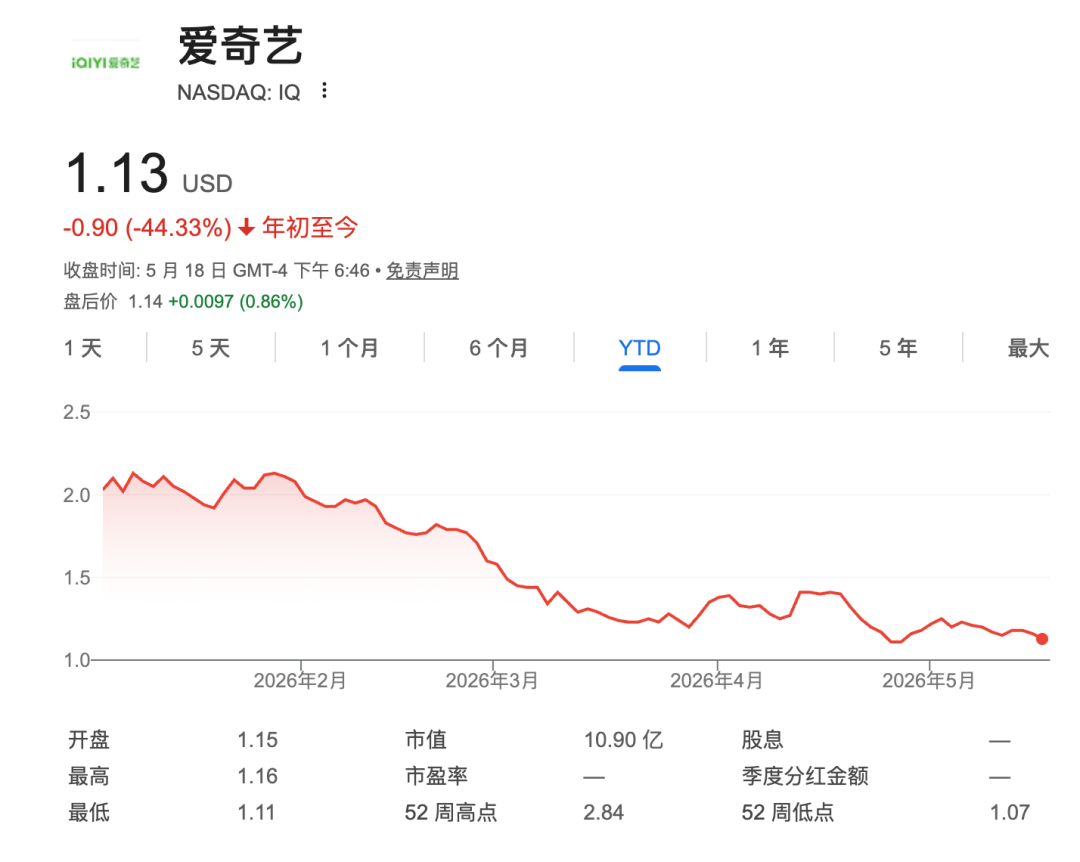
The market, however, overlooked Gong Yu's optimistic outlook for AI's future. Yesterday, at the close of the U.S. stock market, iQIYI's stock price fell by 2.59%, closing at $1.13, with a market capitalization of only $1.09 billion. Since the beginning of the year, iQIYI's stock price has cumulatively declined by over 44%.
Striving to Cut Costs, Yet Seriously Declining
The trend in iQIYI's financial reports over the past two years can be encapsulated in one sentence: striving to cut costs while experiencing a serious decline.
In 2024 and 2025, iQIYI's operating costs decreased by 5% and 2% year-on-year, respectively. However, annual revenue also declined by 8% and 7% year-on-year, respectively. The company's profit decline was even more pronounced, with non-GAAP net profit falling by 47% in 2024 and another 81% in 2025.
It's not that iQIYI hasn't made significant efforts to cut costs. Content platforms differ from other internet companies in that their revenue solely depends on membership service revenue, which in turn relies on the supply of high-quality content. No matter how hard iQIYI tries to cut costs, it's challenging to reduce annual content costs that exceed 15 billion yuan.
In 2024, iQIYI managed to achieve a 5% year-on-year decrease in annual content costs, but by 2025, the decline was only 2%. In the first quarter of 2026, iQIYI's content costs decreased by just slightly over 1% year-on-year, almost the same as the previous year.
The primary factor dragging down iQIYI's performance is the weakness of membership service revenue. At the time of its listing, iQIYI was a video platform driven by both advertising and memberships. However, advertising revenue gradually declined while the proportion of membership revenue continued to rise.
In its first year of listing, iQIYI's membership revenue accounted for only about 40% of the company's total revenue. By 2020, it exceeded 50%, and by 2022, when iQIYI achieved annual profitability for the first time, it exceeded 60%, while the proportion of advertising revenue hovered around 20%.
In the first quarter of this year, due to the collective decline in advertising, content distribution, and other revenues, iQIYI's membership service revenue even accounted for 67.4% of the total revenue.
It's not uncommon for content platforms to rely on membership revenue. However, the issue is that there are fewer and fewer members willing to pay for long-form video platforms. More and more users are turning to short videos, leading to a continuous decline in the audience for long-form videos.
The China Network Audio-Visual Development Research Report (2026) indicates that in December 2025, the average daily usage time of short video apps per person reached 129 minutes, surpassing long-form videos and ranking second among audio-visual segmented apps.
QuestMobile's 2025 China Mobile Internet Annual Report also reveals that the proportion of user time spent on long-form videos across the entire network dropped from 17.8% in 2023 to 11.3% in 2025, while short dramas rose from 2.7% to 10.8%.
Since 2023, iQIYI's membership service revenue has not increased. It fell by 13% year-on-year in 2024 and another 5% in 2025. In the first quarter of this year, iQIYI's membership service revenue decreased by another 5% year-on-year.
Consequently, iQIYI's profit performance has continued to decline. In the first quarter of this year, iQIYI's net loss under non-GAAP was 234 million yuan, reversing from a profit to a loss year-on-year. This also marks the largest quarterly loss for iQIYI in the past 17 quarters since achieving quarterly profitability for the first time in the first quarter of 2022.
One Expands Abroad, One Embraces AI
Gong Yu is well aware of the dilemma faced by long-form video platforms. As early as last year, he publicly lamented the loss of TV drama viewers, the sluggish drama market, and other challenges, emphasizing the need for long-form video platforms to actively seek change.
At that time, his suggestions were somewhat vague, simply advocating for embracing short dramas, not only producing short dramas themselves but also shortening the number of episodes and duration of long dramas. In short, everything should aim to be "short."
This year, with the rise of the AI wave, Gong Yu seems to have finally found a solution to the dilemma of long-form videos.
He stated during the financial report conference call that the biggest challenge for the long-form video industry is that as costs continue to rise, investment risks gradually increase, forcing a reduction in the number of works and concentrating investment on top projects. "However, AI technology can significantly reduce costs and shorten production cycles, encouraging more creators to produce long-form video content."
Gong Yu believes that this will increase the number of long-form videos and naturally attract more users, forming a positive feedback loop that is highly beneficial to the business model of long-form videos and can draw users to long-form video platforms.
"In fact, looking back at the past decade, the development of short videos and short dramas has been driven by technological innovation or other factors that have lowered creation costs and barriers, attracting more creators and leading to industry prosperity. We believe the same principle applies to long-form videos," Gong Yu said.
In April this year, iQIYI's AI video platform, Nado Pro, officially commenced commercial operations. Gong Yu stated that Nado Pro already has over ten thousand active creators and will produce various film and television content, including long dramas, medium dramas, short dramas, comic dramas, and advertisements, with about 100 self-produced projects by iQIYI. Subsequently, iQIYI will also launch a matching platform to help creators better monetize, and an overseas version will be launched soon.
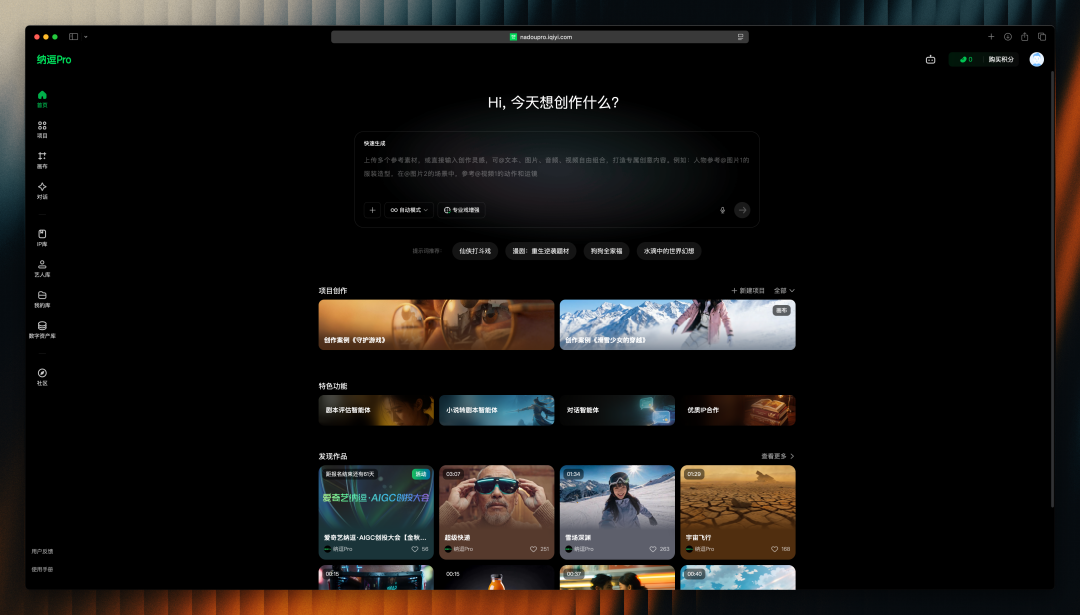
iQIYI Nado Pro
In short, in Gong Yu's view, AI technology will completely solve the cost problem for long-form video platforms, and the film and television content industry will prosper again. iQIYI will also transform from a centralized platform to a decentralized content community through a series of AI layouts, including Nado Pro.
But the question remains: are users truly willing to pay for AI-generated dramas? At iQIYI's World Conference in April, Gong Yu's vision for the future of AI-generated films and television sparked controversy, such as the possibility that live-action filming might become intangible cultural heritage in the future. The next day, Gong Yu had to backtrack and emphasize that technology should always serve people and should never replace them.
Compared to the uncertain future of AI-generated films and television, iQIYI's growth in overseas markets may be more tangible.
Gong Yu revealed during the financial report conference call that in that quarter, iQIYI's overseas membership revenue increased by over 40% year-on-year, with Indonesian membership revenue increasing by over 80% year-on-year and Brazilian and Mexican membership revenue both increasing by over 100% year-on-year. The average daily number of overseas subscribed members reached a record high for the quarter.
iQIYI's approach overseas is somewhat reminiscent of the early days of Korean dramas going global. Chinese audiences may have grown tired of costume idol dramas starring young celebrities, but there is still significant potential for such dramas in the Southeast Asian market. The costume drama "Zhu Yu," which was heavily criticized by the Chinese media as the "Foundation Makeup General" this year, performed well in the Southeast Asian market.
iQIYI executives stated during the financial report conference call that iQIYI's overseas users are mainly young women, with a relatively high proportion of women under 40. Overall, the ARPU of overseas users is generally higher than that of domestic users.
However, the growth in overseas markets seems unable to offset the weakness of domestic membership service revenue. iQIYI emphasized during the financial report conference call that their content reserves for the second quarter of this year are more diverse, and they will seize the marketing opportunities of the 618 shopping festival, believing that the membership business will maintain a steady development trend.
In March this year, iQIYI announced its intention to list on the Hong Kong Stock Exchange. As of March 31 this year, iQIYI's cash balance (including cash, cash equivalents, short-term restricted funds, short-term investments, and long-term restricted funds in prepaid and other assets) totaled approximately 3.99 billion yuan.
© All rights reserved by Shanshang. Unauthorized reproduction is prohibited.
-
![]()
Focus | CCCC’s Takeover of Greentown Comes to Fruition: Why Did the 11-Year ‘Control Without Authority’ Era End?
-
![]()
Final Verdict: The 2026 China Auto Forum Shines with Unique Characteristics at a Pivotal Moment
-
![]()
Tencent Maintains Matrix Approach, Alibaba Merges Entry Points: Tech Titans Initiate AI Agent Consolidation
-
![]()
Geely Secures Portion of Ford’s Spanish Production Capacity
-
![]()
Tesla Stalls This Second
-
![]()
Elon Musk's 'Money-Burning' Spree: All Car Sales Profits Poured into AI
-
![]()
Why Did Tesla’s Profits Drop and Cash Flow Go Negative?
-
![]()
AI Titans Are All in the Red: Time for Intelligent Driving Car Buyers to Reassess?