Domestic Mobile Phone Brands Compete for Gimbal Cameras, Giving Luxshare Precision the Confidence to Break Free from Apple's Grip
 05/21 2026
 646
646
The intention of the Apple supply chain giants to break free from Apple's grip is becoming increasingly evident.
Recent media reports indicate that vivo plans to release a handheld gimbal camera named 'Pocket' in the fourth quarter of this year, with an expected production volume in the millions of units, to be manufactured by Luxshare Precision.
Not only vivo, but OPPO has also reportedly initiated a handheld gimbal camera project codenamed 'Fuyao,' with plans to launch it by the end of the year; Honor, taking a different approach, plans to introduce a robot phone, the 'Robot Phone,' featuring a gimbal camera in the third quarter.
The Android camp is quietly accelerating its layout (layout) in handheld imaging devices.
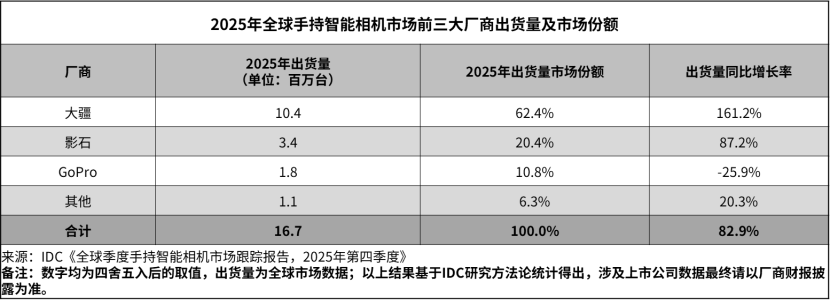
Behind this trend is the continuous explosion of the short video and Vlog markets, which has spurred shooting demands vastly different from those of traditional imaging devices, making handheld smart cameras highly sought after. IDC data shows that global shipments of handheld smart cameras (including action cameras, gimbal cameras, and panoramic cameras) will grow by 83% year-on-year in 2025, reaching 16.65 million units. Among them, gimbal cameras will see growth exceeding 100%, becoming the fastest-growing segment in the market.
Historically, this market has been dominated by DJI, GoPro, and Insta360. Now, with mobile phone manufacturers entering the fray, the existing landscape may be disrupted.
At the product level, this is merely another mass-production battle by the Android camp in the handheld imaging sector, a routine iteration in the consumer electronics industry. However, what truly deserves attention is the partner behind this million-unit order—Luxshare Precision.
For Luxshare Precision, whose annual revenue has surpassed 330 billion yuan, a million-unit order for a new product is not a major deal in terms of volume and has limited impact on the company's overall performance. However, when viewed within the context of Luxshare Precision's recent transformation, the significance of this business deal becomes entirely different.
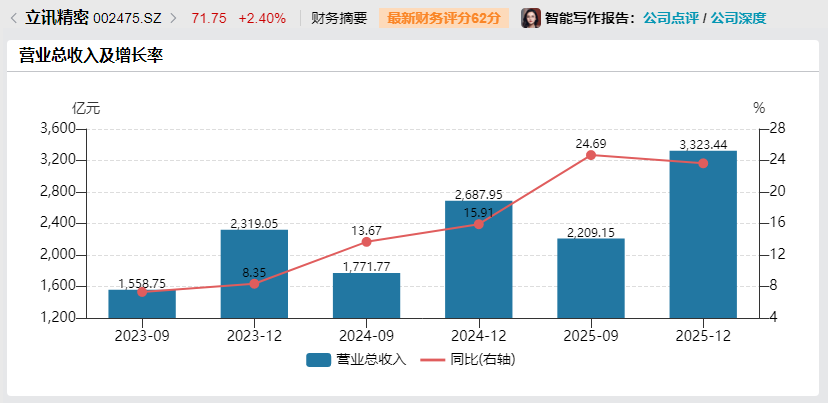
Image source: wind
It is more like a key signal that Luxshare Precision intends to step out of the comfort zone of the Apple supply chain and pursue a diversified strategy.
01. Intent to Break Free from the Apple Supply Chain
In the precision manufacturing circles of China and even the world, the rise of Luxshare Precision is almost a myth that is hard to replicate.
From acquiring Kunshan LianTao to enter the supply chain for Apple iPad cables to later swallowing up Wistron's mainland iPhone production lines and becoming the first mainland company to secure Apple's entire device OEM business, Wang Laichun has led Luxshare Precision to the throne of the 'Apple supply chain leader.' At its peak, Apple's orders accounted for over 70% of Luxshare Precision's revenue for several consecutive years.
Being chosen by Apple means more than just a 'windfall' of orders—it represents an endorsement of manufacturing capabilities.
However, the structural risks of being deeply tied to Apple are equally apparent. As innovation slows down and Apple gradually hits a bottleneck in the high-end market, supply chain companies that once soared with Apple now find themselves standing on the edge of a cliff. The market has come to realize that their performance hinges simply on 'Apple's new product sales multiplied by their own share,' lacking any independent growth logic.
Moreover, affected by tariff wars and geopolitical tensions, Apple has begun shifting its production lines to India and Vietnam to mitigate risks. Luxshare Precision knows better than anyone that putting all its eggs in Apple's basket is not a sustainable strategy.
Thus, a quiet 'escape,' or rather 'self-rescue,' has begun.
The most visible transformation lies in the data.
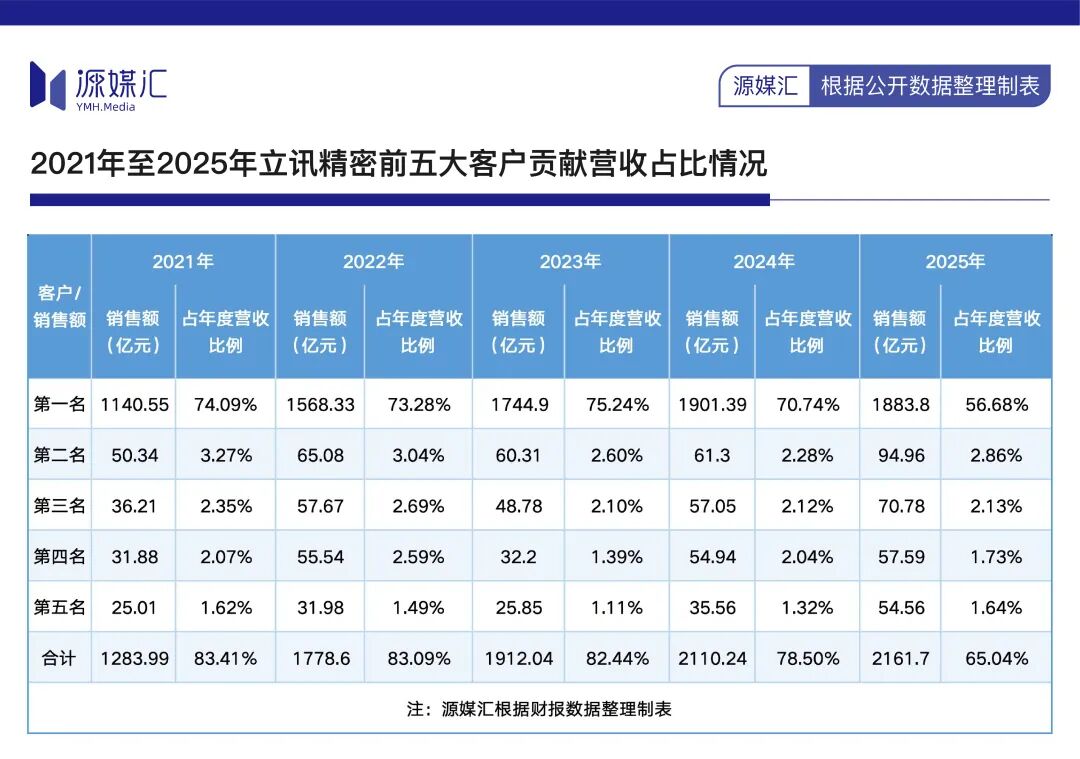
Financial reports show that the proportion of Luxshare Precision's sales from its largest customer (widely believed to be Apple) has dropped from a high of 75.24% in the previous two years to 56.68%. This change sends a clear signal: Luxshare Precision is stepping on the gas, shifting from a single-core to a multi-core driven model.
The path is not mysterious: pursuing a second growth curve through diversification.
The most aggressive acceleration comes from the automotive sector. By 2025, Luxshare Precision's automotive electronics business revenue will reach 39.255 billion yuan, soaring by 185.34% year-on-year.
Behind this high growth lies not only internal efforts but also a powerful capital acquisition move. Luxshare Precision has spent heavily to acquire Leoni AG, a century-old German automotive wiring harness giant, gaining access to the supply chains of mainstream European automakers such as Mercedes-Benz, BMW, and Volkswagen.
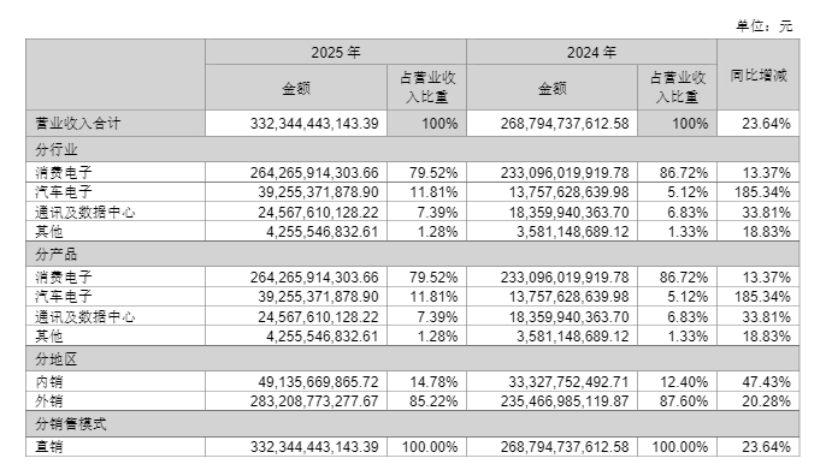
Image source: 2025 Luxshare Precision Annual Report
Beyond automotive, Luxshare Precision is also betting big on AI computing infrastructure. In the communications and data center business segment, 224G high-speed cables have achieved mass production, while 800G and 1.6T optical modules are progressing rapidly through customer validation channels both domestically and internationally. Wang Laichun has also stated that the expected performance surge, originally anticipated in 2026, may well materialize in the fourth quarter of 2025.
Even in the most cutting-edge sectors, Luxshare Precision's presence is felt—it has secured the OEM order for Honor's 'Lightning' humanoid robot, with plans to ship 3,000 units in 2025.
However, for now, all these thriving new branches cannot yet obscure a harsh reality: Luxshare Precision is still far from being able to say 'goodbye' to Apple.
In 2025, Apple's share of Luxshare Precision's total revenue dropped from 75.24% to 56.68%, primarily due to the dilution effect of Luxshare Precision's rapidly expanding overall business—automotive electronics surged by 185% in a year, and the communications and data center businesses also grew rapidly. The swift (swift) growth of new businesses quickly pushed up total revenue, naturally reducing Apple's proportion.
However, the absolute revenue contributed by Apple to Luxshare Precision still reached a staggering 188.381 billion yuan, showing no significant decline compared to previous years.
In other words, what Luxshare Precision is doing at this stage is a delicate 'balancing act': on one hand, it is expanding the pie with new businesses to make the proportion numbers look good; on the other hand, it is carefully maintaining Apple as its 'ballast,' dare not (daring not) to let orders slip.
Thus, the so-called 'breaking free from Apple dependency' is, for now, still a long road that can only be traversed slowly.
02. Embracing More New Allies
The emergence of the vivo Pocket gimbal camera is no coincidence. Over the past two years, the focus of competition among mobile phone manufacturers has quietly shifted from communication specifications to imaging capabilities. Vivo, with its deep optical expertise, has heavily invested in mobile imaging.
The X200 Ultra features an independent camera control key paired with Zeiss's 'super cannon' lens; the X300 Ultra series boasts a 200-megapixel telephoto lens with 'gimbal-level' stabilization. As phones increasingly resemble cameras, a professional imaging accessory product line naturally follows.
In the handheld smart camera market, DJI dominated with around 10.4 million units shipped in 2025, capturing approximately 62% of the market; Insta360 accounted for about 20%. The sector is rapidly gaining momentum, making it an opportune time to enter.
Luxshare Precision's entry at this moment is itself a statement: it is no longer satisfied with being a silent OEM manufacturer behind the brands but seeks to infiltrate the deep waters of brand definition.
This is precisely the unique value of the vivo Pocket category—it runs almost parallel to the Apple supply chain business line. If Luxshare Precision can find success here, it will be like installing a bumper on its consumer electronics business, ensuring that even if global iPhone orders fluctuate, its workshops can continue operating smoothly.
For Luxshare Precision, vivo's million-unit gimbal camera order is not the endpoint but possibly just the beginning.
In fact, OPPO has quietly initiated a gimbal camera project, also expected to launch in the fourth quarter of this year; Honor and Xiaomi are also launching projects. This means that if this path proves viable, Luxshare Precision will hold not just vivo's orders but an entry ticket to the eve of a sector-wide explosion.
Besides securing the vivo gimbal camera order, another move that has drawn attention is Luxshare Precision's collaboration with OpenAI. According to comprehensive reports, this AI giant has designated Luxshare Precision as the exclusive system co-design (collaborative design) and manufacturer for its self-developed consumer-grade AI phones.
This is far from simple OEM assembly or a mere replication of the Apple model. Luxshare Precision is expected to be deeply involved from the product definition stage, participating in the full-link collaboration of hardware and software. If manufacturing for Apple proved 'I can make,' then manufacturing for OpenAI declares 'I can create.'
This is precisely Luxshare Precision's most underestimated capability. While most still equate 'OEM manufacturer' with cheap labor, Luxshare Precision has long built a complete solution spanning material selection, product definition, industrial design, process development, high-yield mass production, and full-lifecycle after-sales support.
After all, no one wants to remain a 'shadow' forever. Continuing to follow Apple, Luxshare Precision can certainly survive well, but such a existence would forever confine it to the shadow of a giant, unable to truly showcase itself.
Now, a new picture is unfolding: automotive electronics, with nearly 40 billion yuan in revenue, is entering the global Tier 1 arena; the communications business is cutting into the core track (sector) of AI infrastructure with 800G/1.6T optical modules; in consumer electronics, seemingly whimsical seed businesses like vivo Pocket and OpenAI phones are incubating imaginative growth spaces for the post-Apple era.
However, the road ahead remains fraught with challenges. The manufacturing common sense (common sense) is that OEM manufacturers' gross margins are 'easy to fall but hard to rise.' Will the massive capital expenditures in automotive electronics and AI infrastructure slow down Luxshare Precision's 'hematopoietic' (blood-making) rhythm? Can the capabilities honed in consumer electronics OEM truly adapt to the pace of full-link product innovation?
All of this remains to be tested by the market.
Note: Some images in the text are sourced from AI generation/the internet. If there is any infringement, please inform us for removal.
-
Ofilm Teams Up with ADSensE to Propel Large-Scale Deployment of All-Solid-State LiDAR Powered by ADS6311 Chip!
-
![]()
Loss of 2.5 Billion Yet Facing Strong Demand for Shares? Another Battle for Control of Lianchuang Electronics
-
![]()
Huawei’s Enjoy Series Flies Off the Shelves, Prompting Xiaomi to Double Down on Budget Smartphones
-
![]()
Beijing Hyundai's Top Executive Criticizes Industry Disorder: Certain Brands Treat Customers as Beta Testers
-
![]()
The domestic mobile phone market has declined for five consecutive quarters! Huawei defies the trend with significant growth: maintains its top market share
-
Annual Revenue Surpasses 3 Billion: An Automotive Trim 'Little Giant' Makes Its Debut on the Beijing Stock Exchange
-
![]()
The Space Force Wants to Spend $30 Billion on Rocket Launches: Is Trump Doubling Down, and Is SpaceX the Big Winner?
-
![]()
Going Crazy! One out of Every Three Plug-in Hybrids Sold in Europe is a Chinese Vehicle