Breaking News | Core Chip Team Member Unexpectedly Changes Jobs! OpenAI Transforms into Anthropic's Talent Hub, with Over 15 Ex-OpenAI Core Members Now Holding Key Roles at Anthropic
 06/08 2026
 410
410
AI Capital Bureau, Shi Tao, June 7
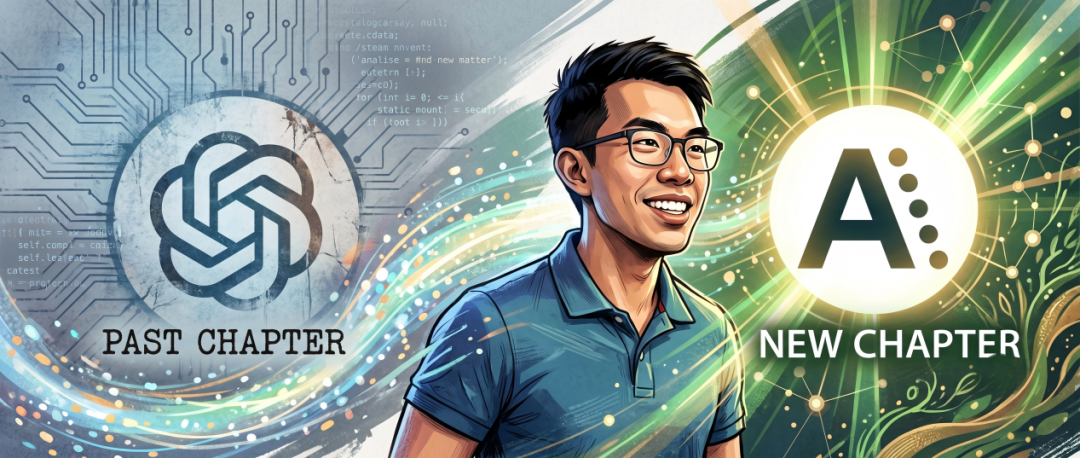
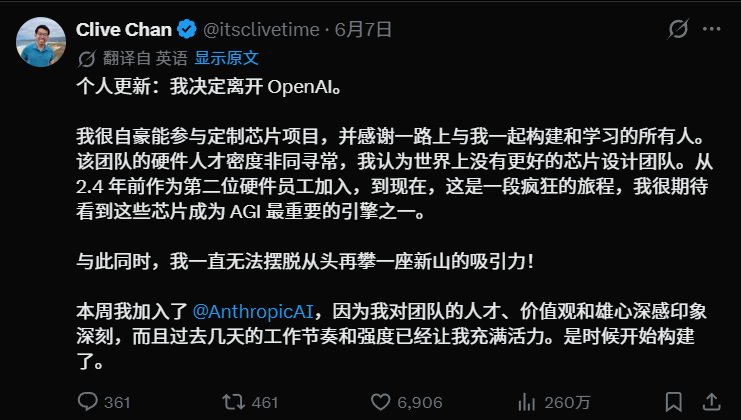
At a pivotal moment when Anthropic and OpenAI are vying to go public, OpenAI has suffered another loss of a key employee. Clive Chan, recognized as “Employee No. 002” in OpenAI's proprietary chip development initiative, announced on the X platform his official resignation from OpenAI to join its rival, Anthropic. This talent shift occurs at a critical juncture for the mass production of a 10GW custom AI accelerator, developed in collaboration with Broadcom. Industry experts view this as another indicator that the AI computing power arms race is expanding from the model layer to the chip infrastructure layer.
Why Did a Seasoned Professional Choose to Leave OpenAI on the Brink of 3nm Chip Mass Production?
In his resignation statement, Clive Chan recounted joining OpenAI in January 2024 as the second recruit for the hardware team, witnessing the entire trajectory of OpenAI's self-developed chip project from its inception to its current stage. He lauded the talent within OpenAI's hardware team as “astonishing—likely unmatched globally in chip design,” and clarified that his departure stemmed not from dissatisfaction but from a desire to “scale new heights,” acknowledging Anthropic's alignment in talent, values, and ambitions.
During his two-and-a-half-year tenure at OpenAI, Chan oversaw matrix multiplication (Matmul), roofline analysis, and hardware-related tasks, deeply involved in the 10GW custom AI accelerator project with Broadcom. The chip, utilizing TSMC's 3nm process, was initially slated for mass production in the latter half of 2026. He also participated in early discussions between OpenAI and TSMC regarding the 1.6nm (A16) advanced process, a technology deemed crucial for OpenAI to reduce its dependence on NVIDIA.
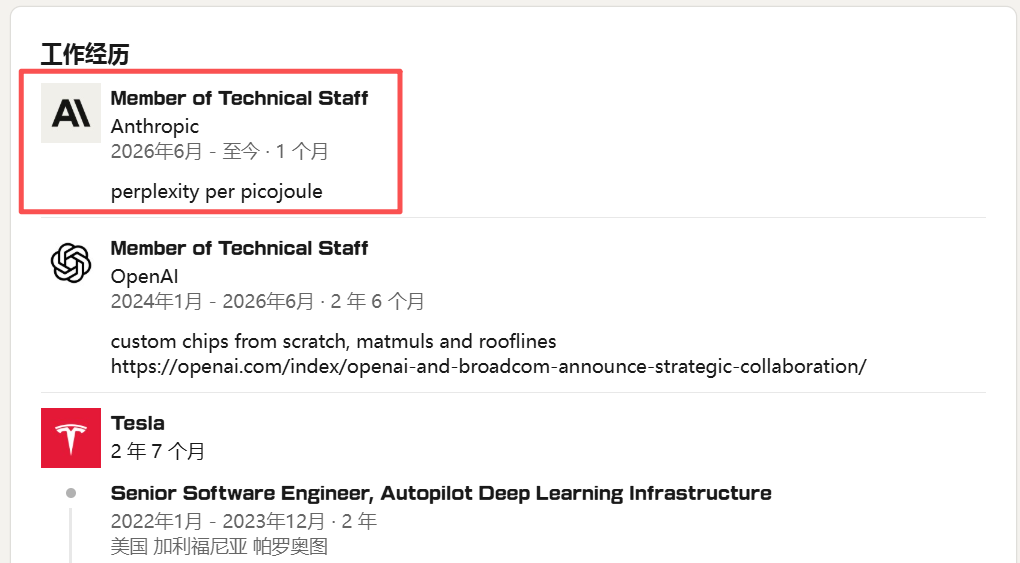
Anthropic has yet to publicly announce Clive Chan's specific role, but his LinkedIn profile indicates his new position as a research and development engineer focusing on “perplexity per picojoule,” suggesting a focus on optimizing the energy efficiency ratio of AI chips, a key direction in Anthropic's current computing power strategy.
A History of Talent Migration: OpenAI Emerges as Anthropic's “Talent Incubator”
Clive Chan's departure is not an isolated incident. Over the past five years, key talent from OpenAI has consistently flowed to Anthropic, establishing a clear “talent migration path”:
1. Founding-Level Departures (2021)

Dario Amodei: Former Vice President of Research at OpenAI, left due to concerns over insufficient investment in AI safety, co-founded Anthropic, and established a “safety-first” technical approach.
Daniela Amodei: Dario's sister and former Vice President of Operations at OpenAI, co-founded Anthropic and serves as CEO, responsible for commercialization and operations management.
2. Core Executives and Technical Leaders (2024)
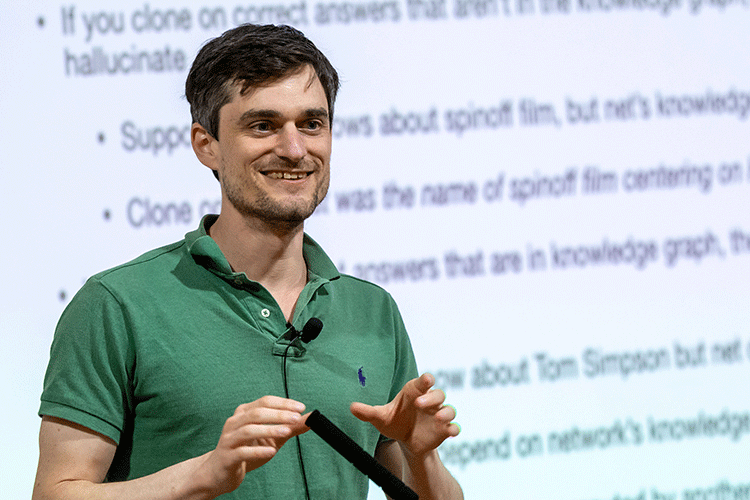
John Schulman: Co-founder of OpenAI and inventor of the PPO algorithm, joined Anthropic in August 2024 to lead AI alignment and technical research. Prior to his departure, he briefly headed OpenAI's safety team.
Jan Leike: Former head of Superalignment at OpenAI, joined Anthropic in May 2024 and is a leading expert in the field of safety alignment.
Durk Kingma: Co-founder of OpenAI, joined Anthropic in October 2024, focusing on optimizing large model training.
3. Technical Pioneers (2026)

Andrej Karpathy: Co-founding member and former head of AI at OpenAI, joined Anthropic's pre-training team in May 2026. He previously led Tesla's autonomous driving vision system.

Clive Chan: OpenAI's “Employee No. 002” for chips, joined Anthropic in June 2026, becoming the latest core talent in the chip field to transition from OpenAI.
According to AI Capital Bureau statistics, as of June 2026, over 15 former core members from OpenAI have assumed key positions at Anthropic, with 7 hailing from the AI safety team, forming a unique cultural circle of the “OpenAI faction.”
Impact Assessment: OpenAI's Mass Production Plans May Face Disruption, Computing Power Competition Intensifies
Clive Chan's departure coincides with a critical phase in OpenAI's self-developed chip mass production and may have threefold impacts:
Firstly, as an early core member of the chip team, Chan possessed a comprehensive technical stack from architectural design to performance optimization. His departure may decelerate the development progress of certain key modules. OpenAI's collaboration project with Broadcom has already encountered setbacks due to production costs and credit issues, and talent loss may exacerbate execution risks.
Secondly, OpenAI's primary objective for self-developed chips is to reduce reliance on NVIDIA, with plans to deploy 10GW of custom AI accelerators by the end of 2029 and halve computing power costs. Chan's departure may influence the pace of this strategy, thereby weakening OpenAI's long-term competitiveness in the AI computing power arena.
Thirdly, the AI arms race has transitioned from model parameter competition to computing power infrastructure construction, with top chip talent becoming a scarce resource. Clive Chan's job transition, along with the concurrent departure of Jeganathan (Tesla's VP of AI Infrastructure and head of Dojo, serving for 13 years), underscores the intense competition for computing power talent in the AI industry.
Market Landscape: Computing Power Autonomy Becomes a Strategic Imperative for AI Giants
Clive Chan's job transition reflects a significant trend in the AI industry: computing power infrastructure has emerged as a core factor determining a company's long-term competitiveness. Presently, global AI giants are accelerating their pursuit of computing power autonomy:
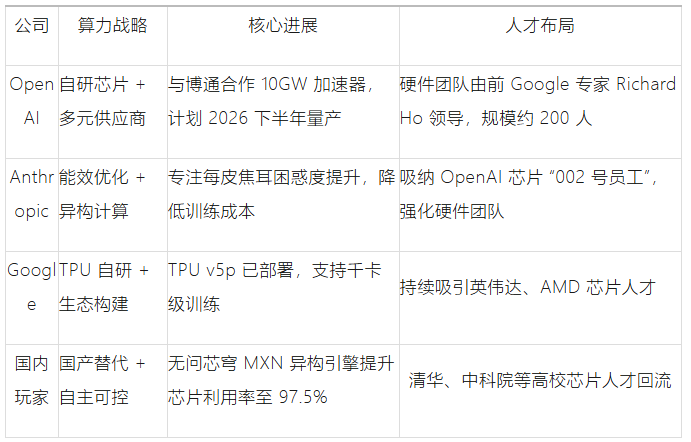
Industry analysts believe that as AI Agents are deployed on a large scale, computing power costs will become a pivotal variable for corporate profitability, and the competition for chip talent will directly influence the long-term valuation and market position of AI companies.
Talent Tug-of-War Shifts the Balance of Power Among AI Giants
AI Capital Bureau posits that Clive Chan's departure is a microcosm of the talent competition in the AI industry, reflecting both the challenges OpenAI encounters in its computing power autonomy process and Anthropic's resolve to accelerate its pursuit in the chip field. At a critical juncture when both companies are preparing for IPOs, talent mobility not only affects technical roadmaps but may also alter the criteria for capital market valuation.
It is noteworthy that OpenAI's hardware team still retains key talents such as core architect Richard Ho, and the self-developed chip project will not be halted due to the departure of a single member. However, the continuous talent exodus undoubtedly serves as a wake-up call: in the AI computing power arms race, while technological leadership is paramount, cultivating an attractive talent ecosystem is equally decisive in determining success.
As of press time, neither OpenAI nor Anthropic has issued an official statement regarding Clive Chan's departure.

AI Capital Bureau is a professional observation and analysis platform dedicated to capital market dynamics in the artificial intelligence field. We closely monitor financing, listings, mergers and acquisitions, and other capital operations of AI and embodied intelligence-related companies, delve into industry and corporate development trends, and provide valuable insights for industry participants. We are committed to serving as a bridge connecting AI innovation and the capital market, aiding Chinese hard-tech companies in achieving value discovery and growth.
Risk Warning and Disclaimer: The market carries inherent risks, and investment should be approached with caution. This article does not constitute investment advice and should not be used as a basis for actual operations. Trading risks are borne by the investor.
-
![]()
Smartphone Prices Surge Amid Manufacturer Anxiety
-
![]()
Orbbec Soars to Record Heights, Eyes Further Capital Influx of 980 Million!
-
![]()
Tongding Interconnect Sets Up Shop in Shaoguan with 800 Million Yuan in Registered Capital
-
![]()
Before Kimi’s A-Share Debut, Zhipu Aims to Secure More 'Strategic Funding'
-
![]()
Innovative Leap | Fiber-Pluggable 1470nm Laser Source: Revolutionizing Precision Laser Weeding
-
![]()
73-Day Rapid Listing: Where Does Unitree's Wang Xingxing's 'Sense of Urgency' Come From?
-
![]()
AI Project Mindverse, Backed by Meituan, Faces Data Inflation Allegations Over Its Macaron Product
-
![]()
3000-word In-Depth Analysis | What Makes Physical AI So Magnetic? It Has Captivated Masayoshi Son, Jensen Huang, and Justin Sun All at Once