Mired in Pricing Controversy and Stock Price Slump: What Ails MiniMax?
 06/11 2026
 456
456
By Yang Feng
Edited by Zhang Xiao
In January of this year, AI large-model companies Zhipu AI and MiniMax made their debut on the main board of the Hong Kong Stock Exchange. For a while, they shone as the brightest twin stars in the Hong Kong stock market.
Zhipu AI's stock price soared to an all-time high of HKD 1,993 per share on May 29, with its market capitalization briefly exceeding HKD 880 billion. Similarly, MiniMax's stock price peaked, closing at HKD 1,238 per share on March 18, with its market capitalization reaching HKD 390 billion at one point.
However, a comparison of the stock price trends of the two companies in the first half of the year reveals an increasingly apparent divergence—
Several months ago, when both companies listed on the main board of the Hong Kong Stock Exchange, their stock prices were nearly equal. Yet, during the subsequent upward fluctuation of stock prices, MiniMax gradually fell behind.
MiniMax's stock price reached its peak in March, followed by a significant overall downward trend. On June 10, when the Hong Kong stock market closed, the company's stock price settled at HKD 451.8 per share. Zhipu AI's stock price peaked at the end of May and has since been fluctuating and declining. On the same day, June 10, its stock price closed at HKD 1,048 per share.
Moreover, a noteworthy signal emerged a few days ago when MiniMax M3 was released but failed to boost the company's stock price. On May 31, MiniMax announced its intention to apply for listing on the Sci-Tech Innovation Board, and on June 1, it unveiled the new model M3. However, the market did not respond positively. On June 1, MiniMax's stock price gapped up and then quickly plummeted, eventually closing down 15.71%, and continued to decline thereafter.
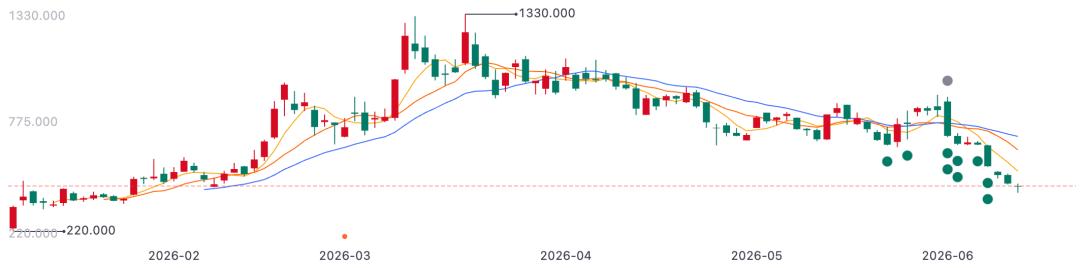
MiniMax stock price trend, Graphic/FinScope
In the medium to short term, the stock price fluctuations of Zhipu AI and MiniMax are likely to persist.
Xiong Wei, a China Internet industry analyst at UBS Securities, recently noted that the high valuations of Zhipu and MiniMax stem from the scarcity of listed model manufacturers globally, which brings additional premiums. At the same time, since the companies have only been listed for a short time and have not yet entered the lock-up expiration period, low liquidity has further inflated valuations.
Now, this environment is rapidly changing.
Zhipu and MiniMax will no longer enjoy scarcity status. OpenAI and Anthropic have both recently filed IPO applications in secret. Among Chinese large-model manufacturers, media reports suggest that Stepfun is expected to submit its Hong Kong stock prospectus in the coming days. Yuezhiaimi, which had previously expressed no intention of financing or going public, has also shifted its stance over the past six months. It has initiated a new round of financing, with a pre-investment valuation reaching USD 30 billion. Reports also indicate that it is dismantling its VIE and red chip structures, widely seen as clearing obstacles for a Hong Kong listing.
In July, Zhipu and MiniMax will also face their first large-scale lock-up expiration. CICC analysis states that MiniMax's lock-up expiration on July 9 accounts for a relatively high proportion of its Hong Kong stock capital, approximately 63%, with financial investors holding more than one-third. Zhipu's lock-up expiration on July 8 accounts for approximately 11.6% of its capital, with the largest lock-up expiration entity being cornerstone investors with state-owned backgrounds.
A factor with higher uncertainty lies in how long the market's patience will last for the high-investment, low-output model of AI companies, and whether there will be differentiation when more large-model companies enter the capital market and compete, making business data and commercialization progress transparent.
For MiniMax, which has just weathered a round of pricing controversy and a significant stock price decline, the challenges have clearly just begun.
On June 1, MiniMax released its new-generation large model, MiniMax M3.
According to official promotions, M3 has achieved cutting-edge capabilities in professional tasks such as programming and intelligent agents, utilizing a new attention architecture MSA that supports up to 1M ultra-long contexts. It is also a native multimodal model that supports image and video input and can operate on computer desktops.
Its powerful coding capabilities, 1M ultra-long context, multimodal model, and open-source nature make M3 somewhat unique.
However, since the release of M3, praise and skepticism have coexisted.
For example, BenchLM concluded that M3's agentic capabilities are in the global first tier, and many voices also believe that M3's agentic capabilities and price competitiveness are high.
The skepticism focuses more on two levels.
The first level of skepticism concerns the credibility of M3's benchmark "self-testing."
MiniMax officially claimed that M3 achieved a score of 59.0% on SWE-Bench Pro, surpassing GPT-5.5 (58.6%) and Gemini 3.1 Pro (54.2%), and approaching Claude Opus 4.7; it scored 83.5 on BrowseComp, even surpassing Opus 4.7's 79.3.
However, several authoritative global tech media outlets, including TechTimes, Startup Fortune, and DataNorth, almost simultaneously issued similar reminders: these benchmark results all come from MiniMax's own testing, with some obtained using external agent scaffolding such as Claude Code and Mini-SWE-Agent, and independent third-party verification is still ongoing. TechTimes put it most directly: "Cutting-edge claims, unverified benchmarks."
This is not the first time MiniMax has faced scrutiny over its "technical credibility." On February 23 this year, Anthropic issued a strongly worded statement accusing DeepSeek, Yuezhiaimi (Moonshot AI), and MiniMax, three Chinese companies, of launching an "industrial-scale distillation attack" on its Claude model. Anthropic described how the three companies interacted with Claude through approximately 24,000 fake accounts, engaging in over 16 million conversational interactions, with MiniMax having the largest volume of interactions, exceeding 13 million.
Of course, Anthropic's accusation also drew considerable controversy. Elon Musk criticized Anthropic on X, calling it "the pot calling the kettle black." Erik Cambria, a professor at Nanyang Technological University in Singapore, pointed out that "the boundary between legitimate use and adversarial exploitation is often blurry." Nathan Lambert from the Allen Institute for Artificial Intelligence even stated bluntly that 150,000 conversations are almost negligible in the scale of training large language models, and "simply obtaining Claude's output does not mean it can be directly used."
Like Yuezhiaimi and DeepSeek, MiniMax did not publicly respond to Anthropic's accusation, but the impact may have been felt silently. Wang Jie, an investor in Yuezhiaimi and Moore Threads, pointed out to Caixin that "MiniMax's business model is relatively mature, but after being accused by Anthropic of distilling models, market confidence has retraced."
The second level of skepticism concerns MiniMax's "backstabbing" price hike.
On the same day as the release of M3, MiniMax announced that it would shift from its long-standing pay-per-use or time-based payment model to a token-based pricing model.
It also announced new API pricing. When the context length is ≤512k, the input price is RMB 4.2 per million tokens, the output price is RMB 16.8, and the cache read price is RMB 0.84. In the 512k-1M range, the input price doubles to RMB 8.4, and the output price is RMB 33.6.
However, according to feedback from social media users, the company quietly canceled the RMB 29/month Starter plan for many users without communication. Some users also reported that the token consumption is now much higher than expected for the same tasks, and the reading quota is depleted faster. Now, the lowest subscription price for its token plan is RMB 49/month.
Price hikes themselves are not uncommon. In the first quarter of 2026, Zhipu also raised its API call pricing by 83%, but call volume still grew by 400%, indicating a supply-demand imbalance in the market.
What truly sparked dissatisfaction among developers and users was the magnitude, timing, and attitude of MiniMax's price hike.
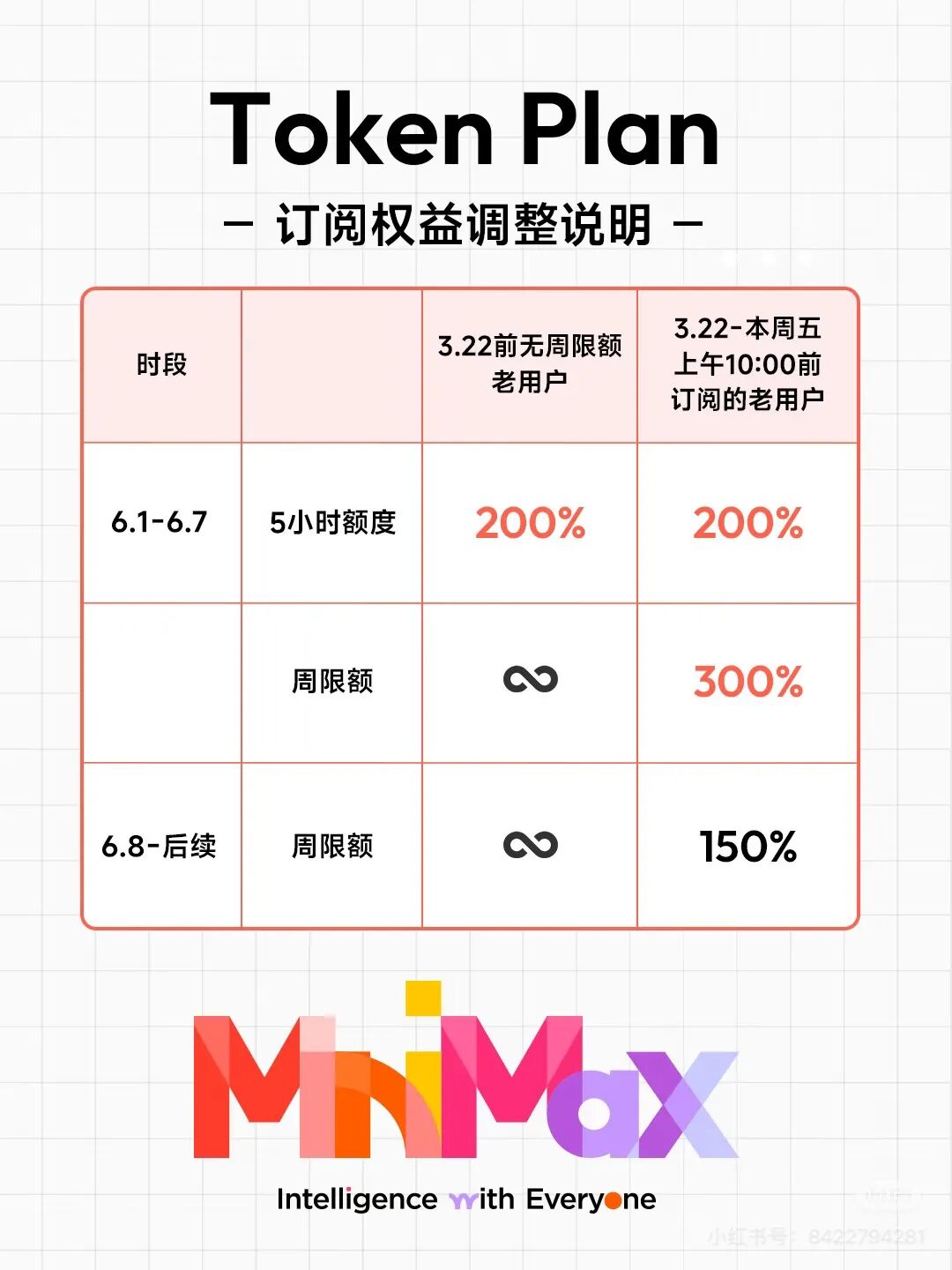
In response to the surge in complaints, MiniMax issued an apology and adjustment explanation through official channels. MiniMax stated that the company failed to communicate sufficiently in advance and explain in detail the changes in M3's corresponding TokenPlan pricing and plans, and its handling of issues such as weekly limits for existing users was also inappropriate.
At the same time, MiniMax announced three compensation measures, as shown in the following figure:
In addition, MiniMax also introduced promotional pricing to offset the controversy, offering a permanent 50% discount on APIs.
The standard pricing for M3 is USD 0.60 per million input tokens (approximately RMB 4.2), but the promotional price is as low as USD 0.30 (approximately RMB 2.1). The output token price has also been reduced from USD 2.40 to USD 1.20. Compared to Claude Sonnet 4.5 (input USD 3, output USD 15), the output cost is 12.5 times lower; compared to GPT-5.2 (input USD 1.75, output USD 14), the output cost is 11.7 times lower.
So, how does M3's pricing compare horizontally?
It is lower than overseas flagship large models GPT-5.5, Claude Opus 4.7, and Gemini 3.1 Pro. For example, Claude Opus 4.7's standard mode costs USD 5 per million input tokens (approximately RMB 35) and USD 25 for output (approximately RMB 175), several times higher than M3.
On the other hand, M3's pricing is higher than the recently announced price reductions for DeepSeek-V4 series and Xiaomi MiMo-V2.5 series—DeepSeek-V4-Flash costs only USD 0.14 per million input tokens (approximately RMB 1) and USD 0.28 for output (approximately RMB 2).
The real reason behind MiniMax's price hike may be a passive choice amid a "computing power shortage."
When token call volume surges but GPU supply cannot keep up, leading to frequent service interruptions, raising prices is both a means to screen high-value customers and alleviate computing pressure, as well as a way to buy time for a commercial model that has not yet turned a profit.
As for the nature of the promotion, it is to use short-term subsidies to retain developers while buying time for independent verification. However, the problem is that after the promotion ends, if M3's independent verification results fall short of expectations, MiniMax will face the dual dilemma of "prices cannot be raised, and customers cannot be retained."
The pricing controversy is just the tip of the iceberg. What truly determines whether MiniMax can emerge from its stock price slump and rebuild market trust is whether it can clearly articulate a more fundamental question: as a listed company, how does it make money, and can the money it makes be sustained?
On May 31, MiniMax announced on the Hong Kong Stock Exchange that its board of directors had resolved to explore preliminary proposals for issuing RMB-denominated shares. The announcement also stated that MiniMax had engaged professional advisors to provide consulting services on its eligibility for listing on the Sci-Tech Innovation Board and had signed a coaching agreement.
The next day, Zhipu also announced on the Hong Kong Stock Exchange that at its board meeting held that day, the company proposed to apply to relevant Chinese regulatory authorities for the allotment and issuance of A-shares and to apply to the Shanghai Stock Exchange for the listing and trading of such A-shares on the Sci-Tech Innovation Board. Zhipu plans to raise a total of RMB 15 billion, allocating RMB 12 billion to artificial intelligence general-purpose large models, RMB 2 billion to a one-stop service platform for large model MaaS, and RMB 1 billion to supplement working capital.
MiniMax and Zhipu are accelerating their A-share IPO processes, primarily to broaden financing channels and replenish the necessary resources for future development.
Currently, both companies are still in the stage of "high R&D investment to drive technological iteration and market scale," with profitability turning points still unclear. In 2025, Zhipu reported an adjusted net loss of RMB 3.182 billion, while MiniMax reported an adjusted net loss of approximately USD 251 million, or approximately RMB 1.73 billion.
Against the backdrop of insufficient self-generated revenue, the market environment is also changing rapidly.
First, since the first half of the year, the trend of AI shifting from infrastructure frenzy to application delivery has become evident. Multimodal fusion, reduced reasoning costs, and expanded application scenarios have accelerated to become the core drivers of growth. For large-model companies, commercialization has become increasingly important.
Second, Vibe Coding and agents have become the highest-certainty tracks for monetization, with B-end enterprise applications being the main battlefield.
Under these two major trends, the long-term challenges MiniMax faces are becoming increasingly clear.
Since its inception, MiniMax's development path has largely been "from C to B." From the outset, it established a native research and development approach across all modalities, allocating R&D resources simultaneously to four technical lines: text, voice, video generation, and music generation. This corresponds to its C-end products, Talkie (Xingye, an AI emotional companionship app) and Hailuo AI (a video generation tool), which follow a standardized subscription model and generate the majority of its revenue.
In 2025, MiniMax's total revenue was USD 79.038 million, a year-on-year increase of 158.9%. Among this, C-end AI native products contributed 67.2% of revenue, a year-on-year increase of 143.4%, while B-end open platform revenue was USD 25.963 million, accounting for 32.8% of revenue, a year-on-year increase of 197.8%.
MiniMax is also a model company primarily focused on overseas markets, with overseas revenue accounting for over 70% in 2025, covering more than 200 countries.
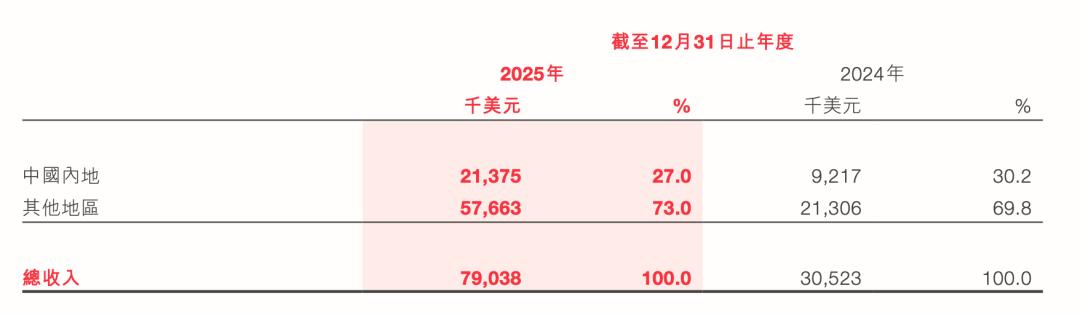
Graphic/MiniMax 2025 Annual Report
To a certain extent, this explains why, during the initial phase of Zhipu and MiniMax's listings in Hong Kong, MiniMax was actually more favored by investors. Its stock price performance exhibited periodic strength that outpaced Zhipu's, primarily due to its more stable and mature consumer-end (C-end) commercialization.
However, as the discourse surrounding large-scale model commercialization shifts rapidly towards Vibe Coding and agent-based models, large model companies with a stronger enterprise-end (B-end) focus are starting to gain more investor favor. In essence, it's not that MiniMax is underperforming; rather, its heavy reliance on the C-end market is prompting a reevaluation by the market.
Nevertheless, MiniMax is currently expediting its B-end commercialization strategy. In late May, Yun Yeyi, co-founder and COO of MiniMax, disclosed in a media interview that MiniMax's user base has surpassed 300 million, catering to over 1 million global enterprise and developer clients—a fivefold increase from six months prior. Concurrently, the company's annualized recurring revenue has doubled over the past two months.
Yun Yeyi also highlighted that MiniMax's enterprise user base is expanding rapidly, with revenue from this segment now contributing half of the total revenue, mirroring the contribution from the C-end segment.
For MiniMax, this is undoubtedly a positive indicator.
However, from a medium- to long-term perspective, the real challenge lies in whether its M3 model can genuinely serve as a catalyst for enhancing the company's revenue structure and unlocking the full commercialization potential of the B-end, transcending mere narrative differentiation. While the low-margin C-end business remains crucial, the high-margin B-end business represents the true commercialization avenue that MiniMax needs to establish.
In other words, the true litmus test for MiniMax lies in its ability to strike a sustainable balance between user scale and user engagement on the C-end and profit generation on the B-end.
Header image/MiniMax's official Weibo account
-
![]()
From Hardware to AI: Has the Intense Competition in Smartphone Imaging Reached Its Limit?
-
![]()
Mired in Pricing Controversy and Stock Price Slump: What Ails MiniMax?
-
![]()
DJI and Insta360 Release 'Cinematic Cameras': Can Pocket Stabilizer Cameras Truly Make It onto Professional Film Sets?
-
![]()
AISpeech's IPO Journey: Valuation Soars by RMB 2 Billion in a Month, Alibaba Trims Stake for RMB 280 Million Gain, Short-Term Debt Deficit Hits RMB 168 Million
-
![]()
DingTalk: At a Crossroads
-
![]()
Uber Exhausts Annual AI Budget in Just Four Months: Why Even Uber Can’t Sustain Token Costs?
-
![]()
"Explosive Risks" in the Trunk: The Unauthorized Battery Modifications in New Energy Vehicles Fuel a Shadowy Industry
-
![]()
From Deep Ties to Strategic Divestment: Is Chery Reevaluating Its Stake in This Industry Leader?