What is the Future for Domestic Large-Scale AI Models?
 06/16 2026
 503
503

Whenever a domestic AI model is released, people often say that Chinese models are about to rise and catching up with Anthropic is just around the corner. However, reality repeatedly proves them wrong. Not only is the gap between models widening, but if you look at various leaderboards on GitHub, an author with an orange avatar has become nearly ubiquitous.

Yet, whether by choice or necessity, as AI moves from the lab into enterprise production environments, a profound business reality has emerged: the smartest models are inevitably the most expensive. While Fable and GPT are excellent, no one can afford to use them 24/7. At this juncture, people seem to see a glimmer of hope for domestic models.
To truly harness AI for productivity and create commercially viable products, standalone cutting-edge models face severe ROI challenges.
Meanwhile, domestic models, which are slightly less capable but more affordable, urgently need to shed their stereotype as mere 'toys.'
A deeper conflict lies in the fact that large model vendors are trying to build closed agent ecosystems to establish monopolies, while enterprise users and neutral third parties are desperately seeking open and decoupled ecosystems.
Therefore, this article will analyze the complex interplay of technology and commerce through two new engineering paradigms: multi-model dynamic routing (Fusion) and the agent meta-framework (Omnigent), revealing the historic evolution of the AI industry from 'computing power hegemony' to 'architectural decentralization.'
01 The Computing Cost Trap and Genuine vs. Artificial Demand
Before discussing how to use international and domestic models, one must first understand a core premise of AI economics: tokens are a computing resource whose value is determined by intelligence.
Previous desktop AI agents, which took over users' computers to perform tasks, revealed a phenomenon despite their disappointing results: many individual and enterprise users are trapped in 'not knowing how to scale token consumption to generate value.'
Consuming tokens through inefficient task enumeration via imperfect underlying structures inevitably creates artificial demand. The obscurity of various agents over the past three months is sufficient proof of this. To get enterprises to pay real money, one must not consume computing power for its own sake but must leverage minimal computing costs to drive maximal task closure.
This is the computing cost trap facing all standalone cutting-edge models today.
Complex commercial tasks, such as in-depth industry research or refactoring tens of thousands of lines of code, exhibit a typical long-tail distribution in difficulty.
Only a few steps may require the extreme intelligence of a model like Fable 5, while most steps only need basic logical capabilities, such as web scraping, basic code translation, formatted JSON output, and post-processing checks. Using flagship models from the 'Big Three' for all tasks is like using a cannon to kill a mosquito, and the prohibitive costs would bankrupt any SaaS product attempting to commercialize.
This vast disconnect between performance and cost is one of the fundamental reasons why AI applications struggle to move beyond trial periods into the 'deep waters.' To resolve this contradiction, waiting for cutting-edge models to engage in price wars is futile. Instead, a new systems engineering approach is needed: task allocation based on difficulty and demand.
02 The Fusion Mechanism and 'Asymmetric Competition' for Domestic Models
Where is the future for domestic models?
This question concerns both insiders and outsiders in the AI field.
The traditional response to this pointed question is often fine-tuning with private data in specific vertical domains, but the results are insignificant because they do not address the essence of system architecture. A more direct solution today is to capture the 'domestic alternative' positioning through ultimate cost-effectiveness, which is the essence of OpenRouter's Fusion technology as a game-changer.
Fusion technology, or multi-model dynamic routing and synthesis, operates on a simple yet effective core logic: a complex problem is distributed in parallel to multiple different models, and a judging model fuses the results.
To illustrate with a programmer's example: let GPT-5.5 and Opus 4.8 design the program architecture, while DeepSeek V4 Pro writes the specific code.
Such a simple approach raises some doubts—can this 'trick' really provide a way out for domestic models?
In the DRACO deep research benchmark tests, convincing data dispelled these doubts: a 'budget model group' consisting of Gemini 3 Flash, Kimi K2.6, and DeepSeek V4 Pro not only outperformed a standalone GPT-5.5 but also scored close to top-tier cutting-edge model combinations, all at just 50% of the cost.
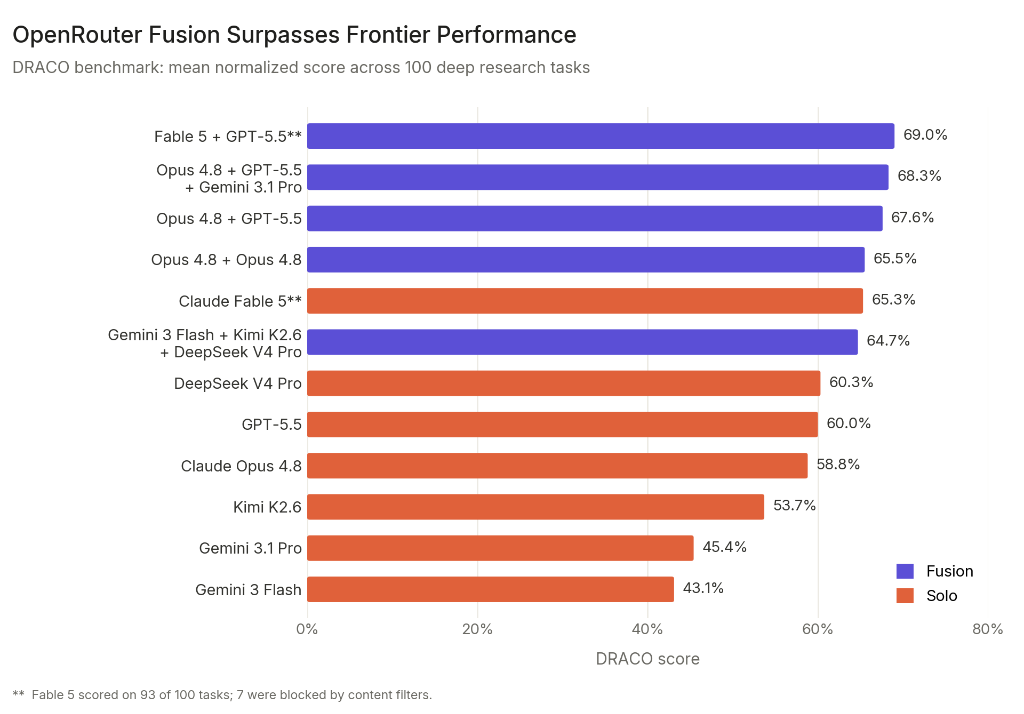
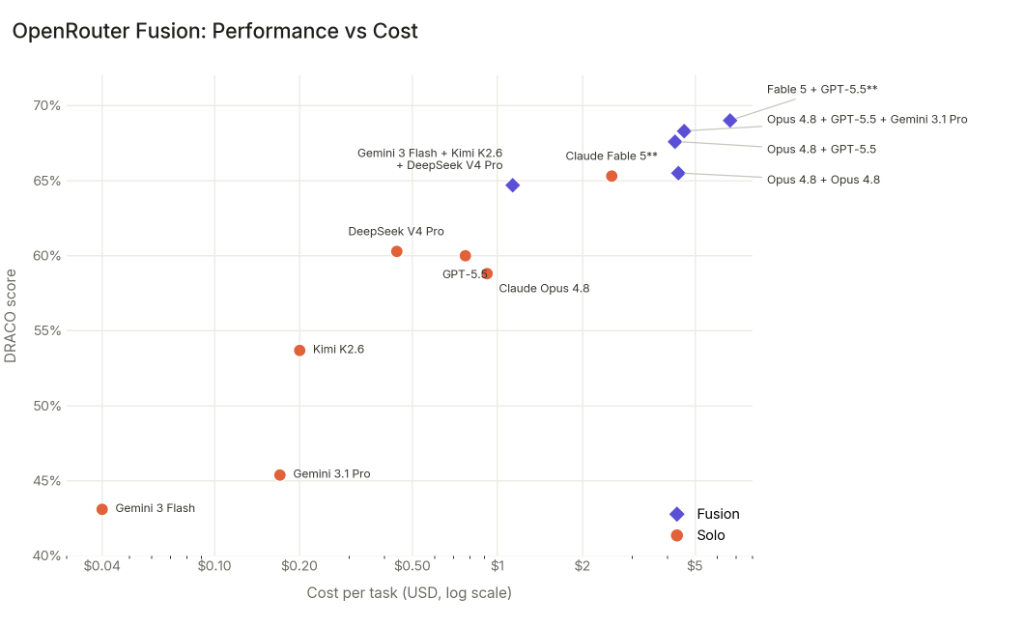
Among the three models in the combination, two are domestic models with a clear performance gap compared to GPT-5.5. However, they provide the most realistic and commercially valuable path for domestic models: becoming the most cost-effective 'limbs' and 'senses' in a powerful heterogeneous system.
Contrary to the artificial demand created by various desktop agents, when it comes to real commercial considerations, the pricing of Anthropic and OpenAI makes 'intelligent allocation' a rigid demand (essential need) for most users and enterprises.
We know that multi-agent collaboration is an inevitable trend in AI, and enterprise-grade agent architectures should not rely on a single powerful model. This is the so-called 'Mixed Agent Architecture (MoA),' which consists of two parts:
1. The 'brain' for scheduling and judgment: accounting for less than half of the token share, handled by flagship models from Anthropic and OpenAI, responsible for final consensus extraction, conflict analysis, and complex reasoning.
2. The 'workforce' for execution: accounting for more than half of the token share, handled by domestic or open-source models like DeepSeek, GLM, and Kimi, responsible for massive document reading, large-scale web parallel searches, and basic code writing.
This is just an ideal scenario, with specific token allocations varying by task difficulty. The key point is that through such 'high-low collocation,' domestic models do not need to compete head-on with the 'Big Three' in all dimensions, especially in extreme reasoning, which is heavily influenced by hardware computing power.
As long as they can achieve passable performance in long-text processing, basic code generation, or specific language understanding, and maintain highly competitive API or subscription pricing, they can occupy an indispensable position in this multi-model routing system, thereby gaining an even larger subscriber base.
Thus, the positioning of domestic models will shift: from 'domestic alternatives' to cutting-edge models to 'computing power levers' for cutting-edge models.
By integrating into this multi-model collaboration ecosystem, domestic models can formally bid farewell to benchmark games on single test sets and, as the underlying gears of infrastructure, truly enter the production cycles of global enterprises.
03 Home-Field Advantage and Ecosystem Closure
This on-demand allocation architecture is a dream come true for enterprise and individual users, but for tech giants providing large models, it undoubtedly undermines their profits and control.
This leads to another obvious trend in the current industry: the construction of 'home-field advantage' in the agent era.
Observing recent product launches: abroad, Anthropic competes with OpenAI, with Claude Code and Codex going head-to-head; domestically, Xiaomi's MiMo Code strengthens binding with MiMo, while Zhipu updates ZCode 3.0 exclusively for GLM.
This strong binding between models and deployment environments (IDE/CLI) is not only driven by commercial exclusivity but also has profound engineering logic and strategic ambitions.
From an engineering logic perspective, this is about using the environment to mask model deficiencies.
The relationship between models and agent environments is akin to that between programming languages and IDEs. Any general-purpose large model has its unique failure modes.
When Anthropic builds Claude Code, in addition to developing a command-line tool, it also hardcodes a vast number of hidden system prompts, error retry logic, and specific tool invocation formats optimized for Claude at the bottom layer (underlying level).
In an external generic agent framework, Anthropic's model might fail due to unexpected errors like non-standard output formats; however, in its Exclusive home court (exclusive home field), the IDE or CLI can silently correct these errors in the background. This home-field advantage makes the model perform exceptionally smoothly in the designated environment, giving users the illusion of 'absolute model superiority.'
From a strategic ambition perspective, this is about establishing supplier 'lock-in' that is difficult to escape.
From Prompt to Skills to Harness, the importance of memory and environment is fully demonstrated. Once users become accustomed to working within a specific agent framework, the accumulated context, custom configurations, and workflows make it difficult for them to leave the underlying model.
A simple API price war can only solve temporary problems, while an extremely polished closed agent environment means upgrading model capabilities into product experiences.
This is Anthropic's secret to success: when the core business workflows of enterprise programmers are solidify (solidified) in a Exclusive Intelligent Agent (exclusive agent), even if OpenAI launches a new model that leaves Altman 'seeing the atomic bomb and collapsing,' or if DeepSeek and Xiaomi release models that are ten or even a hundred times cheaper, enterprises cannot switch with a single click because the workflows are incompatible.
This closed island strategy is the strongest moat for giants to defend against multi-model routing technologies like Fusion and the impact of open-source alternatives.
04 The Rise of Meta-Frameworks and Third-Party Counterattacks
While giants can still cope with open-source technologies, the trend toward multi-agent collaboration is ultimately unstoppable. When enterprises find themselves forced to copy and paste between several incompatible agent islands and bear high costs due to their inability to switch underlying models, a revolution at the infrastructure layer becomes inevitable.
This is the historical backdrop for Databricks' open-sourcing of Omnigent. Databricks positions Omnigent as a 'meta-framework (Meta-Harness),' an abstraction layer of higher dimension than a single agent.
Reviewing computer science history, the greatest leaps often come from new abstraction layers. When engineers struggled to manage dozens of different servers simultaneously, Google developed Kubernetes, abstracting underlying hardware into a unified resource pool. Today, the AI industry is at precisely the same juncture, with various agents and their frameworks (Harness) serving as those largely incompatible servers.
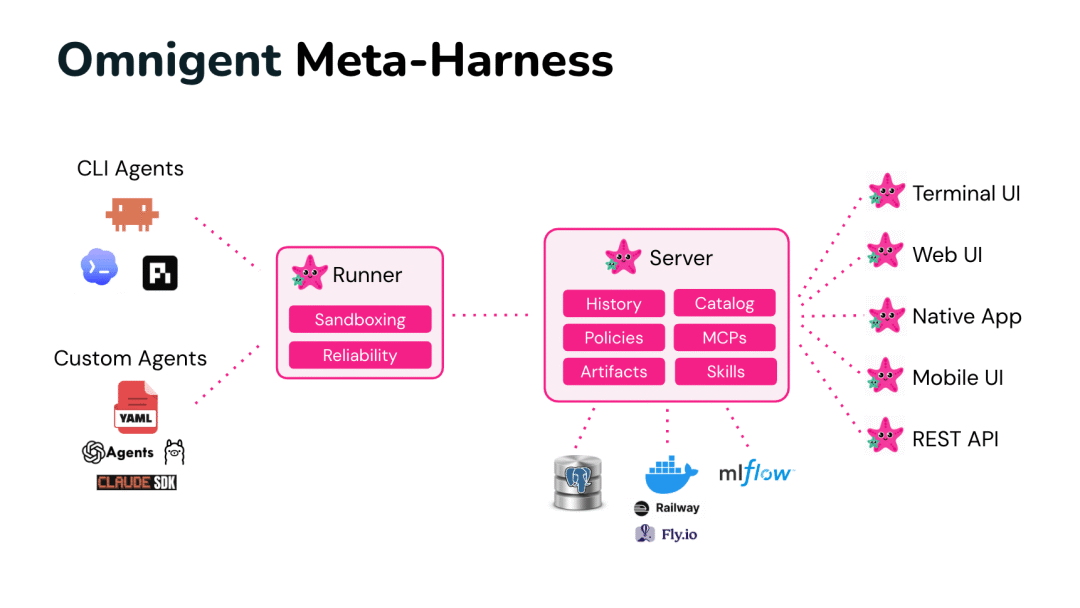
The core value of Omnigent lies in stripping giants of their home-field advantage and returning control to users. By building a unified API, it achieves three disruptive functions:
First is composability akin to 'one-click hot-swapping.'
Users can switch the logic node from Claude to another custom model with just a single line of code within a unified workflow, or simultaneously invoke Codex and multiple self-built agents in one project, directly dismantling the giants' vendor lock-in strategy.
Second is absolute policy control that balances security and cost.
In a closed ecosystem, whether a model can be used, how it can be used, and for how long are entirely defined by the giants' black boxes. However, in a meta-framework, users can freely set hard limits, such as immediately freezing and requesting manual confirmation when token consumption for a session reaches $100, without needing to query consumption from each AI supplier.
Since the control layer is elevated to the meta-framework, even with different underlying models, the security reviews and cost policies most valued by enterprise users can be uniformly enforced.
Finally, it eliminates contextual silos.
Session states no longer reside on a single vendor's servers but are managed by a neutral meta-framework. Whether for human-machine collaboration or multi-agent collaboration, a unified workbench is provided.
Therefore, tools like Fusion technology and the Omnigent framework must and can only come from third parties.
As mentioned earlier, Anthropic, OpenAI, and various domestic AI vendors exhibit severe capital-driven biases. Unless their own models are truly inadequate, they would never introduce a framework that allows enterprises and individual users to seamlessly distribute tasks to competitors to save costs.
Fusion was born on OpenRouter, a neutral model aggregation API platform; Omnigent was born on Databricks, a underlying infrastructure supplier with 'data multi-cloud neutrality' as its core strategy. Only third parties completely decoupled from specific models have the incentive to create such barrier-breaking tools.}
This represents the core interests of the vast majority of enterprise developers: AI should be a commercializable and interchangeable computing resource, rather than a privilege monopolized by tech giants.
05 Reshaping the Value Chain of AI Agents
Over the past three years, people worldwide have been in the era of 'model-centricism,' where everyone is searching for an omnipotent deity capable of solving all problems.
However, reality has shown us that neither Fable 5, GPT-5.5, nor DeepSeek V4 Pro can achieve this. We must now enter the era of 'architecture-centricism.'
In this new phase, closed approaches relying on a single model or agent are destined to be marginalized. Future enterprise-level AI productivity systems will inevitably feature a highly differentiated hierarchical structure:
At the foundational level—the computational execution layer—domestic models will leverage unparalleled cost-effectiveness to undertake vast amounts of basic 'brick-moving' work, shedding their toy-like status to become indispensable cornerstones.
In the middle layer—the cognitive evaluation layer—flagship models from leading companies will step back from handling trivial details, instead serving as overarching engineers responsible for the most challenging core convergence tasks under dynamic routing mechanisms like Fusion.
At the top level—the control and interaction layer—relying on meta-frameworks like Omnigent, the closed ecosystems of major vendors will gradually be dismantled, enabling seamless cross-model and cross-framework collaboration, cost budget management, and enterprise-level security isolation.
True intelligence resides not only within the neural networks of deep learning but also within the macro-architecture connecting these networks.
Only when computational power, intelligence, cost, and neutral infrastructure achieve perfect systemic alignment can AI truly transition from a 'tech mystery box' to an industrial assembly line.
-
![]()
AI Payment War: Strategic Maneuvers by WeChat and Alipay
-
4 Individuals Whose Destinies Were Altered by Jensen Huang
-
![]()
Is DingTalk Still Necessary in the AI Era?
-
![]()
Exclusive Insight | DeepSeek's Funding Puzzle: 100 Billion Yuan in Interest, Yet 50 Billion Yuan Left Unclaimed
-
Another Domestic GPU is About to Hit the Market, with Tencent as Major Shareholder and Big Client
-
![]()
Duan Yongping Offers Insightful Perspectives: New Hurdles for Long-Term AI Investment
-
![]()
Chinese New Energy Vehicle Design: Stepping Out of the Shadows
-
![]()
Li Auto Awards Executives 35 Million Shares Based on Performance Metrics