AI Battle Among Mobile Titans: Alipay Constructs a 'City' with Abao, WeChat Constructs 'Roads' with AI Cards
 06/18 2026
 480
480
WeChat Pay Takes One Path, Alipay Chooses Another.
Yesterday, Alipay unveiled its new AI assistant, 'Abao,' for comprehensive beta testing, integrating millions of daily services into a right-swipe page. This morning, WeChat Pay responded with a significant move, officially launching the 'AI Exclusive Card'.
One is swiftly amassing entry points to construct a 'city,' while the other is deeply exploring underlying infrastructure to lay 'roads.' Within just 24 hours, these two mobile internet behemoths have diverged at the crossroads of AI Agents. These two super apps, which have left their imprint on us through 'Red Packet Wars,' 'Subsidy Wars,' 'Offline Scenario Wars,' and 'Social Wars' during the mobile internet era, are once again clashing in the Agent era.
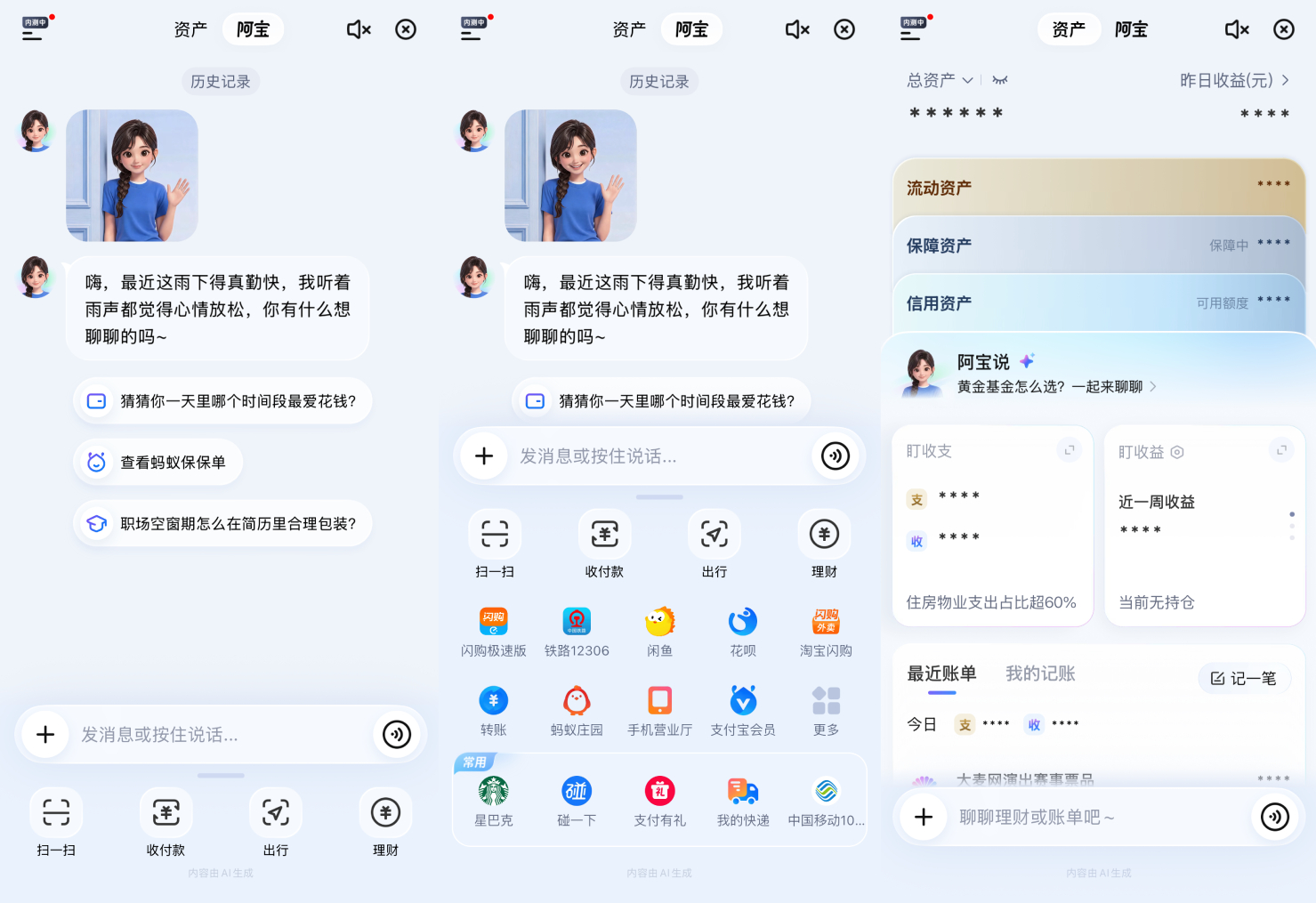
Let's first delve into Alipay's early-adopter AI version, which officially claims to transition from a display-based to a conversational interface. Simply put, it introduces the new 'Abao' AI assistant, asserting that with just one sentence, users can hail a taxi, order food delivery, and check housing provident funds.
(Image Source: Leitech)
From a UI perspective, the most notable change in Alipay's AI version is the addition of a right-swipe entry to 'Abao' on the home page. Swiping over indeed unveils a clean and refreshing AI interaction page. To cater to our muscle memory as long-time users, high-frequency essential sections like scan, pay/receive, and travel at the bottom of the original Alipay home page have been preserved. Simply swipe up, and the dense functional entries on the original home page reappear.
At the top of the dialog box, a single tap switches to the 'Assets' view, where account balances, wealth management, and Huabei are all accessible.
Clicking on the top-right corner of the interface reveals the now-standard AI tool features: personal information, settings, conversation history, etc.
One practical aspect is that system messages are also integrated here. Normally, payment reminders, food delivery updates, and express delivery stagnation notices are all tucked away in this corner, significantly decluttering the main interface.
Now, let's get to the point.
What everyone is most curious about regarding Alipay is, of course, financial matters. Can AI assist me in repaying my Huabei?
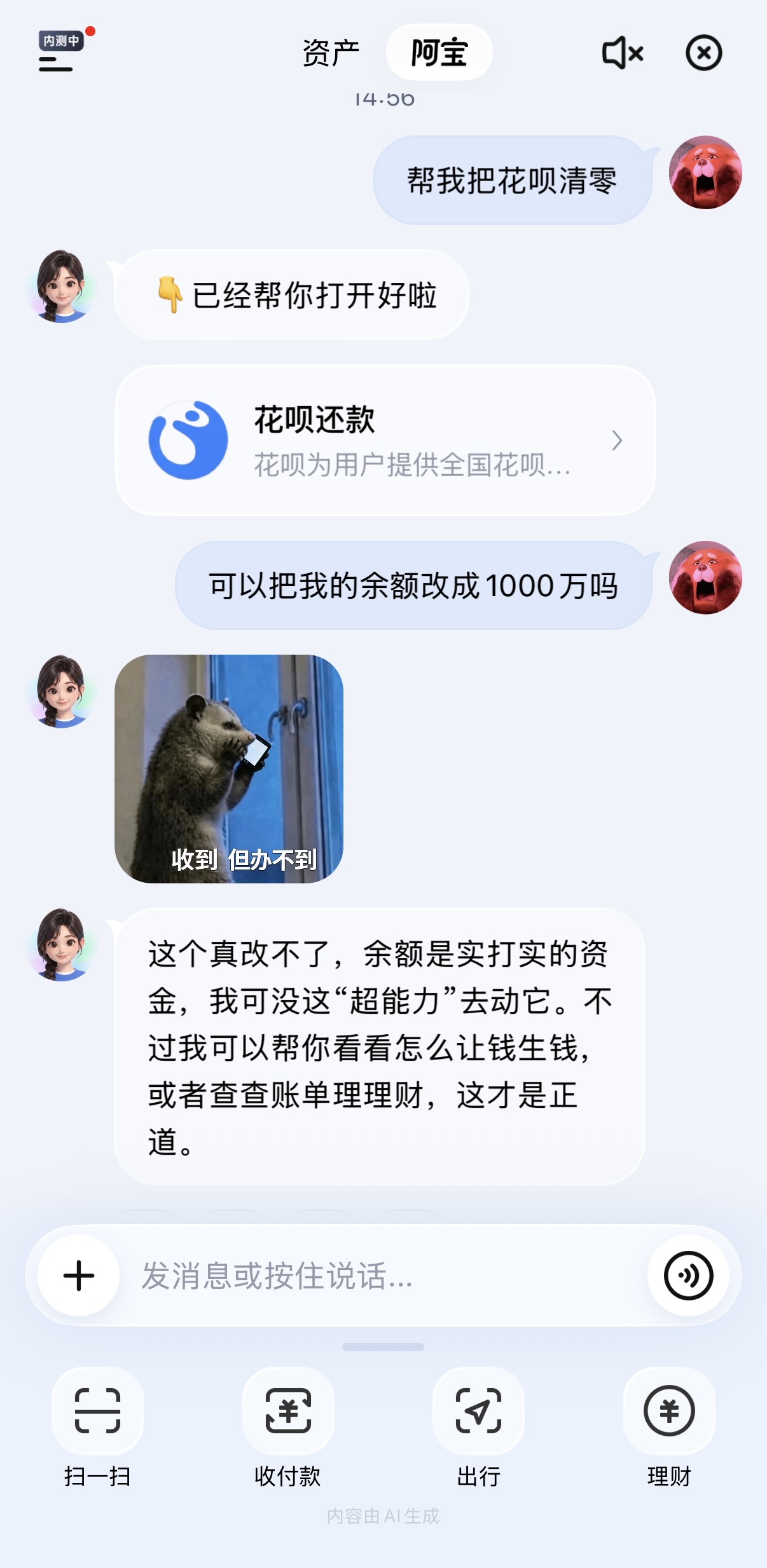
(Image Source: Leitech)
Well, the actual test results are: It simply displays a Huabei interface, prompting me to repay with my own funds. Haha, it seems like we didn't even need to test to know the answer. Leitech (ID: leitech) just wanted to see if it would promise to repay me like Doubao does and then do nothing. I asked Abao to directly transfer money to my account, and to my surprise, it even knew to send an emoji to fob me off. It's getting smarter.
Now, let's examine the most commonly used daily task: ordering food delivery. After all, the Tongyi Qianwen APP has already showcased fully automated operations up to the payment step. As Abao's counterpart, there's no reason for it to fall short, right?

(Image Source: Leitech)
Unfortunately, Abao's performance in ordering food delivery is somewhat unpredictable. For instance, when I requested a chicken burger from Burger King with sugar-free cola, it merely displayed a flash sale entry and searched for 'Burger King Chicken Burger Combo.' It couldn't autonomously place the order like Qianwen does.
(Image Source: Leitech)
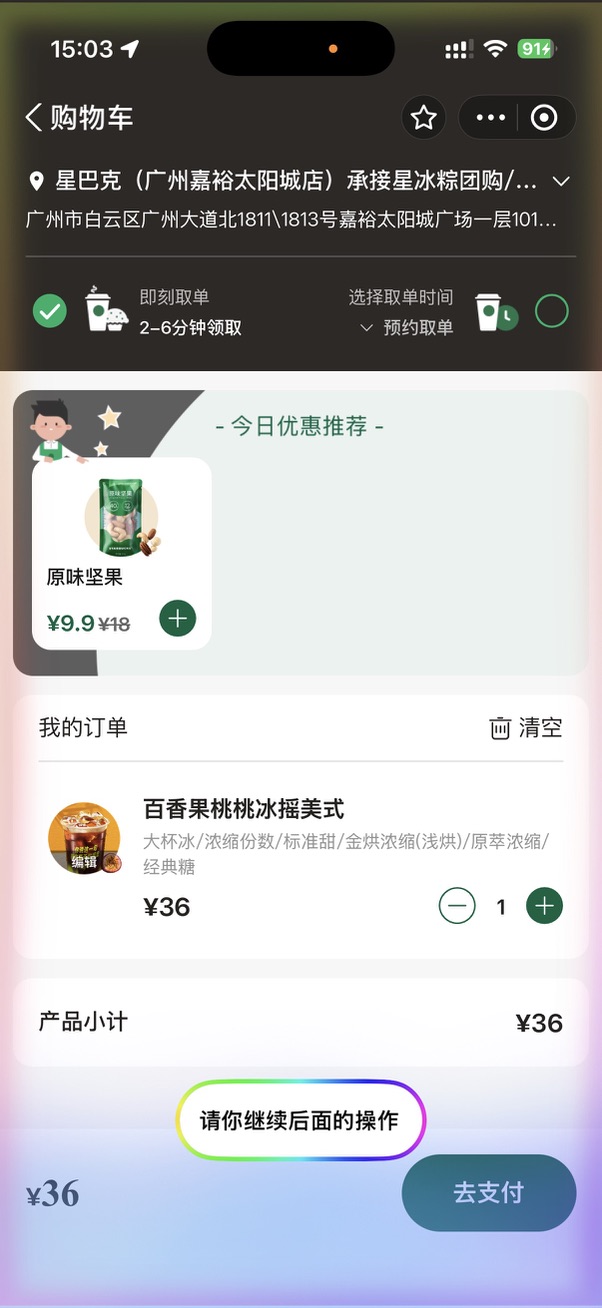
Not convinced, I altered my request and asked it to order an Iced Shaken Espresso from Starbucks. To my surprise, this time Abao seemed to get its act together, directly taking action, opening the Starbucks mini-program, clicking through, and managing to reach the payment interface.
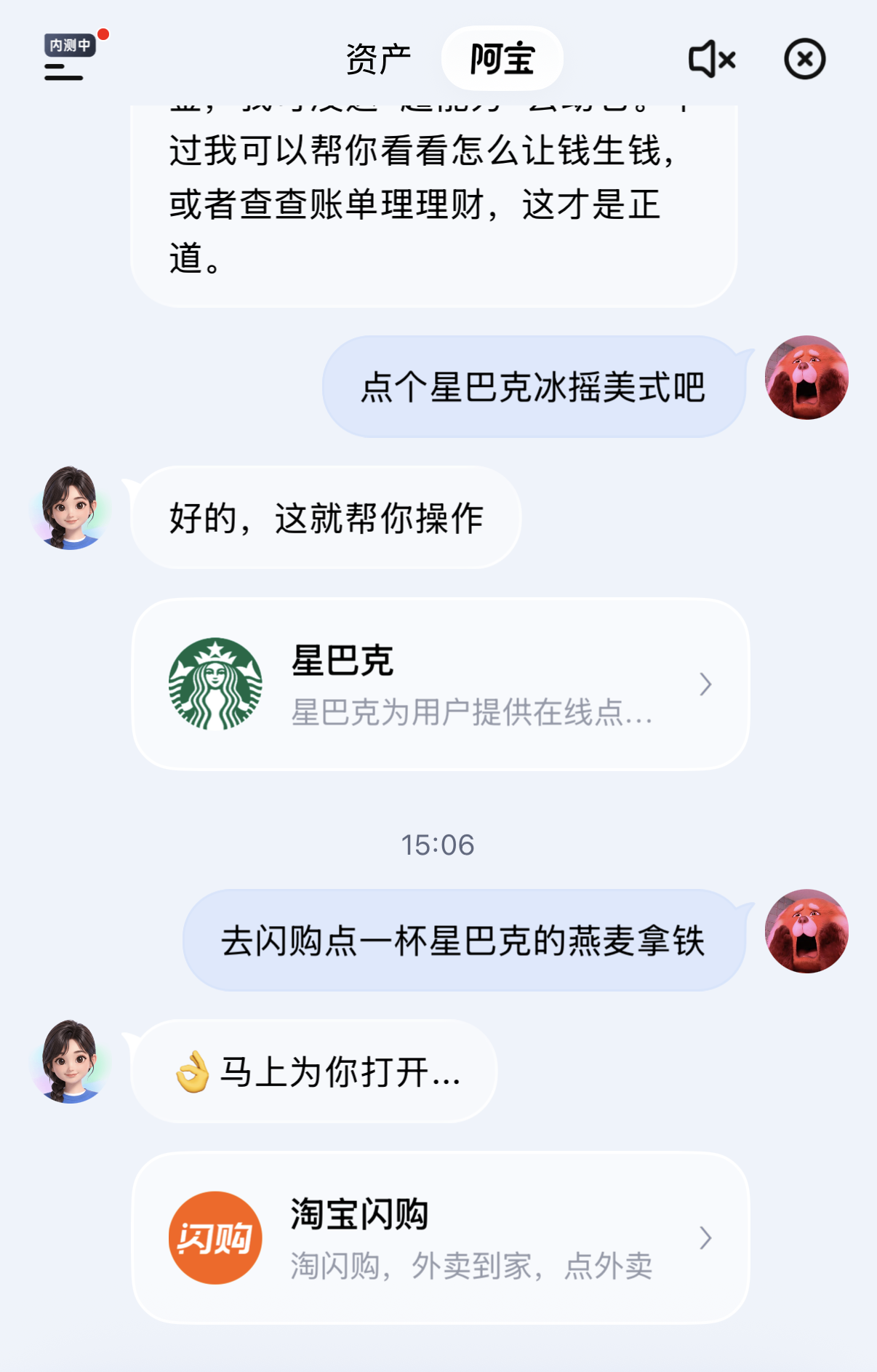
But when I tried again, asking it to order a Starbucks Oat Latte for me through flash sales, things fell apart again. It regressed, only capable of performing the search step.
(Image Source: Leitech)
This inconsistent experience clearly reveals the adaptation issues between Abao and third-party mini-programs.
Officially, it's stated that tens of thousands of services have already been adapted, but in reality, some apps permit Agents to perform screen recognition and simulated clicks through system authorization, while others are heavily guarded.
(Image Source: Leitech)
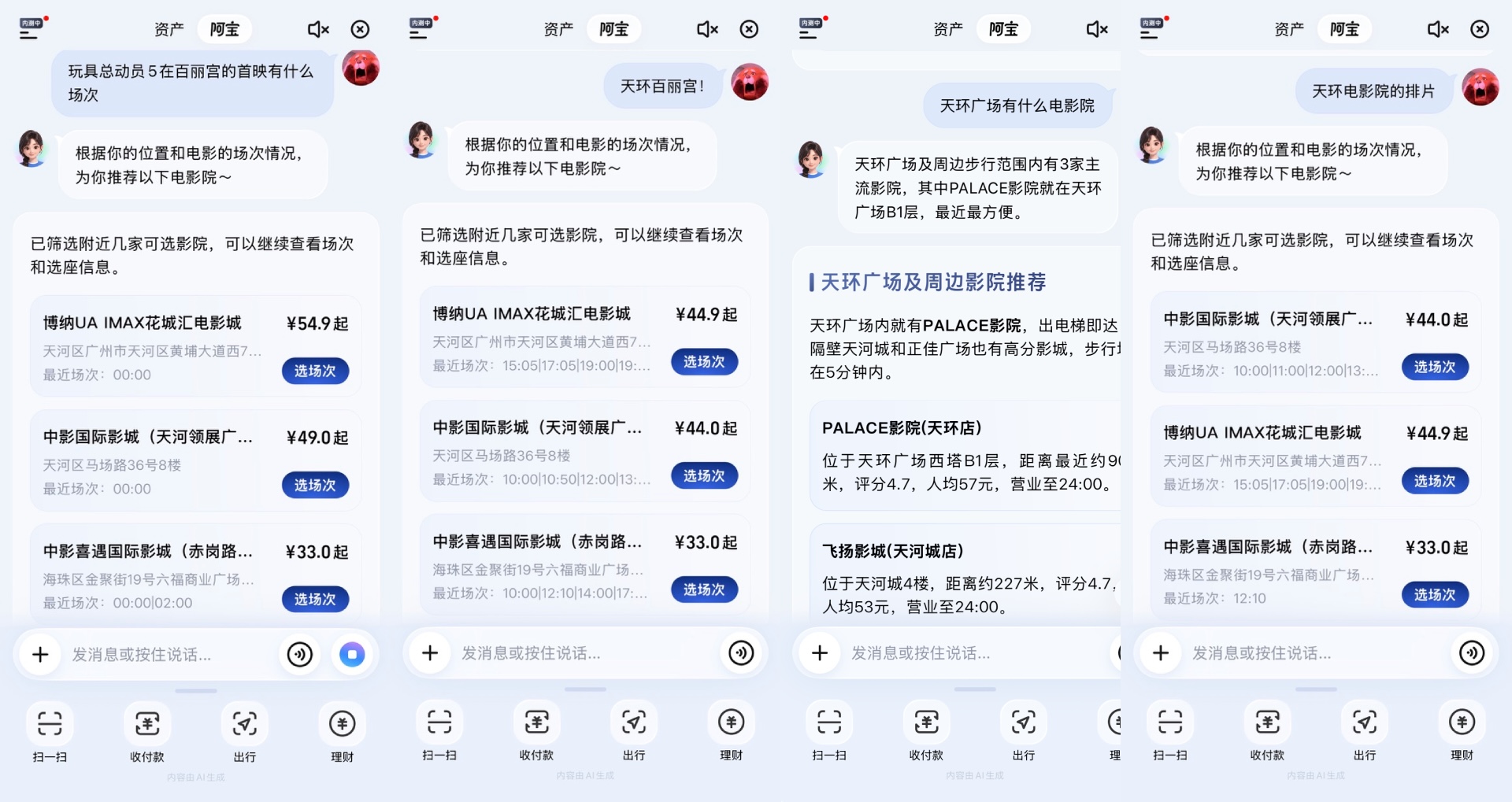
Let's attempt more complex long-tail demands. For example, 'Toy Story 5' is about to be released, and I want to check the showtimes at Tianhuan Paragon.
Unfortunately, Abao couldn't comprehend this. It knew there was a PALACE at Tianhuan Plaza but didn't recognize it as Paragon in Chinese. Even when I simplified it and just asked about movies at Tianhuan, it still couldn't accurately match the showtimes I desired.
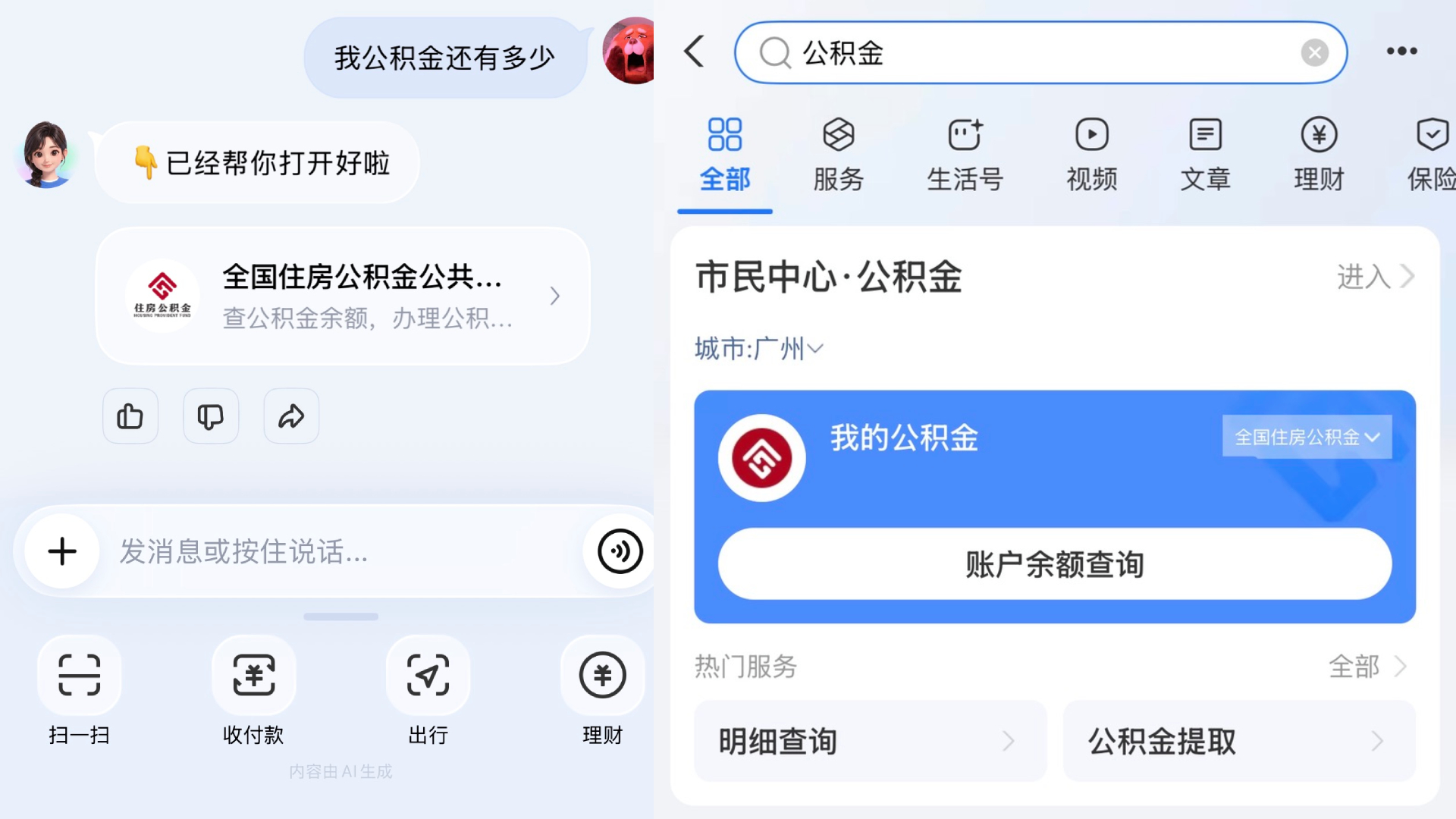
After several attempts, I found that in most scenarios, all Abao does is bring up a functional entry and place it in front of you.
 (Image Source: Leitech)
For example, checking housing provident funds. The official uses this as a typical case, claiming it can be done with one sentence. But the issue is, if I directly search 'housing provident fund' in Alipay's original search box, the same interface appears. Why do I need to bother with AI?
As for basic text conversations, voice interactions, and image reading, honestly, any AI assistant downloaded from the app store nowadays can perform these tasks. It can't be the competitive edge for a national-level APP.
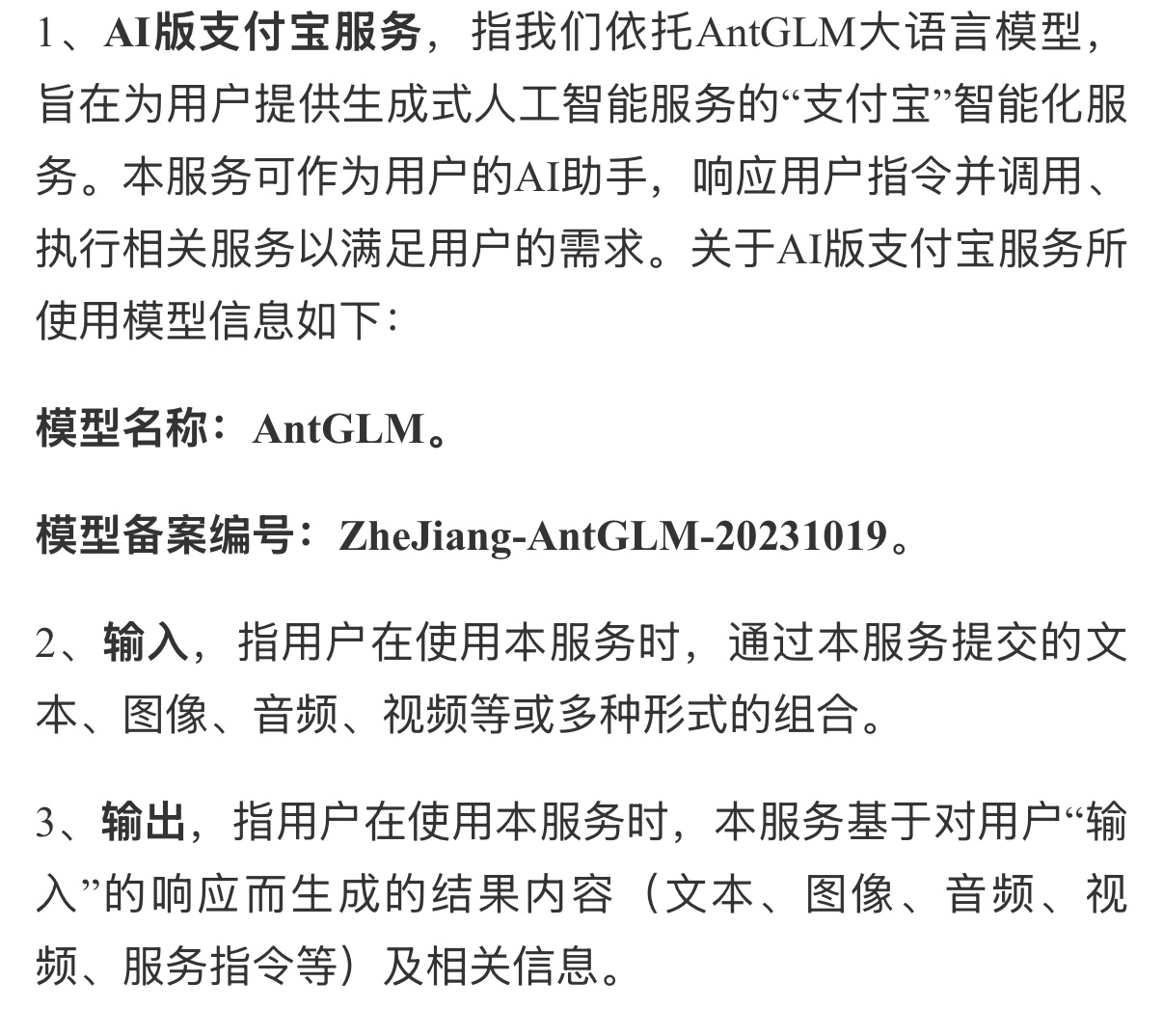
After testing these, I reviewed the user agreement for the AI version of Alipay and discovered something intriguing: The underlying model Abao utilizes is the self-developed AntGLM large language model, which was filed in 2023. This model excels in financial services and serves as the foundation for Ant Group's AI capabilities in recent years.
(Image Source: Alipay)
Regarding privacy, rest assured. The agreement clearly states that when the Agent performs tasks in specific scenarios and simulates clicks, the system employs technical means to block screen recognition for sensitive pages like payment pages, password input pages, and bank cards.
In other words, the AI can't view your money or password during the operation. This confirms the official statement: Abao only runs errands and sets up the window; whether to 'pay' or not is always up to the user.
To understand why Starbucks orders can be placed but not Burger King's, I revisited Alipay-related patents. A patent titled 'Task Processing Method, Device, and Equipment for Multi-Agent Systems' (CN122045522A) was published a month ago and should be the underlying core technology for this update.
It turns out that behind Abao isn't just a single AI fighting alone but a Multi-Agent System (MAS) working in tandem. There's a planning Agent responsible for receiving guests and breaking down your words into tasks; a context injection module responsible for digging through the memory bank for historical records and business knowledge; and finally, the underlying 'execution Agents' that do the actual work.
The disjointed experience we feel is essentially due to the system's generation of call instructions and dependency parsing not fully breaking through for some complex third-party mini-programs. Given time, with the advancement of Agent technology and the prosperity of Ant's AI ecosystem, these current issues will no longer be problems.
2026 marks the inaugural year of Agents. In the AI era, whoever masters Agents holds the key to the largest interaction entry point in the next decade. That's why even Apple, known for its slow pace, is transforming the new Siri into an Agent this year.
But in the showdown between these two national-level super apps, WeChat and Alipay have taken entirely different routes.
WeChat's approach can be described as an 'infrastructure enthusiast.' A2A (Agent to Agent) is advancing rapidly, with service providers like Meituan and Didi, as well as hardware partners like Midea and Honor, all actively connecting, solving the isolation problem between the OS system layer and the application layer.
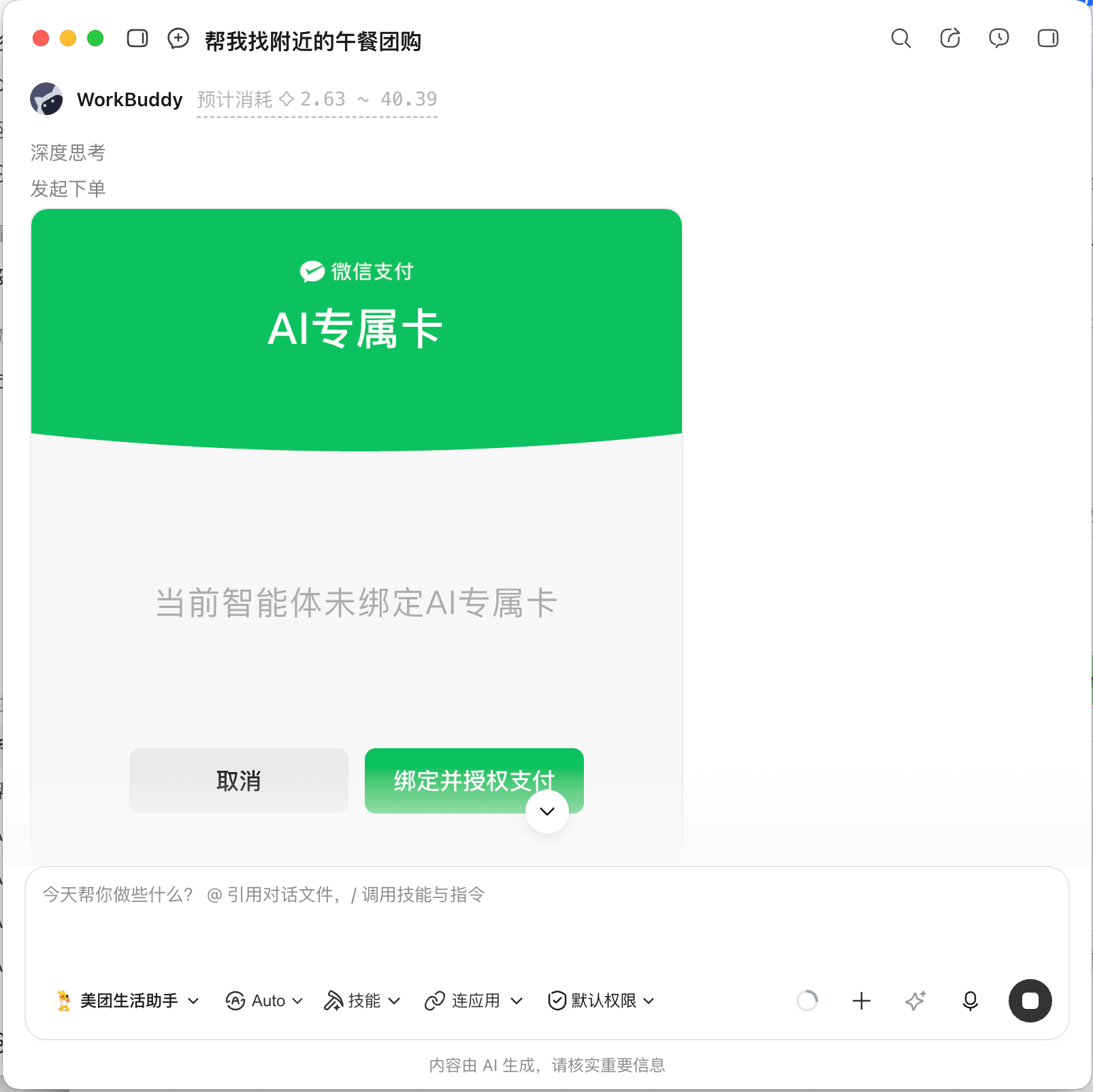
Just today, WeChat Pay officially launched the AI Exclusive Card.
(Image Source: Leitech)
This card is completely isolated from the main WeChat account. I set the limit myself, and AI must obtain my final confirmation before spending a penny, essentially giving AI its own independent wallet.
WeChat's strategy is clear: provide the most convenient payment infrastructure inside and outside the ecosystem, allowing Agents to move freely.
In contrast, from Ant Afu to the current Abao, I can clearly sense Alipay's aggressiveness: not content with just being a payment provider, it aims to seize millions of third-party service entries like government services and travel. More than whether Abao is smart now, what Alipay wants to convey to the outside world this time is its strategic emphasis on embracing Agents.
This obviously stems from the different core strengths of the two companies. WeChat already encompasses social, payment, content, and applications, jokingly referred to as WeChat OS in the industry. It has no rivals in this arena, so it can afford to take its time with infrastructure.
But Alipay is different. Payment and financial services are its biggest strengths, while content and social are areas it has been striving to enhance. Although it has social features like Ant Forest, Lucky Money Collection, chatting, and even live streaming and short videos, not many people spend their entire day chatting or watching short videos on Alipay compared to those who casually use WeChat Pay.
In the end, WeChat Pay takes one path, and Alipay chooses another. These two giants have made diametrically opposite choices today when mobile internet dividends are peaking. AI Alipay 'Abao' swiping right is Alipay's proactive battle to defend its traffic entry points; while the launch of WeChat's AI Exclusive Card is Tencent's customized financial infrastructure for the entire AI second half, built on the foundation of WeChat OS. One goes left, content to be an invisible road builder; the other goes right, aspiring to be an all-powerful city builder. The directions of these two giants are vastly different.
The ruthless competition in the AI era has only just begun.
AI Mobile Payment AI Payment Alipay WeChat
Source: Leitech
All images in this article are from the 123RF royalty-free image library. Source: Leitech
-
![]()
Which Company Leads in Ultra-Fast Charging Technology? Geely’s MW Ultra-Fast Charger Warns Against Use in Temperatures Above 65℃
-
![]()
Survey | Are Fuel-Powered Cars Now 'Cabbage-Priced'? Why Can't I Find Them at Those Prices?
-
![]()
150,000 Orders: Is Production Capacity the Sole Challenge for BYD’s Tang? BYD Adjusts Strategy to Surpass Profit Limits
-
![]()
Tesla Optimus: Not the Best Choice for Full-Sized Humanoid Robots
-
![]()
Robot Sales Skyrocket, But Restricted to Adults: Is Romance the Answer in the Modern Age?
-
Eight Long-Standing Automakers Officially Delisted: The Closure of an Era Filled with Generational Memories
-
What signal does the expansion of the fifth listing criteria on the STAR Market send?
-
![]()
Policy Support & Tech Leap: MiniMax at a Pivotal Moment for Revaluation