Which Company Leads in Ultra-Fast Charging Technology? Geely’s MW Ultra-Fast Charger Warns Against Use in Temperatures Above 65℃
 06/18 2026
 405
405
On June 16, Geely Auto Group announced that, according to the current national standard GB/T44500-2024, "Inspection Regulations for the Operational Safety Performance of New Energy Vehicles," the maximum charging temperature for lithium iron phosphate power batteries should not exceed 65℃.
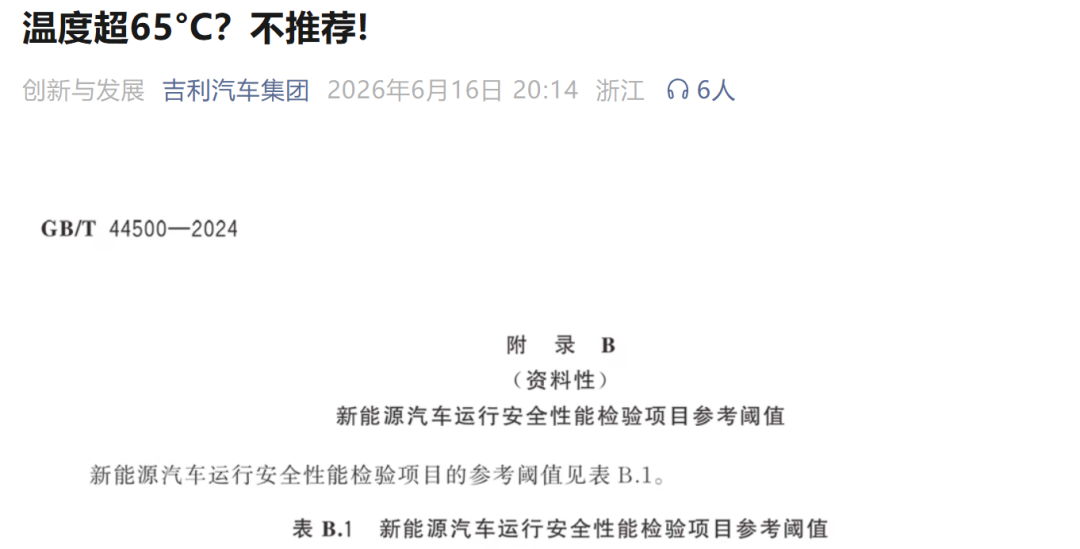
Meanwhile, Geely Auto released temperature test results for the LYNK & CO 10 MW ultra-fast charger conducted by the China Automotive Technology & Research Center. The tests showed a maximum charging power of 1093kW and a peak battery temperature of 64℃.
According to video footage released by Geely Auto, the test was a sampling test. The battery pack started at 9% charge and reached 97% in approximately 10 minutes. During charging, temperature tests were conducted on four groups of battery cells, with temperatures at 12 points from three of the cell groups (52#, 144#, 194#) disclosed. The final charging temperatures for the 52# cells were 63.6℃, 60.9℃, 33.2℃, and 62.3℃; for the 144# cells, they were 61.5℃, 58.3℃, 62.9℃, and 62.4℃; and for the 194# cells, they were 58.7℃, 63.1℃, 61.7℃, and 58.3℃. The lowest temperature was 33.2℃, and the highest was 63.6℃, which complies with the national standard of a maximum of 65℃.
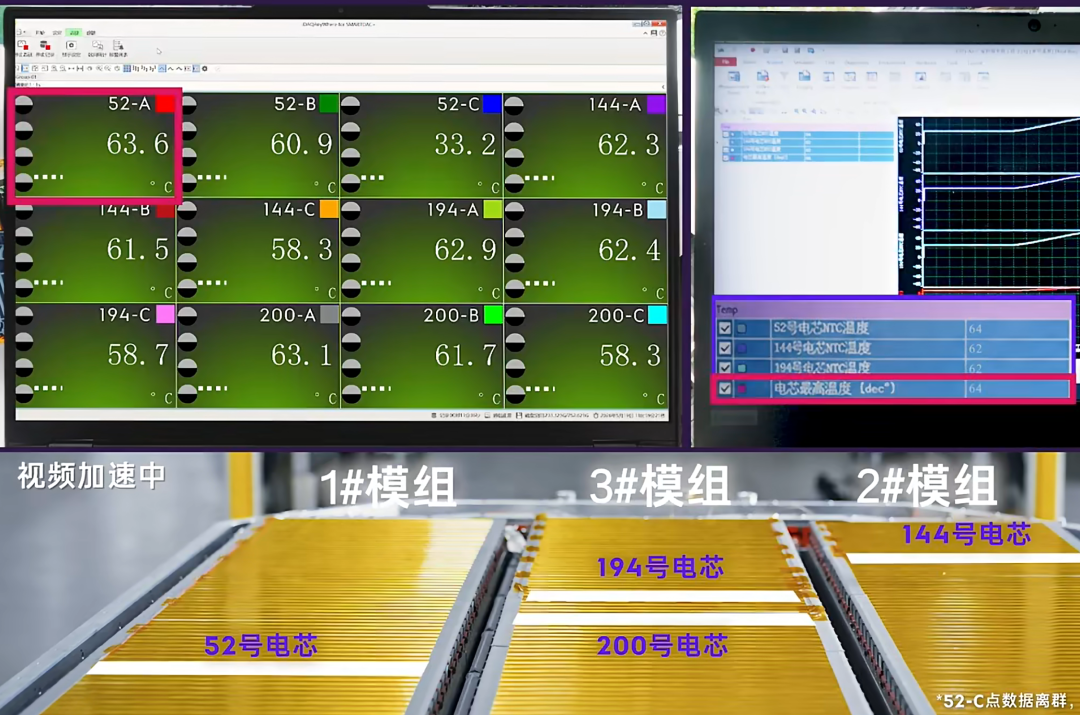
Geely Auto pointed out that, according to Joule's Law, battery heat generation increases exponentially with current, meaning faster charging speeds lead to quicker temperature rises in the cells.
Geely Auto's test marks the industry's first proactive disclosure by an OEM of megawatt ultra-fast charging temperatures for lithium iron phosphate batteries. Although it only sampled the charging temperatures of three cell groups rather than all, it remains highly significant.
Earlier, BYD, Geely Auto, and CATL sequentially announced their "MW flash charging" technologies on March 5, April 7, and April 21 this year, respectively. Among them, CATL's third-generation Shenxing ultra-fast charging technology achieves the fastest charging time, taking only 3 minutes and 44 seconds to charge from 10% to 80% SOC. However, CATL's charging speed may refer to laboratory cell charging times rather than those for a complete vehicle.
In terms of complete vehicles, Geely and BYD conducted real vehicle tests. Geely's LYNK & CO 10 MW ultra-fast charger was released later than BYD's, but its charging time is faster. The LYNK & CO 10 takes only 4 minutes and 22 seconds to charge from 10% to 80%. BYD's charging time from 10% to 70% is approximately 5 minutes.
The simultaneous announcement of their latest MW flash charging technologies by these three leading Chinese automotive and power battery companies has sparked widespread speculation in the industry. Consumers and the media are questioning: Have these three leading Chinese technology and automotive companies completely resolved the previously industry-wide issue of ultra-fast charging damaging batteries?
Fast Charging Temperature Rise: An Objective Physical Challenge, with Consensus Among Multiple Perspectives
In response, on May 12 this year, the People's Daily client "China Energy News" published an article titled "Don't Let Fast Charging Compromise Safety." The article pointed out:
"From a scientific perspective, the essence of battery charging and discharging is the migration and accumulation of charge carriers, such as lithium ions, between the positive and negative electrodes, a process accompanied by significant heat generation. The main sources of this heat are threefold: Joule heating, polarization heating, and side reaction heating, such as from the decomposition of the SEI film. Joule heating is proportional to the square of the current, meaning that when the charging current doubles, the heat generated increases fourfold.
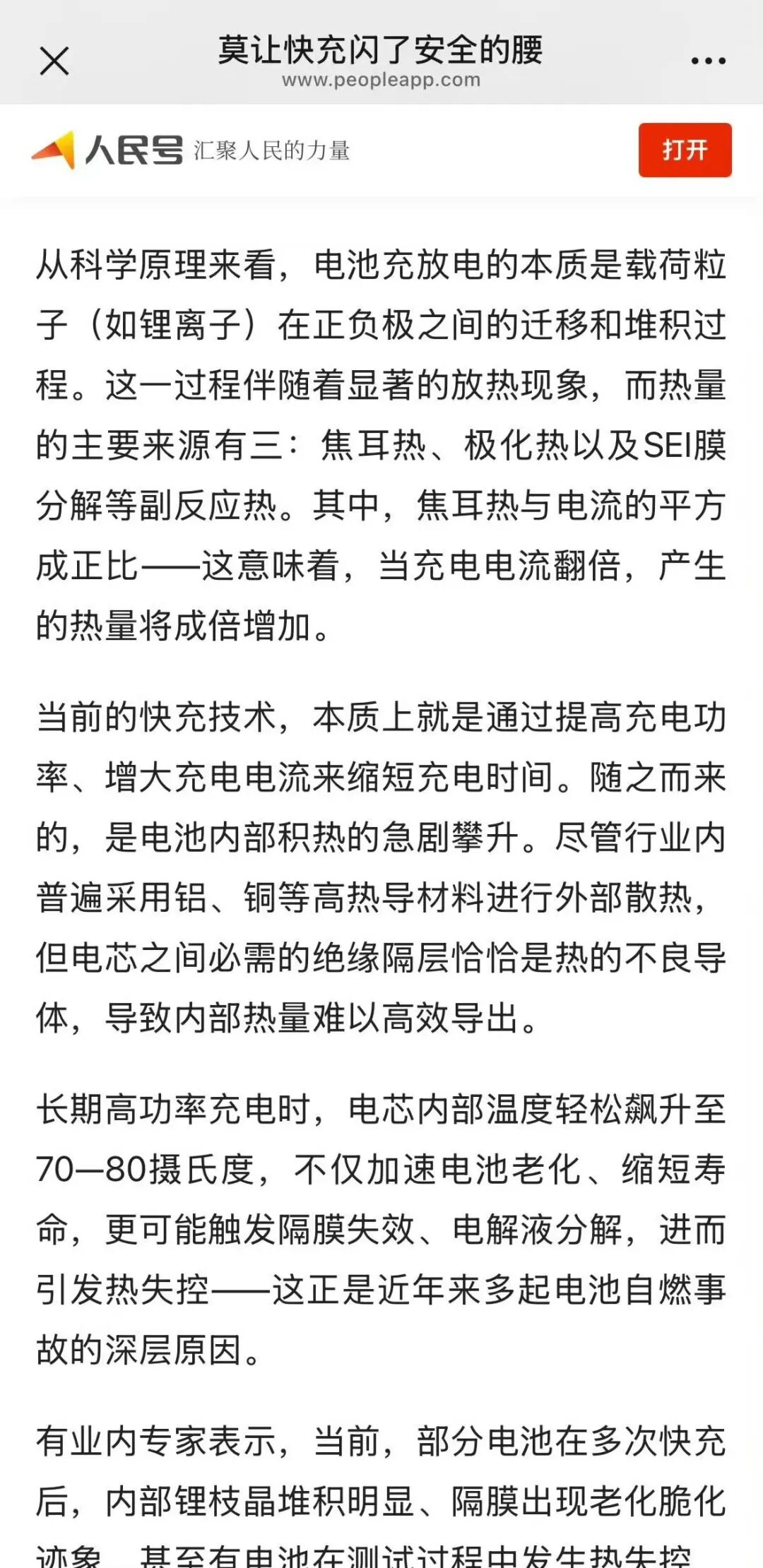
Current fast charging technologies essentially aim to shorten charging times by increasing charging power and current, leading to a rapid rise in internal battery heat. Although the industry commonly uses high thermal conductivity materials like aluminum and copper for external heat dissipation, the necessary insulating layers between cells are poor thermal conductors, making it difficult to efficiently dissipate internal heat. During prolonged high-power charging, cell temperatures can easily soar to 70-80℃, accelerating battery aging, shortening lifespan, and potentially triggering separator failure and electrolyte decomposition, leading to thermal runaway—the underlying cause of many battery spontaneous combustion incidents in recent years."
From this commentary, it is clear that the technical approaches of "flash charging" from BYD, Geely, and CATL are identical: increasing charging power and instantaneous charging current. The "megawatt" referred to by manufacturers, meaning "1000kW," as seen in Geely's LYNK & CO 10 announcement of a "maximum charging power of 1093kW," inevitably leads to battery "temperature rise." As for how high this temperature rise will go, there has been no public practical testing from OEMs or national regulatory agencies, making Geely's LYNK & CO 10 test an industry first.
The viewpoint expressed in the People's Daily commentary was also "supported" by experts from CATL on their April 21 technology release day, albeit earlier than the People's Daily article.
On April 21, Gao Huan, CATL's Chief Technology Officer (CTO), stated at the CATL Super Technology Launch: "The real core challenge of ultra-fast charging has never been trickle charging but battery temperature rise. Temperature rise refers to the battery heating up during charging, which accelerates battery aging. According to the Arrhenius equation, for every 10°C increase in battery temperature, internal side reactions roughly double, significantly impacting battery lifespan. Have you noticed that many ultra-fast charging batteries slow down towards the end of charging? A major reason is the increased battery temperature, necessitating current reduction to control temperature rise, which is what we call trickle charging." From Gao Huan's explanation, it is clear that his viewpoint aligns perfectly with that expressed in the People's Daily article on May 12.
When Geely Auto released its related technology on April 7, it did not specifically address "battery temperature rise" during ultra-fast charging. However, on June 16, Geely echoed the same sentiment: "According to Joule's Law, battery heat generation increases exponentially with current, meaning faster charging speeds lead to quicker temperature rises in the cells."
Technical Route Breakdown of Leading Companies: Each Has Solutions for Temperature Rise
Since battery temperature rise from ultra-fast charging is inevitable, how do BYD, Geely, and CATL address this issue? CATL's approach is to reduce internal resistance.
"Charging speed is determined by charging power. At the same voltage, higher current means faster charging. According to Joule's Law, higher current leads to an exponential increase in battery heat generation. If internal resistance remains unchanged, increasing current to reduce charging time cannot compensate for the temperature rise. Therefore, to increase charging speed without increasing heat generation, the core approach is to reduce battery internal resistance. Thus, we systematically reconstructed the battery from the material gene level, ultimately achieving the world's lowest average internal resistance of 0.25 milliohms for lithium iron phosphate cells," Gao Huan pointed out.
Additionally, CATL enhanced heat dissipation speed through bottom water cooling, large-area cooling, and cell shoulder cooling solutions. Precise temperature measurement is also crucial for better temperature control. CATL controls the accuracy of internal cell temperature measurement within ±1°, aiding in better temperature control.
In its June 16 video, Geely Auto also disclosed solutions to address excessive battery temperatures caused by ultra-fast charging: dual-sided three-dimensional liquid cooling, intelligent thermal management prediction, and aerospace-grade thermal insulation barriers. In comparison, Geely emphasizes heat dissipation and temperature management rather than directly reducing "internal resistance."
In fact, BYD also announced a similar solution path to CATL's at its March 5 technology launch: reducing internal resistance while strengthening thermal management and heat dissipation.
"Our second-generation Blade Battery reduces internal resistance by creating high-speed channels for lithium-ion migration, minimizing heat generation from flash charging. For the heat that is generated, we use the properties of metals like copper and aluminum foils to form parallel heat conduction. We also developed an 'all-temperature intelligent thermal management system' for millisecond-level control, allowing rapid and uniform heat dissipation—like installing an intelligent air conditioner for the battery. Therefore, flash charging with the second-generation Blade Battery has no impact on battery lifespan, charging quickly and lasting long," explained BYD Chairman Wang Chuanfu at the launch.
BYD announced: "The second-generation Blade Battery achieves lower heat generation and more efficient, uniform heat dissipation through 'lithium-ion high-speed channels' and an 'all-temperature intelligent thermal management system,' making flash charging have almost no impact on battery lifespan." From a technical standpoint, BYD and CATL's solutions to this issue are highly consistent.
Practical Testing Controversies and Dual Challenges in Industry Technology and Regulation
However, on May 6 this year, automotive blogger Caishendao's flash charging test on BYD's Fangchengbao Titan 3 model caused unease in the new energy vehicle industry, especially regarding flash charging technology. According to Caishendao's test, the maximum cell temperature captured during testing reached 76℃.
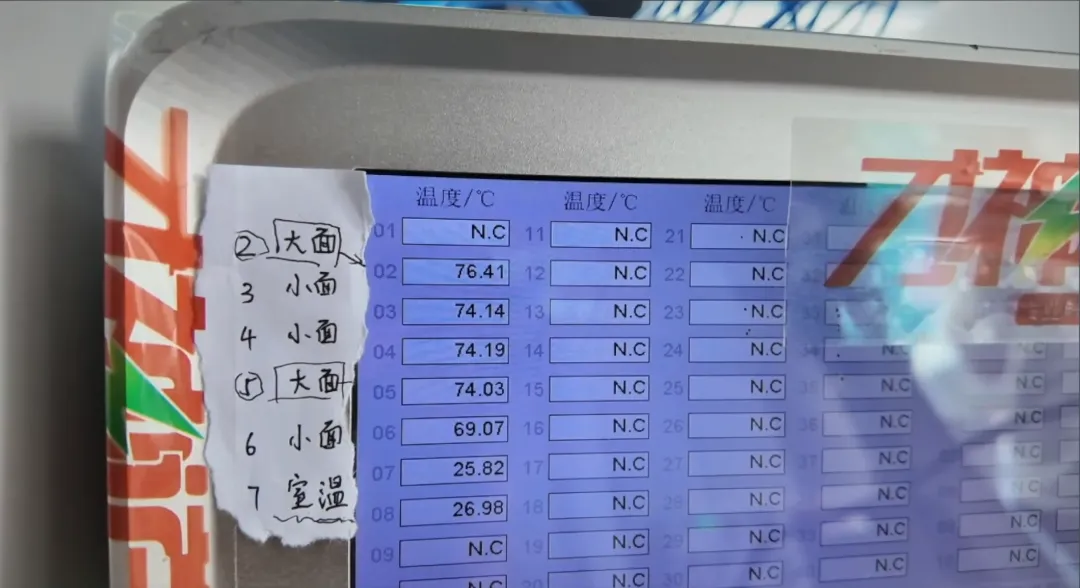
What made consumers uneasy was that Caishendao's test quickly faced complaints, with the reason being: "Continued dissemination of this video content may mislead audiences unaware of the truth." Not only that, but the People's Daily commentary published on May 12 was subsequently "taken down."
What is puzzling is that while automotive blogger Caishendao's public testing may have involved non-standard operations and unscientific, unprofessional experimental conditions, why was the People's Daily's almost entirely neutral commentary also taken down? This has left the industry perplexed.

Around the same time, on May 16, an article by 36Kr Auto featuring an interview with Sun Huajun, CTO of BYD's Battery Business Group, went viral in the industry. The article quoted Sun as saying: "The thermal management challenges posed by flash charging cannot be avoided. High-current charging inevitably generates higher temperatures, and general thermal management technologies cannot match the heat generation rate of flash charging—this is a physical reality."
However, he also pointed out, "We cannot simply say that flash charging damages batteries." From 1C to 2C, then to 4C and 5C, each generation's increase in charging speed has been questioned for "damaging batteries," yet technology has progressed each time. Regarding the upper temperature limit for battery operation, Sun said that 70℃ is just a past cognitive boundary, similar to how the industry once believed the upper temperature limit for lithium iron phosphate batteries was 60℃ a few years ago. "We cannot simply rely on past experience and inertial thinking to view new technologies," but rather must continually break through physical limits through various innovations.
BYD's solution path involves thoroughly researching the electrochemical mechanisms behind charging and battery lifespan, from enhancing the thermal stability of the negative electrode's SEI film to leveraging the natural symmetrical heat dissipation structure of the Blade Battery, reducing battery size, lowering internal resistance, and uniformly distributing heat, forming a systematic solution.
He revealed that BYD conducted extensive cycle testing under various charging rates, including 5-minute, 6-minute, 9-minute, and 10-minute rates, not only single-cycle limit verification but also long-term continuous verification, including 1000 cycles of full flash charging and simulated extreme conditions like "flash charging from Hainan to Harbin" on highways. "We conducted extensive cycling and reliability testing before confidently commercializing this technology on a large scale," he said.
Furthermore, after automotive blogger Caishendao released his test, Li Yunfei, General Manager of BYD's Brand and Public Relations Department, stated on social media: "Summer is coming, and our flash charging stations are available nationwide! Welcome everyone to visit Turpan, Xinjiang, during the hottest months of July and August, check out the Flaming Mountains, and experience our flash charging." Public information shows that summer temperatures in Turpan typically range from 40℃ to 48℃, with interior car temperatures often reaching 60℃ to 65℃ after exposure to the sun. Li Yunfei's statement implies that BYD's flash charging can withstand even the high temperatures of Turpan.
Recent information indicates that BYD's orders have surged since the release of its flash charging technology. On June 9, at BYD's 2025 Annual Shareholders' Meeting, Wang Chuanfu stated, "The production capacity of the second-generation Blade Battery is still insufficient, currently increasing at a rate of 20,000 to 30,000 units per month." He said that the company's sales this year depend on battery production capacity.
According to public information, ever since automotive blogger Caishendao disclosed on May 6th that he had measured an actual battery temperature of 76℃, amid the chorus of complaints directed at Caishendao, no company had made any public statement regarding their battery charging temperatures. That was until Geely stepped forward on the evening of June 16th, releasing its test information and becoming the first company to officially address external doubts.
Multiple sources reveal that China's new energy vehicle-related technologies have witnessed rapid development in recent years. Regulatory bodies have set relatively lenient thresholds for new energy vehicle market entry. At the same time, due to the swift pace of technological progress, regulations and oversight have struggled to keep up. For example, the safety and reliability of emerging technologies such as pure electric external door handles and fully concealed door handles have been the subject of ongoing debates within the industry. Now, the focus of debate has once again shifted to the topic of "megawatt charging." Given that ultra-fast and flash charging are directly linked to the safety of automotive products, public concern over this issue has reached an all-time high.
Geely's proactive disclosure of battery temperatures during ultra-fast charging marks a significant milestone for consumers. It not only underscores the responsible attitude of a conscientious enterprise but also sets a positive example for the industry, shedding light on the truth for those who may be unaware.
-
![]()
Xiaomi and Others Boost Old Smartphone Battery Capacities, Power Banks Face Uncertain Future
-
![]()
Zhipu Soars to New Heights, MiniMax Faces Pressure: The Diverging Trajectories of the 'Dual Titans in Large Models'
-
AI Asset Spin-offs at Major Companies: Is Kling Paving the Way for ByteDance and Alibaba?
-
![]()
AI Agent Security Firm NewCore Raises $66 Million in Seed Funding, Achieves $300 Million Post-Money Valuation
-
From Pessimism to Optimism: China’s Hydrogen Fuel Cell Vehicles Set for Expansive Growth
-
The Race Against Time for Survival of Unitree and Its Peers
-
Dream Weaver in the Eye of the Storm: Elon Musk's Business Empire and SpaceX's IPO Moment
-
![]()
From 'Daydream' to 'Trillions in Wealth': Is SpaceX Really That 'Sci-Fi'?