China's AI: An Unbroken Tsinghua Legacy
 07/03 2026
 400
400
"Tsinghua, AI, Zhang Bo, Sun Maosong, Large Models" — Tsinghua University stands as a cornerstone in China's AI landscape. Zhang Bo laid the groundwork, Sun Maosong built upon it, and together, they have fostered a wealth of talent. The development of AI at Tsinghua boasts three key strengths: direct professorial involvement, a pool of top-tier talent, and a seamless mechanism for transitioning research into practical applications, enabling sustained growth and the ability to compete on par with global leaders like OpenAI.
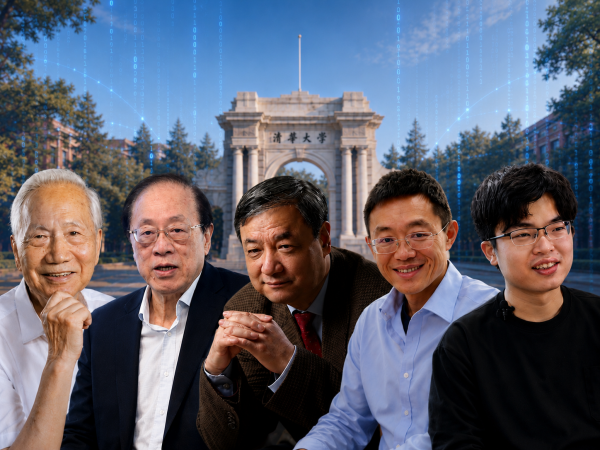
This lineage has remained unbroken for forty-eight years.
Yang Zhilin, founder of Moonshot AI; Tang Jie, founder of Zhipu AI; Wang Xiaochuan, founder of Baichuan Intelligence; Liu Zhiyuan, co-founder of Minbimai AI... All are either current professors or alumni of Tsinghua.
In the realm of embodied AI, another significant branch of AI, a similar pattern emerges. Chen Jianyu, founder of Star Era; Zhao Mingguo, co-founder of Accelerated Evolution; Gao Jiyang, founder of Stellaris; Wang He, founder of Galaxy General... All are also professors and graduates of Tsinghua.
What's even more fascinating is the interconnectedness of these individuals.
Yang Zhilin was mentored by Tang Jie. Liu Zhiyuan's mentor is Professor Sun Maosong from Tsinghua's Computer Science Department, which is also the academic home of Zhang Bo, a pioneer in China's AI field.
This is not merely an alumni directory but a family tree spanning four generations in a single, unbroken chain. The story of China's AI is the story of this chain.
【01】
To most, China's AI boom seems like a recent phenomenon, as if nothing significant happened before.
But that's far from the truth.
In 1978, Professor Zhang Bo from Tsinghua's Department of Automatic Control transferred to the Computer Science Department and set his sights on Artificial Intelligence and Intelligent Control.
He promptly launched a new course, Introduction to Artificial Intelligence, with teaching materials he meticulously compiled based on foreign resources.
During his overseas visits, Zhang Bo came to realize that AI development must harness mathematical tools to enhance algorithmic efficiency. He then collaborated with Professor Zhang Ling from Anhui University's Mathematics Department, communicating across oceans on the thinnest paper with the smallest handwriting to save on postage.
In 1984, Zhang Bo and Zhang Ling jointly published a paper in a top international AI journal, marking the first academic paper by Chinese scholars in the field of AI. Subsequently, Zhang Bo became the first Chinese scientist to publish a paper at the International Joint Conference on Artificial Intelligence.
Over the years, AI has weathered more than one downturn. In the 1980s, the expert system bubble burst, leading to a sharp reduction in global AI funding and a research winter. From the 1990s to the early 2000s, neural networks faced skepticism, and AI was repeatedly written off. During each winter, some left the field, some shifted directions, and some believed the path was untenable.
But Zhang Bo remained at Tsinghua, mentoring students and conducting research, transitioning from professor to academician, steadfastly guarding the flame of AI.
In 2015, at nearly 80 years old, Zhang Bo proposed the theoretical framework of Third-Generation AI, advocating for the integration of data-driven deep learning with knowledge-driven symbolic reasoning to address the fundamental issues of AI systems being unexplainable, unsafe, and unreliable.
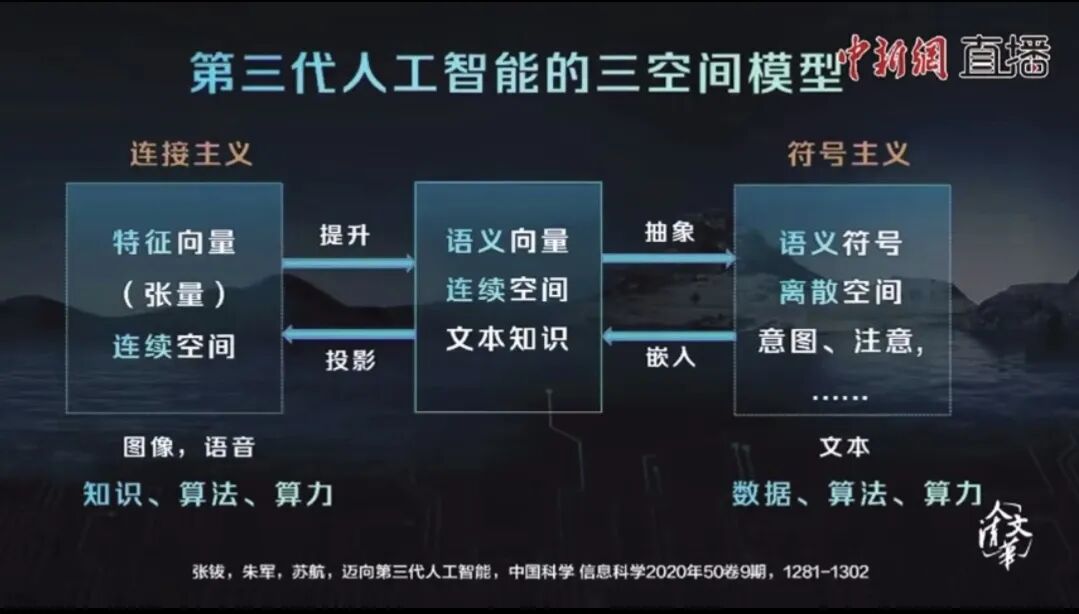
This framework has profoundly influenced today's large models and remains a cornerstone of AI theory.
【02】
Zhang Bo planted the seeds of China's AI, but for them to grow into a tree, someone needed to nurture them.
Professor Sun Maosong from Tsinghua's Computer Science Department is that person.
As a senior professor at Tsinghua, Sun Maosong has dedicated 46 years to the computer field. If Zhang Bo is the founder of Tsinghua's AI, Sun Maosong is the bridge between generations. His research on the Chinese word segmentation system CSegTag, a foundational infrastructure for natural language processing, is indispensable for all subsequent Chinese NLP endeavors.
But Sun Maosong's contributions extend beyond his research to the talented students he mentored.
For example, Tang Jie, who began his Ph.D. at Tsinghua in 2002, rejected opportunities at major companies after graduation, choosing instead to stay and teach, focusing on research. He developed AMiner, an academic search engine that uses AI to mine relationships in academic networks—who collaborated with whom, who influenced whom, and which directions are gaining traction.
This project may seem like a small tool, but it possesses the key capabilities of large models: data mining and knowledge graphs.
In 2019, Tang Jie founded Zhipu AI with a clear goal: to create China's own large model, rivaling OpenAI.
Another example is Liu Zhiyuan, who enrolled as an undergraduate in 2002. Initially lacking significant research experience, competition achievements, or outstanding grades, Sun Maosong recognized his research potential and admitted him to his research group for graduate studies.
Liu Zhiyuan took a different path from Tang Jie. While Tang Jie focused on cloud-based large models, competing on parameters and computational power, Liu Zhiyuan's Minbimai AI focused on edge-side large models, competing on efficiency and deployment.
This tree continues to branch out.
During Tang Jie's tenure at Tsinghua, he mentored Yang Zhilin, teaching him the fundamentals of research—how to identify important problems, approach solutions, conduct experiments, write papers, and present findings. Tang Jie passed on these research skills to Yang Zhilin hand in hand.
Later, Yang Zhilin pursued his Ph.D. at Carnegie Mellon University under the mentorship of AI luminaries from Apple and Google. Subsequently, he returned to China and founded Moonshot AI, developing Kimi.
From Zhang Bo to Sun Maosong, to Tang Jie and Liu Zhiyuan, and then to Yang Zhilin. From 1978 to 2026, four generations over 48 years. Each generation has been at the forefront of AI, each pushing the boundaries forward.
【03】
For Tsinghua-affiliated AI to grow into a towering tree, besides the passing of the torch, there are three key strengths.
First, professors are directly involved.
Tang Jie founded Zhipu AI not as a "professor leaving academia to start a business" but as a Tsinghua professor bringing academic research achievements to directly incubate a company. The foundation of the GLM model is his research accumulation at Tsinghua; Zhipu's team is the original AMiner project team.
Liu Zhiyuan's Minbimai AI follows the same model. He remains an associate professor at Tsinghua's Computer Science Department while co-founding Minbimai AI, balancing his academic and entrepreneurial identities.
Similarly, in the field of embodied AI, Zhao Mingguo, founder of Accelerated Evolution, is a professor in the Department of Automation who began researching bipedal robots as early as 2000.
Chen Jianyu, founder of Star Era, is still an assistant professor at the Institute for Interdisciplinary Information Sciences, with his company incubated within the institute. It is Tsinghua's only equity-held embodied AI enterprise. Laboratory research can directly become company products.
This is uncommon in Chinese sci-tech innovation.
In most fields, academia and industry are separated by a "valley of death"—professors conduct research and publish papers; students graduate and join companies; companies take ideas from papers and slowly develop products. Years or even decades pass in between.
In AI, Tsinghua has directly bridged this valley. Professors don't need to leave their positions, research results don't need to be transferred, and Ph.D. students can directly join projects. Papers published today can lead to models deployed tomorrow—there is almost no time lag between academic frontiers and commercial deployment.
This is also why Tsinghua-affiliated AI companies start quickly—Zhipu AI, founded in 2019, now has a market value of 900 billion HKD, and Moonshot AI reached a valuation of 30 billion USD in just three years.
This is not solely due to capital push but also because the distance from lab to product has been minimized.
Second, there is a top-tier talent pool.
In 2005, Turing Award winner Yao Qizhi returned from Princeton University and founded the Tsinghua University School of Computer Science Special Pilot CS Class, known as "Yao Class."
The goal of Yao Class is clear: to cultivate top-tier talents competitive with or even surpassing MIT and Princeton undergraduates. In 2019, Yao Qizhi founded the "Zhi Class"—an AI class dedicated to nurturing leading talents in AI. In 2022, the Yao Class, Zhi Class, and Quantum Information Class under the Institute for Interdisciplinary Information Sciences merged, offering three directions: Computer Science, Artificial Intelligence, and Quantum Information.
Over 20 years for Yao Class, 7 years for Zhi Class, and 750+ undergraduates and 237 Ph.D. students at the Institute for Interdisciplinary Information Sciences.
This number may not sound large, but its quality is extremely high. Yao Class students are top contestants in provincial informatics competitions before enrollment, receiving world-class research training afterward, becoming the most elite seeds of China's AI.
Third, there is a seamless conversion mechanism.
In December 2020, Tsinghua University Institute for AI Industry Research was established, with Zhang Yaqin, former Microsoft executive and foreign member of the Chinese Academy of Engineering, as its dean.
Having witnessed the frontiers of industry, Zhang Yaqin returned not to teach but to build bridges.
The Institute's positioning is clear: to empower industrial upgrading with AI technology. It is not a traditional lab or an incubator but a "revolving door" in between—university professors can conduct industrial-grade research here, enterprises can find cutting-edge academic technologies, and Ph.D. students can work on both papers and products simultaneously.
Someone asked online why Tsinghua can produce so many talented leaders in the AI race.
Many answers exist, but several reasons are unavoidable.
The first is academia. Since Zhang Bo set the AI direction in 1978, academic heritage has never been broken across generations. Zhang Bo developed theoretical frameworks, Sun Maosong built NLP infrastructure, and Tang Jie worked on knowledge graphs—each generation stayed at the frontier, never losing direction.
The second is technology. Decades of accumulated technical foundations like CSegTag, AMiner, and GLM allowed Tsinghua to avoid starting from scratch during the large model boom. While others searched for directions, they were already on their path.
The third is industry. Professors can balance academia and business, labs can incubate companies, and Tsinghua can hold stakes. AIR institutionalized this industry-academia-research mechanism, minimizing the distance from lab to product.
These three reasons ensure the continuity and growth of Tsinghua's AI legacy.
The AI field has seen too many reshuffles. The expert system bubble burst, neural networks faced skepticism, deep learning surged, and large models disrupted everything—each paradigm shift saw some eliminated, some left behind, and some starting over.
When an industry collapses, it must find a new direction, rebuild, and start from scratch. This has happened in many fields in China—chasing for a decade, only to have directions change and past efforts wasted.
But Tsinghua's AI has avoided such regrets; there has always been someone present. Where there are people, there is a position; where there is a position, there is accumulation.
This is why China's AI can compete with OpenAI—not just because computational power has caught up or capital has flooded in but because, over 40 years, someone has always refused to leave the table, and new players have always joined. Tsinghua AI's table has never been empty for forty-eight years.
——END——
Welcome to follow [Hua Shang Tao Lue] to learn about influential figures and strategic legends.
All rights reserved. Unauthorized reproduction is prohibited.
Some images are sourced from the internet.
If infringement is involved, please contact us for removal.
-
![]()
Hardware is the skeleton, AI is the soul, and data integrates the two
-
![]()
China’s AI Industry: A Unified Pivot Towards Monetization?
-
![]()
New Progress! Infineon Completes Acquisition of ams OSRAM's Non-Optical Sensor Business
-
![]()
35 Million Bet on an Optical Future! Tengjing Technology Makes a Move in AR
-
![]()
Why World Models Get Stuck on Construction Roads in Autonomous Driving Applications
-
Alibaba Initiates Cultural Transformation: Is Jack Ma Making a Strategic Comeback?
-
Tianfeng Heads to Hong Kong for IPO with RMB 3.8 Billion in Funds: Xingyu's Cross-Border Foray into Embodied AI Faces Uncertain Future
-
![]()
Mengshi Auto’s High-End Aspirations Dashed: Huawei Partnership Fails to Revive Sales, New Model’s Entry Price Dips Below 300,000 Yuan