Sober Reflections on the Ultra-Long Live Streams of Factory Operations by Humanoid Robots: Capability vs. Profitability
 07/03 2026
 525
525
By 2026, humanoid robots are set to make a complete transition from laboratory demonstrations and exhibition hall showcases to real-world industrial assembly lines, officially ushering in an era of genuine industrial operation.
Recently, two highly influential, ultra-long-duration factory live streams by Zhiyuan and Figure AI have provided tangible proof of the feasibility of humanoid robots in industrial settings, boosting confidence in their practical application. Yet, behind the media frenzy and intense commercialization efforts, significant hurdles remain, including technological maturity, cost margins, long-term operational and maintenance effects, and systemic integration barriers, all of which pose challenges to large-scale mass production.
Beyond the superficial excitement fueled by capital speculation and marketing hype, the commercialization prospects and technological complexities of humanoid robots are becoming clearer, distinguishing reality from illusion.
Live Stream Trials: Humanoid Robots Demonstrate Feasibility
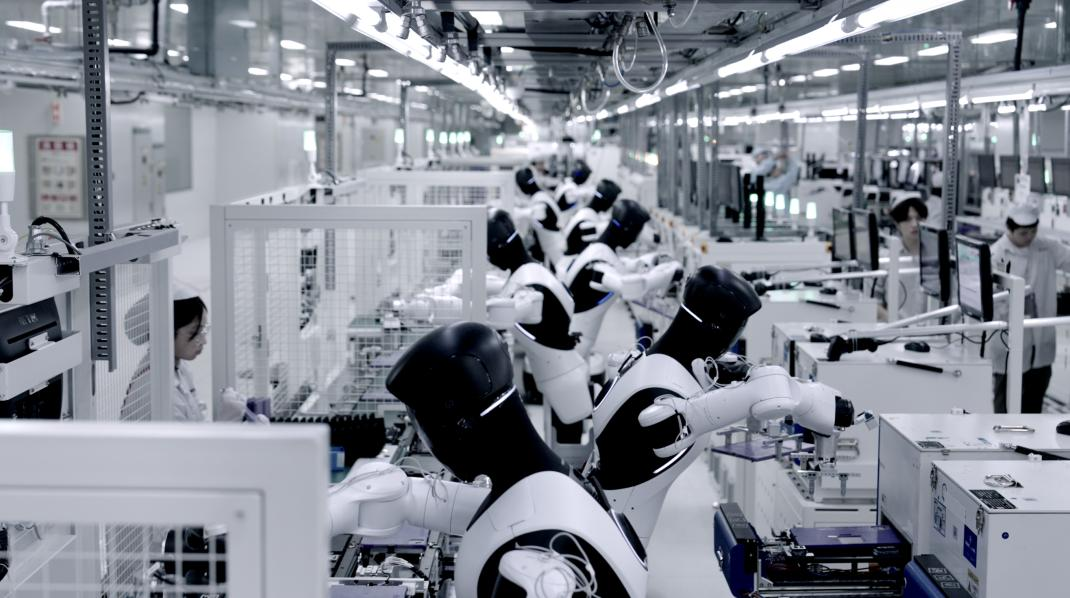
On June 23, eight Zhiyuan Elf G2 cluster robots officially commenced work at Longcheer Technology's factory in Nanchang, Jiangxi, embarking on a six-day, unedited, unrehearsed, and publicly broadcast live stream of factory operations.
During the live stream, the robots adhered strictly to real industrial rhythms, undertaking core mass-production tasks such as 3C product quality inspection, material loading and unloading, equipment connection and disconnection, and finished product sorting. This rigorously validated the stability and robustness of embodied intelligence in demanding industrial scenarios over extended periods.
Across the ocean, leading U.S. humanoid robot company Figure AI completed a 200-hour uninterrupted factory test, achieving stable, high-frequency, long-duration operations in warehousing and sorting scenarios.
These simultaneous ultra-long live stream trials by two global industry leaders shattered the stereotype that humanoid robots are limited to short demonstrations, marking a clear industry turning point. In structured industrial settings like 3C electronics and warehousing, the long-duration continuous operation and stable performance of humanoid robots have achieved closed-loop success, potentially becoming the first mature avenue for large-scale implementation.
However, a crucial caveat remains: technological feasibility does not equate to commercial viability—this is currently the biggest bubble in the humanoid robot industry. The live demonstrations only proved that robots can "work in factories" but failed to provide a return on investment (ROI) model demonstrating "increased profits from robot use" to the market. The industry's closed loop from scenario applicability to positive commercial realization is far from complete.
Double 'Imbalance' in Economics and Operations
At this stage, the primary obstacle to commercializing humanoid robots is their prohibitively high comprehensive costs. Currently, the procurement cost of a single industrial-grade humanoid robot generally matches or exceeds the combined labor costs of frontline factory workers over two to three years. When factoring in hidden expenses like equipment depreciation, annual maintenance, component replacements, and software operations, the robot's total cost of ownership (TCO) over its lifecycle severely squeezes factory profit margins, posing enormous challenges to commercial viability.
In comparison, humanoid robots currently operate at only 30%-60% of the efficiency of skilled human workers. To achieve equivalent production capacity, factories must invest in multiple robots, making cost reduction and efficiency gains unattainable in the short term, let alone establishing a viable ROI logic.
Given this, the industry has reached a consensus: until the manufacturing cost and TCO of humanoid robots substantially decrease, they will remain below the commercial profitability threshold. Current "implementations" by manufacturing companies are essentially forward-looking strategic positioning and scenario validation rather than purely profit-driven commercial behavior.
Even more worthy of sober scrutiny are the "marketing rhetoric traps" beneath the industry bubble. Claims of robots "independently completing" tasks must be viewed cautiously under current technological conditions. While the public sees robots operating smoothly and interacting seamlessly during live streams, they rarely witness the intensive interventions and fallback support provided by engineering teams to ensure closed-loop reliability.
Before production lines officially launch, teams must overcome stringent challenges such as generalization debugging for countless long-tail scenarios, model training, hardware-software collaborative adaptation, and safety threshold calibration. During live operations, continuous high-intensity collaborative support is required, including full-process accompanying debugging, edge anomaly interventions, and real-time data closed-loop monitoring.
Reviewing the two recent benchmark live streams, the collective "silence" on core operational metrics is thought-provoking: during the six-day mass-production operations, frequencies of manual takeovers, downtime for optimization cycles, and fault repair durations were deliberately omitted.
The so-called "fully autonomous" spectacle, upon closer inspection, reveals heavily manual-dependent "controlled operations." A senior industry engineer admitted, "The 99.9% success rate that amazes the public actually relies on engineers standing by, ready to intervene at any moment."
Beyond the spotlight, the leap from single-unit pilot deployments to cluster mass production for humanoid robots still faces multiple unresolved challenges: deep integration with existing factory automation systems, autonomous recovery mechanisms for random production line anomalies, conflict-free multi-robot collaborative scheduling, and stable operation capabilities under continuous mass production. Currently, the industry lacks mature solutions for these issues.
Objectively speaking, all current implementations result from simplified working conditions and heavily customized debugging—essentially interim demos far from true general-purpose deployment and large-scale replication.
Giants Heavily Invest, Betting on a Trillion-Dollar General-Purpose Future
Given the long commercial payback periods, high lifecycle maintenance costs, and difficult mass-production scaling for embodied intelligence, why do global manufacturing giants like Schaeffler, Siemens, CATL, Dongfang Precision, BMW, and Toyota continue heavy investments against the trend?
Fundamentally, their core strategic logic is not to create a "linear upgrade of traditional industrial robots" but to target the transformative value of embodied intelligence—betting that humanoid robots can break through scenario limitations of specialized equipment and reconstruct universal generalization and flexible interaction capabilities in unstructured environments.
Mimicking human work patterns and interaction logic, humanoid robots naturally fit most flexible general-purpose factory scenarios, theoretically capable of replacing 50% of repetitive foundational production line roles. This universal generalization across countless manufacturing scenarios creates imagination for a trillion-dollar global market size, constituting a dimensional advantage in breaking through the "specialized, rigid" barriers of traditional industrial robots.
Traditional manufacturing giants entering the embodied intelligence field reflect a clear industrial undercurrent: using humanoid robots (currently at ~30% efficiency) as "early stakes" to secure strategic first-mover advantages for future "lights-out factories."
They aim to lock in generalized industrial scenario data, establish human-robot collaboration standards, and refine flexible manufacturing business closed loops before industry explosion, trading short-term inefficiency for long-term exponential (300%) growth to ultimately seize rule-setting power for the next industrial productivity revolution.
According to comprehensive industry research data, global shipments of complete humanoid robots are expected to reach 13,000-18,000 units in 2025. In terms of production capacity distribution, Chinese companies dominate nearly 90% of global shipments through strong supply chain ecosystems, with leading players like Zhiyuan Robot exceeding 5,000 unit deliveries individually. In contrast, overseas benchmarks like Figure and Tesla remain at several hundred units annually. The momentum gap in large-scale mass production between domestic and overseas players is evident.
Currently in the early commercialization stage of embodied intelligence, the market size remains limited in the short term, with global complete machine sales of humanoid robots reaching only around 3 billion yuan in 2025. However, the growth curve is extremely steep, with industry compound annual growth rate (CAGR) expected to exceed 40% from 2025-2030. Multiple authoritative institutions predict the global market size will surpass 400 billion yuan by 2035, with the full industrial chain potentially generating a 5 trillion yuan macro narrative in the long term.
Currently, the global humanoid robot industry is in a period of rapid explosion. Domestic manufacturers dominate shipments through supply chain advantages, while global manufacturing giants initiate concentrated bulk procurements and pilot implementations. Industry growth continues to lead the smart manufacturing sector, with industrial enthusiasm repeatedly reaching new heights.
However, bridging the gap from "capable of working" to "capable of mass production," the industry still faces three critical weaknesses: costs have not yet broken through commercialization thresholds, fault tolerance and self-recovery capabilities remain weak, and industrial ecosystem integration standards are lacking. This directly prevents scenario replication at scale and inadvertently raises entry barriers for small and medium-sized manufacturers.
The two recent sensational "ultra-long factory live streams" mark humanoid robots' formal departure from laboratory concepts to full entry into real industrial operations. Simultaneously, as industry bubbles continue to deflate, the industrial implementation logic has shifted from discussing "can they do it" to "is it cost-effective, stable, and scalable."
We must soberly recognize that current humanoid robot factory deployments are not yet mature commercial closed loops but strategic positioning by giants for the future.
Only when hardware costs continue to decline, autonomous operation and maintenance capabilities take shape, and industrial ecosystem standards unify will tens of thousands of humanoid robots enter workshops, truly achieving normalized operations across all product line categories without manual fallback support. Only then will the productivity revolution in manufacturing truly begin.
*Editor's Note: Original content is hard-earned; please respect the author. For reprints, please contact us.
-
![]()
Hardware is the skeleton, AI is the soul, and data integrates the two
-
![]()
China’s AI Industry: A Unified Pivot Towards Monetization?
-
![]()
New Progress! Infineon Completes Acquisition of ams OSRAM's Non-Optical Sensor Business
-
![]()
35 Million Bet on an Optical Future! Tengjing Technology Makes a Move in AR
-
![]()
Why World Models Get Stuck on Construction Roads in Autonomous Driving Applications
-
Alibaba Initiates Cultural Transformation: Is Jack Ma Making a Strategic Comeback?
-
Tianfeng Heads to Hong Kong for IPO with RMB 3.8 Billion in Funds: Xingyu's Cross-Border Foray into Embodied AI Faces Uncertain Future
-
![]()
Mengshi Auto’s High-End Aspirations Dashed: Huawei Partnership Fails to Revive Sales, New Model’s Entry Price Dips Below 300,000 Yuan