AI Computing Power is Pushing Global Power Grids to Their Limits
 07/03 2026
 545
545
▲ All images in this article are sourced from the internet. Please contact us for removal if there is any infringement.
AI Boom Forces Power Shortages
This article was first published in Shadow Memo by Mo Yingsheng.
Recently, Gartner released a report stating that global data center electricity consumption will reach 565 TWh by 2026, a 26% year-on-year increase. By 2030, this figure will exceed 1,200 TWh.
To put it in perspective, the annual electricity consumption of global data centers alone will surpass Japan's total national electricity consumption in a year.
In the same week this figure was announced, at least 75 data center projects across the U.S. were halted or delayed, involving investments totaling $130 billion.
It's not about a lack of money or chips.
It's about a lack of electricity.
Microsoft CEO Nadella recently revealed rare genuine anxiety in a podcast: 'The biggest issue we face now is no longer an oversupply of computing resources but whether electricity can be deployed fast enough where data facilities are located. If we can't do that, we might end up with a bunch of chips sitting in warehouses without power.'
This statement uncovers the harshest truth of the second half of the AI race: When chips are no longer the bottleneck, electricity becomes the new ceiling.

Giants Are All 'Short on Power'
Let's look at some data.
Gartner predicts that global data center electricity consumption will rise from 447 TWh in 2025 to 565 TWh in 2026, a net increase of 118 TWh in one year. Even more shocking is the surge in electricity consumption by AI-optimized servers, jumping from 95 TWh in 2025 to 175 TWh in 2026, an 84% increase.
By 2027, AI servers' electricity consumption will officially surpass that of traditional servers.
In terms of power demand, global data centers will soar from 104 GW in 2025 to 132 GW in 2026, reaching 290 GW by 2030.
The International Energy Agency's forecast is even more aggressive: By 2030, global data center electricity consumption will more than double from 2024 levels, reaching approximately 945 TWh. The U.S. and China will together account for 80% of global data center power demand.
Behind these numbers lies an undeniable reality: AI is consuming electricity at an unprecedented rate.
A GPU server consumes 3 to 5 times more power than a traditional server. NVIDIA's Blackwell architecture GPU has a power consumption of up to 1 kW per unit, a 40% increase from the previous generation Hopper's 700 W.
When hundreds of thousands of such chips are deployed in a single data center, the impact on the power grid is immense.
OpenAI's first 'Stargate' data center in Abilene, Texas, has a peak power demand of up to 1.4 GW, deploying over 400,000 GPUs.
OpenAI's overall 'Stargate' plan, in collaboration with Oracle and SoftBank, will invest $400 billion to build five new data centers in the U.S.
OpenAI executives estimate that deploying 1 GW of AI computing capacity costs approximately $50 billion.
This is not just about building data centers—it's about creating virtual power plants one after another.
Faced with the power crisis, tech giants have only one approach: buy power plants, buy nuclear energy, buy green power—buy whatever they can.
Let's look at the capital expenditure list for 2025:
Microsoft's annual capital expenditure reached $120 billion, a record high. In the third quarter of 2025 alone, it invested nearly $35 billion in AI infrastructure, accounting for nearly half of its quarterly revenue.
By 2025, Microsoft had increased its AI data center capacity by about 80% and planned to double it again in the next two years.
Amazon expected capital expenditures of $118 billion in 2025. AWS's total power capacity had doubled from 2022 levels and planned to double again by 2027.
Amazon is building a data center campus in Indiana at a cost of $15 billion, which will consume 2.2 GW of electricity—enough to power 1 million households for a month.
Google expected capital expenditures of $85 billion in 2025, with third-quarter projections raised to $91-93 billion.
Meta increased its 2025 capital expenditure range to $70-72 billion and warned that 2026 would be 'significantly higher.'
Combined, the four companies invested about $400 billion in 2025, with even higher figures expected in 2026.
But this massive investment only solves the bottleneck at the chip level. The real challenges are just beginning.

An Uneven 'Race Against Time'
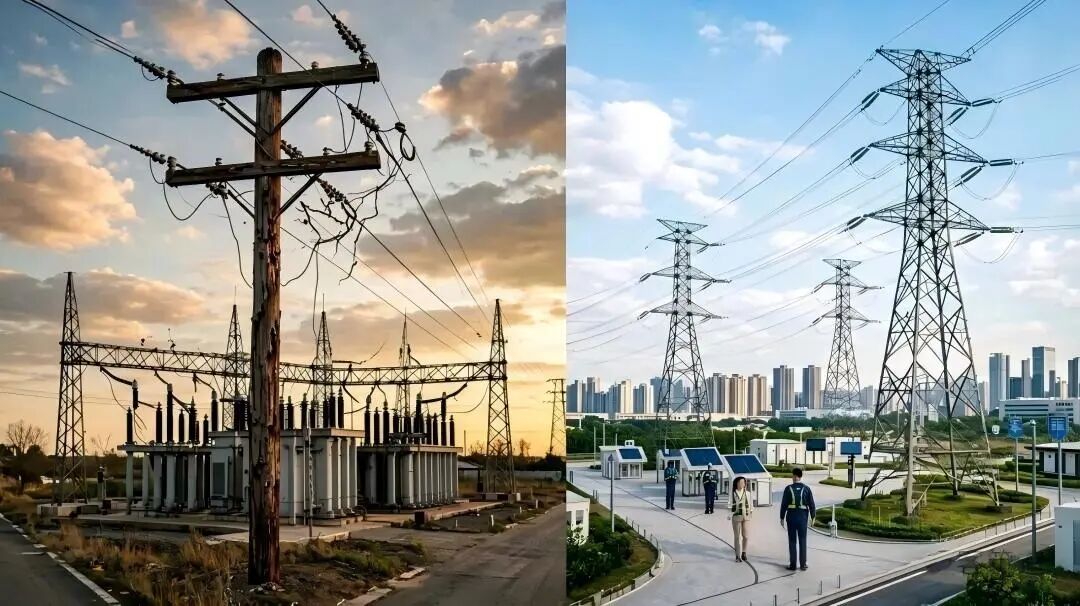
If the chip supply cycle is measured in months, the grid upgrade cycle is measured in years—or even decades.
Building a large data center in the U.S. takes an average of two years, but constructing new high-voltage power lines takes 5 to 10 years.
Transformer delivery times have extended from 12 months to over 24 months.
U.S. demand for power transformers has grown by 119% since 2019, with price increases reaching 77%.
Behind these cold numbers lies a collapsing supply chain system.
In Ashburn, Virginia, home to the world's densest cluster of data centers, over 200 data centers are packed within a few dozen kilometers.
In the summer of 2025, something happened that made the entire U.S. power industry nervous: About 60 data centers simultaneously switched to their backup generators due to routine safety triggers.
Dozens of data centers going offline at once released a surge of excess power that nearly crashed grid dispatching.
Later reviews found that it was neither equipment failure nor extreme weather.
The problem stemmed from a deeper change: More and more data centers now have their own power generation capabilities, and the grid hasn't learned to coexist with them yet.
But that's not the most troubling part.
In June 2026, Capgemini Research Institute released a 120-page report surveying 612 power industry executives and 175 data center executives worldwide.
The report revealed three simultaneous developments: demand is evolving, grids are lagging, and the relationship between data centers and power companies is being reshaped.
How is demand evolving?
Traditional data centers run cloud computing and storage, with relatively stable load curves—busy during the day and idle at night, following predictable patterns.
But AI doesn't play by the rules. It can train tasks 24/7 at full capacity, while inference tasks fluctuate with user traffic. Two queries to the same large model can differ in computing power consumption by several times.
80% of power executives predict that future data centers will experience more extreme and erratic peak electricity demand. 79% of them list this as a serious challenge.
Even worse, one-fifth of grid connection applications are 'ghosts.' 67% of power executives admit that about 19% of data center grid connection applications will never materialize.
The reason is simple: Developers submit applications to multiple power companies simultaneously to secure a spot.
77% of power companies admit they cannot accurately predict data center demand. Building too much risks stranded assets; building too little risks power shortages. Either way, it feels like gambling.
Dominion Energy, Virginia's main power supplier, received data center orders totaling 40 GW—equivalent to the output of 40 nuclear power plants—now increased to 47 GW. Yet in the first quarter of 2026, at least 75 data center projects across the U.S. were halted or delayed.
It's not that grids can't keep up with AI—it's that AI is outpacing grids.

Taking Matters Into Their Own Hands
Since grids are unreliable, the giants decided to take action themselves.
The most aggressive approach is nuclear power.
In October 2025, Google announced the restart of the Duane Arnold Energy Center, a nuclear plant in Iowa that closed in 2020, planning to bring it back online by 2029 to power AI infrastructure.
The two sides signed a 25-year power purchase agreement. Previously, Google had also signed an agreement with Kairos Power to buy nuclear energy from multiple small modular reactors.
Meta is also betting on nuclear power. In 2025, Meta signed a 20-year power supply agreement with Constellation Energy to purchase the entire 1.1 GW output of the Clinton Nuclear Power Station in Illinois starting June 2027.
Amazon went directly to live next to a nuclear plant. In 2024, AWS acquired a data center campus near the Susquehanna Nuclear Power Station in Pennsylvania for about $650 million.
In 2025, power generator Talen signed a 1,920 MW long-term power purchase agreement with AWS.
Besides nuclear power, renewable energy is also a major focus.
Microsoft signed a framework agreement with Brookfield Asset Management to secure over 10.5 GW of new renewable energy capacity between 2026 and 2030, with investments expected to exceed $10 billion.
By 2025, Microsoft had contracted 40 GW of new renewable energy supply through long-term power purchase agreements.
Meta partnered with Brookfield Renewable to deploy 10.5 GW of renewable energy capacity. Google doubled down on its '24-hour carbon neutrality' path, aiming to achieve hour-by-hour carbon-neutral power supply for its global data centers by 2030.
Tech companies are no longer just 'major power consumers'—through long-term power purchase agreements, asset acquisitions, and joint development, they are deeply involved in power generation and grid planning.
They are transforming from internet companies into 'tech companies with power generation businesses.'
Some might argue: Isn't chip energy efficiency constantly improving?
Yes. NVIDIA's Blackwell improves energy efficiency by 25 times compared to the previous generation, and Google's Ironwood TPU is nearly 30 times more efficient than the first generation.
But the Capgemini report introduces a classic economic concept: Jevons' Paradox—the more efficient something becomes, the cheaper its unit computing power gets, leading to more usage, and ultimately, total electricity consumption rises instead of falls.
This principle was proven in the steam engine era and holds true in the AI era.
87% of data center executives place high hopes on chip efficiency improvements. But the report's conclusion is blunt: Efficiency gains can mitigate but not eliminate the growth in data center energy demand.
This electricity-hungry beast cannot be slimmed down with 'diet pills.'

China's New Track of 'Computing-Power-Electricity Coordination'
In this global game of computing power versus electricity, China has taken a different path.
In 2026, 'computing-power-electricity coordination' was written into the government work report for the first time.
The so-called 'computing-power-electricity coordination' is not just about connecting data centers to the grid—it's about using digital and intelligent technologies to achieve dynamic matching and intelligent scheduling between computing resources and power resources, so that computing power follows electricity, and power dispatching relies on computing power.
China's data already illustrates the urgency of this trend. In May 2025, electricity consumption by internet data services surged by 45.4% year-on-year, far exceeding the 6.9% growth in total societal electricity consumption.
National data center electricity consumption rose from 130 billion kWh in 2022 to 196 billion kWh in 2025. By 2025, China had built 42 smart computing clusters with over 10,000 cards each.
But China also has its own strengths. CATL Chairman Zeng Yuqun stated at the 2026 Summer Davos Forum that China's power grid and energy system are highly mature, and the total electricity consumption of new data centers accounts for a limited share of the overall power supply.
He also provided a convincing example: After adopting AI systems, several CATL manufacturing plants reduced electricity expenses by 30%.
AI is not just an energy consumer—it can also be an energy optimizer.
On the power equipment manufacturing side, Chinese companies are seizing the global gap.
In the first quarter of 2026, domestic power transformer exports grew by 76% year-on-year. TBEA's AI-customized transformer orders are expected to grow by over 20% in 2026. Ankao Smart Electric successfully exported transformers to North American data centers.
The global transformer market is expected to reach $69.97 billion by 2026, with Chinese producers accounting for about 42% of global capacity.
Transformer production involves multiple steps, including core cutting, coil winding, insulation processing, and final assembly testing. Training a professional team takes at least 3 to 5 years.
This is a moat built on time—no matter how fast AI advances, it cannot bypass this.

Conclusion
The 2026 Summer Davos Forum placed 'No Power, No Intelligence' at the core of its agenda. This is not just a slogan—it's a reality unfolding before us.
JinkoSolar Vice President Qian Jing calculated at the forum that while traditional fossil fuels might sustain us for three to four decades at current consumption rates, the explosive growth of AI will drastically shorten this window.
She asserted that the future of data centers will hinge not just on chip computing power but on whether they have a stable power foundation and access to sufficiently cheap and clean green electricity.
Gartner Research Director Linglan Wang put it even more bluntly: 'AI computing power is now constrained by power supply, making data center power security the new battleground for global AI competition in terms of scale expansion and profit protection.'
From competing in GPUs to competing in power supply, the rules of the AI race are being rewritten.
Whoever takes the lead in mastering low-cost, highly stable, and zero-carbon power supply capabilities will secure a firm grip on the core discourse power of the global computing industry.
This is not a war about chips. This is a war about power.
And this war has only just begun.
I know you're watching
-
![]()
Hardware is the skeleton, AI is the soul, and data integrates the two
-
![]()
China’s AI Industry: A Unified Pivot Towards Monetization?
-
![]()
New Progress! Infineon Completes Acquisition of ams OSRAM's Non-Optical Sensor Business
-
![]()
35 Million Bet on an Optical Future! Tengjing Technology Makes a Move in AR
-
![]()
Why World Models Get Stuck on Construction Roads in Autonomous Driving Applications
-
Alibaba Initiates Cultural Transformation: Is Jack Ma Making a Strategic Comeback?
-
Tianfeng Heads to Hong Kong for IPO with RMB 3.8 Billion in Funds: Xingyu's Cross-Border Foray into Embodied AI Faces Uncertain Future
-
![]()
Mengshi Auto’s High-End Aspirations Dashed: Huawei Partnership Fails to Revive Sales, New Model’s Entry Price Dips Below 300,000 Yuan