Former Huawei 'Genius Teen' Encounters a 'Hiccup' in DeepSeek's Recruitment Process
 07/07 2026
 391
391

Organizational Strain Amidst 50 Billion Valuation and Workforce Doubling
/
Written by Yang Xiaoruo | Edited by Zhang Hongyi
What was meant to be a routine social recruitment interview during the graduation season unexpectedly ignited intense attention and discussion within the industry.
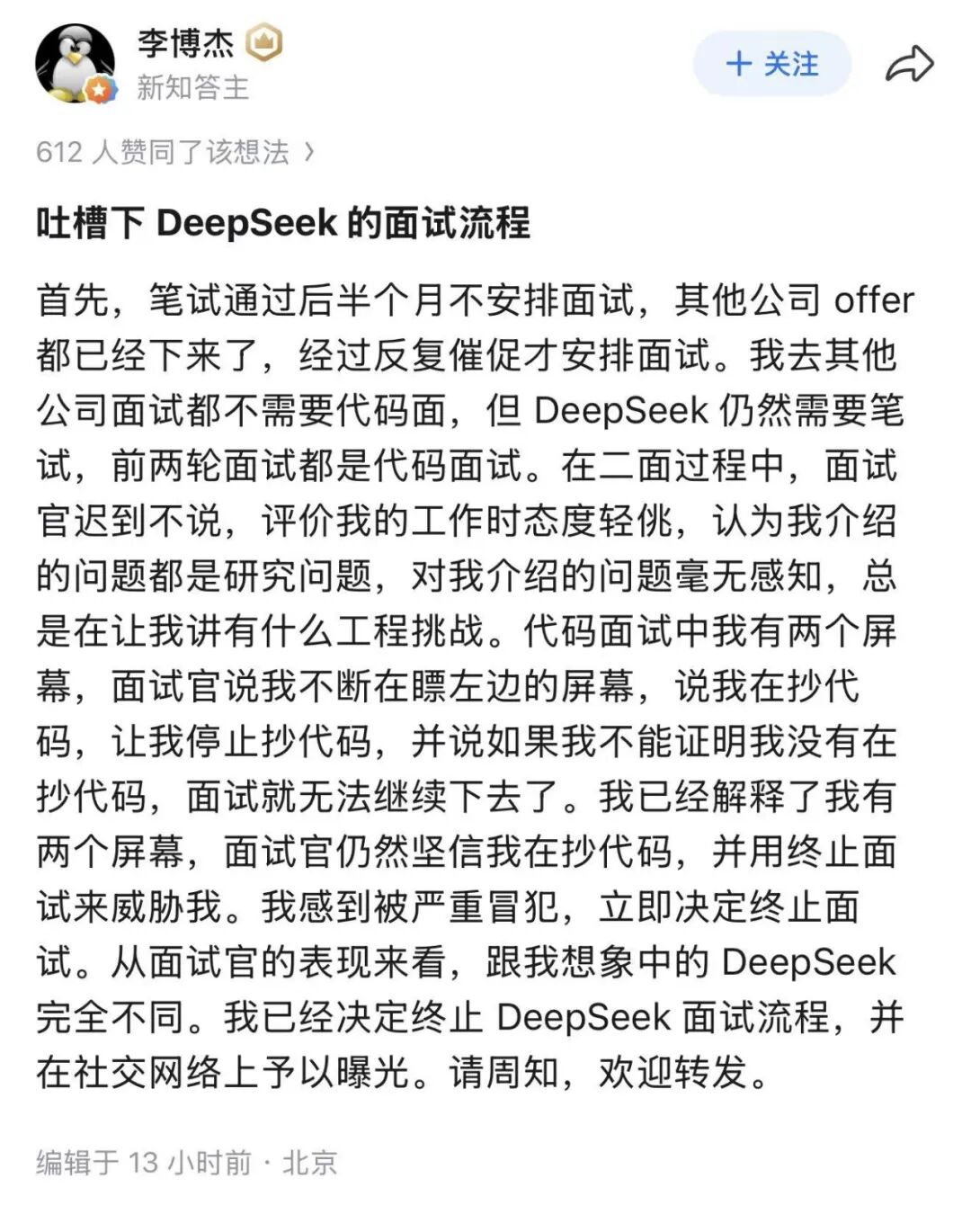
On July 6, Li Bojie, a former Huawei 'genius teen' and currently the chief scientist at PineAI, publicly criticized DeepSeek's interview process on social media and, in a fit of anger, decided to terminate his interview.
Li Bojie stated publicly that the DeepSeek interviewer was not only late but also dismissed his project introductions as indicative of a 'frivolous work attitude.' Without any substantial evidence, the interviewer even suspected him of 'code copying' merely because he used a dual-screen setup, which Li found to be 'highly insulting.'
It is evident that talented young individuals feel they are not being treated with the respect they deserve. Public information reveals that Li Bojie, born in 1992, holds a Ph.D. in Computer Science from the University of Science and Technology of China (USTC). He is also an alumnus of the USTC Youth Talent Program, a joint Ph.D. initiative between USTC and Microsoft Research Asia (MSRA), and was one of the first selected participants in Huawei's 'Genius Teen' program.
According to public records, Li Bojie has published multiple papers at top-tier conferences such as SIGCOMM, SOSP, NSDI, ATC, and PLDI. He has been honored with the ACM China Outstanding Doctoral Dissertation Award and the 'Microsoft Scholar' scholarship. Currently, he is also engaged in large-scale model entrepreneurship as the chief scientist of Pine AI.
The confluence of Li's multiple identities—USTC Youth Talent, Huawei 'Genius Teen,' and AI entrepreneur—coupled with the widespread attention on social media, has dealt a significant blow to a company already in the public eye.
Since June 25 this year, DeepSeek has embarked on its largest recruitment drive to date, covering seven major categories, including algorithms, R&D, operations and maintenance, products, data engineers, and functional departments. A total of 33 positions are open, with work locations in Beijing and Hangzhou, and all positions are available to interns.
DeepSeek stated at the time that it was 'striving to at least double the size of all departments' and promised to allow new hires to directly participate in the most core and critical tasks, hoping that employees could rapidly develop into top industry talents.
Meanwhile, the official version of DeepSeek V4 is set to launch in mid-July. Gu Yuxian, a 2021 Ph.D. student at Tsinghua University and recipient of the 2025 Outstanding Graduate Scholarship, has joined DeepSeek, and his name previously appeared on the list of authors for the DeepSeek V4 paper.
Is Li Bojie's personal experience merely an isolated workplace incident (accidental miscommunication), or does it reflect systemic talent recruitment and management challenges faced by DeepSeek, an AI technology company valued at nearly 50 billion USD, amidst its frenzied hiring spree?
01 What Was the Interview Like?
Based on Li Bojie's account, we may catch a glimpse of the systemic vulnerabilities in DeepSeek's interview and recruitment process concerning standardization, talent evaluation systems, and interviewer training and management.
He stated on public social media that after successfully passing the written test, DeepSeek unreasonably delayed the first-round interview by half a month, by which time he had already received offers from other companies. Only after repeated urging did DeepSeek arrange the interview.
However, during the second-round interview, the interviewer was not only late but also lacked understanding of Li's cutting-edge technology research and project achievements, repeatedly focusing on basic engineering questions. Moreover, without any evidence, the interviewer subjectively questioned Li's on-site 'code copying' based solely on his use of a dual-screen setup and used the threat of terminating the interview as leverage, ultimately leading to the premature end of the interview.
Some job seekers reported that Li's account was accurate. They noted that during DeepSeek's expansion, issues such as interviewers being late, frequent interruptions during interviews, and mismatched questions with the resume and position frequently occurred.
A job seeker who interviewed during the same period admitted to experiencing a long wait, stating, 'The interview only progressed after repeated follow-ups. I was frequently interrupted during the interview and even asked questions that did not match my expertise.'
According to an analysis by a senior technical practitioner in the industry, social recruitment for top senior technical experts and leading scientific research talents generally de-emphasizes basic coding tests and repetitive coding interviews. Instead, it focuses more on comprehensive assessments of project implementation capabilities, technical architecture thinking, and scientific research innovation abilities.
'DeepSeek has not established a dedicated evaluation system for high-end talent. For someone like Li Bojie, who has mature technical achievements and implementation experience, they still followed the evaluation model for ordinary fresh graduates and junior engineers, requiring him to take written tests and focusing on basic coding assessments in the first two rounds of interviews. The misalignment between the evaluation criteria and the candidate's qualifications and position level actually exposes vulnerabilities in the talent evaluation and management system of this star company during its rapid development phase,' the senior technical practitioner said.
'If the interviewer lacked understanding of Li Bojie's in-depth industry research and merely questioned him about code copying based on the industry-standard practice of using a dual-screen setup without any evidence, it reflects a lack of basic respect for top technical talent,' another AI industry practitioner told 'Business Show.'
An anonymous insider stated that since late June, the team has been under extreme recruitment pressure, constantly conducting interviews but still facing a talent shortage.
A core reason is the company's rapid short-term expansion. The HR department has been casting a wide net to collect resumes and blindly increasing interview volumes. The technical team is understaffed and overwhelmed with their primary responsibilities, leading to a situation where many technical employees without systematic interview training or familiarity with recruitment standards are temporarily assigned interview tasks.
Under these multiple factors, interviews have ceased to be a precise talent-screening process and have instead become a procedural task to fulfill KPIs for expansion.
02 Behind the Workforce Doubling
Over the past year, DeepSeek has indeed undergone a dramatic transformation.
From late 2024 to early 2025, DeepSeek achieved industry-leading model performance with its V3 and R1 models at extremely low training costs, completely breaking away from the industry's singular narrative of 'stacking computational power.' With its low-cost, high-performance open-source models, DeepSeek quickly gained global attention in the AI sector.
According to reports, DeepSeek-R1 was trained at a low cost of approximately 6 million USD and fully open-sourced, causing a global stir in the AI community due to its cost-effectiveness and open attributes.
The real turning point came in 2026. On June 16, media reports revealed that DeepSeek had completed its first external funding round since its inception, raising a total of 51 billion RMB and achieving a post-investment valuation exceeding 50 billion USD. Industry giants such as Tencent, CATL, and JD.com participated in the funding round.
With capital infusion and technological maturity, DeepSeek transitioned from a geek lab to an industrial-grade platform.
To support the commercialization of AGI and build a more comprehensive computational infrastructure and business system, DeepSeek launched its largest-ever recruitment drive on June 25 this year, officially announcing plans to at least double the size of all departments. It opened 33 positions at once, covering algorithms, R&D, products, operations and maintenance, and middle- and back-office functional departments.
Rapid expansion of any organization subjects the company to all-encompassing pressures and challenges.
DeepSeek, which originally had around 300 employees relying on a flat and efficient elite technical team, quickly faced overwhelming recruitment pressure. Its existing mature recruitment system, talent evaluation mechanism, and interviewer management system struggled to adapt to the short-term doubling of hiring needs, inevitably leading to distortions and disarray in the recruitment process.
Perhaps the supply-demand imbalance in recruitment had already become apparent. According to a report by National Business Daily, Cui Tianyi, the head of DeepSeek's newly established Agent Harness team, publicly admitted on June 21, 'As a newly formed department, the DeepSeek Harness team has ambitious goals and heavy workloads but remains severely understaffed. I am constantly conducting interviews and posting job ads everywhere... There are three positions available: Harness researcher, Harness engineer, and Harness product manager.'
According to Cui, the current job vacancies have increased, but the recruitment workflow is no different from that of other DeepSeek teams, generally involving one written test and three rounds of interviews, with him conducting the 'final interview.' The work location is uniformly in Beijing.
Li Bojie's interview experience may be a microcosm of the 'distortions' in DeepSeek's recruitment system during its expansion phase.
As of press time, DeepSeek had not issued any public response or explanation regarding the interview controversy and the recruitment chaos discussed by netizens.
Some commentators say that DeepSeek is one of the few companies in China's AI circle that does not follow the 'genius narrative.' It has long refrained from seeking financing, hyping itself up, or being short-sighted. Both the company and its founder, Liang Wenfeng, have maintained a low-key, pragmatic, and mysterious aura, pursuing a vision of technological breakthroughs.
Now, armed with 50 billion RMB in financing and standing at the industry's forefront, DeepSeek has indeed achieved exponential growth in valuation and scale through technological breakthroughs. However, behind its rapid expansion, the company may also be exposing issues such as recruitment disarray and talent management.
These are growing pains that all rapidly advancing tech unicorns must confront. While capital can quickly inflate a company's size and valuation, a great AI technology company ultimately relies on a reverence for technology and respect for talent to sustain its long-term development. "The End"
-
![]()
The Surprisingly Significant Impact Difference Between Quiet and Noisy Cars!
-
![]()
Breaking Through Storage Cycle Barriers: How AI Large Models and Coding Technology Synergize to Drive Transformation in the Security Industry
-
Facilitating the Slimming of Camera Modules! O-film Obtains Utility Model Patent for Periscope-Type Reflective Component
-
![]()
Hikvision Raytine’s Millimeter-Wave Body Imaging Security Inspection Device Achieves ECAC SSc Category A Standard Level 2.1 Certification for European Civil Aviation
-
![]()
Global Market Share for Security Windows Hits 26%! This Optical 'Little Giant' Makes Its Debut on NEEQ
-
![]()
The Evolutionary Path of Agent Engineering: From Prompt to Harness by Zhang Yutao, Co-founder of Moonshot AI
-
![]()
Profits and stock prices are both declining, so why are executives from these auto companies increasing their purchases?
-
![]()
Burning Tens of Billions of Dollars, Yet No Unified Definition for World Models