The Surprisingly Significant Impact Difference Between Quiet and Noisy Cars!
 07/07 2026
 356
356
Driving different cars can truly evoke distinct feelings.
Have you ever noticed this: driving on the same highway in different cars can leave you feeling entirely different upon arrival. In some cars, you feel refreshed after stepping out and are still up for a meal with friends. In others, all you want is to lie down and remain silent.
What's the difference? Beyond the seats and chassis, it's often noise that's secretly sapping your energy. In automotive engineering, there's a technical term for this: NVH.
N stands for Noise; V for Vibration; and H for Harshness.
It may sound academic, but it simply pertains to whether a car is noisy, shaky, or unpleasant to drive.
This concept really resonated with me after watching a video titled 'Engineer's Confession' from a certain joint-venture automaker. In the video, engineers shared insights on noise sources, noise reduction technologies, and the overall cabin quietness engineering design of current new energy vehicle models.

Because when this automaker discusses NVH, it's not just about claiming 'we use a lot of sound insulation' or 'our doors feel heavy when closed.' Instead, it treats cabin quietness as a comprehensive system engineering project. Simply put, it's not about achieving a certain decibel level in the lab, but about whether the user feels tired, annoyed, or nauseous while sitting inside the car.
Back in the era of gasoline cars, the engine was always running, masking many subtle sounds. You could liken it to having white noise on in an office—keyboard clicks, footsteps, and quiet conversations become less noticeable.
But in the era of electric and extended-range vehicles, engine noise drops significantly, and problems become more pronounced. The sound of tires on the road, vibrations from the chassis, noise from the thermal management system, and even small, previously unnoticeable rattles are all amplified.

Extended-range vehicles are particularly notable in this regard. They're usually as quiet as electric cars, but once the range extender kicks in, if not controlled properly, the psychological impact can be significant. It's not necessarily about the loudness of the sound, but rather the sudden interruption of your quiet state. It's like wearing noise-canceling headphones and listening to music when someone suddenly turns on a vacuum cleaner nearby—even if it's only for a moment, it makes you frown.
So now, a car's quietness is no longer just a desirable feature; it's part of the overall quality experience. Especially for family users, whether the front seats can chat easily during long trips and whether the elderly and children in the back get irritable or carsick are all related to NVH.
Quietness Isn't About Over-Insulating the Car
Many people think cabin quietness means adding more sound insulation and making the glass thicker and the door panels heavier. This approach isn't entirely wrong, but it's more like wearing ten sweaters in winter—you'll be warm, but you won't be able to move much.

The same applies to cars. Simply piling on sound insulation materials increases weight and energy consumption, and it mainly addresses mid-to-high-frequency noises like wind noise and gravel impact. The truly annoying low-frequency road noise, body resonance, and dynamic range extender engagement sounds aren't easily solved by just adding more materials.
The NVH approach in the video involves both active and passive noise reduction. Passive noise reduction lays the foundation by performing over 120 sound absorption and insulation treatments in key areas like the engine compartment, passenger cabin, and body, along with standard quiet tires, effectively blocking, weakening, and dispersing noise paths into the cabin.
This part sounds simple, but it requires meticulous engineering.
The source of the noise, how it travels, and where it's most easily perceived by passengers must all be addressed separately. It's not about stuffing materials everywhere but sealing where sealing is needed, absorbing where absorption is needed, and blocking where blocking is needed.
Active Noise Reduction: The Key Upgrade
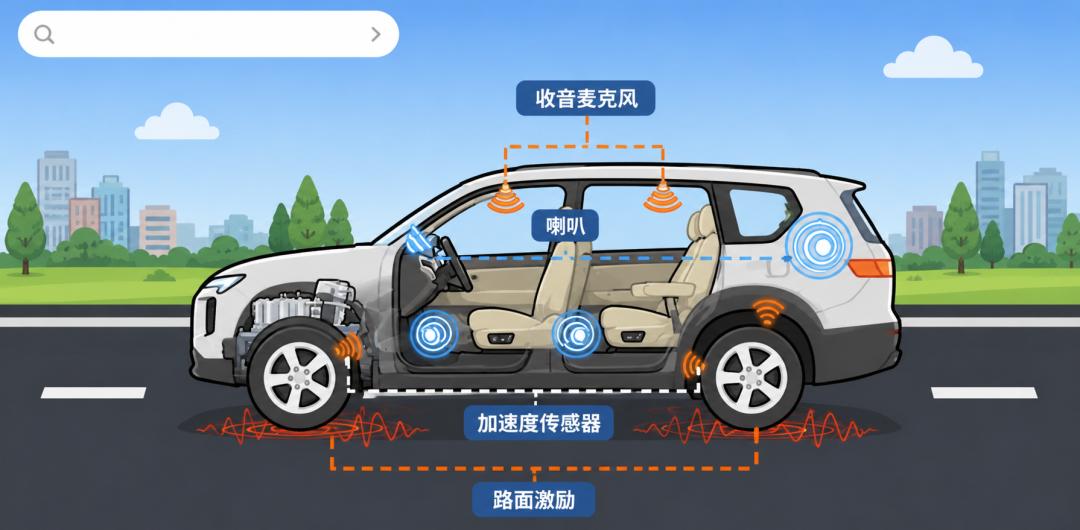
More critically, active noise reduction is where the real advancement lies. Active noise reduction first requires detecting where the noise is coming from. This car uses four acceleration sensors, four recording microphones, and six in-car speakers in its hardware setup.

Simply put, the sensors detect body vibrations, the microphones collect interior noise, the system identifies the type of sound, and then the speakers emit inverse sound waves to cancel out the uncomfortable noise.
It sounds similar to noise-canceling headphones, but cars are much more challenging. Headphones only need to cover two ears and a small space, while cars must deal with the entire cabin—front row, second row, different seating positions, different road surfaces, and varying speeds, with sounds constantly changing.
This ID. ERA 9X's noise reduction system supports a 48kHz sampling rate and 3ms ultra-fast response, along with adaptive full-operating-condition control for ENC (Environmental Noise Cancellation) and RNC (Road Noise Cancellation). ENC primarily targets powertrain noise, ensuring 'the range extender doesn't disturb you when it kicks in'; RNC focuses more on road noise control, preventing 'rough roads from being overwhelming.'
This goes beyond basic ANC (Active Noise Cancellation). Traditional active noise reduction mainly deals with relatively fixed engine harmonic noise, but what truly bothers people in new energy vehicles are often dynamically changing sounds.
When the road suddenly becomes rough, tire vibration frequencies change; as speed increases, low-frequency road noise emerges; when the range extender starts under certain conditions, a new layer of presence suddenly appears in the cabin.
These sounds are unpredictable, so the system must be fast and intelligent enough.
From test data, vehicles equipped with this noise reduction system recorded interior noise below 58 decibels while driving at 40 km/h in pure electric mode during minus 30-degree testing in Heihe.

More critically, when the range extender starts, the noise change in the front row is less than 0.5 decibels, and nearly 0 decibels in the second row.
This data means the range extender isn't silent, but when it's working, it doesn't significantly disturb the passengers. For an extended-range vehicle, this is more important than simply saying 'it's quiet.'
Because what users truly dislike isn't that the machine is working, but that it suddenly reminds you, 'I'm here.'
Another easily overlooked point is that low-frequency noise can really make people irritable and even more prone to carsickness.
Many people feel uncomfortable in electric and extended-range vehicles not just because of rapid acceleration but also due to low-frequency road noise, vibrations, and the physical sensations of acceleration and deceleration. Especially for the elderly and children sitting in the back, being surrounded by dull low-frequency sounds for long periods can easily lead to fatigue, nausea, and restlessness.

Actual tests show that active noise reduction can reduce peak low-frequency road noise by 5 to 10dB. This isn't just about 'turning down the volume'; the sense of oppression decreases exponentially.
You might not exclaim 'Wow, it's so quiet!' as soon as you get in, but after sitting for two hours, you'll notice you're not as tired, and the people in the back aren't as easily irritable.
So the true strength of NVH tuning isn't about making a car seem quiet in a showroom; it's about ensuring long-term comfort on real roads.
On the surface, the automotive industry is obsessed with big screens, intelligent driving, zero-to-100 acceleration times—things that make for great short videos. But what truly determines whether a car remains comfortable for long-term use are often these engineering details that don't make for flashy poster headlines.
Cabin quietness isn't about adding something extra; it's about those things that would normally disturb you being quietly removed by engineers.
-
![]()
The Surprisingly Significant Impact Difference Between Quiet and Noisy Cars!
-
![]()
Breaking Through Storage Cycle Barriers: How AI Large Models and Coding Technology Synergize to Drive Transformation in the Security Industry
-
Facilitating the Slimming of Camera Modules! O-film Obtains Utility Model Patent for Periscope-Type Reflective Component
-
![]()
Hikvision Raytine’s Millimeter-Wave Body Imaging Security Inspection Device Achieves ECAC SSc Category A Standard Level 2.1 Certification for European Civil Aviation
-
![]()
Global Market Share for Security Windows Hits 26%! This Optical 'Little Giant' Makes Its Debut on NEEQ
-
![]()
The Evolutionary Path of Agent Engineering: From Prompt to Harness by Zhang Yutao, Co-founder of Moonshot AI
-
![]()
Profits and stock prices are both declining, so why are executives from these auto companies increasing their purchases?
-
![]()
Burning Tens of Billions of Dollars, Yet No Unified Definition for World Models