Farewell to Image-First: Robotic Vision is Undergoing a Fundamental Reconstruction
 07/07 2026
 375
375
Author|Maoxinru
When a robot truly enters a factory or real-world environment, the gap in visual capabilities often lies not in recognition but in the courage to act.
In the latest demonstration of Ant Group Lingbo's LingBot-Depth 2.0, this gap is vividly amplified: In the same scene, the boundaries in the depth map are cleaner, fine structures are no longer easily lost, and distant areas remain stable and usable.
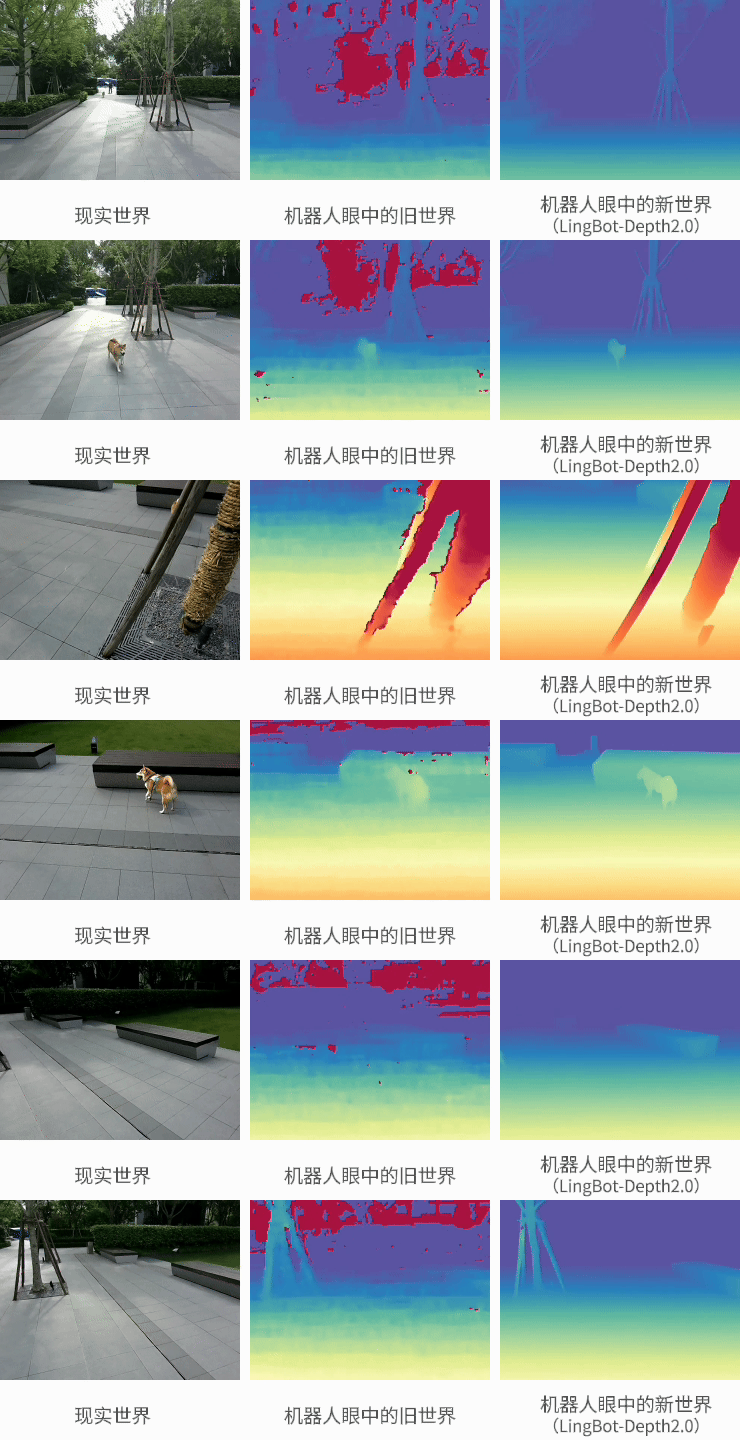
These changes may seem like mere visual improvements, but for robots, their significance is entirely different.
Robots are not just viewing images; they rely on this information to make decisions.
Blurry boundaries can lead to offset grasping; unstable long-distance perception can delay path planning; and the loss of fine structures can result in overlooked risks.
Because of this, the improvements in LingBot-Depth 2.0 are not simply about precision optimization but about making depth information more actionable for the first time.
However, if we delve deeper into the origins of these changes, we find that the answer lies not just in the depth model itself.
Ant Group Lingbo did not continue to use (adopt) general-purpose visual models but instead pre-trained its own visual foundation model, LingBot-Vision, from scratch to replace general-purpose solutions like DINOv3, and it has been made open-source.
In other words, the improvements in LingBot-Depth 2.0 essentially stem from a more fundamental change: Robotic vision is no longer centered around image semantics but around spatial reconstruction itself.

Enabling Robots to Truly See the 3D World
Among all robotic tasks, depth perception is the most fundamental.
Grasping requires knowing how far an object is and where its boundaries lie; movement requires judging whether a passage is navigable and whether there are obstacles in the distance; obstacle avoidance requires continuously perceiving changes in spatial structure in complex environments.
If depth results are unstable, subsequent robotic decisions will be like building a house on a shaky foundation, prone to collapse at any moment.
The changes in LingBot-Depth 2.0 revolve around this very point.
Compared to the previous version, it focuses on solving several long-standing issues that have hindered practical applications, enabling depth results to transition from being generatable to actionable.
The most intuitive improvement is seen in boundaries.
Traditional depth models often produce blurry or even adherent edges around object boundaries. While these phenomena may not be visually striking, they are amplified during robotic execution.
Offset grasping positions and errors in obstacle avoidance judgments often stem from these subtle uncertainties.
The improvements in LingBot-Depth 2.0 result in more complete object contours and clearer separation between foreground and background, providing a more stable foundation for subsequent operations.
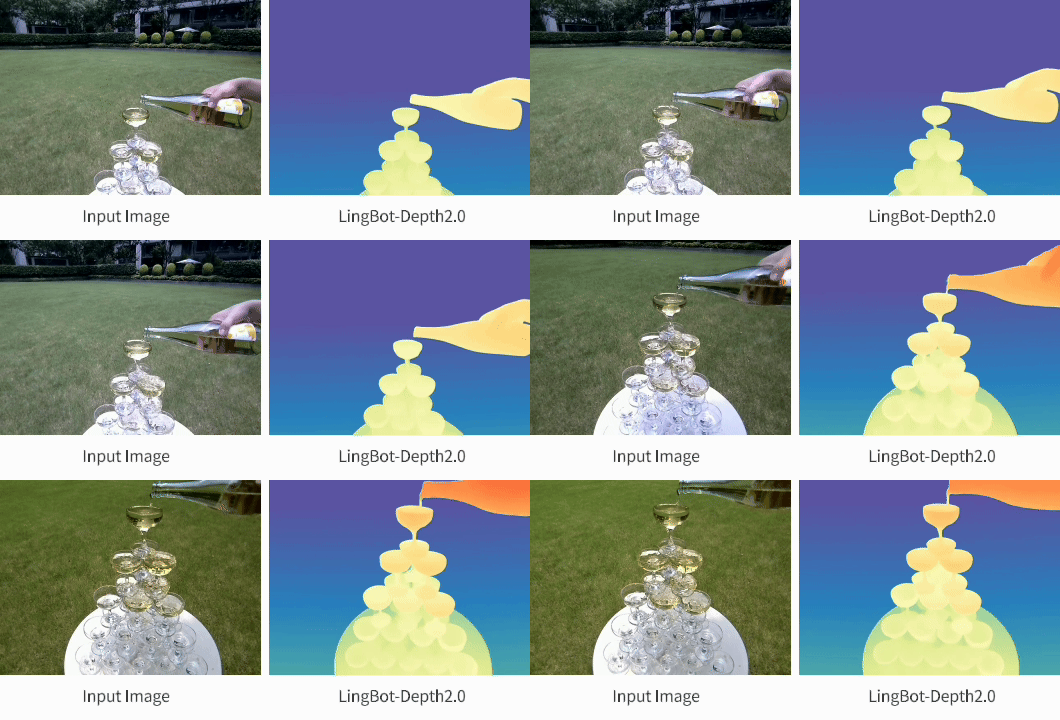
Note: The champagne tower scene is a challenging problem for depth perception. The glass walls are transparent, allowing light to pass through; the liquid surface is fluid, causing reflections to change; and the cups are stacked front to back, making their contours prone to adhesion. The depth map generated by LingBot-Depth 2.0 shows that the model not only fully retains the fine contours of each goblet but also avoids hollow (holes) in the fluid surface area and maintains strict geometric boundary separation where the cups overlap.
Accompanying the improvement in boundaries is the ability to handle fine structures.
In real-world environments, many critical objects do not appear as large, regular volumes but rather as cables, thin rods, or small-sized targets.
In the past, such structures were often difficult to capture stably, causing the system to overlook risks at critical moments.
In the new version, these details are now consistently retained, and the depth map no longer easily loses this information, significantly enhancing the model's reliability in complex environments.
Another important change occurs in the distance dimension.
Traditional depth models are prone to noise in distant areas, forcing the system to make effective decisions only when close to the target. This passive reaction compresses the decision-making time available to the robot.
LingBot-Depth 2.0 improves stability in distant areas, enabling earlier path planning and making the entire decision-making process more composed (composed).
When scenes become even more complex, the performance differences between models become more pronounced.
Glass, reflective materials, occluding structures, and non-uniform lighting have long been weak points for depth models.
In these situations, depth maps are prone to fragmentation, holes, or even local failures.
The performance of LingBot-Depth 2.0 in these scenes more closely resembles continuous spatial reconstruction, with results that no longer frequently break, enabling robots to complete longer continuous tasks.
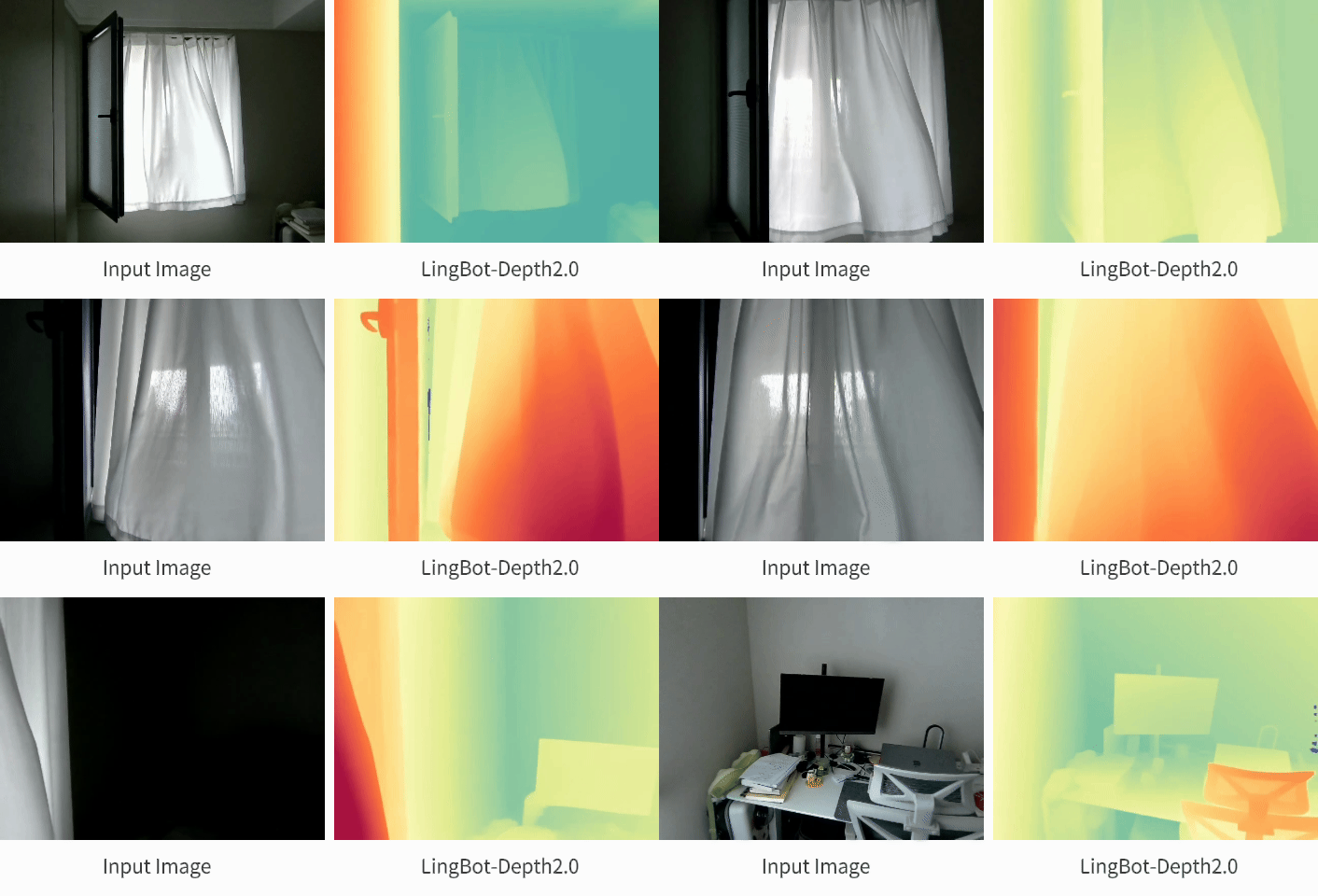
Note: This scene simultaneously contains dynamic thin flexible objects (fluttering curtains) and high-density heterogeneous cluttered objects (computers, books, cables, etc.), presenting a typical composite challenge for depth perception. The depth map generated by LingBot-Depth 2.0 shows: complete capture of the wrinkled contours of the fluttering curtains, with stable inter-frame timing and no motion blur; clear geometric boundaries maintained for multi-scale objects on the desktop, with no holes, adhesion, or missed detections. The model's generalization ability for thin layers and fine objects ensures pixel-level reliability of depth information in unstructured home/office environments.
In authoritative evaluations, LingBot-Depth 2.0 ranked first on 12 out of 16 mainstream depth evaluation datasets, including NYUv2, reducing relative error (REL) in indoor scenes by over 70%.
Its performance is particularly superior to existing mainstream solutions in notoriously difficult scenes involving transparent objects and mirror reflections.
More importantly, the upgrade to LingBot-Depth 2.0 is not an isolated algorithmic tuning.
Its underlying capability stems from a larger technological decision: Ant Group Lingbo chose to train its own visual foundation model from scratch rather than continuing to rely on general-purpose internet image models.

Reshaping Robotic Vision from the Ground Up
The outstanding performance of LingBot-Depth 2.0 would not be possible without the underlying support of LingBot-Vision.
Ant Group Lingbo independently pre-trained this spatial-native visual foundation model for embodied intelligence from scratch, replacing traditional general-purpose visual foundation models like DINOv3, and has made it open-source.
Over the past few years, general-purpose visual foundation models like DINOv3 have demonstrated remarkable capabilities in tasks such as image classification, detection, and segmentation.
By undergoing self-supervised pre-training on vast amounts of internet imagery, they have learned highly rich visual semantic representations.
However, the problem lies in the fact that these models are designed to understand image content—that is, to answer what is in an image—which does not align with the skill requirements for current robotic deployments.
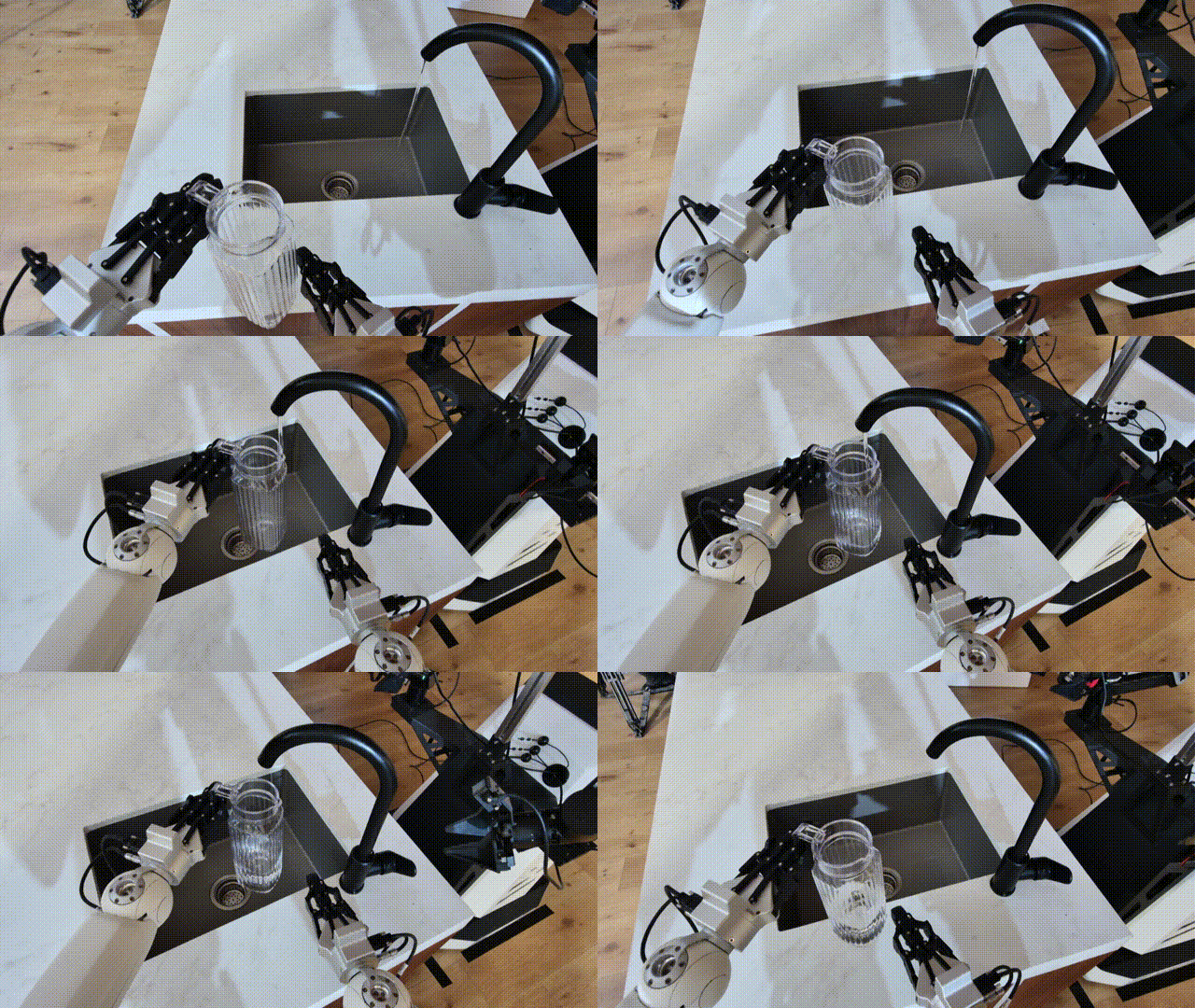
The design philosophy of LingBot-Vision is entirely different.
From the outset, it was not created for image understanding but rather for the interaction needs of robots in the physical world.
The Ant Group Lingbo team introduced a Boundary Forcing mechanism into the self-supervised learning framework.
In simple terms, most general-purpose visual models use random masking during training, where small random blocks of an image are obscured, and the model is tasked with guessing what is missing.
This process is akin to being given a text filled with mosaics and being asked to fill in the blanks based on intuition, teaching the model the semantic patterns of the image as a whole.
In contrast, LingBot-Vision specifically masks pixels along object edges and contours during training, forcing the model to understand where the boundaries of an object lie, what its shape is, and what spatial relationships exist between its different parts.
This mechanism brings about fundamental changes.
Traditional models learn image-level semantic representations, while LingBot-Vision also learns pixel-level geometric representations.
The former is suitable for image description, while the latter is suitable for robotic manipulation.
The effects are directly reflected in the data.
In public benchmark tests, LingBot-Vision, with approximately 1.1 billion parameters, achieved performance comparable to DINOv3, which has 7 billion parameters, using only about one-seventh of the parameter count. Moreover, its pre-training corpus consisted of approximately 160 million images, less than one-third of DINOv3's.
This means that Ant Group Lingbo has trained a more suitable spatial visual representation for robotic tasks using less data and a smaller model.
More notably, LingBot-Vision also offers a lightweight version for edge deployment.
The ViT-L model, with 300 million parameters, achieves accuracy comparable to DINOv3, which has 7 billion parameters, in the NYUv2 depth estimation task, using only one-twenty-third of the parameter count.
This provides true practical value for humanoid robots, small service robots, and other devices with limited computational power and energy consumption.
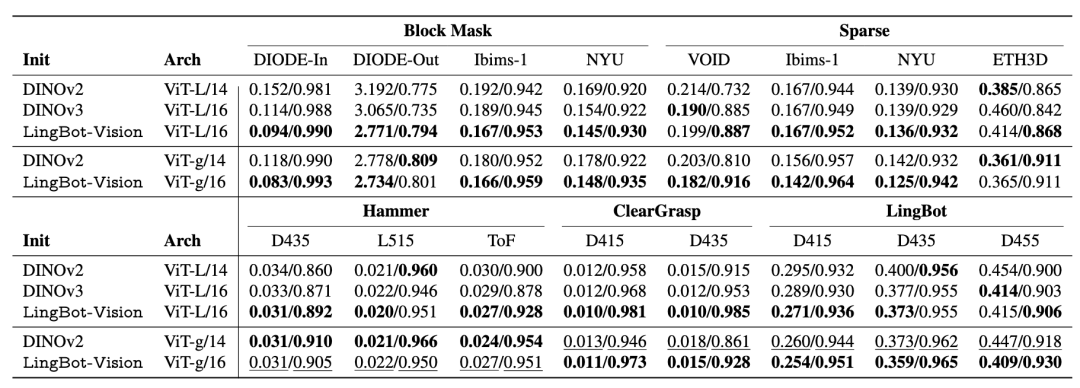
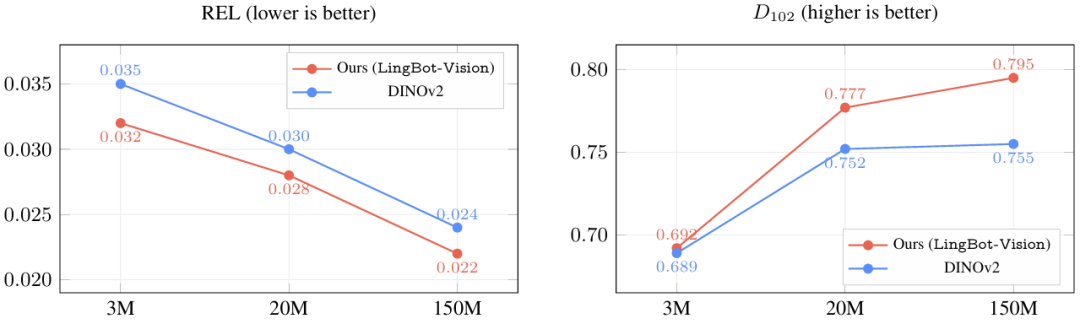
LingBot-Depth 2.0 is the first key validation built upon this spatial-native foundation.
It proves that the geometric representations learned by LingBot-Vision can be effectively transferred to depth perception tasks and that their performance is significantly superior to solutions relying on general-purpose visual models.
More importantly, beyond depth estimation, developers can also build their own downstream tasks based on LingBot-Vision, such as 6D pose estimation, SLAM, grasping planning, and spatial reconstruction.
Overall, this foundation establishes a clear technological pathway: embodied-native visual foundation model → spatial perception capabilities → robotic task deployment.

Integrating Hardware and Software to Unlock Commercialization Pathways
The value of a technological pathway must ultimately be proven in industry.
Although the LingBot-Depth series was released only recently, it has already established a pathway from model development to commercial deployment.
The collaboration between Ant Group Lingbo and Orbbec provides a concrete example.
Orbbec is an industry-leading AI and robotic 3D vision company. In their collaboration, the LingBot-Depth 2.0 model has been deeply adapted to Orbbec's Gemini 330 series binocular 3D cameras.
The camera provides chip-level raw depth data, which LingBot-Depth 2.0 enhances for spatial perception, such as edge completion, detail optimization, and depth map repair in complex scenes. The final output depth information is of significantly higher quality than that of a bare hardware solution.
More importantly, this combination has already been validated in real-world projects.
LingBot-Depth 2.0 has passed professional certification from Orbbec's Depth Vision Laboratory, achieving industry-leading levels in terms of accuracy, stability, and adaptability to complex scenes.
In practical tests, LingBot-Depth 2.0 demonstrated clear advantages in terms of contour integrity for small objects, depth stability for distant targets, and data reliability in complex material scenes involving reflections and transparency.
The collaboration between the two companies is now moving from technical validation to productization.
On the data acquisition side, Orbbec has launched the EGO-RGBD data collection device based on LingBot-Depth 2.0's API, specifically designed to provide high-quality first-person RGB-D data for training embodied intelligence models.
On the application side, Orbbec has released an SDK integrating the latest version of LingBot-Depth's model capabilities, forming a joint product solution combining Orbbec hardware with LingBot-Depth capabilities.
In the longer term, the two companies plan to launch an integrated camera product incorporating LingBot-Depth Commercial Edition by the end of this year, delivering 3D camera capabilities and spatial perception in a single package.
This means that robot customers no longer need to do algorithm adaptation by themselves. Once the hardware is purchased, the spatial awareness capability is already built in.
From API to SDK and then to the integrated camera, this productization path is clear and pragmatic.
At the same time, Ant LinkBot chooses to open source LingBot-Vision.
On the surface, open source means making the code publicly available, but in essence, it is a collaborative effort to build industrial infrastructure. Capabilities become a shared foundation for the industry, so developers don't have to reinvent the wheel; downstream companies can accelerate validation, significantly shortening the cycle from R&D to implementation.
Back to the original question: Why do robots still struggle to act even though they can 'see'?
The answer is becoming clearer. The problem doesn't lie in insufficient recognition capabilities but rather in the lack of native spatial understanding in the visual system.
When the goal of visual models remains stuck at image semantics, it is difficult to support interaction needs in the real world. However, when spatial structure is placed at a more central position, an entire system of capabilities undergoes transformation accordingly.
From this perspective, the release of LingBot-Vision and LingBot-Depth 2.0 is not just about launching two models but rather serves as a signal: vision is shifting from an image-first paradigm to a spatial-first reconstruction path.
And this path is precisely the step that embodied AI must take to achieve large-scale implementation.
The key change at this stage is not that model parameters become larger or task metrics further improve, but that vision truly begins to serve the physical world itself.
-
![]()
The Surprisingly Significant Impact Difference Between Quiet and Noisy Cars!
-
![]()
Breaking Through Storage Cycle Barriers: How AI Large Models and Coding Technology Synergize to Drive Transformation in the Security Industry
-
Facilitating the Slimming of Camera Modules! O-film Obtains Utility Model Patent for Periscope-Type Reflective Component
-
![]()
Hikvision Raytine’s Millimeter-Wave Body Imaging Security Inspection Device Achieves ECAC SSc Category A Standard Level 2.1 Certification for European Civil Aviation
-
![]()
Global Market Share for Security Windows Hits 26%! This Optical 'Little Giant' Makes Its Debut on NEEQ
-
![]()
The Evolutionary Path of Agent Engineering: From Prompt to Harness by Zhang Yutao, Co-founder of Moonshot AI
-
![]()
Profits and stock prices are both declining, so why are executives from these auto companies increasing their purchases?
-
![]()
Burning Tens of Billions of Dollars, Yet No Unified Definition for World Models