When AI Begins to Reshape Infrastructure: A Reshuffle in the U.S. Cloud Market
 07/07 2026
 388
388
Author|He Qing
Editor|Focus Editor
In 'The Structure of Scientific Revolutions,' Thomas Kuhn states that a mature system often enters a stage of 'normal science'—where all participants implicitly follow the same set of rules, merely optimizing within an established framework.
For the cloud computing industry, these rules have been: whoever owns more data centers, more servers, and more enterprise customers holds a larger market share. The U.S. cloud computing industry has maintained a stable order for nearly two decades: AWS, Azure, and Google Cloud have formed a nearly uncontested competitive landscape.
However, what truly transforms an industry is not optimization within existing rules but the breaking of those rules by new variables. AI is that new variable.
Recently, Bloomberg reported that Meta is planning to establish a cloud infrastructure business, selling its internal AI computing power and model access capabilities to external customers. For AI giants like Meta, which already possess vast resources in data centers, GPUs, chips, and models, computing power itself has become a resource that can be independently sold and monetized.
Meanwhile, OpenAI has tied Oracle into its 'Stargate' plan, using its demand for training models with trillion-parameter scales to continually push Oracle to invest heavily in expansion. xAI simultaneously procures computing power from Oracle and Nebius Group, maintaining its bargaining power between the two suppliers. Anthropic, while deeply reliant on AWS for training resources—committing to purchase over $100 billion in computing resources from AWS over the next decade and securing up to 5GW of Trainium-series chips—continually pushes AWS to adjust its AI product ecosystem. AWS has created a second parallel product channel internally for Anthropic, with the pace of new feature rollouts controlled by Anthropic.
Model companies are not only clients but also strategic partners of cloud providers, becoming the most critical variable in the entire cloud computing industry. The traditional power structure is repeatedly disrupted. The scarcer computing power becomes, the less satisfied model companies are with passive procurement; instead, they actively intervene (intervene in) infrastructure planning, construction, and even product definition. Armed with billions in financing and holding the largest future demand for computing power, they procure resources from AWS, Oracle, and CoreWeave while also designing their own chips and building AI clusters.
Thus, a new change is underway: whereas cloud providers once served AI companies, now AI companies are beginning to reshape cloud providers in reverse.
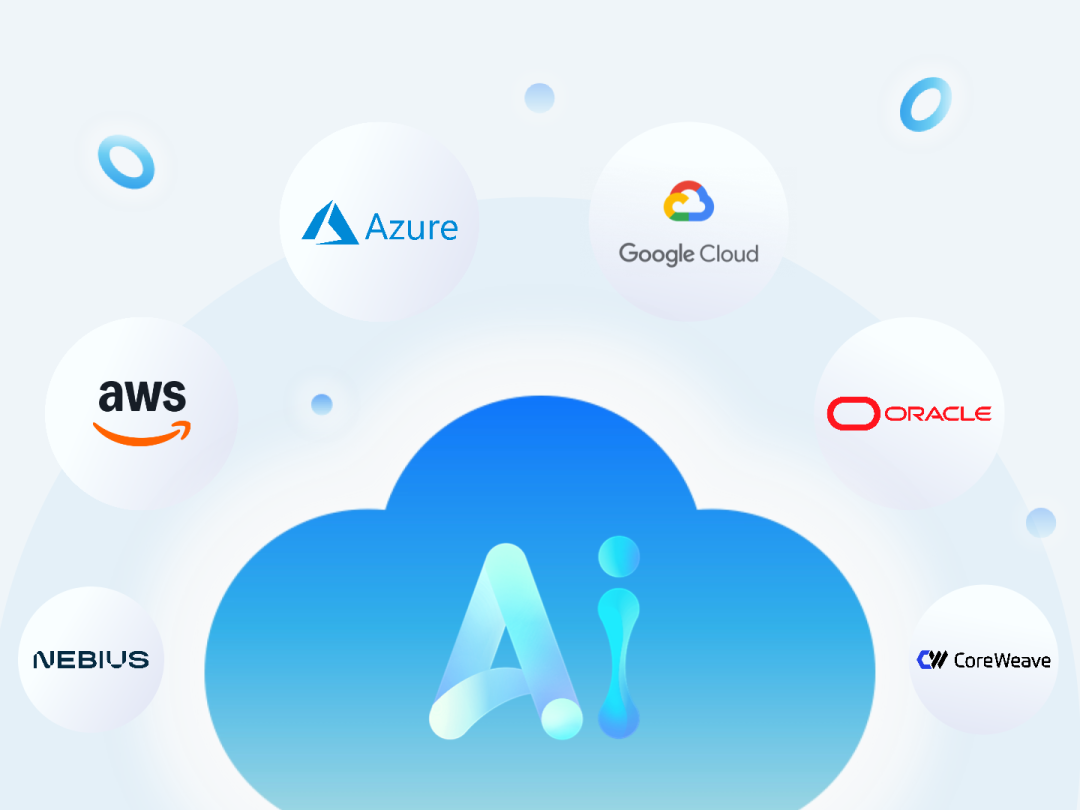
Indeed, since Amazon Web Services launched cloud services in 2006, followed by Microsoft Azure and Google Cloud, the U.S. cloud market has revolved around a few super cloud providers. In the AI era, we observe that the U.S. cloud market is evolving into a new ecosystem where three forces compete: traditional super cloud providers, AI-native clouds, and model companies at the top of the value chain. The global AI cloud market is undergoing a reshuffling.
Traditional Cloud Giants Are No Longer Enough
In the past few years, players like AWS, Azure, and Google Cloud have maintained their positions as the top three globally, with no fundamental changes in the market landscape. However, when examining the sources of growth, changes become evident.
AWS's latest quarterly revenue reached $37.6 billion, up 28% year-over-year, marking its fastest growth in nearly four years. To meet the cloud service demands of AI companies, Amazon's quarterly capital expenditures hit $43.2 billion, a record high. CEO Andy Jassy stated that current AI-related demand exceeds the company's available computing power, with plans to continue expanding AI infrastructure investments in the coming years.
Microsoft's growth similarly comes from AI. In the latest fiscal quarter, Azure and other cloud services revenue grew 40% year-over-year, driving a 28% increase in Intelligent Cloud business revenue. Microsoft disclosed that server and cloud services revenue increased by $6.7 billion, primarily driven by Azure's growth, which stems from the Continuous expansion (continued expansion) of various workloads, including AI. Meanwhile, the company's capital expenditure costs grew 43%, largely allocated to building AI infrastructure.
The fastest growth, however, comes from Google Cloud. In the latest quarter, Google Cloud revenue reached $20 billion, up 63% year-over-year, marking the fastest growth since Alphabet began disclosing cloud business performance separately. Enterprise AI solution revenue grew eightfold year-over-year, and the cloud business backlog nearly doubled to approximately $460 billion. To meet sustained AI demand, Alphabet again raised its 2026 spending forecast to $180–190 billion and began selling TPUs externally for the first time, hoping to transform AI infrastructure originally used for internal model training into new cloud products.
For the 'Big Three' of U.S. cloud providers, GPUs, high-speed networks, and AI data centers have become the most frequently mentioned keywords in earnings calls. AI has become the new growth engine of the U.S. cloud market.
Meanwhile, in the latest fiscal year ending May 2026, Oracle—often considered the fourth major player—reported cloud infrastructure (OCI) revenue of $18.1 billion, up 77% year-over-year, with fourth-quarter growth reaching 93%. In contrast, Cloud Applications (SaaS) grew only 10%, while traditional software business revenue declined by 2%. Oracle's fastest-growing segment is no longer databases but AI infrastructure built around large-scale model training and inference. Company management admitted in earnings reports that most of the RPO growth in the past two quarters came from large AI contracts, with customers prepaying $75 billion for GPU access or providing their own GPUs for Oracle to manage. Building AI factories around super AI clients like OpenAI has become Oracle's top priority.
More notably, the fastest-growing companies in the U.S. cloud market do not belong to the traditional top four cloud providers. NeoCloud (AI-native cloud) is capturing the incremental cloud market.
Take CoreWeave, an AI-native cloud provider, as an example. Its market capitalization rapidly surged to tens of billions of dollars after going public, driven by its client roster—leading model companies like OpenAI, Meta, and Anthropic have long-term locked-in computing contracts with it. CoreWeave is not a traditional cloud provider but rather a GPU cloud operating system designed specifically for large-scale model training/inference, serving as an AWS alternative in the AI era. Nebius, meanwhile, gained prominence by signing a $27 billion AI infrastructure agreement with Meta, with market expectations projecting its annualized revenue to reach $7–9 billion by the end of 2026.
The cloud industry is undergoing a structural reshuffling. On one side are traditional cloud providers, with stable businesses and a stronghold in enterprise IT legacy markets. On the other side are AI-native clouds, which are rapidly growing by building NeoCloud systems around GPUs, model training, and Agentic AI, with demand directly driven by model companies.
According to BofA, by 2029, the AI infrastructure market alone will reach $79 billion, with Agentic AI becoming the primary demand source in the coming years. The 'east wind' for AI-native cloud providers has arrived.
As model companies become the largest buyers in the cloud computing industry for the first time, they are using massive orders to transition from being cloud providers' clients to becoming new players in the cloud market. Meta is preparing to open its AI infrastructure as a cloud service, OpenAI is elevating cloud players like Oracle and CoreWeave, and Anthropic, while reliant on AWS, is also pushing AWS to launch new AI chips and model services.
However, it is worth noting that while many discuss AWS, Azure, Google, and Oracle, the true determinant of rankings is NVIDIA.
SemiAnalysis argues that 'the biggest bottleneck in the AI era is not demand but GPUs and electricity.' GPUs determine who can deliver, who can expand, and who can secure orders. CoreWeave, Oracle, and Nebius all rely on GPU supply. NVIDIA, holding the allocation order for GPUs, has become the fourth hidden player reshaping the U.S. cloud market.
Next-Gen Cloud Companies Are Selling 'Intelligence'
If the past two decades of cloud computing competition revolved around who owned more data centers, the focus in the AI era is shifting.
A trend is emerging: when procuring cloud services, more AI companies no longer care about CPU models, virtual machine specifications, or even storage capacity. Their top concerns are: Do you have GPUs? Is inference speed fast enough? How much does a million Tokens cost? How long does an Agent take to complete a task?
Traditionally, AWS, Azure, and Google Cloud sold standardized computing resources like computing power and servers, with CPUs, storage, bandwidth, databases, and virtual machines as their main product offerings. Enterprises would rent these resources and then deploy databases, build applications, and develop software themselves. In the AI era, however, more clients are purchasing not resources but capabilities. GPU clusters, model hosting, inference services, Token-based billing, Agent Runtime environments, and model fine-tuning platforms—products that did not exist before—are becoming new revenue streams for cloud providers.
What determines a cloud provider's competitiveness is its ability to deliver intelligence more efficiently. This shift is even more pronounced among the four traditional cloud providers: AWS, Azure, Google Cloud, and Oracle.
Over the past year, Oracle has nearly become one of the fastest-growing cloud providers globally. Many attribute this to OpenAI's massive orders, but what truly propelled Oracle ahead was its radical strategy of completely Refactoring (reconstructing) its infrastructure around AI. Unlike traditional cloud providers emphasizing general-purpose computing and multi-tenancy isolation, Oracle has bet most of its resources on large-scale model training scenarios. It deeply optimized RDMA high-speed networks for GPU clusters to reduce cross-node communication latency and even customized entire data centers for OpenAI's growing training demands, from power supply and cooling to network topology.
For traditional enterprise clients, such investments are almost unimaginable. But for training models with hundreds of billions or even trillions of parameters, reducing network latency by a few percentage points can mean tens of millions of dollars in training cost differences.
Oracle is not alone. AWS launched EC2 UltraCluster in 2025, paired with its in-house Trainium chips and EFA (Elastic Fabric Adapter) networks, supporting parallel training across tens of thousands of GPUs. In 2026, it further expanded its 5GW computing power lock-in agreement with Anthropic. Google Cloud, leveraging TPU v5p and AI supercomputer architectures, provides high-bandwidth, low-latency inter-chip connectivity while opening multi-gigawatt-scale TPU computing power to Anthropic and xAI. Azure deployed the Maia 100 accelerator and collaborated deeply with NVIDIA to build a million-GPU-scale AI supercomputing cluster serving OpenAI and other large model clients.
The difference is that Oracle carries far less baggage from traditional enterprise clients than the other three, allowing it to sacrifice some general-purpose computing capabilities for long-term binding with top AI companies. Such customized investments are difficult to fully replicate for AWS and Azure, which still need to cater to massive traditional enterprise workloads.
CoreWeave's rise has been even more rapid, akin to an internet company's speed.
Traditional hyperscale cloud providers often take a year and a half or even two years to build a large data center, involving complex processes from land and power approvals to network access and server deployment. CoreWeave, however, redesigned all its organizational capabilities around AI. It does not pursue global coverage but rapidly builds AI clusters around GPUs, compressing data center delivery cycles from 18 months to around six months. Simultaneously, through long-term fixed-price contracts, it locks in GPU price fluctuations and depreciation risks in advance.
For AI companies eager to release next-generation models, whoever can deliver GPUs faster wins orders. The moat built by traditional cloud providers through scale has been breached by CoreWeave's high execution efficiency.
As cloud providers increasingly transform into AI factories, the industry's competitive logic is being rewritten. In the AI era, more services are being charged based on model capabilities. The competitive focus for cloud providers has shifted from servers to GPU acquisition capabilities, model ecosystems, inference efficiency, network architectures, and the ability to rapidly complete customized deployments for super clients.
The Next Destination for Cloud Providers: Agents
Keenly aware cloud providers have reached a consensus: while the past two years' opportunities in AI cloud came from large-scale model training, the industry's largest growth in the coming years will likely come from Agents.
It is important to note that foundational models are entering a convergence phase. In recent years, the industry has competed around one thing: whoever has more GPUs can train larger models. From GPT-3 to GPT-4 and now to foundational models with hundreds of billions of parameters, training a model once often requires tens of thousands of GPUs running continuously for weeks or even months. Training determined everything, and cloud providers competed for training orders, building data centers around training and prioritizing GPU allocation for training tasks.
However, as the marginal returns of the Scaling Law slow, the industry is realizing that the next AI competition will no longer be just about training larger models but about integrating models into workflows. Over the past year, nearly all model providers—OpenAI, Anthropic, Google, and Microsoft—have begun focusing their roadmaps around Agents.
A Gartner study points out that a typical Agent workflow consumes 5 to 30 times more Tokens than traditional chatbots. This means that while a user might have called a model a few dozen times a day before, a single request like 'Help me complete market research' could now involve hundreds or even thousands of model calls, with an Agent potentially working continuously in the background for hours.
For cloud providers, this represents a fundamentally different business.
A significant amount of GPUs were previously purchased for model training, involving substantial order values, but these were one-time investments. After model training is completed, a large number of GPUs return to idle status. However, Agents are like a 24/7 operational computing power factory, with each Agent continuously generating token consumption.
Amidst the upward pressure on computing costs, two new metrics have emerged in the industry: Cost per Task and Cost of Pass. The former measures how much it costs to complete an Agent task, while the latter calculates the amount of computing power required to complete a valid inference. Customers no longer pay based on GPU utilization but instead ask, "How much does it cost to complete a financial report analysis?" Intelligent delivery results are beginning to become a new commodity.
This is why an increasing number of NeoCloud companies are starting to restructure their business models. Nebius has begun exploring a shift from charging per GPU and per token to gradually evolving towards charging per task and per result. In the future, enterprises may not purchase a million tokens but rather the results of completing a coding task, automated procurement, or marketing planning itself. Cloud providers need to establish task-level billing and optimization systems.
Meanwhile, another competition is beginning to surface.
With the rapid growth in inference demand, costs have once again become the biggest concern for all enterprises. Gartner predicts that by 2027, approximately 40% of Agent projects will fail due to infrastructure cost overruns. The true limitation to Agent adoption may no longer be model capabilities but rather inference costs. When completing each task costs several dollars, Agents will never be able to penetrate core enterprise operations.
As a result, all cloud providers are entering the same battle. AWS continuously optimizes Trainium and Inferentia to reduce inference prices; Azure relies on the OpenAI ecosystem to continuously improve inference efficiency; Google attempts to establish a cost advantage with TPU; AI clouds like CoreWeave and Nebius constantly work on reducing unit task costs by optimizing GPU utilization, network scheduling, and inference orchestration. Cloud providers need to accomplish more tasks with fewer GPUs. The focus of competition among cloud providers has gradually shifted from the scale of data centers to inference efficiency and the capability and cost of Agents completing tasks.
This time, cloud computing has not reached its endpoint due to AI but has instead returned to the center of transformation. What will determine the reshuffling of the rankings among US cloud providers is no longer who has more servers or merely the number of GPUs, but who can continuously, stably, and cost-effectively supply intelligence. Whoever can drive down the inference costs of Agents to a lower level will capture a market ten times larger than traditional ERP systems—a business involving millions of concurrent Agents processing tens of thousands of requests per second.
And this is precisely the commanding height that AWS, Azure, CoreWeave, Nebius, and others will compete for in the next phase.
-
![]()
The Surprisingly Significant Impact Difference Between Quiet and Noisy Cars!
-
![]()
Breaking Through Storage Cycle Barriers: How AI Large Models and Coding Technology Synergize to Drive Transformation in the Security Industry
-
Facilitating the Slimming of Camera Modules! O-film Obtains Utility Model Patent for Periscope-Type Reflective Component
-
![]()
Hikvision Raytine’s Millimeter-Wave Body Imaging Security Inspection Device Achieves ECAC SSc Category A Standard Level 2.1 Certification for European Civil Aviation
-
![]()
Global Market Share for Security Windows Hits 26%! This Optical 'Little Giant' Makes Its Debut on NEEQ
-
![]()
The Evolutionary Path of Agent Engineering: From Prompt to Harness by Zhang Yutao, Co-founder of Moonshot AI
-
![]()
Profits and stock prices are both declining, so why are executives from these auto companies increasing their purchases?
-
![]()
Burning Tens of Billions of Dollars, Yet No Unified Definition for World Models