In the AI-Driven Office Era, Is WPS Becoming a Hidden Threat to Hard Drives?
 07/07 2026
 475
475

Source | Benyuan Finance
Author | Li Youshan
In the spring of 1988, at the Caiwuwei Hotel in Shenzhen, a 24-year-old programmer worked tirelessly alongside a 386 computer, the keyboard clicking away for over 400 days and nights. His efforts culminated in 122,000 lines of code, giving birth to China's first word processing software: WPS 1.0.
The young man was Qiu Boyun. Although he never made it onto the Forbes list or any celebrity rankings, the WPS software he created marked a significant milestone in Chinese software history.
Today, WPS, which started with the mission of "making office software accessible to everyone," has grown into a bona fide national software powerhouse, boasting 678 million monthly active devices worldwide and a gross margin exceeding 85%. However, it has recently found itself in the spotlight due to accusations of "excessive fees and betraying user trust."
Users have accused WPS of using "cloud sync" as a pretext, while its cached and cloud-backed-up files secretly occupy space on the computer's C drive, becoming an "invisible assassin" behind system slowdowns and document losses.
Once hailed as a beacon of domestic innovation, WPS now finds itself mired in controversy, caught between the pressures of commercialization and the rights of its users. Is the criticism against WPS justified?
1. The Hard Drive "Assassin"
Many users have experienced the frustration of turning on their computer for work in the morning, only to find the C drive alarmingly full. Upon investigation, they often discover that WPS has been silently storing tens of gigabytes of cache in the background. Attempting to clear this "cache garbage" in bulk, they are met with a message stating they lack VIP privileges. This is a common experience for WPS users.
The spark that ignited public outrage came from Sina Weibo CEO Wang Gaofei, known online as "Laiqu Zhijian," who wrote in a post: "For 30 years, I've seen this cycle too many times: Use free offerings to capture the market, low prices to lock in users, and once migration costs become prohibitively high, start reaping profits. This isn't WPS's innovation; it's a classic playbook for commercial software."
Although it was later clarified that this comment was "posted by shrimp he raised himself," it still triggered widespread discussion due to its resonance with user pain points.
User complaints primarily focus on several areas:
Firstly, the installation and storage path settings are unclear. While the WPS software itself is installed on the D drive, cached and cloud-backed-up files are written by default to the C drive's system directory. This convenience for the development team comes at the expense of users bearing the risks of system slowdowns and hard drive space consumption. The specific locations and actual sizes of cached files are also not transparent.
Even more frustrating is the difficulty in finding entry points to clear these caches and backup files. Even when found, users must manually select each file one by one, a process that feels endless. Basic features like one-click bulk deep cleaning and automatic cache management are locked behind paid membership privileges.
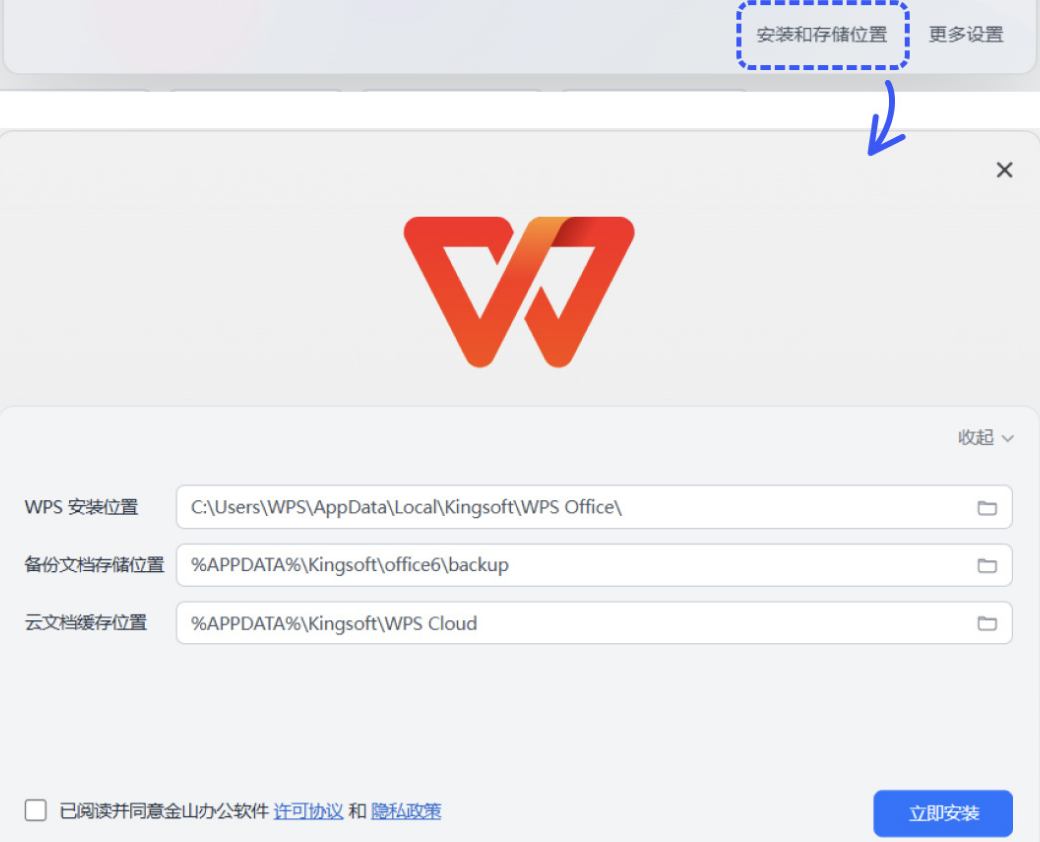
In response to these issues, while WPS has not issued an apology, it has taken proactive steps for remediation, announcing that a new version set to launch in July will introduce systematic optimization solutions. Specifically, it will "add new storage paths, cache management, and free cleaning functions."
Public sentiment has not subsided, with many long-time users reporting on social media that WPS's membership tiers are overly complex, at one point featuring up to five types of memberships and numerous packages, with "pop-up ads severely impacting the user experience."
In 2026, its membership system was simplified to two categories: Super Membership and Grand Membership. The primary difference lies in AI privileges, but the memberships employ a "nested pricing" model, where "purchasing Super Membership still requires buying AI Membership separately."
WPS's strategy of breaking down essential functions into multiple paid points has been criticized as unsightly.
Kingsoft Office's WPS Office Assistant once again responded, stating that claims of "WPS imposing excessive fees and betraying users" are untrue and that high-cost services require independent billing.
As a Chinese software company that initially gained traction by offering "free personal use," WPS still enjoys a certain domestic filter (nostalgic sentiment). However, trust is built over years, while reputation and credibility can crumble overnight.
The term "backstabbing" is not just an accusation against software technical flaws and pricing models; it represents a rift in the emotional bond between the company and its users. Profit-seeking and convenience are not mutually exclusive, and WPS may need to revisit its business ethics.
2. The Dilemma Between Sentiment and Commerce
Early WPS carried a heroic aura. During the DOS era, WPS once held over 95% market share, only to be outmaneuvered by Microsoft in the 1990s through a format-sharing agreement that reduced its share to single digits. Kingsoft's own Pangu component development failure missed a critical window, gradually relegating it to a backup option for Office. During this low point, Qiu Boyun sold his villa as a reward to himself, leading a team of around ten people through four years of grueling research and development to compete against Microsoft Office's team of over 200. Later, with WPS 97 and WPS 2000, they regained ground, and with government procurement policies favoring domestic software, they secured a foothold in the government and enterprise market. Even when bullied by Microsoft and shattered by piracy, Qiu Boyun remained resolute: "Unless the state sounds the 'retreat' signal, Kingsoft will never abandon WPS." Lei Jun also said, "From a purely commercial standpoint, developing WPS office software is foolish." Kingsoft has consistently used profits from online gaming to support WPS, "never abandoning it, no matter how weak it may be."
 Kingsoft Office launched WPS Office 2005, marking a turning point in its fate. Technologically, it abandoned its proprietary format standard, which it had adhered to for over a decade, to fully compatible with Office formats from the ground up, enabling zero-learning-cost migration for users. Commercially, it disrupted tradition by committing to a permanently free personal version, relying solely on government and enterprise professional versions and value-added services for profit, while compressing the installation package to 20MB. Coupled with the mobile internet boom around 2011, Kingsoft preemptively entered the mobile space, quickly dominating the mobile office market in China with advantages like free, full-featured, touch-optimized, and cloud-sync capabilities, achieving a curve overtaking. According to Tianyancha and financial report data, Kingsoft Office successfully listed on the Shanghai Stock Exchange's STAR Market in 2019, with Lei Jun as its current controlling shareholder. Kingsoft Office has achieved notable commercial success. In 2025, the company reported revenues of RMB 5.929 billion, up 15.78% year-on-year; net profit attributable to shareholders of RMB 1.843 billion, up 11.63% year-on-year; and R&D investment of RMB 2.095 billion, with an R&D expense ratio as high as 35%. By business segment, WPS personal business revenue was RMB 3.626 billion, contributing over 61% of total revenue; software business revenue related to information technology innovation was RMB 1.461 billion; and WPS 365 government and enterprise subscription revenue was RMB 720 million. WPS personal business has become one of Kingsoft Office's most important revenue sources, while the B-side and G-side drive growth but remain small in scale. Notably, WPS Office's global monthly active devices reached 678 million, indicating that the C-side market has largely plateaued. Combined with slowing revenue growth, pressure on profit margins, and persistently high R&D investment, WPS has largely bid farewell to a phase of all-around high growth. Under intense pressure, Kingsoft Office aggressively ramped up C-side commercialization this year, sparking user conflicts and public sentiment, with over 10,000 complaints accumulated on the Heimao Complaints Platform, half targeting membership-related issues. This may not even be Kingsoft's most pressing problem. In the era of AI office, WPS's competitors are no longer just Microsoft but also DingTalk, Feishu, Doubao, Qianwen, and Yuanbao.
3. Outpacing AI Office
On the AI front, Kingsoft has not lagged, firmly committed to "going all in on AI."
Following closely behind Microsoft Copilot's release, Kingsoft Office officially launched its generative AI application "WPS AI" in 2023, positioning itself as the best implementer of large models. In 2024, leveraging a new wave of technological transformation, Kingsoft Office introduced "WPS 365," a one-stop AI office product for organizations and enterprises, fully benchmarked against Microsoft 365, proposing to help enterprises build their own corporate brains.
In 2025, Kingsoft Office invested over one-third of its revenue into R&D, launching WPS AI 3.0 and the native office intelligence agent "WPS Lingxi," along with the Skill system and scheduled tasks, upgrading its positioning from an "AI tool" to an "AI office assistant accessible to everyone."
Its self-developed Qingqiu Agent achieved a score of 69.96% on the April 2026 SpreadsheetBench spreadsheet capability rankings, ranking second globally. After iterations in June, WPS AI Spreadsheet Agent (Seed 2.0) topped the global rankings with 73.46%, surpassing human expert baselines for the first time.
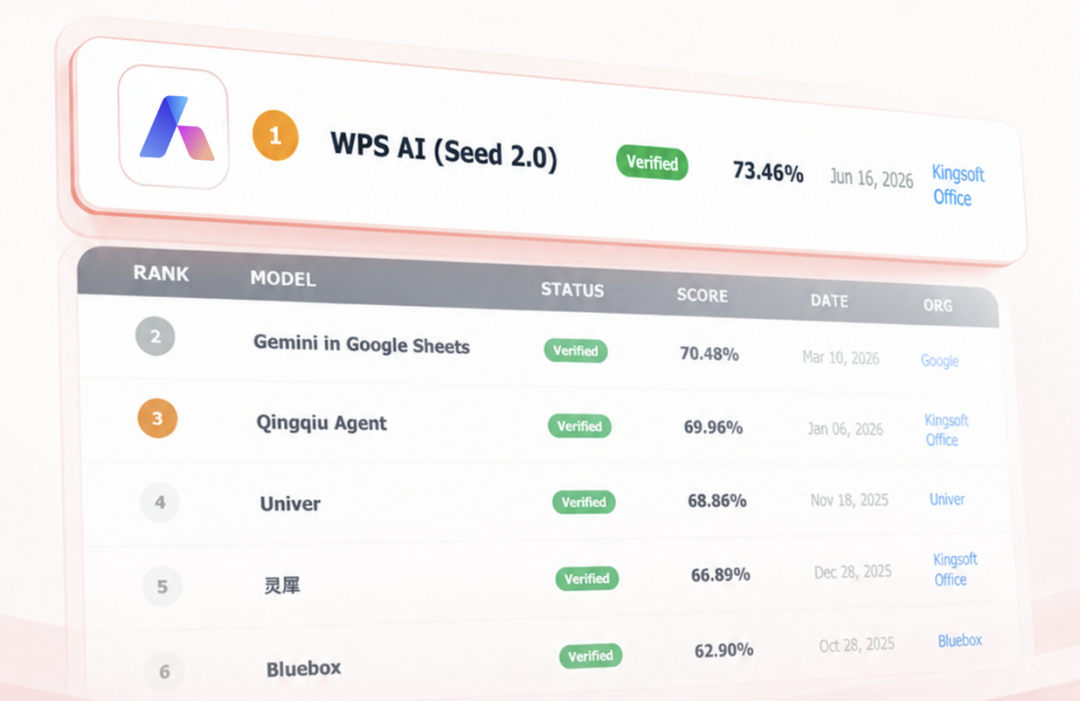
Focusing on AI office, Kingsoft's investment and determination in AI are evident.
WPS AI's domestic monthly active users surpassed 80.13 million, up 307% year-on-year. While impressive, the issue lies in AI features' limited impact on C-side revenue growth. Domestic personal business revenue growth (7.87%) even lagged behind paying user growth (10.67%), indicating that AI users have not yet translated into significant ARPU (Average Revenue Per User) increases. In contrast, Microsoft Copilot has deeply integrated into the office ecosystem with a relatively mature paid model.
WPS's AI commercialization remains underwhelming and is not separately listed in financial reports, raising doubts about its independent revenue-generating capabilities.
In the B-side market, where user migration costs are extremely high, WPS faces competition from DingTalk, Feishu, and WeCom. According to QuestMobile, a third-party data agency, by 2025, the combined market coverage of DingTalk, Feishu, and WeCom in China's collaborative office market had reached 92%.
Cloud-native and AI-native collaboration products are gradually capturing office scenarios among young users and internet enterprises by restructuring office workflows. While WPS 365 has shown impressive growth, it still struggles to shoulder the load.
Technologically, Zhang Qingyuan believes Kingsoft's core competitiveness lies in Office itself. WPS does not develop its own general-purpose large models but instead integrates third-party models like Doubao and DeepSeek, positioning itself as an implementer of large models.
The advantage of "large model collaboration + small model self-development" is reduced inference costs, but the ceiling of this model is clear: Kingsoft AI's capability upper limit essentially equals that of its partner large models, naturally lagging half a step and weaker than native large models.
During the boom in general-purpose large models, WPS's total user base and paying users continued to grow. However, as more casual users discover that "basic office needs can be met with free large models," they are inevitably diverted.
More notably, the past moat of format locking is being replaced by "one-sentence format conversion" features from Doubao Qianwen and others. While WPS desperately integrates AI into documents, spreadsheets, and presentations, the future necessity of document software itself is questionable.
As large model companies, backed by their parent companies' financial and ecological advantages, invest tens of billions of RMB annually and easily access PB-scale data across all fields, their rapid penetration into the office sector poses a crisis for WPS.
In the short term, WPS's core market remains stable, with irreplaceable demand for heavy-duty office tasks, government and enterprise information technology innovation, and format delivery. AI integration enhances product competitiveness and paid value, while overseas growth is notable. In the long term, it must accelerate upgrades to its "office intelligence agent platform" and build its own scenario and data barriers; otherwise, it risks sliding toward the lower end of the value chain, transforming from an office gateway into a formatting terminal for AI output.
The new office era demands new value anchors and organizational paradigms. WPS and even Kingsoft Office have seen their stock prices halve from their peaks this year—their original aspirations and reputation must not be compromised.
Operations / Yu Shuya Design / Yanweier Data / Tianyancha *All rights reserved. No reproduction without authorization.
end
-
![]()
The Surprisingly Significant Impact Difference Between Quiet and Noisy Cars!
-
![]()
Breaking Through Storage Cycle Barriers: How AI Large Models and Coding Technology Synergize to Drive Transformation in the Security Industry
-
Facilitating the Slimming of Camera Modules! O-film Obtains Utility Model Patent for Periscope-Type Reflective Component
-
![]()
Hikvision Raytine’s Millimeter-Wave Body Imaging Security Inspection Device Achieves ECAC SSc Category A Standard Level 2.1 Certification for European Civil Aviation
-
![]()
Global Market Share for Security Windows Hits 26%! This Optical 'Little Giant' Makes Its Debut on NEEQ
-
![]()
The Evolutionary Path of Agent Engineering: From Prompt to Harness by Zhang Yutao, Co-founder of Moonshot AI
-
![]()
Profits and stock prices are both declining, so why are executives from these auto companies increasing their purchases?
-
![]()
Burning Tens of Billions of Dollars, Yet No Unified Definition for World Models