"Elusive to Define": This Seems to Be the Best Description for Yang Zhilin and Moonshot AI | WAVE
 07/10 2026
 362
362
Edited by|Yang Xuran
The financing frenzy in China's large model sector has been astonishing, with Yang Zhilin's Moonshot AI and its Kimi standing out as absolute leaders. The company has evolved from being one of the "AI Six Little Tigers" to a coveted target for global capital.
In just the first half of this year, Moonshot AI secured four rounds of financing, attracting nearly US$4 billion (approximately RMB 27 billion), with financing events occurring almost every month and an average daily intake of nearly RMB 200 million.
Recently, there have been reports that Moonshot AI is negotiating a new round of financing of up to US$2 billion, with a corresponding pre-investment valuation as high as US$30 billion (approximately RMB 203.6 billion). If this round of financing is completed, the company will have accumulated nearly US$6 billion (approximately RMB 40 billion) in capital within half a year.
As a third-party independent vendor outside of BAT and ByteDance, significant differentiation has occurred within the "AI Six Little Tigers": Zhipu and MiniMax have entered the capital markets, some have voluntarily exited general-purpose foundational models to focus on vertical areas, and others are targeting overseas markets.
Beyond being the most successful in financing, Kimi also stands out for its steep valuation growth, its obsession with foundational technologies, and the unique temperament of its founder.
This article is an in-depth value piece from the WAVE content team. Feel free to follow us on multiple platforms.

Capital-Intensive
On June 8, foreign media reported that Moonshot AI's Kimi was negotiating a new round of financing with institutions, aiming to raise up to US$2 billion, with a pre-investment valuation as high as US$30 billion.
Just a month earlier, Moonshot AI had completed a round of financing of approximately US$2 billion, with Meituan Dragonball alone investing over US$200 million, and participants including CITIC and China Mobile, pushing its post-investment valuation past US$20 billion. This marked the largest single round of financing since the company's inception and one of the highest amounts in private financing for a large model enterprise in China to date, earning Kimi the nickname "capital-devouring beast" of large models.
The speed of its valuation growth is even more astonishing. Based on the aforementioned figures, its valuation swelled by US$10 billion in a single month, equivalent to the market capitalization of either Pien Tze Huang or Bull Group.
Entering 2026, Moonshot AI's financing pace accelerated significantly, securing three rounds of financing in January and February alone, raising US$500 million, US$700 million, and US$700 million respectively. Including the latest round, the company has raised nearly US$4 billion in less than half a year, with an average daily intake of nearly RMB 200 million.
Kimi's cumulative financing has exceeded RMB 37.6 billion, making it the most well-funded startup in the large model sector. In comparison, even including IPO proceeds, MiniMax has raised only RMB 15 billion, and Zhipu just RMB 13 billion.
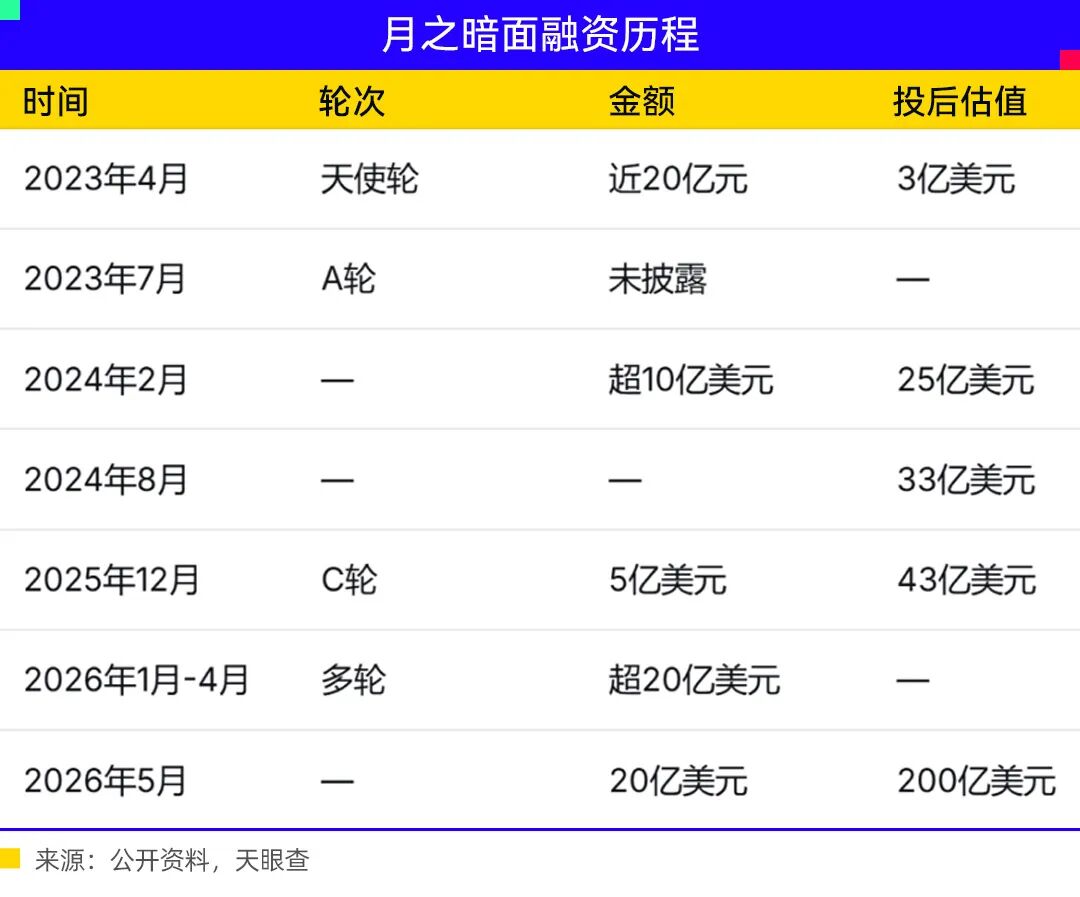
The investor lineup is also evolving. Early on, traditional venture capital firms like Sequoia China, ZhenFund, and Capital Today dominated. In the past six months, industrial capital and state-owned funds such as China Mobile, CITIC Capital, Alibaba, and Tencent have taken the lead. This shift reflects an upgraded recognition of large models within the industry: AI is no longer just a target for VC/PE seeking financial returns but also a crucial strategic asset for downstream enterprises and national capital.
The large model competition has shown a winner-takes-all, head-clustering trend. Even DeepSeek, which is not short of funds, completed its first external financing round earlier, raising over RMB 50 billion with a post-investment valuation of approximately RMB 400 billion. Capital is concentrating on the leaders in this field, and the trend is irreversible.
What many people don't realize is that large models follow a "counter-internet" cost logic.
In the consumer internet business model, once an application goes live, costs decrease marginally as the user base grows. For large models, however, inference-end costs equal the number of active users × single-token invocation volume × unit computing power price. An increase in any of these three factors leads to a linear increase in total costs, with no economies of scale.
A prime example is Doubao, whose long-term strategy of offering free services to scale up resulted in daily computing costs (estimated) as high as RMB 130 million to RMB 240 million, totaling billions annually, while daily revenue once fell short of RMB 1 million. This was a major reason for ByteDance's plummeting net profits.
Across the ocean, OpenAI is also charging ahead amid massive losses. Last year, its total costs and expenditures reached US$34 billion, with internal projections of US$25 billion in cash outflows for 2026 and US$57 billion for 2027, burning US$1.6 for every US$1 earned.
Training-side costs are equally staggering. As an independent vendor, Moonshot AI must purchase AI chips at high prices, incur significant computing and electricity costs, and cover exorbitant salaries due to the talent war. Financing rounds by OpenAI and Anthropic, as well as the massive capital expenditures by Meta and Google, all confirm that large models have entered a capital expenditure race. Only by securing financing can they stockpile more AI computing power, improve infrastructure, iterate models, and achieve commercialization.
Six months ago, Yang Zhilin said, "Moonshot AI has sufficient cash on hand and no urgent need for a short-term IPO." Today, Kimi must join this financing arms race because financing has transformed from an accelerator into a ticket to entry.

Breakthrough
Becoming the "Chinese Anthropic" is a key reason for capital's crazy (fengkuang, crazy here means 'frenzied') bet on Kimi.
In April 2023, Moonshot AI gained initial fame for its "long-text" capabilities. By 2024, its ability to parse 2 million words of context losslessly made it unbeatable. Entering 2025, Kimi faced a "falling behind" crisis, frequently clashing with the "low-cost + open-source" DeepSeek. Its MAU plummeted from 21.653 million in the first quarter of 2025 to 9.027 million by year-end.
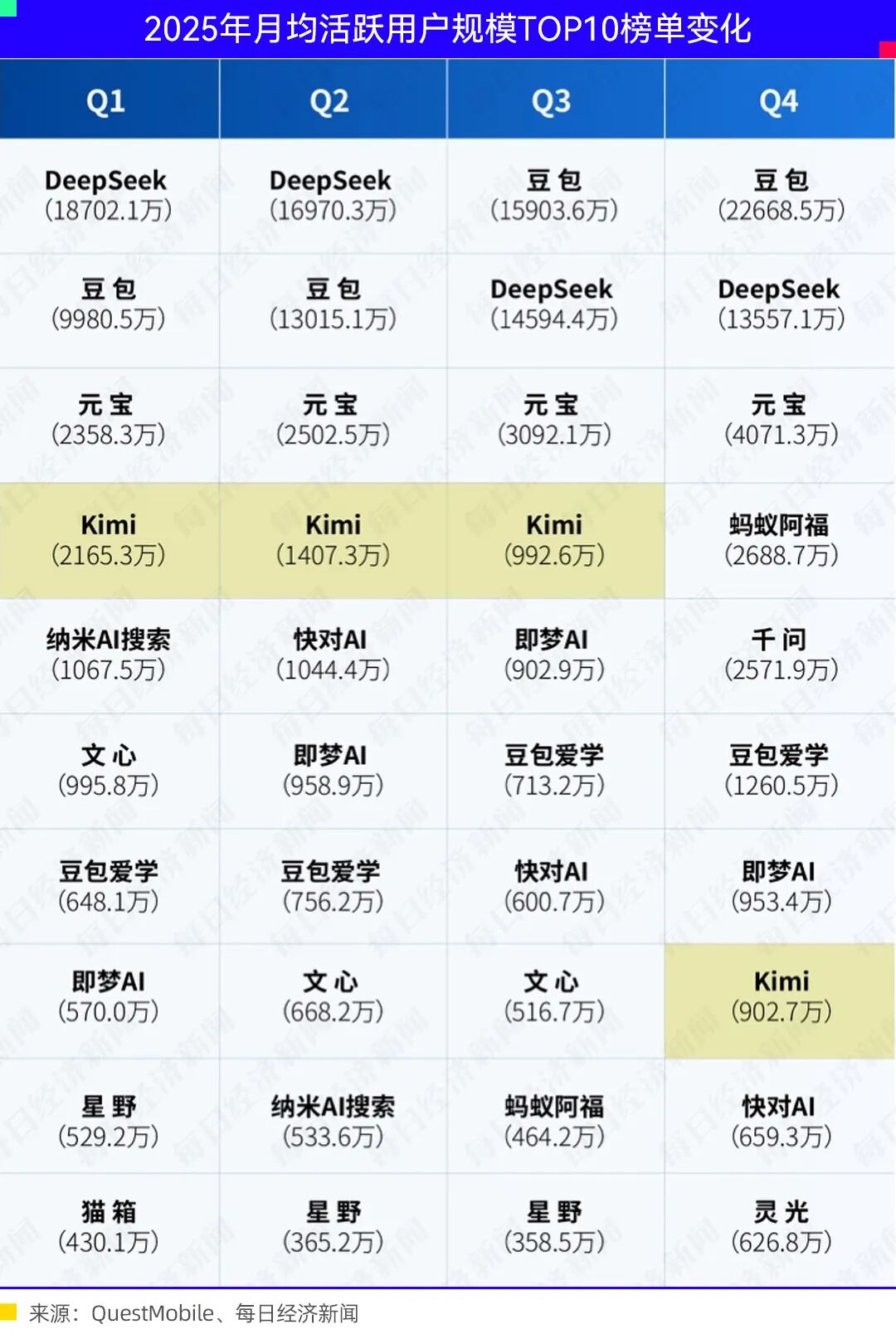
Yang Zhilin changed course, halting the US$700 million annual "money-burning for user acquisition" and shifting to foundational technology "self-sufficiency." The business focus pivoted from C-end chat assistants to overseas developer ecosystems, academic, and office verticals.
His most crucial decision was the bold move to abandon further refinements on K1 and bet everything on developing the better-reviewed open-source trillion-parameter model K2, shifting focus to Agent capabilities. K2 Thinking caused overseas API revenue to multiply. On January 27 this year, the K2.5 version was upgraded with an "Agent cluster" mechanism, enabling long tasks to be split among dozens of sub-Agents, achieving top scores in multiple overseas Agent evaluations.
Reports suggest that within 20 days of the version's release, Kimi's revenue surpassed the total for all of 2025. The ARR (Annualized Recurring Revenue) growth curve steepened further: surpassing US$100 million in March, US$200 million in May, and US$300 million by mid-June, tripling in three months.
This is clearly the main reason for capital's frenzied pursuit of Kimi this year. Looking back, Kimi's path closely resembles Anthropic's, validating a route previously untaken by domestic large model vendors—API-driven, developer ecosystem-powered, and overseas market-led.
APIs contribute over 70% of Kimi's revenue, primarily from developers and B-end clients, rather than C-end individual subscriptions. Huang Zhenxin, Moonshot AI's B-end head, revealed at the Amazon Web Services China Summit that Kimi's overseas paid users and API revenue have both grown by 400%, with the product reaching over 200 countries and regions.
This strategy mirrors Anthropic's playbook. When Anthropic's ARR first reached US$100 million, APIs were the main driver, relying on natural developer word-of-mouth without large-scale user acquisition or marketing.
Its pricing strategy is equally intriguing. While the industry is mired in price wars, Kimi raised the per-million-token input price from RMB 4 in K2 to RMB 6.5 in K2.7 Code, a more than 60% increase, without shrinking demand—revenue instead tripled. From the impressive K2 last year to this year's K2.5, K2.6, and the recent K2.7 Code and Kimi Work, each upgrade in model capabilities and application adaptability was followed by a price hike, yet invocation volumes surged even faster.
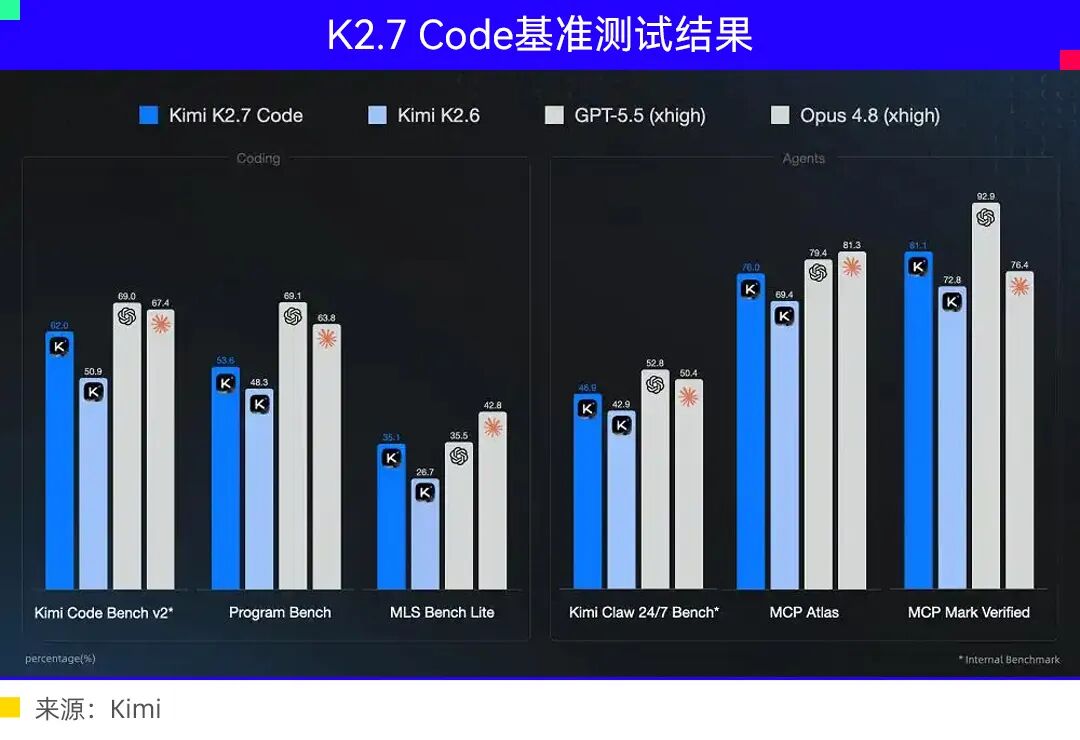
This indirectly confirms a fundamental business logic: low-price internal competition leads nowhere; only by solidifying product strength can global breakthroughs be achieved.
While Kimi's ARR of around US$47 billion lags far behind Anthropic's, it is the first domestic firm to achieve a viable commercial prototype through developer ecosystems and APIs, cementing its leading position in the large model melee.

Taste
A company's values often extend from its founder's style. To fully understand Moonshot AI, one cannot bypass Yang Zhilin.
Born in 1992 in Shantou, Guangdong, Yang embodies a blend of contradictory yet rich traits: a straight-A student, first-place winner in Olympic competitions, a rock music enthusiast, and an aspiring wandering poet. During his time at Tsinghua University, he founded the rock band Splay and even reached the finals of the Tsinghua Campus Singer Contest.
After graduation, Yang pursued advanced studies at Carnegie Mellon University in the U.S., under the mentorship of Ruslan Salakhutdinov, former head of AI at Apple, and William Cohen, Google's chief scientist.
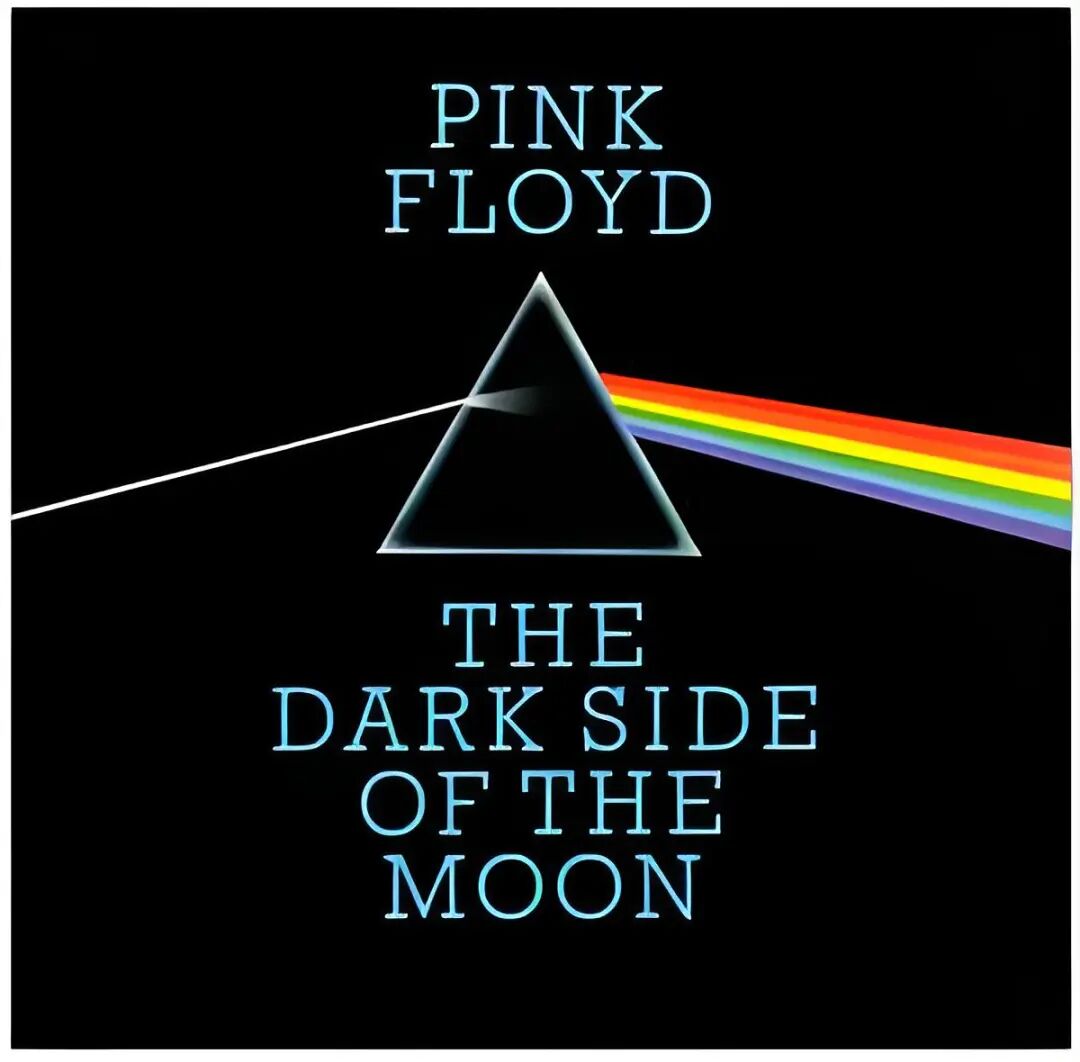
Yang's favorite band is reportedly Britain's Pink Floyd, and the name "Moonshot AI" derives from their album *The Dark Side of the Moon*. He once explained: "The far side of the moon has always intrigued humanity. It's not dark—just always facing away from us, sparking endless imagination."
In team discussions, Yang often emphasizes "taste" ( taste , pǐnwèi), a quality that naturally permeates Kimi's products. The company eschews flashy product launches and marketing hype, preferring to let code and technology speak for themselves.
In some ways, Yang resembles Anthropic founder Dario Amodei. Both exhibit a rebellious spirit:
Dario left OpenAI amid disagreements over AI safety and commercial interests, leading a group of "defectors" to start their own venture and even earning the title "public enemy" for some radical remarks. After K1, Moonshot AI reconstructed foundational components from optimizers to attention mechanisms and residual connections, likely the first in the industry to do so. The Kimi team discovered that visual reinforcement learning (Vision RL) could enhance pure text capabilities—a notion once deemed impossible in the industry, which generally believed introducing visuals would degrade text performance. By breaking down dimensional barriers, Kimi achieved cross-modal cognitive gains, leading to the birth of K2. Yang views K2 as K2 Peak, the world's second-highest mountain, also known as the "Savage Mountain" and "Killer Peak" due to its extreme lethality, symbolizing Kimi's resolve to tackle challenges.
Organizationally, Moonshot AI balances "radical technological innovation" with "restrained organizational expansion." The company has only around 300 employees, the fewest among leading large model startups.
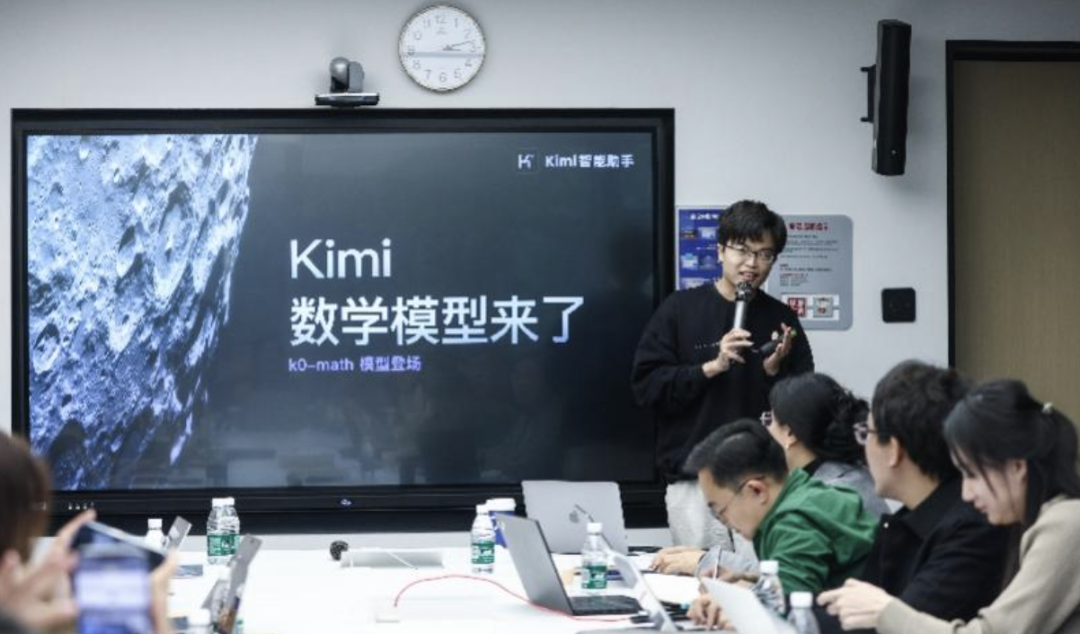
There are no OKRs, no departmental silos, or even traditional departments. Positions like directors and vice presidents are absent, and the office features a piano and electric guitars. Zhang Yutong, Moonshot AI's president, has repeatedly emphasized the company's somewhat "obsessive" talent philosophy in public: "Abstract thinking" and "people who will work crazy (fengkuang, crazy here means 'relentlessly')" are the right fit.
In mid-July, Kimi is expected to release its next flagship model, K3, featuring a Mixture of Experts (MoE) architecture with 2.52 trillion parameters—a domestic record—and integrating a 1M (1 million-token) ultra-long context window and native unified multimodal processing capabilities. This unique "taste" forms the cornerstone of Kimi's comeback.

In the End
By 2026, Kimi will emerge as a Large Language Model (LLM) that is 'distinctive' and 'undefinable.' Whether it's venturing into technological uncharted territories that others dare not bet on or adhering to an aesthetic vision that requires a touch of obstinacy, I believe that more Kimi-defined innovations will make unique contributions to accelerating the development of human civilization. This distinctiveness is the greatest significance of our existence.
With this unique 'technological aesthetic,' Yang Zhilin seems in no hurry to pursue an IPO.
While companies like Zhipu, MiniMax have already listed on the Hong Kong Stock Exchange, and StepFun is rushing to submit its application, followed by DeepSeek's large-scale funding, Kimi has been seeking a unique commercial path and internal coherence. 'Difficult to define' seems to be the best description for Yang Zhilin and Moonshot AI.
Capital can buy computing power and talent, but it cannot buy 'taste.' In the crowded field of AI, this may be the most scarce competitive advantage that Yang Zhilin brings to Kimi.
-
![]()
MiniMax Shares Unlock: Cornerstone Shareholders Show Long-Term Optimism, Yet Stock Plummets Nearly 30% in Two Days; Zhipu Also Sees Nearly 20% Drop Today
-
![]()
Single-Day Plunge of 40%: The 'First AGI Stock' Faces More Than Just Share Price Concerns
-
![]()
Ricoh and Fuji Hike Prices on Legacy Edge; Insta360 Poised to Disrupt Mirrorless Camera Market
-
![]()
Ricoh and Fujifilm Raise Prices in Tandem, Relying on Established Reputations; Insta360 Poised to Disrupt Mirrorless Camera Market
-
![]()
Strategic Shift in Photoelectric Sensing: Maxvision Secures Controlling Stake in CAS Optotech
-
![]()
Optical Communication and Robot Vision: OFILM’s Bold Transformation Amid a 460 Million Yuan Loss
-
![]()
From 100,000-GPU Computing Might to Industrial Efficiency: The Logic Behind AI4S-Driven Intelligence
-
![]()
OpenAI, Grok, and Meta Release Three Major Models: Who is the King of Cost-Effectiveness?