MiniMax: At the Heart of the AI Maelstrom
 07/14 2026
 559
559
Source | Benyuan Finance
Author | Zhang Yexing
When reassessing the landscape of domestic AI large model companies, MiniMax and Zhipu have found themselves at markedly different crossroads from their initial starting points.
In January of this year, MiniMax (00100.HK) and Zhipu (02513.HK) both went public on the Hong Kong Stock Exchange at nearly the same time. At that time, the market showed a greater preference for MiniMax's multimodal capabilities. On its debut, MiniMax's stock surged by 109%, with its market value exceeding HK$100 billion. In contrast, Zhipu nearly fell below its issue price, with a market value of around HK$57.9 billion, making the difference between the two less than double.
Six months have elapsed, and both MiniMax and Zhipu have encountered their first share lock-up expiration during the same period, experiencing yet another stark contrast in their market trends. Zhipu's market value soared past HK$1 trillion before retreating to over HK$700 billion. Meanwhile, MiniMax climbed to HK$400 billion before plummeting to just over HK$70 billion. The difference between the two has now surpassed tenfold.
Given their similar DNA as independent large model companies, why has MiniMax, which was initially ahead, fallen behind? From Mini to Max, how much further does MiniMax have to go?
MiniMax Diminishes to Mini
From HK$100 billion → HK$400 billion → HK$70 billion, judging by the pricing in the secondary market, MiniMax is clearly shrinking in stature.
Faced with pressure and doubts, founder and CEO Yan Junjie sent an internal letter to all employees titled "To the End of the Sky," announcing that he would take no salary until the company achieves Artificial General Intelligence (AGI). However, this failed to halt the stock price's downward trajectory.
Meanwhile, MiniMax launched a HK$16 billion refinancing plan in the form of "new share placement + convertible bonds," to be used for AI infrastructure R&D, model research and development, and intelligent agent harnessing (Harness) product development. Given that the convertible bond conversion price is nearly aligned with the average price over the five trading days before issuance, the premium capacity is clearly weak.
Zhipu, with an H-share structure, was quickly included in the Stock Connect after six months of listing. In contrast, MiniMax, with a red-chip + dual-class share structure, must meet stricter conditions and currently lacks liquidity support.
At the time of listing, only 5.4% of MiniMax's shares were tradable, but this surged to over 48% upon lock-up expiration. According to HKEX rules, MiniMax can only welcome southbound capital in August at the earliest. The market lacks stable incremental funds to absorb the unlocked shares, and with financial investors accounting for over one-third, there is real exit pressure, making the stock price naturally prone to decline.
However, MiniMax's weakness was not solely triggered by the lock-up expiration; its stock price has been continuously retreating from its March high, with the expiration merely amplifying the decline.
From a performance and capital expenditure perspective, MiniMax is still in a high-investment phase.
MiniMax's 2025 revenue was approximately $79.04 million, up 159% year-on-year, though the absolute value is not high; annual losses were $1.87 billion, up 302% year-on-year. Excluding non-cash accounting items, the adjusted net loss was $251 million, roughly flat with the previous year. Full-year R&D expenses were approximately $253 million, with R&D accounting for 320% of revenue, and sales and distribution expenses were $51.9 million.
During its Hong Kong IPO in January this year, MiniMax raised a net amount of approximately HK$5.285 billion, originally planned mainly for R&D and infrastructure. As of June 30, 2026, about 77% has been used, with a significantly faster consumption rate than initially expected at listing. The official explanation is accelerated model iteration and increased customer scale driving higher computational demand.
From a revenue perspective, MiniMax remains a company primarily reliant on C-end income.
In 2025, MiniMax's AI-native product revenue was $53.075 million, accounting for 67.2% of total revenue, mainly from charging C-end consumers for apps like Minimax Agent, Hailuo AI, Talkie, and Xingye. The C-end business, dragged down by computational and customer acquisition costs, has a gross profit margin of less than 5%.
Revenue from the B-end open platform was $25.963 million, accounting for 32.8%. The B-end business has a gross profit margin of about 70%, and while its growth rate is significantly higher than the C-end, it is not yet the main performance driver.
Combining B and C ends, Minimax's gross profit margin is 25.4%, lower than Zhipu's 41%.
The 16% difference represents the true cost disparity between the two commercial paths.
Divergence in AI Monetization Paths
At the beginning of the year, domestic tech giants focused on entry-point narratives, hoping to monetize C-end consumers. However, C-end profitability requires extremely high marginal costs and diversified monetization capabilities.
According to data disclosed by Tan Dai, president of Volcano Engine, the daily Token calls for Doubao's large model exceeded 180 trillion, a 1,500-fold increase from the initial 120 billion in May 2024. However, revenue growth, while undisclosed, is certainly far below 1,000-fold.
The massive Token consumption orders struggle to support actual delivery outcomes, with both large and small companies collectively falling into "Token inefficiency."
Just as the tech giants' HK$4.5 billion red envelope battle was concluding, new opportunities emerged in AI monetization scenarios.
On one hand, the hype around multimodal content generation continues to wane.
OpenAI's Sora officially shut down, and commercialization efforts for leading video models like Runway encountered obstacles, while ChatGPT's e-commerce initiatives were paused. Former star sectors are gradually hitting growth bottlenecks.
On the other hand, Agent and Coding have become new AI hotspots.
The OpenClaw open-source framework emerged, sparking phenomenal popularity among developers. Claude Code's annualized revenue surpassed $1 billion in just six months, with Anthropic overtaking OpenAI in momentum, as 80% of the world's top ten wealthiest enterprises became its paying customers.
This indicates that AI monetization is no longer limited to helping users order milk tea but is shifting towards enterprise productivity scenarios, directly embedding into workflows to assist users and targeting human labor replacement value.
Commercial maverick Elon Musk also calculated in SpaceX's IPO filings:
The future total market size for AI applications is $28.5 trillion (excluding China and Russia), with $2.4 trillion for infrastructure and $22.7 trillion for enterprise applications. As for C-end subscription and advertising scale, Musk estimated only $1.36 trillion.
Zhipu is a beneficiary of this trend, with its entire business focused on the B end.
Zhipu bet earlier on the Coding direction, with GLM excelling in foundational model capabilities and programming benchmark tests, earning praise from developers as one of the "most suitable domestic models for Agentic tasks," with strong API pricing power. The market is essentially buying into the expectation of "China's Anthropic."
MiniMax's Turning Point
MiniMax has pursued a diversified path, not focusing primarily on the B end. Its C-end "cost-effectiveness" strategy was quickly eroded by giants using subsidies, making it difficult to command high premiums.
Additionally, with overseas revenue accounting for 73% of its total, it is more sensitive to international policy and market fluctuations.
In the "AI companion" sector, Talkie/Xingye face competition from products like Maoxiang, Zhumeng Island, Jiuguan, GLOW, and EVE, while also contending with increasingly stringent regulations at home and abroad, leaving high uncertainty.
In the AI video generation sector, Minimax's platform Hailuo AI was once a domestic leader on par with ByteDance's Seedance and Kuaishou's Kling AI. Currently, Hailuo AI's presence has diminished somewhat.
However, video generation scenarios can systematically generate revenue from the B end. According to LatePost, Seedance 2.0, relying on its proprietary content ecosystem, generates over RMB 1 billion in monthly revenue with a gross profit margin of 70%. Kuaishou's Kling generated RMB 650 million in revenue in Q1 2026, with its ARR (Annualized Revenue Run Rate) nearing $500 million, entering the commercialization Redemption period (realization phase).
Seedance and Kling are not pursuing C-end entertainment playbooks but are focused on cost reduction, efficiency improvement, and mass production for mature content industries, providing Minimax with a new approach.
Despite the gloom, MiniMax's technological narrative has not halted.
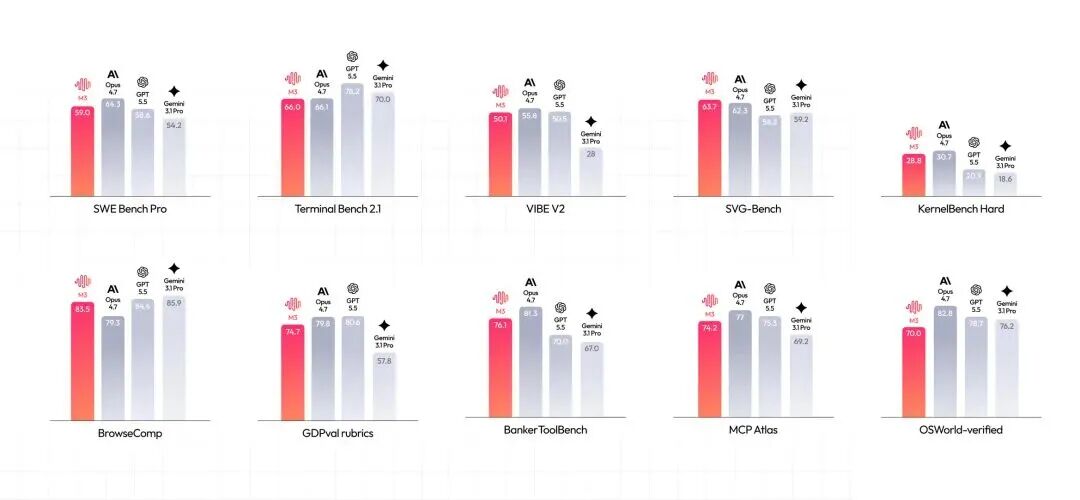
On June 1, MiniMax released its next-generation model M3, with 428 billion parameters (23 billion activated), claiming that M3's programming capabilities achieved 59% on SWE-Bench Pro, surpassing GPT-5.5. However, independent evaluator Artificial Analysis's Intelligence Index ranked it ninth among mainstream models.
M3's pricing is roughly double that of its predecessor, switching from the long-standing "per-use" billing to "per-Token" billing, with existing users' package prices directly increased from RMB 29/month to RMB 49/month, causing some discontent.
Just one week after launch, MiniMax succumbed to pressure, admitting "insufficient communication and ill-considered transition plans," and announced a permanent 50% price reduction, bringing prices back to the M2.7 level. This naturally raised investor doubts about whether the model's capabilities were inadequate.
JPMorgan's response was blunt, downgrading its rating from "Overweight" to "Neutral" with a target price of HK$400, further lowering it to HK$300 in July.
JPMorgan stated that MiniMax is "still in the catching-up phase" in terms of model capabilities and that M3's price reduction aligns it with DeepSeek's pricing range, while Zhipu's API prices doubled during the same period with sales still growing, indicating that "pricing power will depend more on capabilities than merely product coverage breadth or usage scale."
Citigroup also lowered its target price to HK$533/share in July, noting the muted market reaction following M3's early June release and stating that uncertainty in user retention and monetization strategies will continue to pressure the stock price.
MiniMax management stated in recent roadshows that M3 is powerful but suffered from poor marketing, also disclosing that its May 2026 ARR (Annualized Revenue Run Rate) had reached $400 million, indicating urgency about the current stock price.
According to market rumors, MiniMax may launch its next-generation flagship model M3 Pro in Q3 this year, with 2.7 trillion parameters, enhancing Agent, multimodal, and complex reasoning capabilities. This could be MiniMax's turning point to regain investor confidence and achieve its $1 billion ARR target in the second half of the year.
IPO dreams, lock-up expiration tests prices, and commercialization efficiency defines the future. Hard metrics are the ultimate truth, and the market is revaluing large model companies.
Operations / Yu Shuya Design / Yan Weier *All rights reserved. No reproduction without authorization.
end
Thank you for subscribing.
Please contact us first if you have any suggestions.
-
![]()
Hunan’s Wealthiest Entrepreneur Eyes Comeback with Apple’s Foldable iPhone
-
![]()
Planning to Secure 1.055 Billion Yuan to Propel AR Optics Forward! Lante Optics Receives Green Light for Private Placement on the Science and Technology Innovation Board
-
![]()
MiniMax: At the Heart of the AI Maelstrom
-
![]()
Securing 600 Million Yuan in Funding: This AR Optics Company Steps into the Limelight!
-
![]()
From a 706% Surge to a $340 Billion Market Cap Plummet: Has MiniMax's Moment Passed?
-
![]()
High Demand, Low Stock Price: Can the Emotional Companion Robot Ease UBTECH’s Worries?
-
![]()
Why Does Yin Qi, Who 'Doesn't Listen to Advice,' Insist on Making AI Agent Smartphones? | Interview with Jieyue Xingchen
-
![]()
AI-Generated Code Reveals Surprise That Thrills China