Hunan’s Wealthiest Entrepreneur Eyes Comeback with Apple’s Foldable iPhone
 07/14 2026
 566
566

Source | Yuan Media Group
Despite any criticism, Apple remains the undisputed leader in today’s smartphone market.
On June 30, reports emerged that Apple’s Indian supplier, Tata Electronics, fell victim to a ransomware attack, resulting in the leak of over 204,000 confidential files totaling 630GB. The leaked data included schematics for the iPhone 18 Pro/Pro Max motherboard, the A20 Pro chip manual, and details on component suppliers.
This development excited sellers in Shenzhen’s Huaqiangbei electronics market. Previously, they could only speculate about Apple’s new products based on fragmented leaks, but now they had access to comprehensive information.
Instantly, the topic “Huaqiangbei Unveils Apple’s Product Launch in Advance” trended on social media.
Despite the massive data breach, Apple remained unfazed. The reason is straightforward: while Huaqiangbei vendors can replicate the appearance of Apple products, they cannot duplicate Apple’s proprietary chips and iOS ecosystem.
Some sellers admitted they could only produce counterfeit devices with Android-based motherboards that mimic the iPhone 18 Pro’s design.
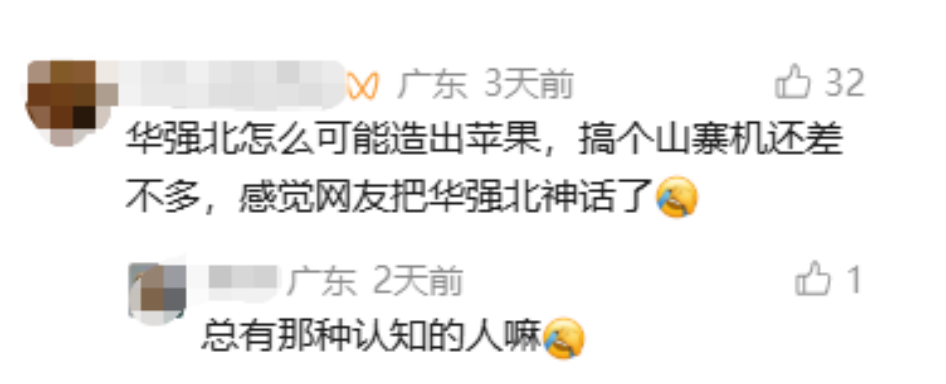
Image Source: User comments on related social media posts
The leak of the iPhone 18 Pro did not diminish market enthusiasm for Apple’s foldable smartphones.
According to an exclusive report by Lanjing News, Apple’s first foldable model is set to enter mass production, with key component suppliers largely finalized. Among them, Lens Technology will supply the UTG (Ultra-Thin Glass) cover glass—the outermost protective layer for foldable screens.
This major contract offers hope for Lens Technology, which faced performance pressures in the first quarter of this year and even experienced a rare quarterly loss. The company now sees growth potential in the second half of the year.
01. The Drive to Diversify Beyond Apple’s Supply Chain
In recent years, major Chinese suppliers in Apple’s supply chain have been actively seeking to reduce their reliance on Apple.
From 2021 to 2025, revenue contributions from major clients (widely believed to be Apple) declined for supply chain giants such as Luxshare Precision, Lens Technology, Goertek, and LY Technology. Luxshare Precision saw the most significant drop.
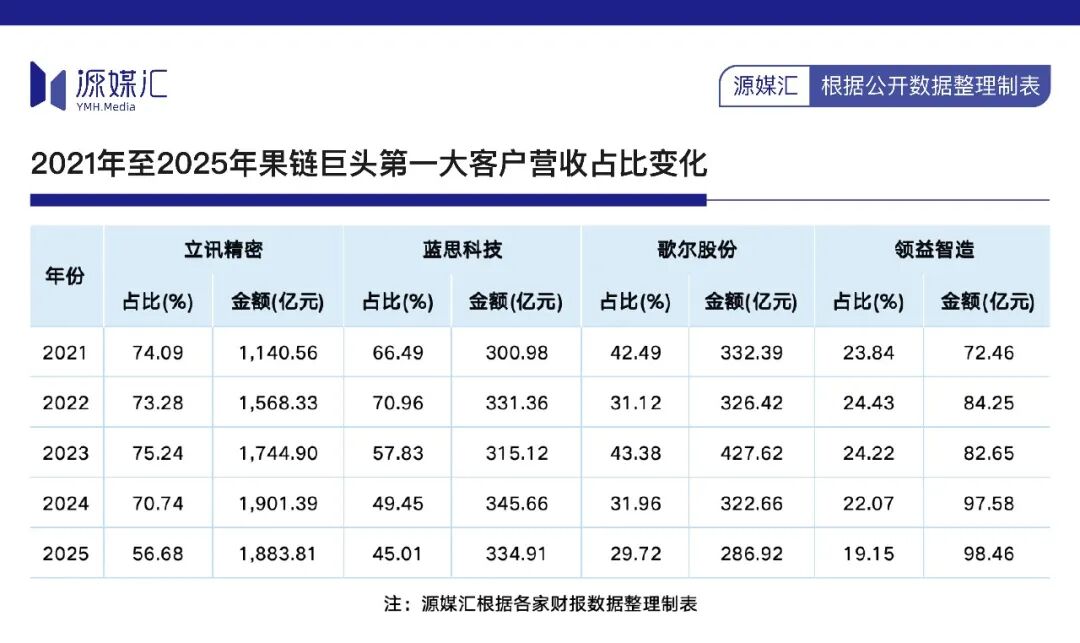
In 2021, O-film Tech was abruptly removed from Apple’s supply chain, leading to a sharp decline in its performance. The company quickly shifted its focus to domestic smartphone brands like Huawei, Xiaomi, OPPO, and Vivo, gradually stabilizing its business.
This served as a wake-up call for other supply chain giants. That same year, Luxshare Precision set a strategic goal to reduce revenue dependency on a single client to below one-third within a decade. Market observers believe this client refers to Apple.
To achieve this, supply chain giants have begun diversifying their business portfolios.
Their efforts have focused on two main areas: expanding their client base by partnering with leading domestic smartphone brands to reduce reliance on Apple, and venturing into new sectors such as automotive components, communication equipment, industrial manufacturing, and artificial intelligence.
Lens Technology has followed suit, exploring cutting-edge fields like smart cockpits, AI servers, commercial spaceflight, embodied AI, and AI optical glasses in recent years. However, these emerging businesses have yet to achieve economies of scale and currently contribute little to overall performance.
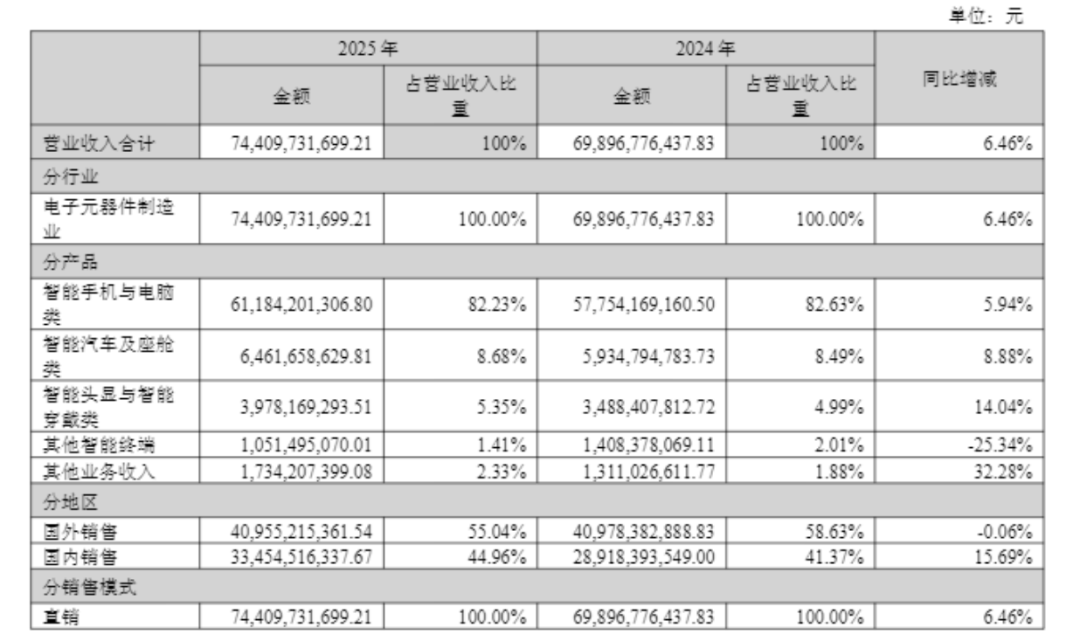
Image Source: Lens Technology’s 2025 Annual Report
Financial data shows that in 2025, smartphone and computer-related businesses accounted for 82.23% of Lens Technology’s revenue. Sales to its largest client represented 45.01% of total annual revenue.
This means the company’s performance remains heavily tied to Apple’s sales, with traditional 3C businesses dominating its portfolio.
The first-quarter 2026 loss highlighted the vulnerabilities of this business structure. During this period, revenue fell 17.13% year-on-year to 14.14 billion yuan, with a net loss attributable to shareholders of 150 million yuan.
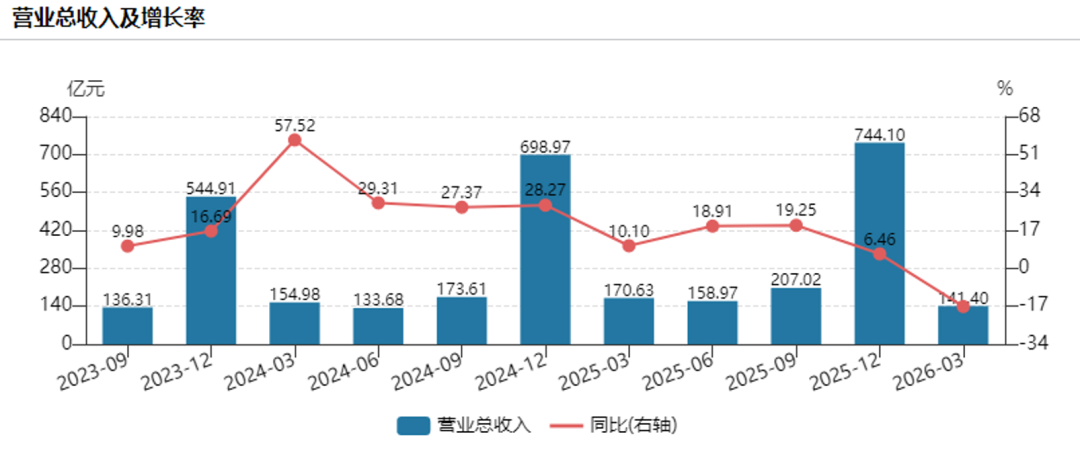
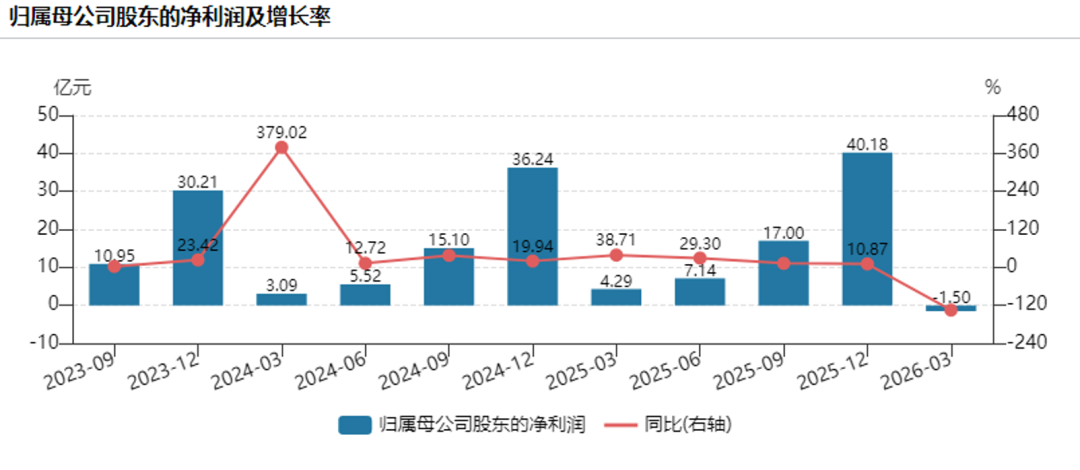
Image Source: Wind
The performance pressure stemmed from exchange rate fluctuations and rising storage chip prices, which weakened global demand for smartphones and PCs. Terminal manufacturers reduced orders and cut production, impacting upstream suppliers.
This marked a rare quarterly loss for Lens Technology in recent years.
In fact, the company had anticipated this trend.
In its 2025 annual report, Lens Technology cited research predicting that rising storage chip and component prices would lead to an overall decline in the smartphone and computer markets in 2026. However, high-end and foldable models were expected to remain strong, offering structural growth opportunities.
Based on this assessment, Lens Technology outlined its core business directions for 2026, focusing on scaling up production of high-end precision products such as foldable UTG glass, 3D curved glass, titanium metal frames, and liquid metal components.
The foldable UTG business is set to commence supply at the end of the second quarter. Once foldable screen production ramps up in the second half of the year, the company’s performance could see a significant recovery.
Major institutions have expressed optimism. Morgan Stanley raised Lens Technology’s stock price target from 18 yuan to 31 yuan, reflecting strong market confidence.
02. Leveraging Foldable Screens for a Turnaround
Apple’s foldable screens could be a game-changer for Lens Technology by breaking the profit ceiling of traditional smartphone components and unlocking higher product value.
For traditional iPhone models, Lens Technology’s per-unit value contribution is approximately $50, comprising front glass, rear glass, and metal frames. Its profit model relies heavily on high-volume shipments with limited per-unit margins.
The story is different with foldable screens.
Also supplied by Lens Technology, the per-unit value for foldable screens is expected to surge to $175. This includes $10 for regular front glass, $15 for rear glass, $50 for frames (doubled from traditional models), and an estimated $100 for the core UTG glass.
$175 versus $50—a 3.5x increase.
Multiple institutions agree: the unit value of foldable screen components is three times that of ordinary high-end smartphones, with per-unit value estimated to be 3-5 times higher than traditional smartphone glass covers. This could bring over $50 in incremental value per unit.
A glass cover priced at $175 represents not just a price hike but a transformation in product design.
Some may ask: Why is it so expensive?
The answer lies in precision craftsmanship.
UTG ultra-thin flexible glass covers undergo highly complex processes such as chemical thinning, strengthening, and cutting. Unlike ordinary smartphone screen glass, its thickness must be below 30 microns, and it must withstand tens of thousands of bends without issues.
Lens Technology independently developed a central thinning process, achieving a stable yield rate of over 90% and addressing concerns about foldable screen creases and durability. According to supply chain sources, its UTG mass production yield rate exceeds 95%, far surpassing the industry average.
Moreover, Lens Technology doesn’t just supply UTG—it provides a full suite of structural components, including glass support plates, PET films, and 3D glass covers, covering the main segments of transparent protection and support layers for foldable screens.
This means Lens Technology has extremely high “penetration” in each foldable smartphone, essentially supplying all glass components.
In terms of market share, Lens Technology has secured about 70% of Apple’s foldable UTG orders, establishing itself as the clear leader.
Regarding production volume, Apple has raised its 2026 production target for foldable iPhones to approximately 10 million units, higher than previous market expectations of 7-8 million units.
At $175 per unit, this theoretically amounts to $1.75 billion in total value, equivalent to over 12 billion yuan. Even considering yield rate improvements and initial shipment rhythms, this represents a substantial growth opportunity.
Analyst Ming-Chi Kuo expects foldable iPhone assembly shipments to reach approximately 7-8 million units in the second half of 2026. Other institutions predict that foldable iPhones could contribute 5% and 12% of Lens Technology’s revenue in 2026 and 2027, respectively.
The driving force behind this transformation is Zhou Qunfei, founder and chairwoman of Lens Technology.
The Hurun China Rich List shows that in 2025, Zhou Qunfei and her husband retained their position as Hunan’s wealthiest individuals with a fortune of 110 billion yuan.

Image Source: 2025 Hurun China Rich List
This “Glass Queen,” hailing from a rural area in Xiangtan, Hunan, dropped out of school at 15 and earned 7 yuan per day working on an assembly line. She later founded Lens Technology and, through relentless focus on glass, built the company into a market cap exceeding 300 billion yuan.
Now, she’s not only relying on Apple’s foldable screens to revive her company’s performance but also quietly betting on the next era with this wealth.
03. Another Growth Engine: AI Computing Infrastructure
Focusing solely on foldable screens tells only part of Lens Technology’s story.
Over the past six months, another under-the-radar development involving this Apple supply chain leader has garnered attention: AI computing infrastructure.
In December 2025, Lens Technology announced its intention to acquire 100% of Peimeigao International’s shares, entering the AI server cabinet and liquid cooling sectors.
Through this acquisition, Lens Technology swiftly gained mature technologies and client certifications for server racks, slides, trays, Busbars, and other cabinet-related businesses, as well as advanced liquid cooling system integration capabilities.
In the AI computing infrastructure field, Lens Technology started with server chassis structural components and gradually expanded to key modules like liquid cooling units and solid-state drives. Currently, chassis structural components have achieved mass shipments, with solid-state drive assembly expected to reach large-scale production in 2026.
In May 2026, Lens Technology announced its plan to acquire approximately 27.81% of Juteng International, a Hong Kong-listed company, to further expand its high-end production capacity.
The most notable move came a month ago. On June 12, Lens Optoelectronics, a wholly-owned subsidiary of Lens Technology, announced its strategic acquisition of a controlling stake in Tongsheng Optoelectronics, officially entering the hollow-core fiber sector.
What is hollow-core fiber? Simply put, it allows light to travel through air rather than glass. Traditional solid-core fibers can only achieve about two-thirds of the speed of light in a vacuum, while hollow-core fibers reduce latency by nearly half compared to traditional fibers.
As AI large model training evolves from ten-thousand-card clusters to hundred-thousand- and million-card clusters, the physical limits of traditional fibers are being rapidly approached. Microsoft plans to deploy 15,000 kilometers of hollow-core fibers in its Azure global network over the next two years, with Google and AWS following suit.
Tongsheng Optoelectronics is one of the few domestic companies mastering core hollow-core fiber technologies, holding patents for anti-resonant hollow-core fiber basic structures and 21 key processes. It has independently developed high-precision graphite furnaces and pressure control algorithms, enabling full in-house capabilities from design and drawing to measurement.
Notably, Tongsheng Optoelectronics has launched China’s first low-loss anti-resonant hollow-core fiber product with a cladding diameter of 125 microns, making it the only domestic company capable of mass-producing 125-micron standard hollow-core fibers.
These three acquisitions form a clear strategic thread: expanding from precision manufacturing for consumer electronics to comprehensive AI computing infrastructure.
Lens Technology has designated 2025-2026 as a critical window for strategic business structure optimization, establishing four strategic directions: AI smart terminals, embodied AI, AI servers, and commercial spaceflight. Hollow-core fibers and optical sensing devices will further enrich its capabilities in optical waveguides, optical transmission, and optical sensing products, creating a complete “precision structure manufacturing + high-end optoelectronic component” industrial chain.
If foldable Ultra-Thin Glass (UTG) stands as Lens Technology's most definitive catalyst for performance growth today, its AI computing infrastructure layout—where "Layout" is aptly translated as "strategic deployment"—emerges as the second growth trajectory anticipated over the next three to five years.
However, whether it hinges on the resurgence through Apple's foldable phones or places its bets on the future of hollow-core fibers, both scenarios epitomize an expansion of Lens Technology's core competency in "precision manufacturing" to its utmost limits.
For Zhou Qunfei, the true challenge does not lie in riding the wave of foldable screen dividends; rather, it rests in accomplishing her metamorphosis from the "Glass Queen" to an "AI infrastructure powerhouse."
The fortune of the wealthiest individual may ebb and flow with stock market fluctuations, but a company's enduring vitality hinges on its prowess in excavating sufficiently deep competitive moats in emerging sectors before the old ones wane.
Note: The content of this article is derived from official reports and publicly accessible information. The viewpoints expressed herein are for reference purposes only. Some images are either generated by AI or sourced from the internet. Should any infringement be identified, please notify us for prompt removal.
-
![]()
Hunan’s Wealthiest Entrepreneur Eyes Comeback with Apple’s Foldable iPhone
-
![]()
Planning to Secure 1.055 Billion Yuan to Propel AR Optics Forward! Lante Optics Receives Green Light for Private Placement on the Science and Technology Innovation Board
-
![]()
MiniMax: At the Heart of the AI Maelstrom
-
![]()
Securing 600 Million Yuan in Funding: This AR Optics Company Steps into the Limelight!
-
![]()
From a 706% Surge to a $340 Billion Market Cap Plummet: Has MiniMax's Moment Passed?
-
![]()
High Demand, Low Stock Price: Can the Emotional Companion Robot Ease UBTECH’s Worries?
-
![]()
Why Does Yin Qi, Who 'Doesn't Listen to Advice,' Insist on Making AI Agent Smartphones? | Interview with Jieyue Xingchen
-
![]()
AI-Generated Code Reveals Surprise That Thrills China