Tencent AI Finally Catches Up
 07/20 2026
 473
473
▲All images in this article are sourced from the internet. Please contact us for removal if there is any infringement.
Tencent AI is Accelerating

This article was first published on Shadow Memo by Mo Yingsheng.
In 2026, Tencent is experiencing extreme divergence.
On one side, its fundamentals are at an all-time high: net profit for the first quarter of 2026 increased by 11% year-on-year to 67.9 billion yuan, and the gross profit margin reached a record high of 57%.
On the other side, its stock price has fallen by more than 30% year-to-date, with a market cap evaporation exceeding 1.5 trillion Hong Kong dollars. By the end of June, the stock price stood at 429 Hong Kong dollars, down nearly one-third from the high of 633.7 Hong Kong dollars at the beginning of the year.
The root cause of this divergence is singular—AI.
Over the past two years, Tencent's "sluggishness" in the AI race has been almost a public label. While Baidu's ERNIE Bot, Alibaba's Tongyi Qianwen, and ByteDance's Doubao were already staking their claims, Tencent's Hunyuan and Yuanbao models were always a step behind.
However, entering 2026, especially with a series of moves in the first half of the year, Tencent AI is catching up at an astonishing pace and even beginning to surpass peers in certain dimensions.
This is not merely a case of "throwing money to catch up" but a systemic reconstruction spanning organizational structure, technical approach, talent acquisition, and product launch.
What is the most fundamental reason behind all this?

Why Did Tencent AI Fall Behind?
After ChatGPT ignited the global AI competition in early 2023, Baidu was the first to release ERNIE Bot, followed closely by Alibaba's Tongyi Qianwen. ByteDance's Doubao rose rapidly through aggressive marketing.
Tencent, however, did not release its Hunyuan large model until September 2023, and the Yuanbao app did not launch until May 2024.
In terms of computing power investment, compared to Alibaba's 380 billion yuan and ByteDance's over 200 billion yuan in AI capital expenditures, Tencent's total capital expenditure for 2025 was only 79.2 billion yuan, up just 3% year-on-year.
With a late start in foundational models, lagging consumer-facing products, and tepid computing power investment, capital market skepticism toward Tencent AI was not unfounded.
But behind the "slowness" lay reasons far more complex than surface appearances.
A fundamental deviation in technical approach. The story of Tencent's Hunyuan begins in September 2023. At the Global Digital Ecosystem Summit, Tencent officially unveiled the Hunyuan large model, making a grand entrance. However, it soon fell into a "self-justification logic."
At Tencent's 2026 annual conference, President Martin Lau publicly dissected why the Hunyuan large model underperformed. He used a vivid metaphor: a high school student cramming for exams. The report card looks good, but the true test exposes flaws.
Specifically, with limited foundational model capabilities, the team took a shortcut, using Supervised Fine-Tuning (SFT) to climb the leaderboards.
The results were immediate, and the report card looked impressive, but problems emerged in real-world business scenarios: poor generalization and inability to translate model capabilities into product performance.
Digging deeper, cracks appeared at every level: insufficient data, unstable pre-training, unscalable AI infrastructure, lack of factors and objectives in reinforcement learning, and a foundational model unable to support upper-layer applications.
Decentralized organizational structure and internal friction. Tencent has long focused on product engineering, with AI teams playing a supporting role—first build the product, then adapt AI to it.
In Lau's words, Tencent's AI development was like "a product without a product manager, with the R&D team lacking direction, rendering much of the work futile."
More troublingly, business lines within Tencent—WeChat, gaming, advertising, enterprise services, etc.—all needed AI capabilities, but the old Hunyuan could not deliver. It was not that businesses did not want to use it; the results fell short of expectations.
Some core businesses even shunned Hunyuan, preferring to find their own solutions. "A large company's self-developed large model could not even secure a seat at its own table"—this was the most direct portrayal of Hunyuan's past dilemma.
Tencent had long operated with multiple parallel technical systems: besides Hunyuan's self-developed general large model, the WeChat team independently developed a lightweight scenario-based large model, WeLM.
AI Lab and the Hunyuan team worked in silos, with computing resources uncoordinated. Within Hunyuan, before Yao Shunyu's arrival, there had been two heads, Zhang Zhengyou and Jiang Jie, whose backgrounds were primarily in computer vision and big data, not natural language processing.
The combination of technical approach fluctuations and decentralized organizational structure formed the underlying logic of Tencent AI's "slowness."
At Tencent's 2026 shareholders' meeting in May, Pony Ma offered a vivid metaphor: "A year ago, we thought we had boarded the ship, only to find it was leaking. Now we feel we're on board but can't sit comfortably yet. We still hope the ship can speed up."
Acknowledging "slowness" was precisely the beginning of change.
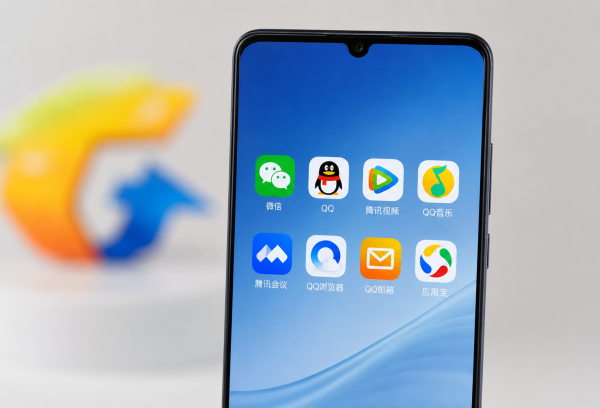

From "Score-Driven" to "Scenario-Driven"
The real turning point came in the second half of 2025.
In December 2025, Tencent upgraded its large model R&D architecture, establishing new AI Infra, AI Data, and Data Computing Platform departments to comprehensively strengthen the R&D system and core capabilities of large models.
Meanwhile, Yao Shunyu, a former OpenAI researcher, joined Tencent as Chief AI Scientist in the "CEO/President's Office," reporting directly to President Martin Lau while also heading the AI Infra and Large Language Model departments.
The arrival of this 27-year-old was seen as a turning point for Tencent AI. But Yao did not bring "magic" but rather a fundamentally different R&D methodology.
"Four Reconstructions" and Paradigm Shift. After taking over, Yao discovered that Hunyuan's core challenge was not insufficient computing power or talent but an R&D system misled by an "exam-oriented logic."
In late January 2026, Hunyuan initiated a bottom-up infrastructure reconstruction, including pre-training, reinforcement learning, data systems, and evaluation systems. Dubbed internally as the "Four Reconstructions," this effort essentially represented a paradigm shift: from "score-driven" to "scenario-driven."
The Hunyuan team significantly reduced reliance on public benchmarks, instead establishing an evaluation loop based on real business tasks, high-quality human feedback, and actual product experience.
Model iteration directions were no longer defined by third-party benchmarks but by real demands arising from business scenarios such as WeChat, Tencent Cloud, and office software.
Centralized Organizational Structure. On March 20, 2026, Tencent announced internally the dissolution of AI Lab, with some personnel transferred to the Large Language Model department under Yao Shunyu's leadership.
Others were reassigned to the Industry-Academia-Research Collaboration Center under TEG. Founded in 2016, AI Lab was Tencent's enterprise-level AI lab, focusing on vision, language, natural processing, and machine learning. Its dissolution signaled Tencent's full concentration of AI foundational R&D on large models.
Tencent also stepped up talent acquisition. Since December 2024, Sun Qingfeng, a core member of Microsoft's open-source model WizardLM team; Hu Han, former lead researcher of Microsoft Research Asia's Visual Computing Group; and Xu Can, creator of Microsoft's WizardLM project, joined Tencent in succession.
In August 2025, Tan Xu, a researcher from Yuezhi AIMian studying voice models, joined Tencent. Tencent's recruitment target was clear—"only candidates from DeepSeek, Yuezhi AIMian, ByteDance, and Alibaba's foundational model teams." ByteDance employees at the 2-2 level could receive T12 or T13 positions at Tencent, with salaries doubling or even tripling.
From centralized organizational structure to high-intensity talent acquisition, Tencent completed its AI R&D system reconstruction in just a few months.
From the reconstruction launch in late January to the release of Hy3 preview on April 23 and the official Hy3 version on July 6, a complete R&D chain from bottom-up reconstruction to product feedback was established in under half a year.
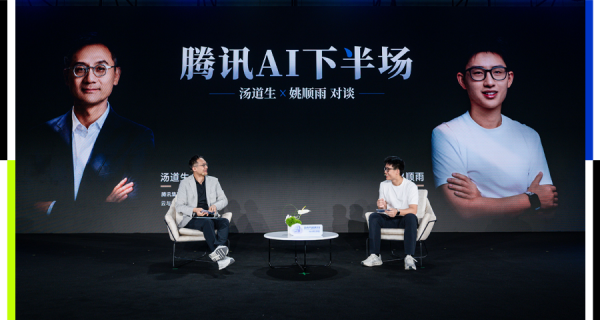
At Tencent Cloud AI Industry Conference on June 5, Yao made his first public appearance, stating that his core change was "defining more authentic problems and improving data quality."
He judged, "The second half of AI has just begun. I don't believe ChatGPT and Claude Code will be the only Super Apps; that would be a very bleak world. I believe new opportunities will continuously emerge."

A "Pragmatic" Answer Sheet
On July 6, Tencent officially released the Hunyuan Hy3 model. This was Yao's first official flagship model answer sheet.
Technical "Restraint." Hy3 adopts a Mixture of Experts (MoE) architecture with 295 billion total parameters but only 21 billion activated, supporting 256K context length.
Behind this "restraint" lay clear strategic choices.
In blind testing by 270 experts based on real work tasks, Hy3 scored 2.67/4, higher than GLM-5.1's 2.51/4.
With less than a quarter of the activated parameters, it achieved a higher overall score. In agent capabilities, Hy3 improved across the board compared to the preview version: Terminal-Bench2.1 rose from 58.0 to 71.7, and DeepSWE leaped from 0.9 to 28.0.
More notably, practical metrics improved: hallucination rate dropped from 12.5% to 5.4%, and common-sense error rate from 25.4% to 12.7%.
Yao stated on social media that Hy3 represented not just a leap in reasoning and agent capabilities but also Synchronization (simultaneous) improvements in anti-hallucination, reliability, and product experience.
Pricing strategy was equally aggressive. Hy3 API was priced at 1 yuan/million tokens for input and 4 yuan/million tokens for output, with cached input priced at just 0.25 yuan/million tokens.
This was significantly lower than GLM-5.2's 8/28 yuan and Qwen3.7-Max's 12/36 yuan. Meanwhile, Hy3 adopted the Apache 2.0 open-source license, allowing global developers to download and commercialize it for free.
The model was successively launched on overseas platforms like OpenRouter, Hermes, Kilo, and Cline, achieving "day 0" access to open-source communities like Huggingface and Modelscope.
The market provided the most direct feedback. Within a week of launch, Hy3's total call volume surged 68 times over the previous Hy2 generation. By July 13, Hy3 ranked first in OpenRouter's weekly model call volume rankings.
The preview version maintained its top daily call volume even after charging. Upon Hy3's launch, WorkBuddy experienced peak computing resource consumption and queuing, with queuing rates exceeding 50% at times. This was both good news (high demand) and a warning (still tight computing resources).
But Hy3 was not without shortcomings. In tasks requiring advanced mathematics or complex coding—which test foundational reasoning and engineering capabilities—Hy3 still lagged noticeably behind top models like GPT-5.5 and Claude Opus 4.8.
It was more of a "pragmatic" answer sheet, prioritizing model stability, reliability, and practicality in real business scenarios while controlling reasoning costs and ensuring response efficiency. In Yao's words, "practical value outweighs benchmark-chasing value."
If model capability is the ticket to rejoining the game, product launch is the true deciding factor.
In the first half of 2026, Tencent AI products rolled out in rapid succession:
On March 9, WorkBuddy officially launched. This all-scenario workplace AI agent platform had become the domestic DAU leader in office efficiency agents.
From "a single sentence" to "delivery," it went beyond dialogue, autonomously breaking down tasks, planning workflows, invoking tools, completing work, and delivering results. On July 18, WorkBuddy released its standalone app, with iOS, Android, and HarmonyOS versions launching simultaneously. Users could remotely initiate and execute tasks on their computers via mobile phones.
On June 5, at the Tencent Cloud AI Industry Application Conference, WorkBuddy Enterprise Edition and the office agent suite Agent Suite were officially released. Tencent adopted a "from super individuals to super teams" product design philosophy to help enterprises transition to AI Native organizations.
In late June, WeChat, with over 1.4 billion monthly active users, quietly began gray-testing its native AI assistant "Xiaowei." Some users saw two green dots appear in the top-left corner of WeChat, which could be activated with authorization.
Xiaowei had multiple entry points, including the homepage top-left corner, chat toolbar, and side menus of official accounts and video channels. Its capabilities spanned instruction execution, ecosystem invocation, content understanding, and custom tool generation. Leading platforms like Meituan, JD.com, Ctrip, and Dewu were among the first to integrate with WeChat's AI ecosystem.
On July 18, at the 2026 World Artificial Intelligence Conference, Tencent officially upgraded and released its Embodied Intelligence full-stack solution, spanning cloud infrastructure, model layers, platform layers, and application layers.
Tencent systematically showcased its embodied model matrix, including Hy-Embodied-VLA-0.5, Hy-Embodied-VLM-1.0, and Hy-Embodied-RxBrain-1.0. Meanwhile, the overseas version of Tencent Cloud's enterprise-grade agent development platform ADP 4.0 went live, along with the "Top 10 Industries, 100 Major Scenarios Ecosystem Plan."
AI is transitioning from being able to 'talk' to being able to 'act'. Tencent's strategy is clear: instead of pursuing top rankings for a single model, it focuses on building a sustainable competitive edge by combining its competitive model capabilities with unique scenarios across WeChat, gaming, advertising, office productivity, cloud services, and more.
The effectiveness of this strategy is already evident. In internal evaluations of the WorkBuddy office scenario, task success rates increased from 72% to 90% after integrating Hy3, while average time consumption decreased by 34%.
After Yuanbao launched file delivery with Hy3, its rate of common-sense errors dropped by half, and its hallucination rate decreased by more than half. Ima's knowledge base Q&A reasoning quality improved by nearly 19%, with its Agent system stability reaching 95.1%. Marvis's core scenario task completion rate rose to 93.7%, and the accuracy of multi-Agent collaboration dispatch reached 92%.

AI is starting to 'crunch the numbers.'
Any AI strategy must ultimately answer one question: Can it generate revenue?
Data from the first quarter of 2026 provides a preliminary answer. Tencent's advertising revenue grew 20% year-on-year to RMB 38.2 billion, driven by continuous upgrades to its AI-powered ad recommendation models, which were fully deployed for ad conversion rate estimation tasks and implemented across scenarios such as WeChat Channels, official accounts, and Mini Programs.
Dowson Tong, Tencent's Senior Executive Vice President, revealed that in gaming and advertising, AI has helped boost user engagement, improve conversion rates, and contributed to over 20% revenue growth in these businesses.
Tencent's smart ad delivery product matrix, 'Tencent Marketing AIM+,' powers approximately 70% of advertisers' marketing service spending. After expanding the parameter scale and optimizing algorithms for WeChat Channels' content recommendation model, total user time spent increased by over 20% year-on-year.
On the investment side, Tencent's moves in the first quarter of 2026 were notably 'aggressive': AI-related capital expenditures, R&D investments, and marketing expenses totaled over RMB 65 billion. Capital expenditures for the quarter reached RMB 31.9 billion, almost entirely allocated to AI computing power and model iteration. Marketing and promotional spending surged 44% year-on-year to RMB 11.3 billion, primarily for promoting AI-native applications.
Tencent has set its investment in core AI products like Hunyuan and Yuanbao to grow 'more than double,' prompting Daiwa Securities to sharply raise its 2026 AI capital expenditure forecast for Tencent from RMB 108 billion to approximately RMB 181 billion.
While investments are increasing, the direction has become clearer.
Tencent is shifting from 'filling capability gaps' to 'forming a model-product closed loop (closed loop).' Research by Shenwan Hongyuan judges that as model capabilities improve and product closed loops gradually take shape, market perception of Tencent is expected to shift from 'AI cost investment' to 'AI product and ecosystem monetization.'
If the above represents what Tencent's AI has 'done right,' the core answer boils down to two words: ecosystem.
This is also the fundamental differentiator between Tencent and all its competitors.
When explaining why he chose to join Tencent, Yao Shunyu said, 'There are many good problems here, and many products.' He elaborated: 'On one hand, good products can solve the issue of where to apply value after pre-training and post-training. On the other hand, the environment is crucial—without a good environment, Agents can't do various things. Most importantly, context matters, whether for enterprises or individuals. Models are increasingly adept at transforming complex inputs into outputs, and often, your competitive edge lies in whether you have the most Original (original) inputs. Tencent has a very strong advantage here.'
This ecological advantage is transforming into AI's competitive edge, manifesting across multiple dimensions:
Data flywheel. Hy3 has been honed through global developer usage and Tencent's vast real-world business operations, with daily Token consumption surging 20-fold since its preview launch.
Real user tasks are beginning to feed back into model training and evaluation. Demands from real, complex scenarios on WorkBuddy provide high-value directions for iterating Hunyuan's model capabilities. Every model invocation becomes a learning opportunity; every real-world failure case becomes a starting point for the next iteration.
Scenario penetration. Hy3 has been integrated into core products such as Yuanbao, WorkBuddy, CodeBuddy, Marvis, ima, QQ Browser, WeChat Reading, and Tencent Games.
In WeChat official account customer service scenarios, the AI customer service assistant powered by Hy3 better understands user intent. In gaming, the AI game assistant for 'Path of Exile: Ascendancy' saw significantly improved output accuracy after integrating Hy3.
WeChat's native AI assistant, 'Xiaowei,' goes a step further by deeply embedding AI development capabilities into the Mini Program ecosystem, offering the ability to generate custom tools with a single sentence.
Developer ecosystem. WeChat has opened its AI ecosystem to developers, who can freely use Tencent's flagship Hunyuan model via the WeChat Cloud Development Platform and directly integrate large model capabilities into Mini Programs.
Tencent Cloud's ADP platform has been deployed across over 30 industries, covering business scenarios such as intelligent customer service, knowledge management, and media production. Hy3 adopts the Apache 2.0 open-source license, allowing global developers to use it commercially for free.
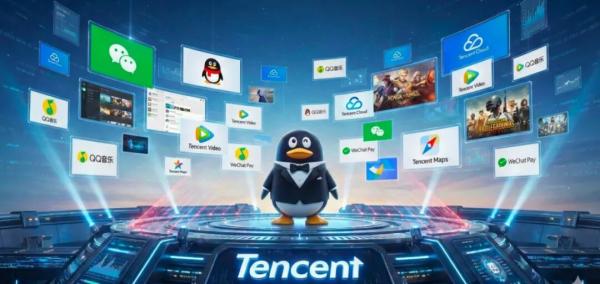
Full-link coverage. Tencent has built a collaborative chain unlike any other major company: WeChat → Tencent Yuanbao → Tencent Docs → Tencent Meeting → Enterprise WeChat → WorkBuddy. This chain covers the full spectrum of social, search, creation, collaboration, and office scenarios, with potential for account, data, and experience integration across links.
From a strategic completeness perspective, Tencent is one of the few Chinese major companies possessing full-stack capabilities in consumer AI (C-end), industrial AI (B-end), internal efficiency AI, and foundational model layers.
Tong said bluntly, 'Tencent has ecosystem-scale advantages, enabling scalable AI deployment, testing innovations, learning from user feedback, and then bringing validated innovations to clients and enterprises.'
Tencent Cloud has even explicitly stated that 'Tokens are a low-quality business,' choosing to bypass price wars and bet on a differentiated path of 'AI + SaaS' by embedding AI capabilities into every specific business scenario. This strategic resolve is precisely built on Tencent's massive SaaS product matrix.
Of course, Tencent's AI is not without shortcomings—some are quite pronounced.
The gap in C-end products is real. Yuanbao's performance in the consumer market still lags far behind Doubao. As of March 2026, Yuanbao had 57.35 million monthly active users (MAUs), ranking fourth in the industry; Doubao had 345 million MAUs, six times that of Yuanbao.
By June, Doubao's MAUs reached 382 million, Qianwen 141 million, and DeepSeek 127 million. Yuanbao had yet to join the club of products with over 100 million MAUs.
A larger disparity is evident in user retention. During the Spring Festival, Tencent distributed RMB 1 billion in red envelopes, briefly boosting Yuanbao's daily active users (DAUs) to 45.04 million on New Year's Eve. However, by February 23, DAUs had fallen back to baseline levels before the campaign began.
Tong revealed in an interview that about 80% of Yuanbao's users now use Hunyuan 3.0, with noticeable improvements in retention. However, he remained cautious about commercialization: 'Our competitors are further ahead in C-end monetization.'
The computing power bottleneck remains severe. Tong rarely disclosed that Tencent's GPU computing power has long been 'insufficient,' with limited resources prioritized for internal needs, including 'Hunyuan's training, WeChat's demands, meeting requirements, and Yuanbao, which also consumes significant computing resources.'
Full-year 2025 capital expenditures of RMB 79.2 billion fell short of the original target, with management attributing this mainly to GPU supply constraints: 'We wanted to buy cards, but for a long time, we couldn't secure them.' Shortly after Hy3's integration into WorkBuddy, computing power shortages led to queuing, exposing Tencent's still-inadequate inference-side computing reserves.
The gap with overseas first-tier players remains objective. Hy3 still lags noticeably behind GPT-5.5, Claude Opus 4.8, and others in tasks like advanced mathematics and complex coding.
China's large model market is rapidly entering a phase of price wars and scenario-driven implementation, with players like DeepSeek, Alibaba, Zhipu, and Xiaomi launching lower-cost, stronger reasoning models. A 'good enough' model will struggle to establish a moat.
The inflection point where AI investment shifts from cost to productivity has not yet fully arrived. Martin Lau stated on the earnings call that model training is largely an investment in the future and may not yield immediate returns.
Tong also admitted that the operational and inference costs of AI-native services remain very high, making it difficult to cover costs solely through the advertising models of the mobile internet era.

Conclusion
Yet the direction and trend are clear.
From being 'late' in 2023 to organizational adjustments and talent acquisition by the end of 2025, followed by intensive progress in the first half of 2026—from foundational model reconstruction to full-stack product implementation—Tencent has transformed from a 'leaky ship' to 'sailing at full speed' in under a year.
This transformation was possible precisely because Tencent possesses assets no competitor can replicate: a super-ecosystem covering 1.4 billion users, encompassing social, content, payment, office productivity, and gaming.
AI is not an 'extra credit' assignment for Tencent but is organically growing into every crevice of this ecosystem.
Reviewing Tencent's history, this is not its first 'come-from-behind' victory. In 2010, when Lei Jun's Miaochat had already launched and surpassed 1 million users, Tencent only officially released WeChat 1.0 in January 2011.
For the first five months, there was virtually no commercial promotion, relying solely on organic growth. However, Allen Zhang accurately captured the core needs of mobile socializing—'connecting with strangers' and 'lightweight communication'—adding features like 'People Nearby,' 'Shake,' and 'Drift Bottle' in the second half of 2011, each sparking nationwide participation.
By the end of 2012, WeChat had over 300 million users, securing Tencent's ticket to the mobile internet era.
Today, Tencent AI is reenacting the same script:
Not the first to start, but leveraging deep scenario understanding, ultimate (extreme) product refinement, and unparalleled ecological advantages to leap from follower to leader.
Yao said, 'The second half of the AI race has just begun.'
For Tencent, this is a competition it can no longer afford to lose.
-
DRAM, A Disruptive Technological Breakthrough!
-
Robot Army Mobilizes for Action
-
![]()
Electric Vehicle Penetration Soars Past 60%, Yet Seven of Top Ten Brands Hail from Traditional Fuel Vehicle Sector, Casting Doubt on Their Longevity
-
![]()
Conant Optics Clinches R&D and Procurement Framework Deals with Top Tech Firms!
-
![]()
Over 87% Surge in Net Profit for H1 Anticipated! Dongtian Micro Leads in AI Optical Communication
-
![]()
Tech Titans Offload AI Ventures, Tencent Shifts Stakes to Capitalize on Artificial Intelligence Surge
-
![]()
WAIC 2026 Observations: Mapless, Brain-Powered, and Task-Ready—Is Physical AI Taking Off?
-
![]()
Self-driving Technology Hits the Road: NVIDIA's Structural Adjustment, the Emergence of a First Mover... The Second Half of the Autonomous Driving Race Begins