Can Apple's AI Conquer the Chinese Market?
 07/20 2026
 391
391
▲ All images in this article are sourced from the internet. Please contact us for removal if any copyright infringement is detected.
Apple's Siri AI: Revitalized Through Local Collaborations

This article was initially published in Shadow Memo by Mo Yingsheng.
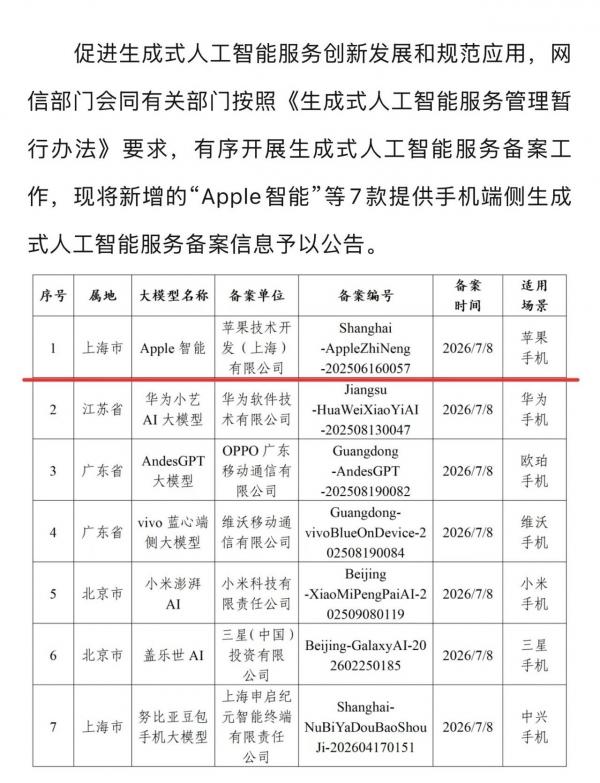
On July 15, 2026, the official WeChat account of the "Cyberspace Administration of China" announced that seven on-device generative AI services for mobile phones had successfully completed their filing procedures.
Notably, "Apple Intelligence" was included in the list, alongside Huawei's Xiaoyi AI, OPPO's AndesGPT, vivo's Blue Heart on-device large model, Xiaomi's HyperOS AI, Samsung's Galaxy AI, and Nubia's Doubao mobile large model.
For the hundreds of millions of iPhone users in China, this milestone marked the culmination of two years of anticipation.
Since Apple first unveiled Apple Intelligence at the WWDC in June 2024, domestic iPhone users had been unable to access this AI capability, which Apple had high hopes for.
At the WWDC in June 2026, Apple introduced a revamped Siri AI capable of understanding on-screen content, retaining conversation context, and performing cross-app tasks. However, Craig Federighi, Apple's senior vice president of software engineering, stated on stage that mainland Chinese users would not have access in the near future.
Just a month later, the filing was approved. But with this "ticket" in hand, can Apple truly make its mark in China's competitive AI smartphone market?

From "Most Intelligent" to "AI Handicap"
Let's rewind to 2011, when the iPhone 4S was launched, and Siri made its debut as a "smart voice assistant."
At the time, it was a groundbreaking innovation for tech enthusiasts worldwide, capable of engaging in natural language conversations, checking the weather, setting alarms, and sending texts. In an era when smartphones were limited to basic touch interactions, Siri seemed like a product straight out of the future.
However, over a decade later, Siri's reputation among Chinese users has shifted dramatically, from being hailed as the "most intelligent" to being perceived as the opposite.
For many users within Apple's ecosystem, Siri is now synonymous with "AI handicap." This is not a harsh critique but rather honest feedback based on long-term experience.
According to industry analysts, the primary reasons for this shift are as follows:
Linguistic and cultural mismatches. Siri's underlying semantic understanding is primarily built around English, causing it to struggle with the nuances, colloquial expressions, and internet slang prevalent in Chinese contexts.
While domestic voice assistants can understand requests like "help me edit this photo," Siri might still be puzzled by what "p" stands for.
Lack of localized services. Siri can interact with Apple's native apps, but its integration with third-party apps like WeChat, Alipay, Meituan, and Gaode—which are essential to Chinese users' daily lives—remains severely limited.
A voice assistant that cannot order food, hail rides, process payments, or book tickets is merely a "half-baked" product in China's highly developed mobile internet ecosystem.
Slow functional updates. While domestic smartphone makers have already made AI features like object removal, document summarization, and real-time translation standard offerings, Apple's Apple Intelligence only secured domestic approval in July 2026. A two-year gap is sufficient to reshape user habits entirely.
Some media outlets argue that Siri now resembles a simple voice remote control, far from a true "smart assistant."
When users are accustomed to generating meeting minutes, removing photo bystanders with a single tap, and translating foreign web pages in real-time on domestic phones, Siri's "set an alarm" function feels particularly underwhelming.
The news of the filing approval sparked excitement among domestic iPhone users. However, upon closer inspection, this "ticket" may not deliver the Siri AI that everyone expects.
The Siri AI showcased by Apple at the WWDC in June 2026 was powered by a new model co-developed with Google, derived from Gemini.
It could understand on-screen content, recall recent conversations, and perform multi-step tasks like writing emails, browsing old photos, and organizing itineraries. This represents Apple's vision for a "next-generation" smart assistant.
However, the "Apple Intelligence" that passed the filing is likely the 2024 version, featuring text rewriting, content summarization, image generation, and basic cross-app operations. The true "next-gen" Siri AI may still be in the pipeline.
Media reports indicate that the filing addresses compliance qualifications but does not mean the product is ready for market.
Some sources claim that parts of Apple Intelligence's image recognition still rely on Google's reverse image search, which is unavailable in mainland China. This technical dependency requires further localization, leaving Apple with significant engineering work ahead.
In other words, Apple AI's entry into China may come with an "old ticket"—it can enter the market, but not necessarily with the latest offerings.

Surrendering the "Soul" to Alibaba and Baidu
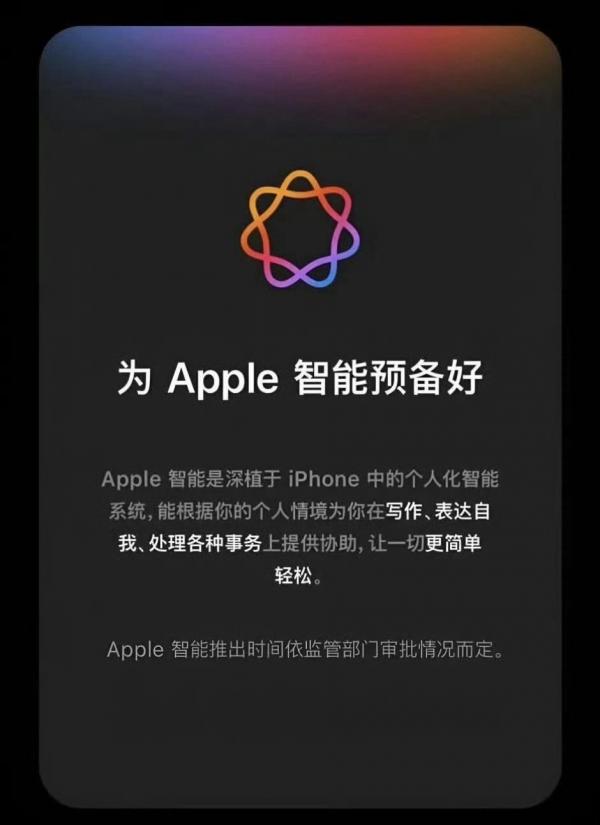
The overseas version of Apple Intelligence integrates ChatGPT and Gemini, but neither service is available in China. Apple had to seek local partners.
As early as 2023, Apple began testing AI models from Chinese developers. By March 2024, reports emerged that Apple was in negotiations with Baidu.
Subsequently, Tencent, Alibaba, ByteDance, Baichuan AI, DeepSeek, and other firms were rumored to be in talks.
Apple initially chose Baidu as its primary partner, but the collaboration fell through due to Baidu's ERNIE model's response limitations and Baidu's desire to retain and analyze user data—a conflict with Apple's strict privacy stance.
Ultimately, Apple settled on a dual partnership with Alibaba and Baidu.
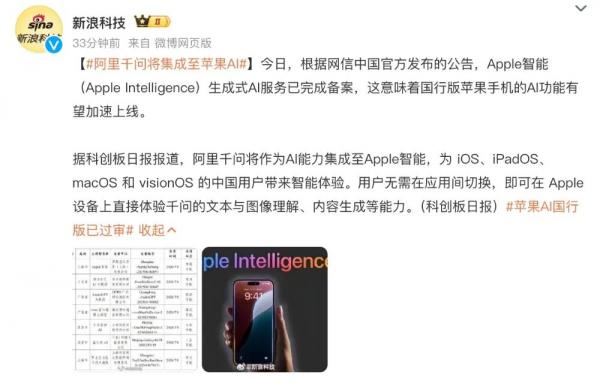
According to public information, the division of labor is roughly as follows: Alibaba's QianWen handles general multimodal capabilities, including text understanding, image interpretation, and content generation. Baidu supports Siri's voice assistant and visual intelligence, covering AI search and information retrieval.
Foreign media report that QianWen takes the lead, handling about 65% of tasks, while Baidu's ERNIE assists with the remaining 35%.
Apple's AI localization in China adopts a "dual-track" collaboration model. This "international giant + local large model" approach satisfies domestic regulatory requirements for data security while leveraging local models' strengths in Chinese language and scenarios.
However, a problem arises: Apple has effectively outsourced the "soul" of its AI.
In overseas markets, Apple's partnerships with OpenAI and Google are essentially "plug-in" integrations—ChatGPT and Gemini serve as external capabilities, with Apple's self-developed on-device models and private cloud remaining central.
In China, Alibaba's QianWen and Baidu's ERNIE provide the foundational model capabilities, significantly diminishing Apple's self-developed models' presence. Apple has ceded the underlying model layer to local partners to secure market entry.
Is this a shrewd business compromise or a dangerous strategic concession?
From Apple's perspective, it may be the best solution under the circumstances. With self-developed large models lagging behind schedule—as evidenced by the delay of Apple Intelligence announced at WWDC 2024—Apple shifted its AI strategy to actively engage external large model providers.
In China, where AI regulatory barriers are high, Apple had little choice but to partner with local suppliers.
Rapid integration with top-tier local models addresses Apple's technical shortcomings, stabilizes its user base, and gives it a fighting chance in the AI terminal entry point competition.
But Apple has not surrendered entirely. Tim Cook retains control over Siri, which remains the sole system-level gateway to Apple's ecosystem. App invocation permissions, user data loops, and service distribution rules remain firmly in Apple's hands. Alibaba and Baidu's models are merely one link in Apple's vast supply chain.
For Alibaba and Baidu, this is no ordinary technology supply deal. Integrating with Apple's premium hardware ecosystem elevates their AI capabilities from ordinary app services to system-level core infrastructure—a strategic breakthrough difficult to achieve through consumer-facing promotions alone.
A mutually beneficial transaction is reshaping China's AI smartphone power dynamics.

Apple Faces Multiple Challenges
Apple AI's entry into China is not into a blank market but a mature one already shaped by domestic players.
The seven co-approved products include Huawei's Xiaoyi AI, OPPO's AndesGPT, vivo's Blue Heart, Xiaomi's HyperOS AI, Samsung's Galaxy AI, and Nubia's Doubao mobile large model—covering nearly all major smartphone players today.
Since 2024, domestic smartphone makers have made AI features like object removal, document summarization, and real-time translation standard offerings.
Counterpoint predicts that by 2026, 45% of global smartphone shipments will feature generative AI capabilities. As AI transitions from a flagship differentiator to an industry baseline, competition will shift from "having AI" to "how deep AI penetrates."
Apple's competition extends beyond smartphone makers.
QuestMobile data shows that as of June 2026, terminal manufacturers' AI apps had 755 million monthly active users, surpassing AI-native apps' 499 million.
However, terminal AI apps averaged 51.4 monthly uses and 9.8 minutes per session, far below AI-native apps' 92.7 uses and 183 minutes—nearly double the frequency and 18.7 times the duration.
This indicates that users rely more on native AI apps like Doubao and DeepSeek for complex tasks rather than built-in phone AI.
Apple must compete not only with Huawei and Xiaomi but also with superapps like Doubao, WeChat, and Alipay for the same prize: the next-generation service gateway.
Apple's hardware-software integration remains a strength. By enhancing conversational abilities, screen perception, personal context understanding, and cross-app task execution across iPhone, iPad, and Mac, Apple aims to address its two-year absence in the generative AI wave.
However, domestic players' on-device AI iteration speeds have exceeded expectations. Features like meeting minutes generation, AI assistants, and system-level intelligent scheduling have transformed AI from a smartphone bonus into a user necessity.
If Apple continues to lag, it risks losing high-end users and seeing its iOS marginalized by AI-OS systems.
Returning to the original question: Can Apple AI succeed in China?
There is no simple "yes" or "no." The answer hinges on three levels:
First, technical. Can Apple quickly upgrade from an "old ticket" to a "new one"? If the approved Apple Intelligence remains the two-year-old "entry-level" version while the true Siri AI delays, user disappointment will spread rapidly.
More critically, will the integration of Alibaba's QianWen and Baidu's ERNIE capabilities be smooth? Can core functions like cross-app invocation and screen perception be realized in China? These are real technical hurdles.
Second, ecological. Apple's hardware-software integration is its core moat, but in the AI era, this moat is eroding. Domestic players have embedded large models into their operating systems, deeply connecting with payment, travel, e-commerce, and office apps.
Can Apple build a similarly deep third-party app ecosystem in China? If not, even a powerful Siri AI will remain an "Apple native app assistant" rather than a "daily assistant for Chinese users."
Third, user-centric. This is the most crucial variable. Chinese users are already accustomed to domestic smartphones' AI experiences—generating meeting minutes with one sentence, removing photo bystanders with one tap, translating foreign web pages in real-time.
When Apple AI finally arrives, users will vote with their feet: Will they stick with familiar domestic AI or adapt to a "Apple-style AI" that arrived two years late? Once domestic users acclimate to AI-native interactions on local phones, the cost of switching back to Apple AI could become a brand liability.
Some analysts argue that by ceding its AI "soul," Apple is essentially mitigating losses. It compromises on the model layer to secure compliance windows and user experience continuity. But mitigating losses ≠ winning.
In the AI smartphone war, Apple is already two steps behind—announced in 2024, securing Chinese entry in 2026—while domestic players have completed multiple AI iteration cycles.
"Being late" itself is not fatal; what is truly fatal is remaining mediocre after being late.

Epilogue
Apple's AI entry into China serves as a mirror.
It reflects Apple's anxiety in the AI era, namely that the progress of its self-developed large model has fallen short of expectations, forcing it to rely on external cooperation.
It reveals the uniqueness of the Chinese market, where a globally uniform product logic is unworkable in the AI era, and localization is an unavoidable threshold. It also highlights the rise of China's AI industry, transitioning from being a "supplier" chosen by others to a "partner" actively sought after by giants like Apple.
Joe Tsai, co-founder of Alibaba, publicly stated in 2025, "Apple has always been very picky. They engaged with multiple Chinese companies and ultimately chose us as their partner. We feel incredibly fortunate and honored to collaborate with such a great company."
These words embody a blend of humility and self-assurance. There was a period when Chinese companies eagerly vied to become part of Apple's supply chain; today, however, Apple is proactively pursuing collaborations with Chinese AI enterprises. The tides of the era have undeniably turned.
Yet, for Apple, cooperation marks merely the starting point.
Placing the "soul" of AI in the hands of Alibaba and Baidu might grant them a "passport" to the Chinese market, but it doesn't assure them the "votes" of users.
Ultimately, the triumph of Apple's AI in China won't hinge on the official endorsement or the sensational headlines about its partnership with a prominent AI model company. Rather, it will be determined by the experience each iPhone user encounters in the very first moment after they turn on the screen and awaken Siri.
Is it intuitive or cumbersome? Does it bring a delightful surprise or a sense of letdown?
Is it a long-awaited arrival or just another ordinary feature?
The verdict rests with the users.
-
DRAM, A Disruptive Technological Breakthrough!
-
Robot Army Mobilizes for Action
-
![]()
Electric Vehicle Penetration Soars Past 60%, Yet Seven of Top Ten Brands Hail from Traditional Fuel Vehicle Sector, Casting Doubt on Their Longevity
-
![]()
Conant Optics Clinches R&D and Procurement Framework Deals with Top Tech Firms!
-
![]()
Over 87% Surge in Net Profit for H1 Anticipated! Dongtian Micro Leads in AI Optical Communication
-
![]()
Tech Titans Offload AI Ventures, Tencent Shifts Stakes to Capitalize on Artificial Intelligence Surge
-
![]()
WAIC 2026 Observations: Mapless, Brain-Powered, and Task-Ready—Is Physical AI Taking Off?
-
![]()
Self-driving Technology Hits the Road: NVIDIA's Structural Adjustment, the Emergence of a First Mover... The Second Half of the Autonomous Driving Race Begins