TRAE Work Launches 400,000-Word 'AI Work Manual'! Firsthand Practical Test Here
 07/20 2026
 477
477
Author|Lin Yi
Editor|Key Points Editor
The barrier for ordinary people to use AI in office work has been significantly lowered.
Because just these past two days, TRAE Work has released an AI work knowledge base, directly presenting a multitude of tasks from real-world work and learning scenarios:
17 beginner's guides
14 official feature tutorials
6 sections, 7 scenarios, 30+ practical guides, approximately 400,000+ words of practical tutorials
Plus officially selected prompt templates, Skills, and MCP checklists
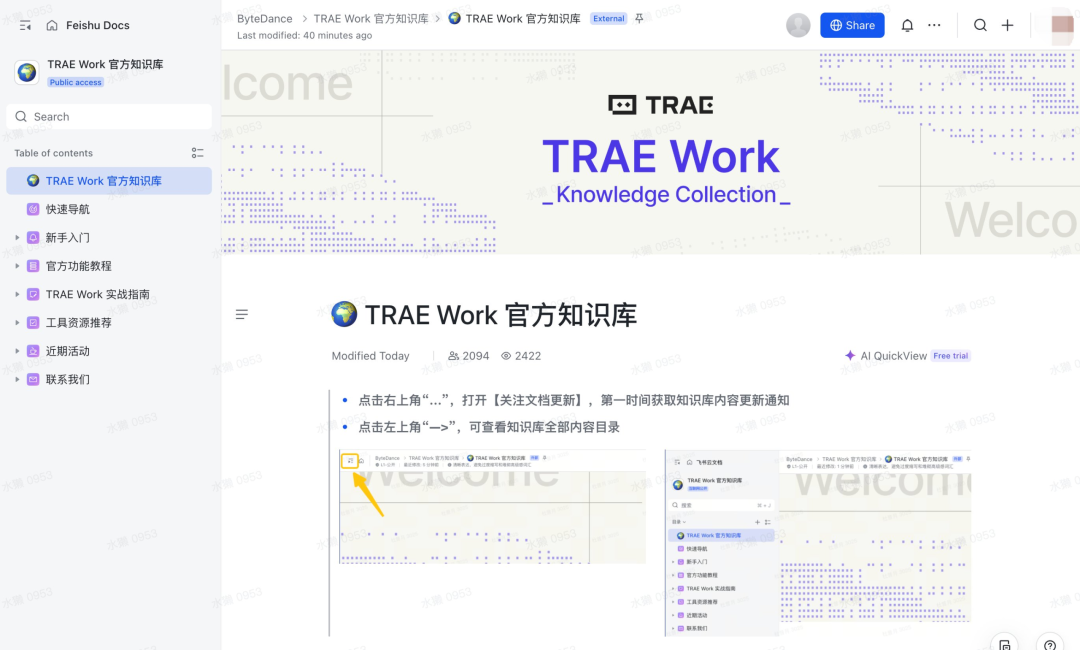
Upon opening, we found it's not one of those common '100 Prompt Collections' found on the market. All content revolves around real work tasks, such as education and personal growth, document writing, data processing and analysis, presentation and design creation, workflow automation, information retrieval and research, each with corresponding operational guides.
Moreover, each guide outlines a complete process of 'Input Prompt → TRAE Work Generation → Result Display,' making it relatively user-friendly for university faculty and students, investment research analysts, content creators, product managers, financial operations, designers, and other specific groups.
Perhaps precisely because this AI work knowledge base focuses on daily work tasks, avoiding much of the vague talk about 'what AI can do,' it surpassed 18,000 visits within just six hours of launch!
However, a knowledge base is just a knowledge base. When it comes to real-world scenarios, can TRAE Work truly hold up?
So, this time, we designed four highly diverse tasks ourselves, providing TRAE Work with complete materials and Prompts to see what results it would produce.
Adding Some Chaos to the Four Practical Tests
To assess TRAE Work's capabilities in real-world work and learning scenarios, the test content couldn't be as simple as 'Help me write something.'
Following the content of the AI work knowledge base, we set roles in the Prompts, defined task boundaries, attached self-checklists... To replicate the trivial (trivial) issues in real scenarios as much as possible, some tasks even intentionally embedded errors and contradictions in the original materials.
The first task was to research significant changes in the AI Coding Agent field over the past 30 days.
We required TRAE Work to search online for public information, Filter (screen) 8-12 truly important updates, prioritizing company official websites, official blogs, GitHub Releases, and original papers. Each piece of information needed to clearly state the time, subject, change, and source, and finally extract (distill) 3 industry trends, generating a Word briefing for use by tech media editors.
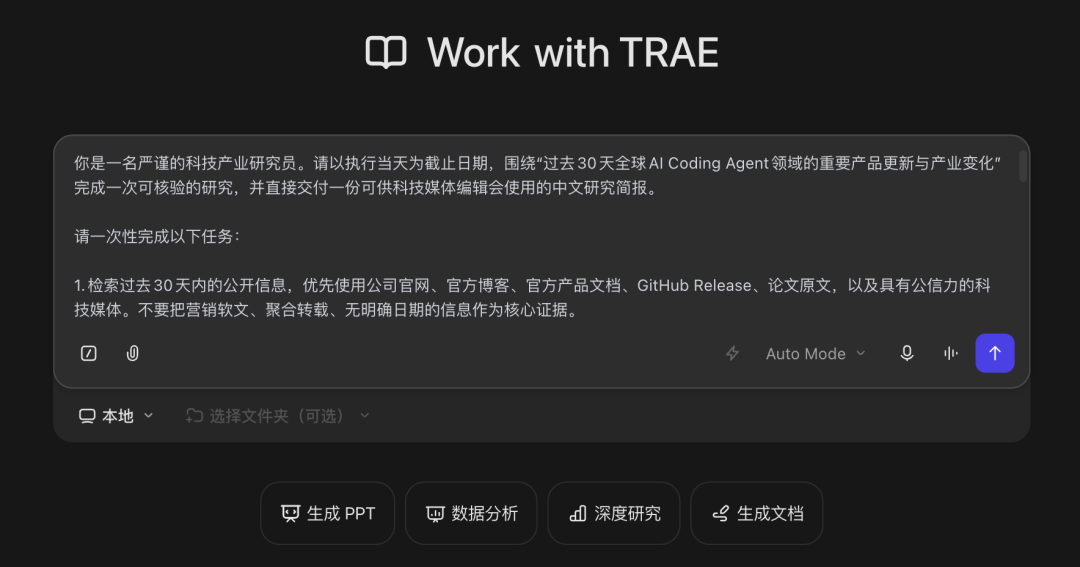
Without uploading any materials, this task tested TRAE Work's ability to gather up-to-date information, adhere to the given search scope, and organize and summarize the information afterward.
Moreover, the generation process was transparent, with TRAE Work displaying in real-time which steps the Agent had completed and how it executed them.
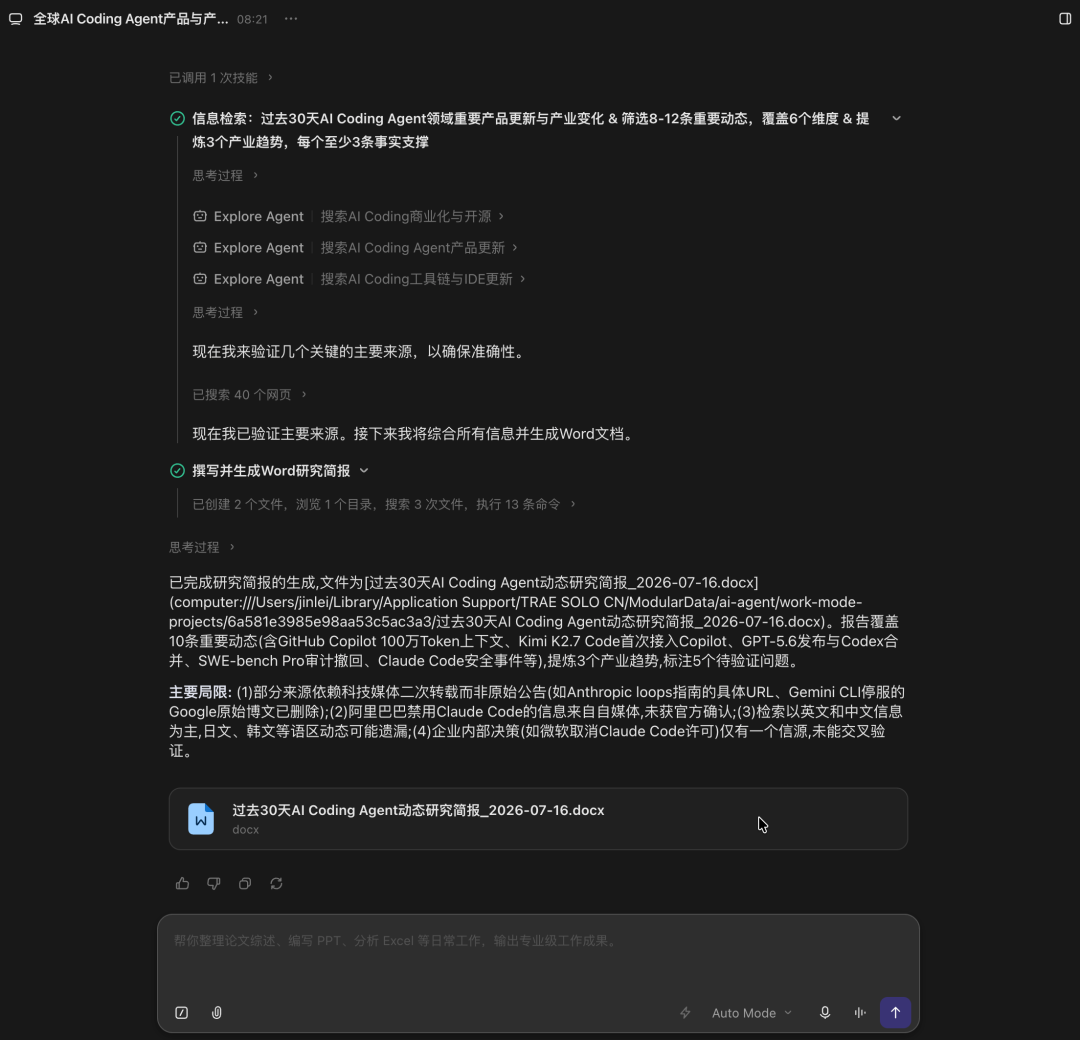
Ultimately, a 14-page dynamic research briefing meeting our requirements was generated.
From the content, the cover noted the research period as June 16 to July 16, 2026, with information sources including company official blogs, GitHub Releases, papers, the MIIT's NVDB platform, and some tech media.
The document structure was already quite complete, starting with a one-page editorial summary, extract (distilling) 5 key pieces of information, 3 industry trends, and 3 questions worth pursuing further. The events were then unfolded one by one, each including 'What Happened,' 'Core Changes,' and 'Why It Matters.'
Just by its presentation, it closely resembled research material ready for a meeting. However, TRAE Work even attempted to push the news clues further, summarizing the changes over the period as accelerated pay-per-use, the implementation of Agent interoperability protocols, and developers shifting from round-by-round prompts to circular engineering.
In the second task, we provided TRAE Work with 'Campus Coffee Shop Operating Data,' including order details from three stores over six months. This test material was deliberately processed, with six types of issues mixed in: duplicate orders, missing values, abnormal quantities, refund amounts exceeding sales, inconsistent month formats, and missing channel fields, without any prior warning.
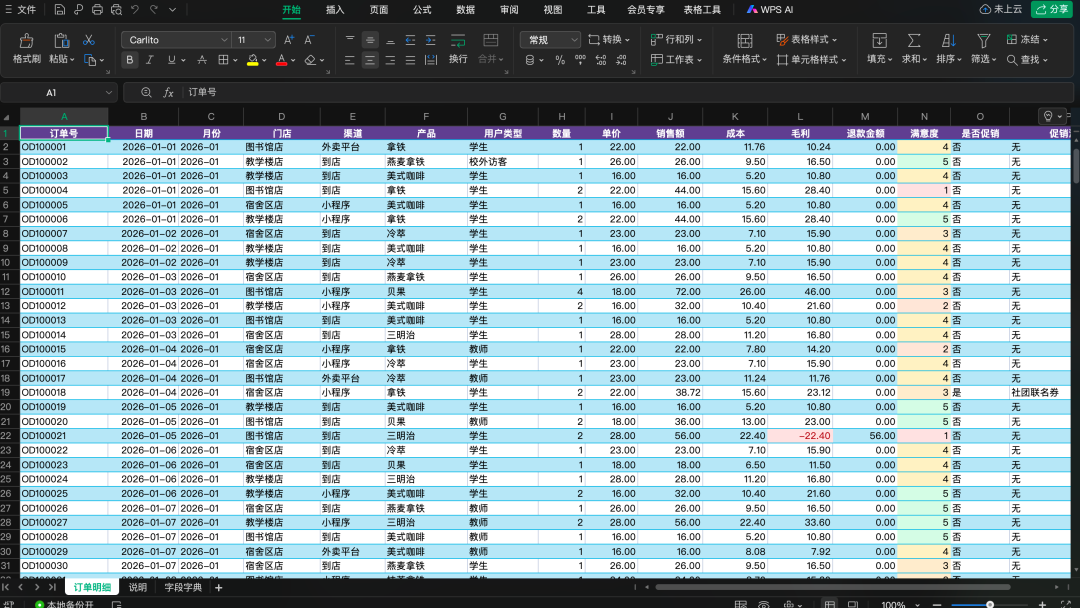
Next, we required TRAE Work to complete data checking, cleaning, operational analysis, promotion evaluation, and generate an Excel analysis result and a management Word briefing.
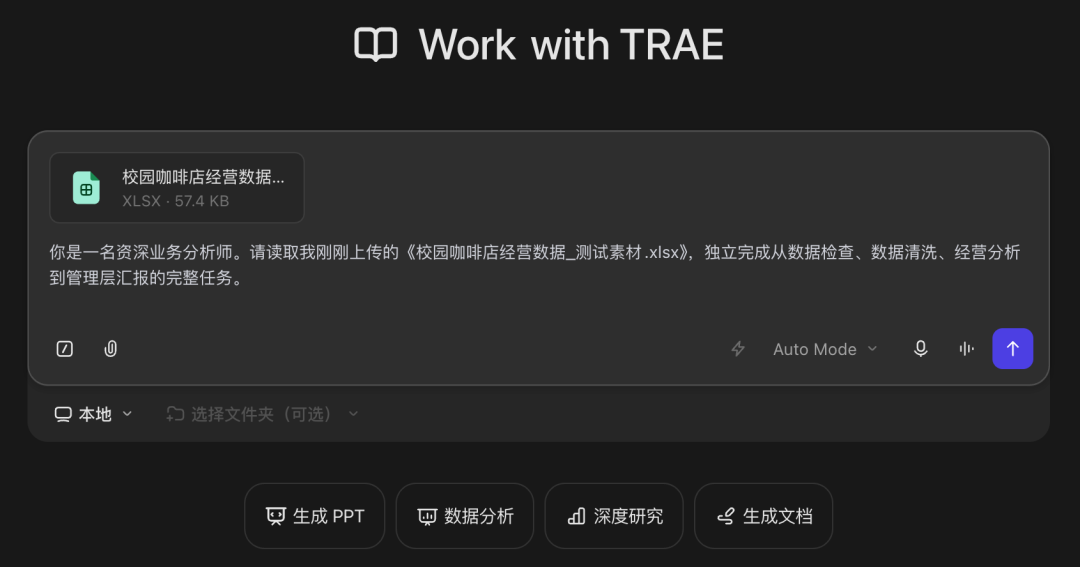
Similarly, upon receiving the task, TRAE Work began breaking down the steps and executing them one by one:
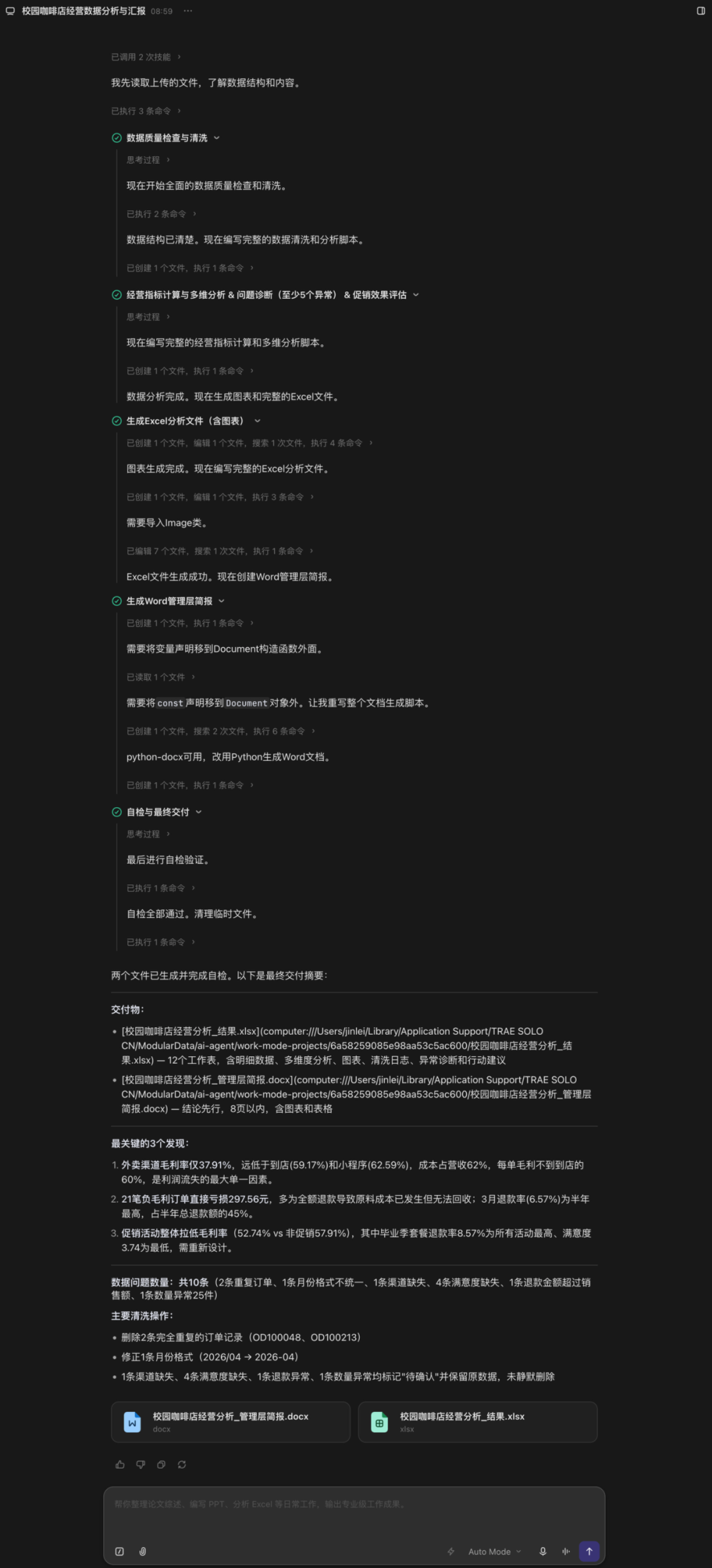
TRAE Work first identified and addressed data quality issues: deleting 1 duplicate order, correcting 1 month format, while marking missing channels, missing satisfaction ratings, abnormal refunds, and abnormal quantities as 'Pending Confirmation,' without directly deleting all suspicious data.
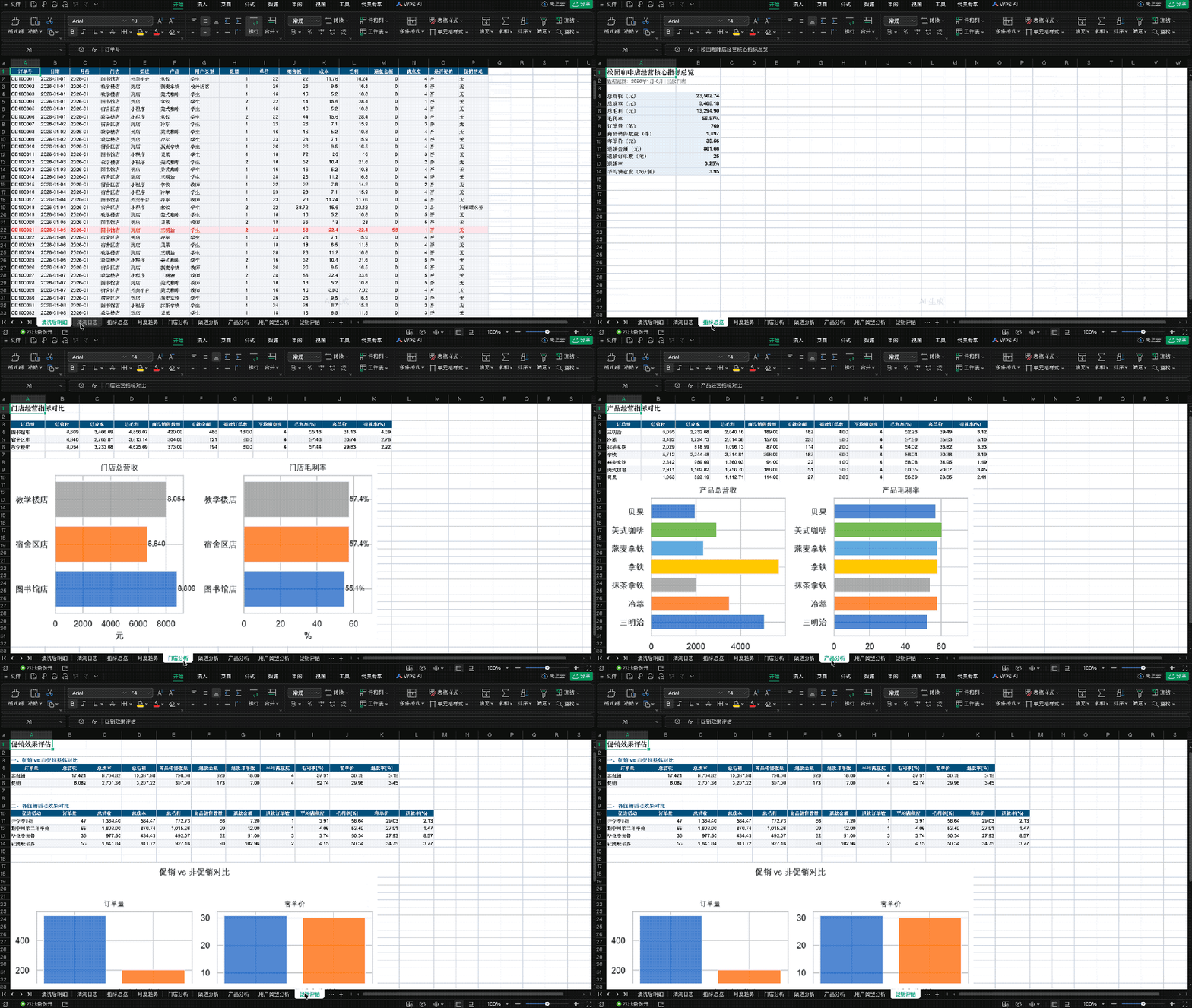
After cleaning, it calculated from 769 valid orders: a total revenue of 23,502.74 yuan for half a year, a gross profit of 13,294.90 yuan, a gross profit margin of 56.57%, an average order value of 30.56 yuan, and a refund rate of 3.25%.
In the promotion analysis, it also proactively reminded that the differences between promoted and non-promoted orders could only indicate correlations, and that promotions concentrated in specific months and stores could not be directly attributed to the activities themselves.
From the delivered results, TRAE Work began demonstrating three crucial layers of capability in business analysis: first checking the data, then identifying structural issues, and finally converting those issues into actionable recommendations.
The delivered results were also quite complete. The Word briefing included indicator tables, monthly trends, store and channel comparison charts, while the Excel retained the cleaned details, cleaning logs, indicator overviews, promotion evaluations, and action recommendations.
Of course, there's still room for improvement in the details. For example, some charts were quite basic, with color schemes and layouts resembling automatically generated standard reports; and explanations for business reasons mainly relied on experienced speculation.
However, for a single input and direct delivery, this set of results already possessed strong usability.
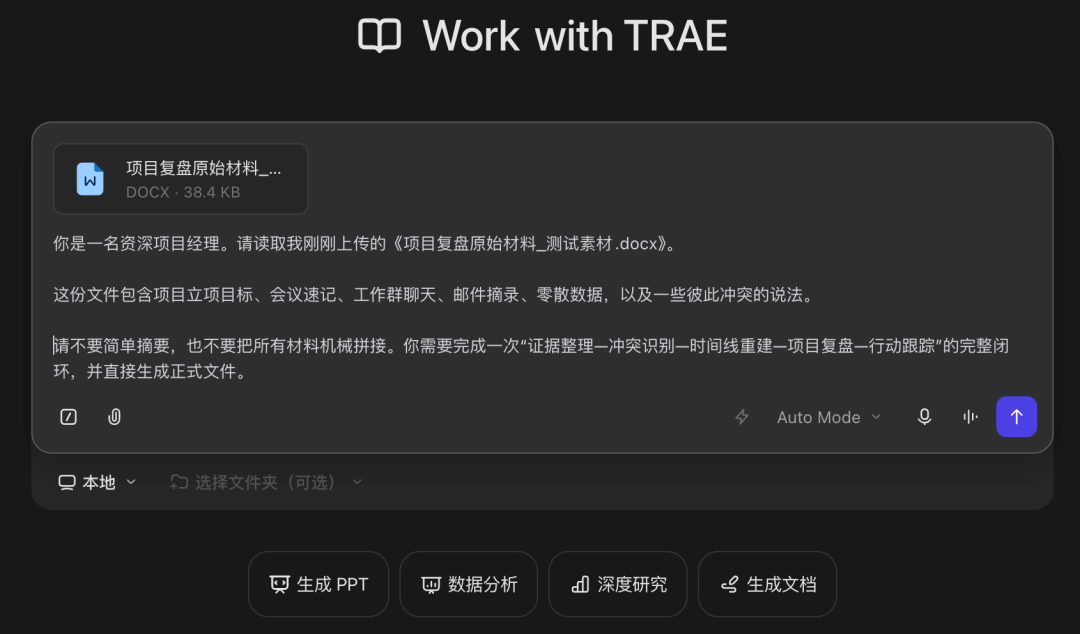
For the third test, the materials we provided to TRAE Work were even closer to the real state of daily work. There was no neat database, only project meeting shorthand, group chat snippets, email excerpts, and scattered data.
For the same Summer AI Open Course, there were two versions of registration numbers: 917 and 884; four versions of attendance figures: 221, 230, 236, and 248; two versions of content quantities: 13 and 14; and the budget even included uninvoiced final payments and unconfirmed temporary additions.
We required it to reconstruct the timeline, identify conflicts, calculate indicators, and generate a project review, action tracking table, and a one-page summary for management.
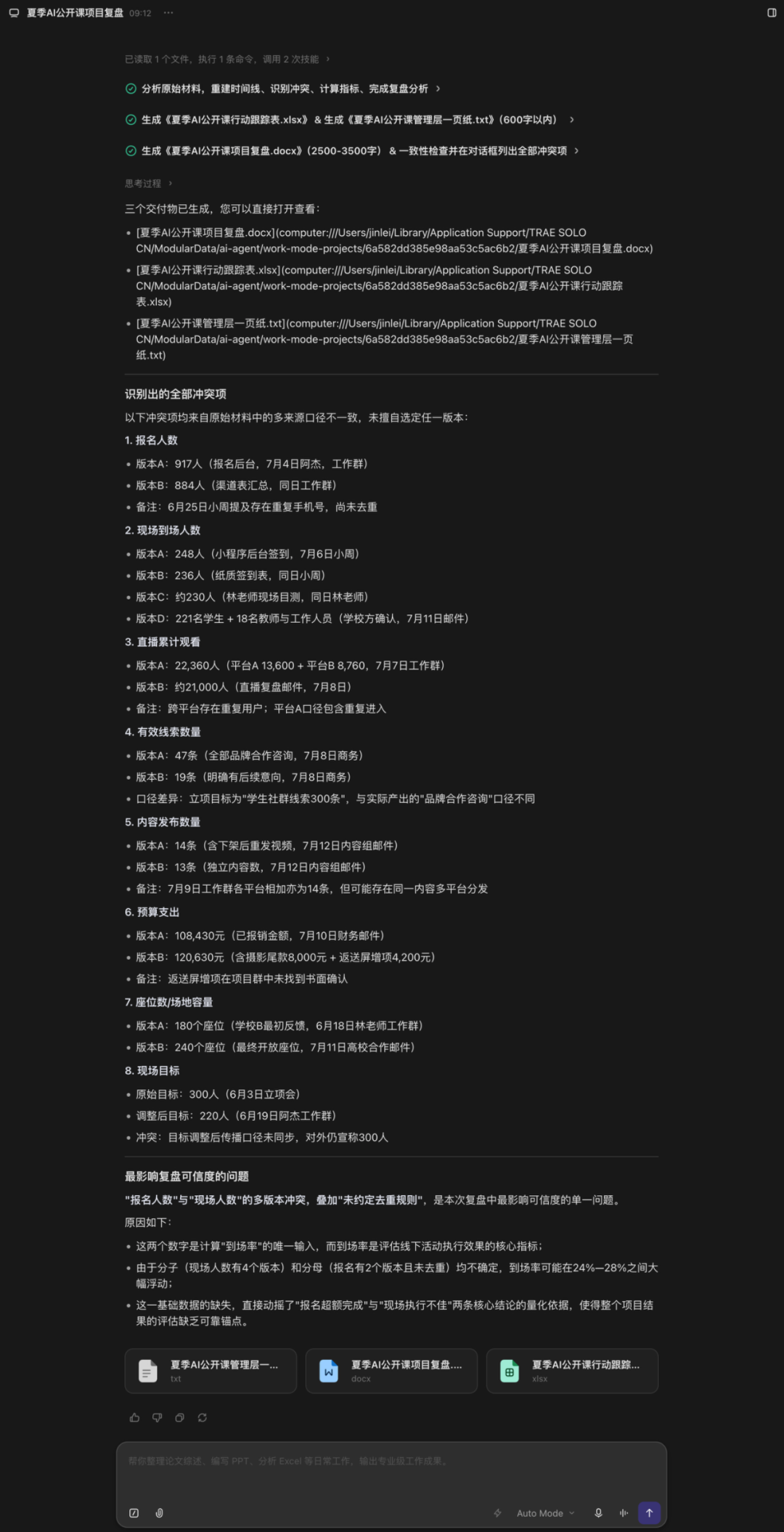
TRAE Work didn't forcibly condense the varying figures into one. In the final 'Summer AI Open Course Project Review,' the four versions of attendance figures were fully retained, with their respective information sources and discrepancies noted one by one, and finally placed in a 'Pending Confirmation' list.
Root cause analysis didn't stop at conclusions like 'inadequate communication,' which sound correct but aren't very helpful. The report broke down the issues into 8 specific dimensions, such as goal management, process design, and supplier management, with one judgment directly pinpointing the node where 'after goal adjustment, no one confirmed in the group whether it had been synchronized to the communication plan,' making it more actionable than vaguely blaming team collaboration.
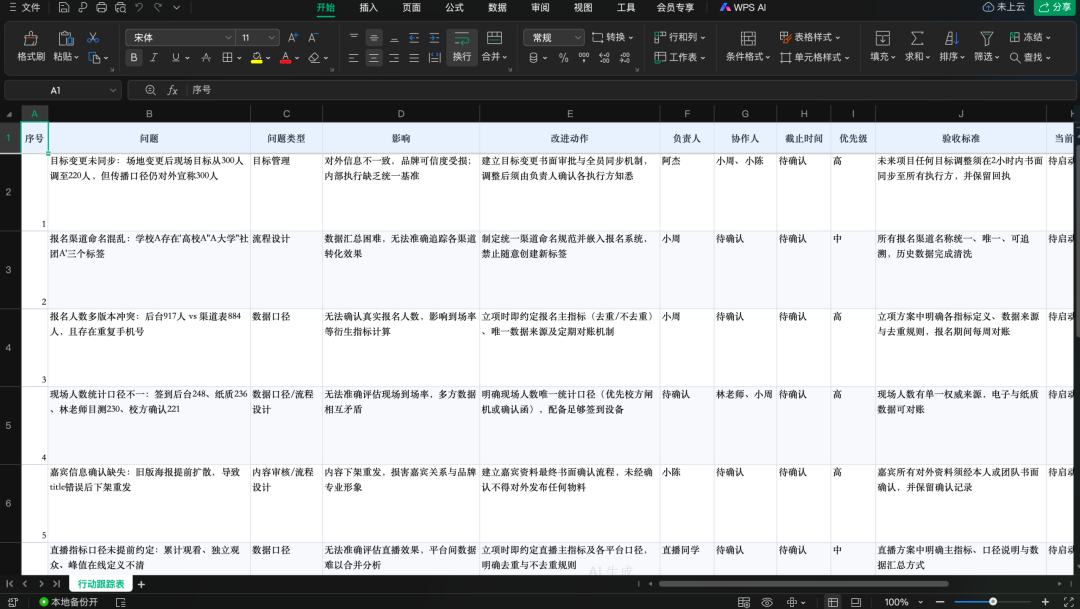
The accompanying 'Action Tracking Table' featured 12 fields, including issue, issue type, impact, improvement action, responsible person, collaborator, deadline, priority, acceptance criteria, current status, risk, and remarks. Where the original material didn't clearly state the responsible person, the table uniformly marked it as 'Pending Confirmation,' without arbitrarily filling in a name.
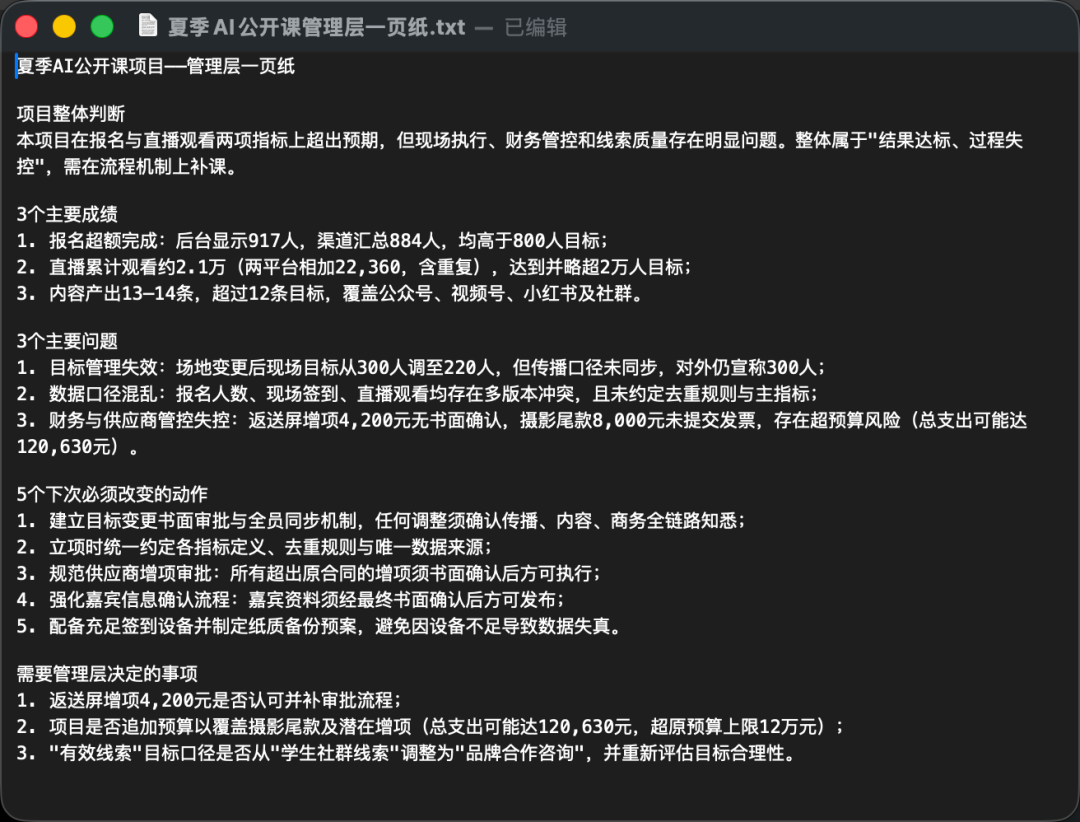
Finally, the under-600-word one-page summary for management placed 'Registration and live streaming exceeded expectations, but process management spun out of control' at the forefront, while listing three matters requiring management decision. This included whether to approve the 4,200 yuan additional expense, and whether to increase the budget after total expenditures might reach 120,630 yuan, exceeding the original budget by 630 yuan. The numbers in the three documents corresponded without new contradictions.
The fourth task was student-oriented.
We provided a summary of 120 simulated questionnaires, 6 interview segments, and 6 literature viewpoint cards, asking TRAE Work to complete a research report, a 10-page defense outline, and a research process appendix on 'How Generative AI Affects College Students' Learning Efficiency and Quality.'
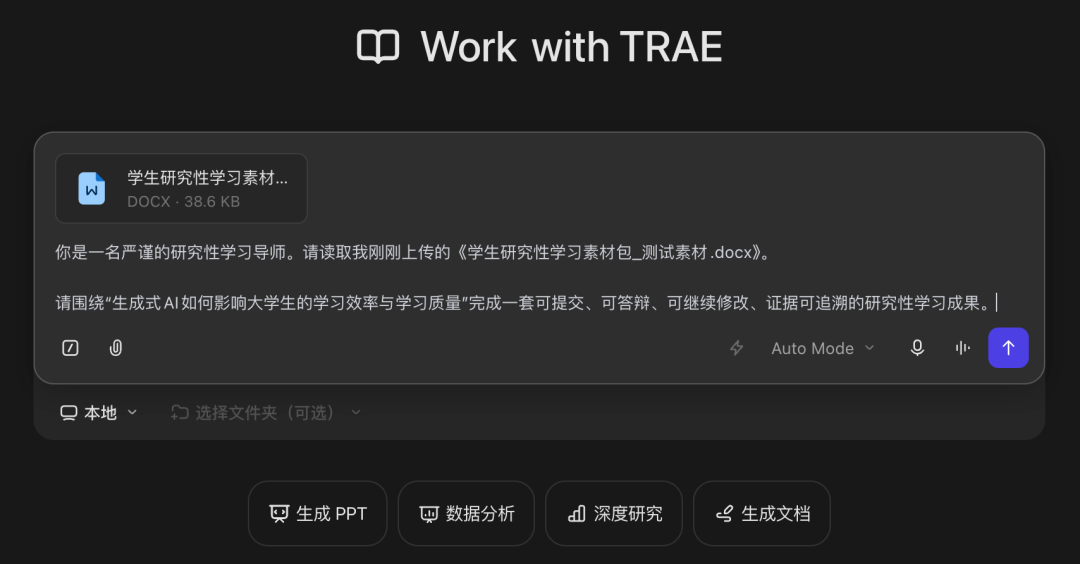
This task had only one core constraint, but it directly related to whether the conclusions could be used. All numbers in the material could only serve research method training and could not be written as judgments about real college student groups, nor could literature, authors, or statistical tests be fabricated to make the report seem complete.
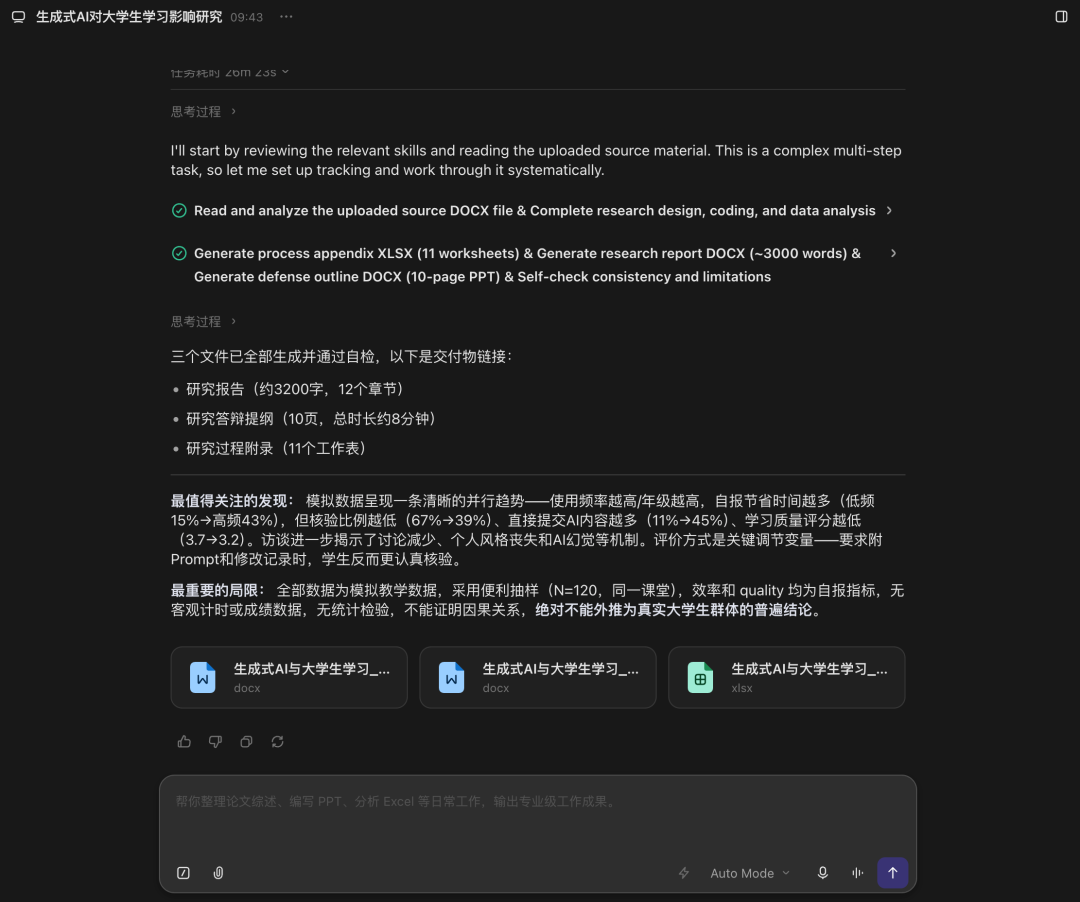
TRAE Work delivered three documents, including an approximately 3,000-word research report, a 10-page defense outline, and a research process appendix containing 11 worksheets such as a data dictionary, questionnaire summary, interview coding, and hypothesis verification status. The defense outline clearly stated on each page the core viewpoint, suggested charts to display, key points for oral explanation, and duration, keeping the entire presentation within 8 minutes.
The numbers in the three documents also corresponded. Taking the trend 'High-frequency users reported 43% time savings, but only 39% verified, directly submitting AI content reached 45%, and learning quality scores dropped to 3.2' as an example, the report body, defense outline, and appendix tables used the same set of numbers. The grade dimension showed a similar direction, with reported time savings increasing from 24% in freshman year to 39% in senior year, while verification rates decreased from 58% to 43%.
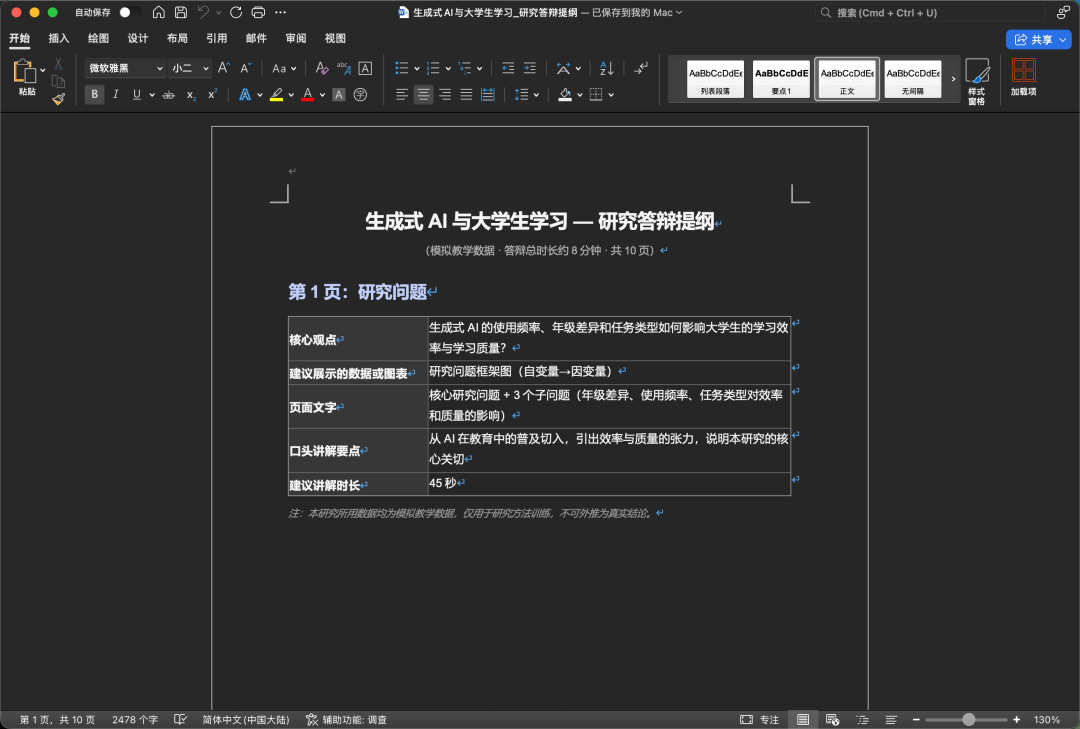
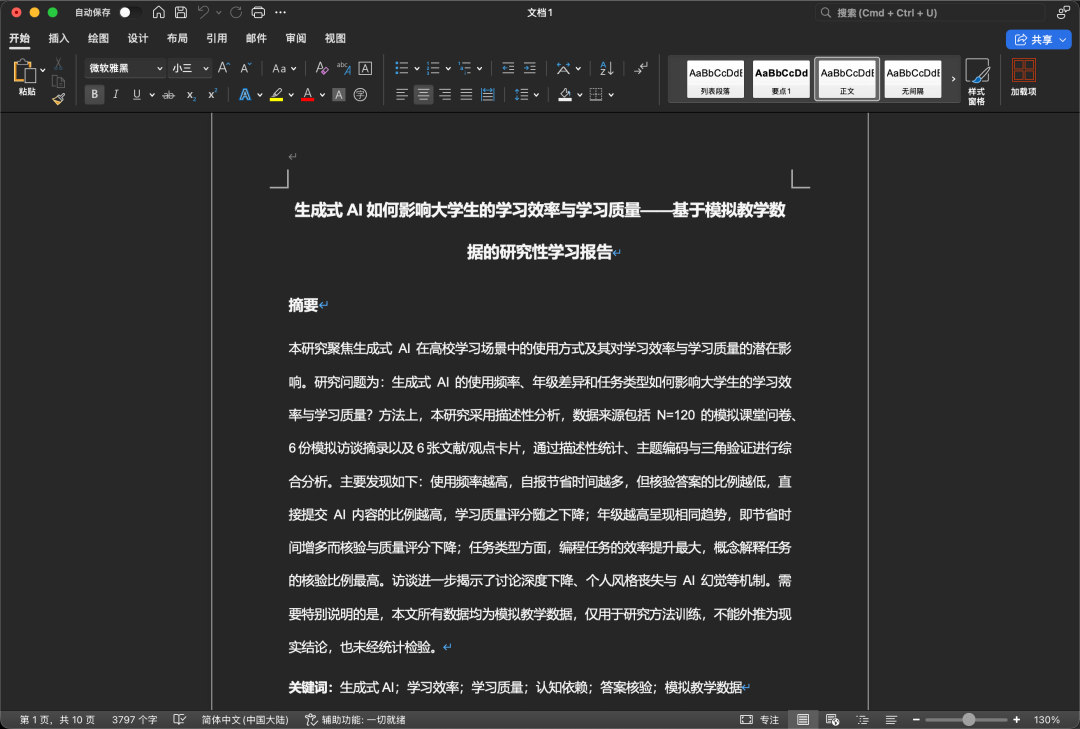
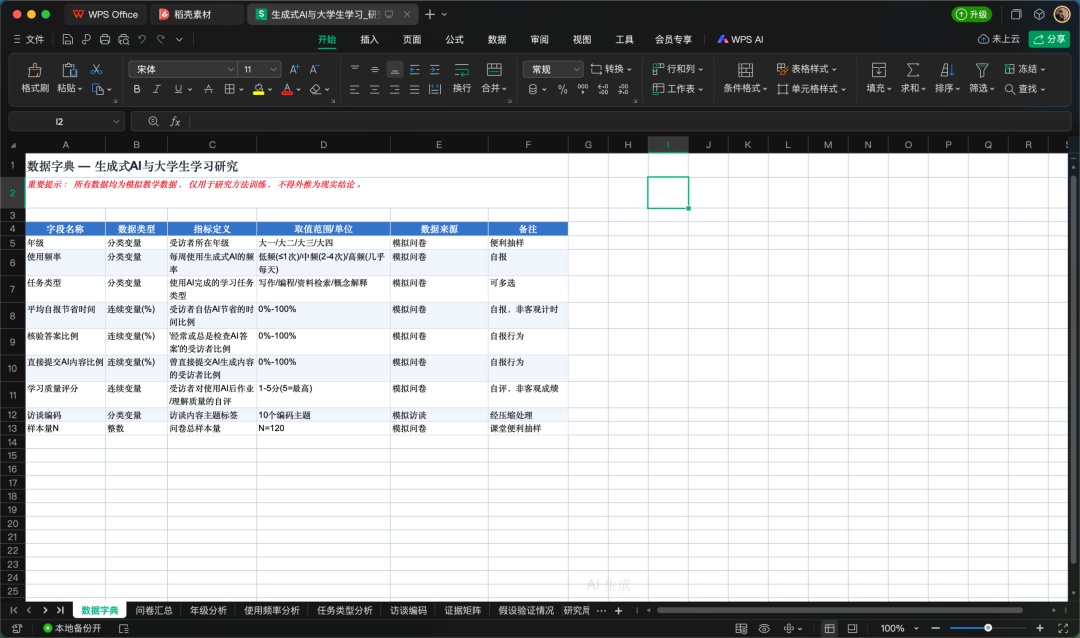
One detail is worth noting. Behind every page of the outline and every conclusion generated by TRAE Work, the same reminder was attached—'All data used in this research is simulated teaching data, intended only for research method training and not to be extrapolated as real conclusions.' This boundary wasn't omitted due to space constraints or to pursue surface-level completeness.
Why Did TRAE Work Create This Knowledge Base?
After testing the four tasks, how well Excel pivot tables were made or how smoothly Word documents were written only counted as basic capabilities. The main differences emerged in the intentionally left pitfalls, seeing whether the system would gloss over issues to deliver a seemingly complete result.
Judging from the deliverables of the four actual tests, the 'To Be Confirmed' labels in data cleaning, the four co-existing headcount versions retained side by side in project reviews, and the recurring boundary prompts in the research report all indicate that TRAE Work maintains basic restraint in scenarios where it needs to 'admit ignorance'. It does not sacrifice information reliability for the sake of producing a neat conclusion.
At this point, it becomes clearer what this knowledge base can help with.
Focusing on TRAE's product roadmap for this year, it initially started as an AI-native IDE for developers. In March this year, it introduced an independent SOLO mode, and in June, it was officially renamed TRAE Work, expanding its product positioning from an 'AI engineer' to an 'AI workbench' for everyone. The capabilities of context understanding, task decomposition, and progress tracking accumulated in the AI Coding scenarios have also begun to enter broader daily office scenarios.
Up to now, in addition to assessing whether the Agent capabilities are strong enough, the question of how ordinary people should actually use it has become an unavoidable issue. The newly launched knowledge base provides a more specific answer. It does not simply pile up a list of features but mainly focuses on the Prompt method of 'role setting + task boundaries + self-checklist'. The relatively complete deliverables we obtained in our four actual tests also relied on these prerequisites.
However, it should also be noted that the scope of this actual test was limited. The four tasks were designed by us and intentionally included distractors, so the results largely depended on whether the task descriptions were detailed enough.
This also illustrates that 'knowing how to use AI' is becoming a skill that requires specialized learning. Simply asking a question casually in the chatbox often makes it difficult to obtain a satisfactory answer directly. For professionals who frequently deal with messy data, coordinate with multiple parties, and are responsible for the conclusions, a knowledge base that consolidates methods into reusable guidelines may be more practical than simply chasing a 'more powerful model'.
-
DRAM, A Disruptive Technological Breakthrough!
-
Robot Army Mobilizes for Action
-
![]()
Electric Vehicle Penetration Soars Past 60%, Yet Seven of Top Ten Brands Hail from Traditional Fuel Vehicle Sector, Casting Doubt on Their Longevity
-
![]()
Conant Optics Clinches R&D and Procurement Framework Deals with Top Tech Firms!
-
![]()
Over 87% Surge in Net Profit for H1 Anticipated! Dongtian Micro Leads in AI Optical Communication
-
![]()
Tech Titans Offload AI Ventures, Tencent Shifts Stakes to Capitalize on Artificial Intelligence Surge
-
![]()
WAIC 2026 Observations: Mapless, Brain-Powered, and Task-Ready—Is Physical AI Taking Off?
-
![]()
Self-driving Technology Hits the Road: NVIDIA's Structural Adjustment, the Emergence of a First Mover... The Second Half of the Autonomous Driving Race Begins