Embodied AI Embraces the ‘Tactile’ Revolution! Qianjue Leads the Charge in Robotic ‘Sense of Touch’
 07/20 2026
 461
461
From July 17 to 20, the 2026 World Artificial Intelligence Conference (WAIC 2026) officially kicked off. As a cornerstone event in the AI industry, this year’s conference once again brought together leading domestic and international large-scale model companies, AI application developers, and hardware vendors. Leikeji (ID: leitech), through its dedicated AI-focused new media platform ‘Leikeji AGI (leikejiagi),’ dispatched a reporting team to Shanghai for on-the-ground coverage.
The robotics exhibition area at WAIC 2026 was a hive of activity. Humanoid robots were seen dancing and boxing, while robotic arms were skillfully tending bars and crafting ice cream. While these flashy demonstrations had audiences quickly reaching for their phones to capture the moment, the dual-armed robot at Qianjue Robotics’ booth moved with a more deliberate grace—grasping a delicate piece of cardboard, carefully unfolding it, folding the edges, and methodically pressing it into a box shape.
What made this display truly captivating was the interaction: on-site staff intentionally interfered with the cardboard during the folding process. The robot, equipped with advanced tactile and visual feedback systems, detected the material deformation and changes in force, adjusted the coordination strength of its dual arms accordingly, and successfully completed the entire sequence of grasping, unfolding, folding, and pressing.
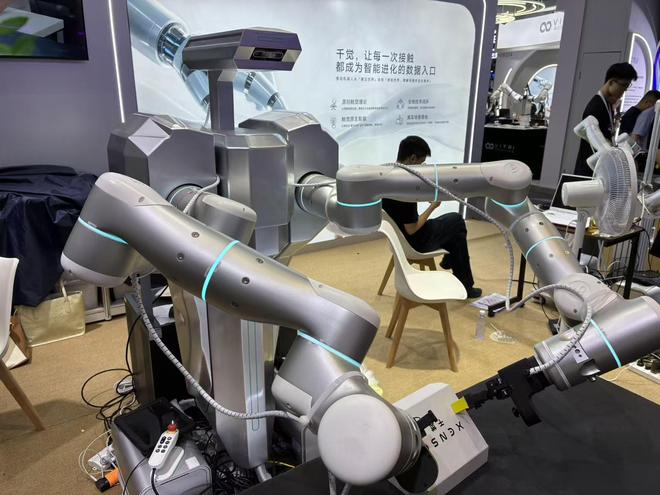
Image Source: Leikeji
What might seem like a simple task—folding a cardboard box—actually poses a significant challenge for robots: managing contact. While cameras can identify the placement and outline of the cardboard, they struggle to continuously assess whether it has slipped, if the folds are precise, or the exact amount of force being applied. The thin cardboard also deforms during handling, and a pre-programmed path can easily be disrupted by human interference. Qianjue’s innovative approach involves using visuotactile sensors to capture contact location, force, and deformation, enabling the model to adjust its actions in real-time based on both visual and tactile feedback.
On the other side of the booth, precision headphone assembly showcased a scenario more akin to industrial production. Faced with smaller, irregularly shaped components that leave little room for error, the robotic arm dynamically adjusted its position and orientation in response to offsets, stalls, and edge collisions. While the cardboard test challenged the robot’s ability to handle flexible materials and perform long-sequence operations, the headphone assembly tested its capacity for millimeter-level precision: the final few centimeters often prove the most challenging as robots transition from grasping objects to executing complex tasks.
Qianjue’s X-TouchMind V1, unveiled prior to WAIC’s opening, represents a significant engineering feat designed to tackle these challenges. It is a VTLA (Vision-Touch-Language-Action) embodied tactile model that seamlessly integrates vision, language, touch, action, and the robot’s own state into a unified system. The upper layer comprehends tasks, the middle layer generates optimal paths, and the lower layer continuously refines actions based on high-frequency tactile feedback.
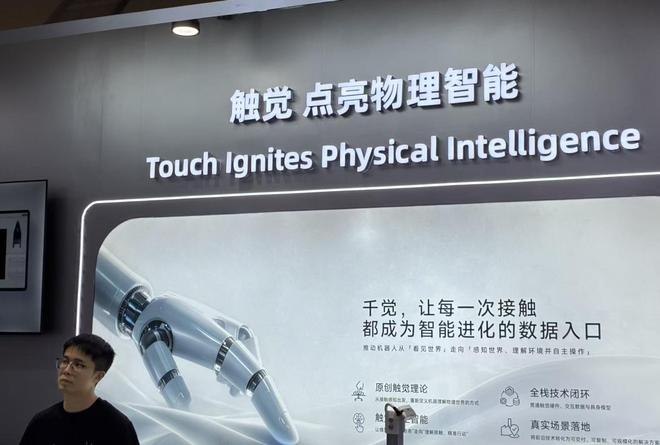
Image Source: Leikeji
In simpler terms, the model must not only understand what needs to be done and where to reach but also maintain stability and precision upon contact with an object.
Behind this sophisticated model lies the TacVerse 1k dataset. Qianjue revealed that this dataset comprises 1,000 hours of real-world physical interaction records, capturing visual, tactile, force, and pose information through self-developed wearable devices. The first 100 hours are slated to be made available for applications on July 30, covering over 40 diverse scenarios. The complete dataset will be released in batches starting in August, accessible via platforms like ModelScope and Hugging Face.
For the robotics industry, which has long grappled with a scarcity of high-quality tactile data, this development is a game-changer.
There was also a more relatable demonstration for the general public. Qianjue and Dewu jointly presented an AI authentication robot that utilized a robotic arm to grasp sneakers. A high-definition camera then collected detailed information about the shoe’s upper, midsole, insole, accessories, and packaging, transmitting it to Dewu’s verification system. Within approximately five seconds, an authentication report appeared on the screen.
Tasks that previously required human authenticators to repeatedly inspect, focus, and photograph are now efficiently handled by the robotic arm.
To be fair, the core authentication process in this demonstration still primarily relied on Dewu’s extensive image and product databases, with Qianjue’s contribution focusing more on stable grasping and precise physical operations. However, this collaboration precisely highlights the commercial potential of robotic ‘touch’: as AI transitions from screens to factories, warehouses, and quality inspection stations, models must ultimately interact with real-world objects safely and reliably.
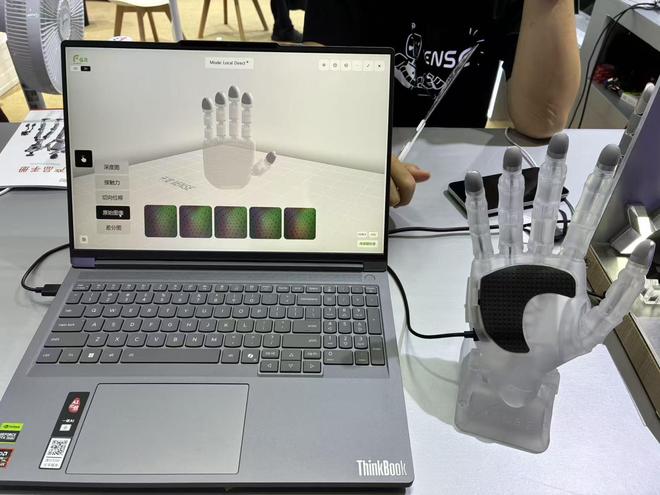
Image Source: Leikeji
Founded in May 2024 by Ma Daolin, an associate professor at Shanghai Jiao Tong University, Qianjue draws on Ma’s postdoctoral research at MIT, where his work on tactile perception earned the Best Conference Paper Award at ICRA 2021. Just three days before WAIC’s opening, the company announced the successful completion of a 100 million yuan funding round, with proceeds earmarked for further development of visuotactile sensors, data collection, and physical intelligence models.
From tactile sensors to data collection, model training, and applications involving cardboard boxes, headphones, and product authentication, Qianjue endeavored to showcase a comprehensive pipeline at this year’s WAIC. Of course, successful booth demonstrations still differ from real-world production lines, with long-term success rates, sensor durability, calibration maintenance, and deployment costs requiring validation through more complex on-site testing.
But at least while robots throughout the venue were busy showcasing their ability to see, hear, and move, Qianjue focused on a specific and increasingly vital question: it’s time for robots to develop a ‘sense of touch.’
The AI narrative has evolved from merely stacking model parameters to implementing Agent-driven productivity; heterogeneous collaboration and photonic computing continue to push computational boundaries; embodied intelligence accelerates real-world applications, with robots entering homes and factories to make physical AI a tangible reality.
Leikeji’s WAIC exploration team has arrived in Shanghai to witness the annual peak of AI industrialization—stay tuned for more updates!
-
DRAM, A Disruptive Technological Breakthrough!
-
Robot Army Mobilizes for Action
-
![]()
Electric Vehicle Penetration Soars Past 60%, Yet Seven of Top Ten Brands Hail from Traditional Fuel Vehicle Sector, Casting Doubt on Their Longevity
-
![]()
Conant Optics Clinches R&D and Procurement Framework Deals with Top Tech Firms!
-
![]()
Over 87% Surge in Net Profit for H1 Anticipated! Dongtian Micro Leads in AI Optical Communication
-
![]()
Tech Titans Offload AI Ventures, Tencent Shifts Stakes to Capitalize on Artificial Intelligence Surge
-
![]()
WAIC 2026 Observations: Mapless, Brain-Powered, and Task-Ready—Is Physical AI Taking Off?
-
![]()
Self-driving Technology Hits the Road: NVIDIA's Structural Adjustment, the Emergence of a First Mover... The Second Half of the Autonomous Driving Race Begins