Zhipu and MiniMax Stocks Plunge: Kimi K3 Is Not the Culprit
 07/20 2026
 462
462
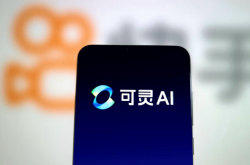
Last Friday, Kimi K3 made its debut. Officials stated that while its overall performance still trails behind the top closed-source models, Claude Fable 5 and GPT-5.6 Sol, it showcases state-of-the-art capabilities across the entire evaluation spectrum and consistently outperforms all competing models.
The AI sector in Hong Kong stocks immediately faced a “Black Friday,” with Zhipu’s stock plummeting by 28.49% and MiniMax dropping by 15.63%. Additionally, AI infrastructure stocks such as Biren Technology, Guanghe Technology, Kingboard, Shenghong Technology, YOFC, and SMIC all saw declines exceeding 10%. Some media outlets were quick to assign blame—pointing the finger at Kimi K3.
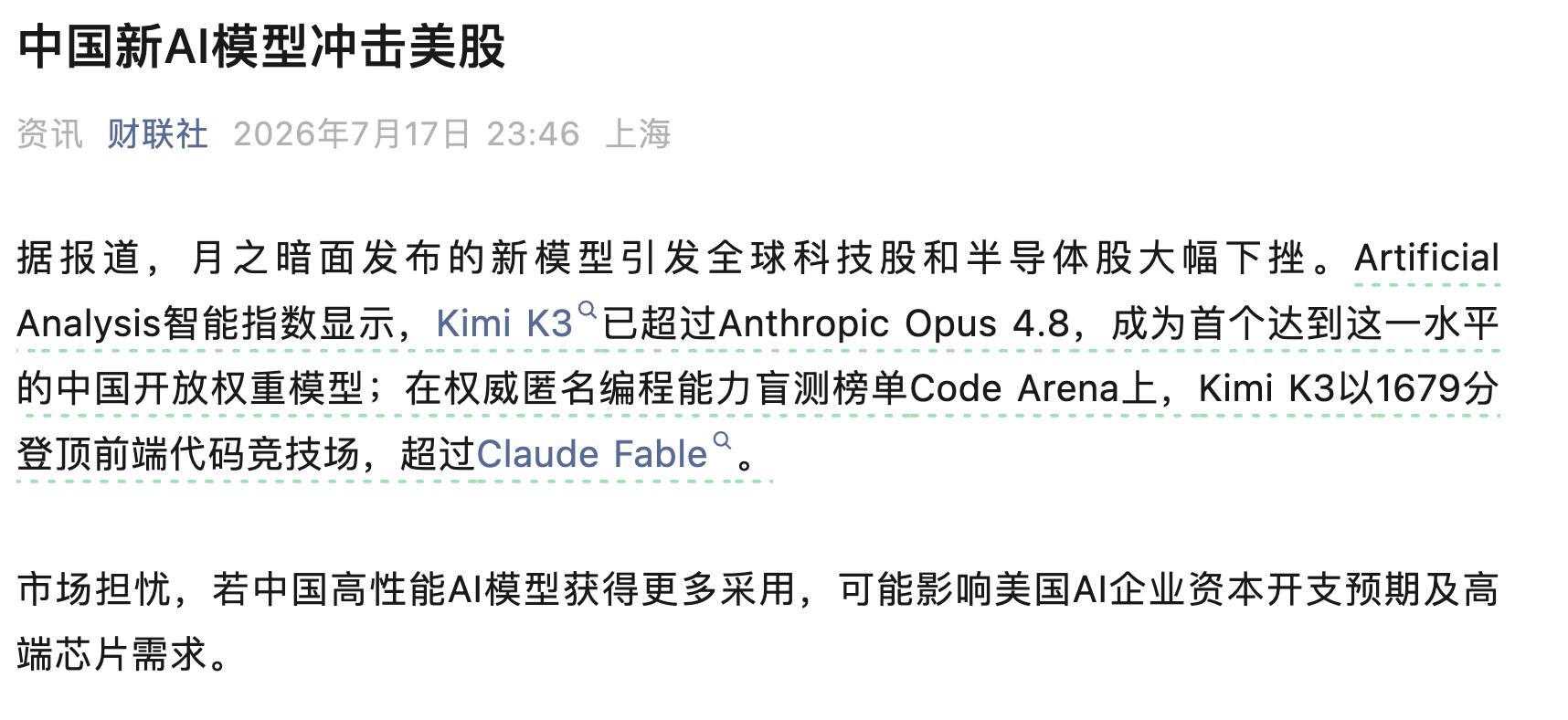
The reasoning went like this: Kimi K3 is too powerful, boasting 2.8 trillion parameters and being the world's first open-source model to approach 3 trillion parameters. It surged to the top in Arena.ai programming rankings. Investors, fearing that such a powerful model would reduce computing demand, began selling off semiconductor and AI concept stocks. This narrative seemed vaguely plausible, and many bought into it.
This is utter nonsense.
A quick look at U.S. stocks on Friday night reveals the truth: On the same day as Kimi K3's release, the Philadelphia Semiconductor Index (SOX) briefly plunged 5.7% intraday but closed down just 1.6%. NVIDIA only dropped 2.21%. There was no “global semiconductor sector collapse.” The declines were confined to A-shares and Hong Kong stocks, not U.S. stocks. Blaming K3 for a global semiconductor crash is like shooting first and drawing the target later—and missing badly.
Even if Kimi K3 were genuinely anxiety-inducingly powerful, creating a “second DeepSeek moment” as some media claim, and even if U.S. semiconductor stocks had truly plummeted on Friday night, the logic that K3 caused a global semiconductor crash still wouldn’t hold water.
In January 2025, DeepSeek R1 emerged, demonstrating performance close to OpenAI's o1 at a fraction of the industry's average computing cost. The market reacted dramatically: NVIDIA plunged 17% in a single day, losing nearly $600 billion in market value. The Philadelphia Semiconductor Index (SOX) fell 9.19% that day. Now that was a real “collapse.”
Yet within a month, NVIDIA and the SOX index recovered swiftly because the market had completely misunderstood DeepSeek's impact. Jensen Huang stated at the time: Investors mistakenly saw DeepSeek's progress as a sign that AI companies no longer needed high-intensity computing, but “the opposite is true.” Over the next 18 months, the semiconductor sector continued its meteoric rise.
Thus, more powerful open-source models never suppress computing demand; they only drive AI adoption, creating even greater demand. DeepSeek was not NVIDIA’s nemesis, and neither is Kimi K3.
Moreover, the semiconductor sector's correction began long before Kimi K3's debut.
By the close on July 17, the Philadelphia Semiconductor Index had retracted 20% from its June peak, officially entering a technical bear market. The CSI Chip Industry Index retracted approximately 30%, and Taiwan’s Semiconductor Index retracted 28%. These declines occurred before K3's release, not after.
Anyone paying attention to the semiconductor industry could see that the claim “K3 caused the semiconductor sector to fall” is absurd.
What truly triggered this semiconductor correction? At least two significant factors played a role:
First, Meta, the “spoiler,” stirred the pot. In early July, after falling behind in the AI race, Meta announced it would lease idle AI computing power. The market’s immediate reaction: “Did they overbuy computing?” Meta had been a major computing buyer, and now it was renting out GPUs—was this a sign of oversupply? Soon after, Zuckerberg admitted at an internal staff meeting that AI agent development over the past four months had “not accelerated as expected,” and the company’s bets on new organizational structures had “not yet borne fruit.”
The market worried that AI commercialization pathways might not work, that AI infrastructure investments were overheated, and that major buyers like Meta could slash capital expenditures. Infrastructure stocks (including chips, storage, and data centers) all took a hit.
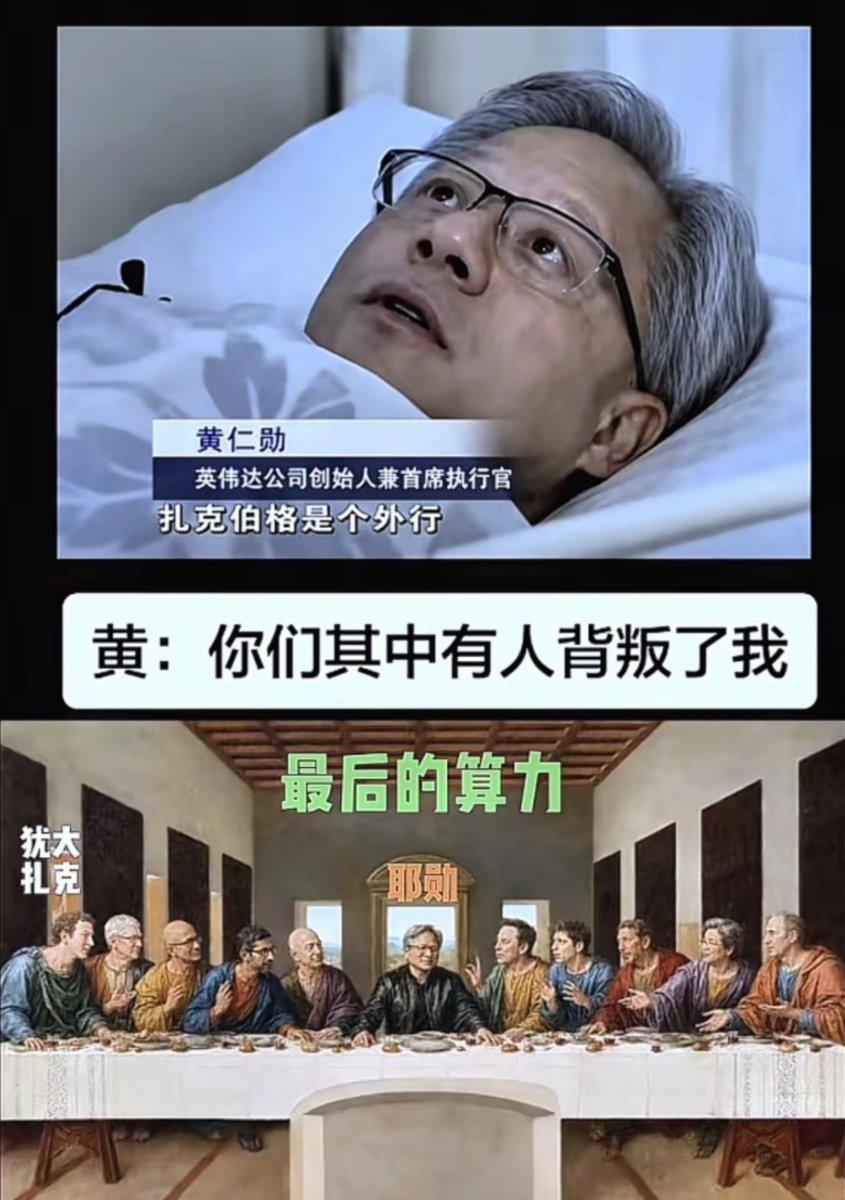
Second, Buffett labeled current AI market investments as “overheated” and even “casino-like.” On July 16, Buffett told CNBC in an interview that the market is now dominated by short-term trading, marginalizing long-term value investing:
“When greed and gambling emotions override reason, bubbles will inevitably form. I never predict short-term market moves; I only look for companies with reasonably estimable intrinsic value. If a company relies solely on AI hype without stable, sustained profits, no matter how much its stock surges, I won’t touch it. Casinos always breed flashy bubbles, but patient value investors simply ignore such noise.”
At 95, Buffett calling the AI market a gamble is a fundamental challenge to valuation logic—far more impactful than any single model.
Finally, Zhipu and MiniMax’s collapses needed no external catalyst—this has always been my view: Market caps propped up by “hype probabilities” will eventually collapse.
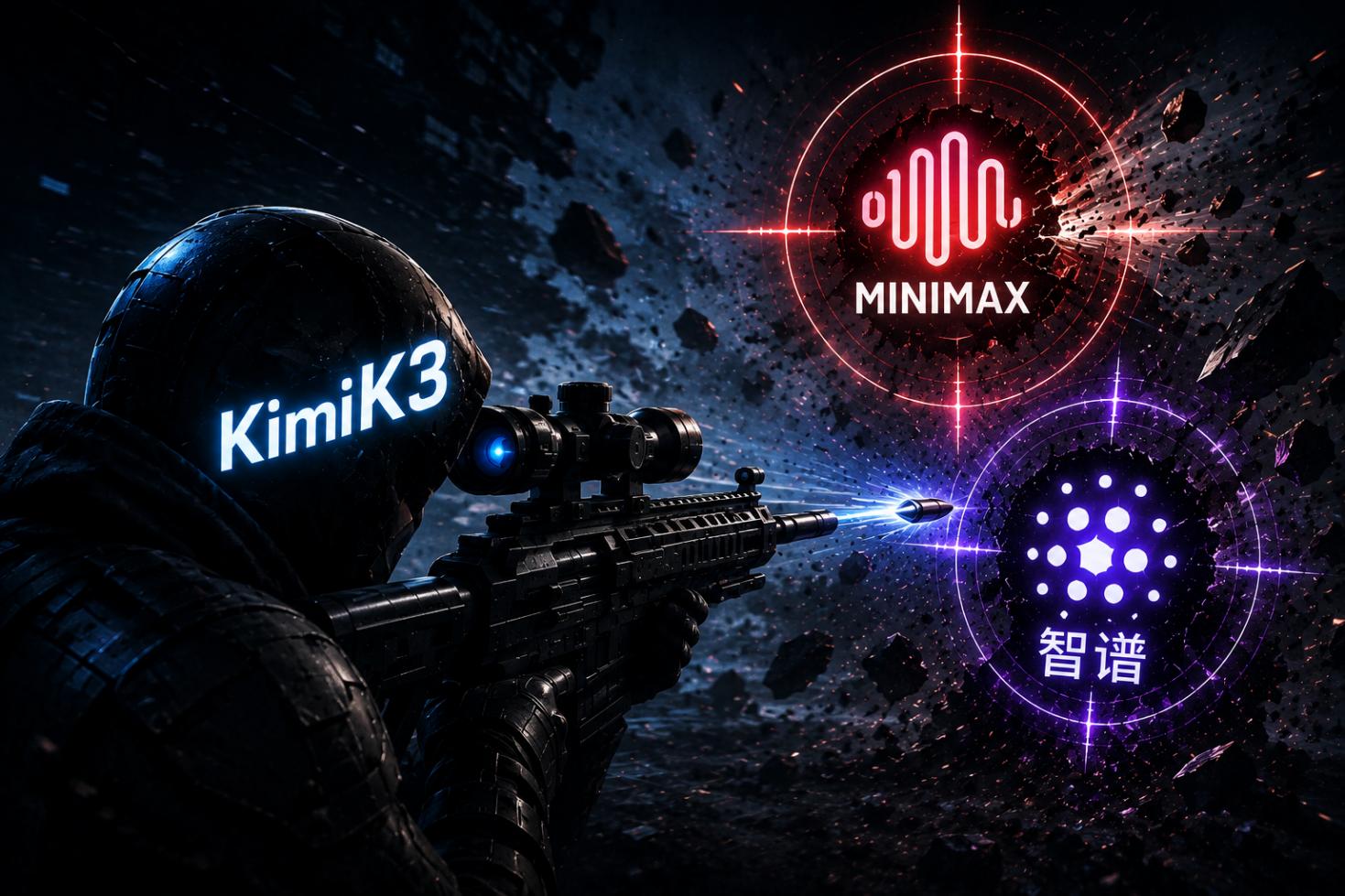
(Image source: Generated by ChatGPT via Luo Chao Pro)
Even if Kimi hadn’t released K3, or if K3 had underperformed, these two companies would likely still have fallen. On July 8, Zhipu faced its first lock-up expiration, involving approximately 25.68 million shares. The stock didn’t drop that day; instead, it rose 13.35%. But soon after, Zhipu placed nearly 20 million new H-shares at HK$1,588, raising HK$31.4 billion—participating institutions faced a 30% float loss seven trading days later. In 2025, full-year revenue was RMB 724 million, with an adjusted net loss of RMB 3.182 billion, and the price-to-sales ratio once exceeded 1,000x.
MiniMax fared even worse. Its stock hit a high of HK$1,330 in March, valuing it at over HK$410 billion—surpassing AI veterans like Baidu. By July 17’s close, it stood at HK$216, with a market cap of HK$75.4 billion—a collapse of over 80%. And all this happened before Kimi K3’s release, including an 18% single-day plunge on the lock-up expiration day. So who’s to blame for the previous 80% drop?
The AI market is shifting from “scarcity premium” to “fundamentals-based pricing.” The storytelling phase is over; now it’s time for accountability. That’s all.
So if you’re still confused about why some AI companies collapsed, watch Buffett’s recent interview.
That said, Kimi K3 is a strong model, adding another ace to China’s large model ecosystem. Open-source players like Kimi, DeepSeek, and Qwen are racing ahead, offering hope that China’s AI can carve a unique path through open-source innovation—far more noteworthy than Zhipu and MiniMax’s collapses.
Buffett’s words ring true here: “The market has two extreme phases: one where quality opportunities flood in faster than you can handle them, and another where spending two or three years finding a single reliable target feels like a blessing.”
Most of the time, the market is in the latter state. Eventually, feverish humans will return to “common sense.”
WAIC 2026, themed “Intelligent Partners · Co-creating the Future,” is in full swing!
The AI narrative has shifted from model parameter stacking to Agent productivity deployment. Heterogeneous collaboration and photonic computing continue to push computational limits. Embodied AI accelerates applications, with robots entering homes and factories, making physical AI a reality.
Lei Technology’s WAIC exploration team has arrived in Shanghai to witness the annual peak of AI industrialization. Stay tuned!
-
DRAM, A Disruptive Technological Breakthrough!
-
Robot Army Mobilizes for Action
-
![]()
Electric Vehicle Penetration Soars Past 60%, Yet Seven of Top Ten Brands Hail from Traditional Fuel Vehicle Sector, Casting Doubt on Their Longevity
-
![]()
Conant Optics Clinches R&D and Procurement Framework Deals with Top Tech Firms!
-
![]()
Over 87% Surge in Net Profit for H1 Anticipated! Dongtian Micro Leads in AI Optical Communication
-
![]()
Tech Titans Offload AI Ventures, Tencent Shifts Stakes to Capitalize on Artificial Intelligence Surge
-
![]()
WAIC 2026 Observations: Mapless, Brain-Powered, and Task-Ready—Is Physical AI Taking Off?
-
![]()
Self-driving Technology Hits the Road: NVIDIA's Structural Adjustment, the Emergence of a First Mover... The Second Half of the Autonomous Driving Race Begins