Exploring the World's Most Powerful AI Conference: Turing Award Winners, Nobel Laureates, and AI Leaders Focus Not on AI, but on "Humans"
 07/20 2026
 359
359
From July 17 to 20, the main forum of the 2026 World Artificial Intelligence Conference & High-Level Conference on Global Governance of Artificial Intelligence (WAIC 2026) was officially held. As an annual AI industry event, this year's conference once again brought together major domestic and international large model companies, AI application and hardware vendors. Leitech's AI new media outlet, "Leitech AGI (leikejiagi)," dispatched a reporting team to Shanghai for on-site coverage.
On the first day of the conference, the most discussed topics on stage were, of course, models, intelligent agents, world models, and embodied intelligence. However, when these experts, scholars, and business leaders pushed the conversation further, they repeatedly encountered the same question:
As machines become increasingly capable, what should humans do? This may also be the question ordinary people most want to ask today, yet it is the hardest to find an answer to at a technology conference.
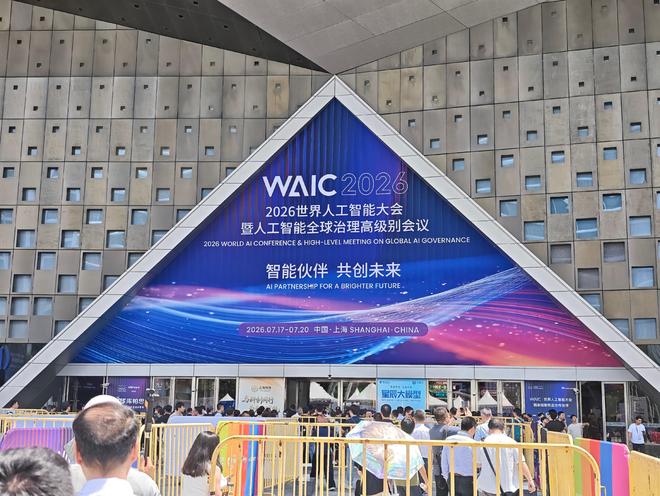
Image Source: Leitech
In the past few years, the industry's most common response has been, "AI won't replace humans; those who can use AI will replace those who can't." This statement isn't wrong, but by 2026—when intelligent agents can perform tasks continuously and AI begins to enter scientific research and the physical world—it has become somewhat inadequate. The real changes have long surpassed merely learning an additional tool. More and more tasks that originally required human responses, operations, and even decision-making can now be taken over by machines.
Humans, of course, cannot outperform machines in every aspect. However, this doesn't mean ordinary people can only learn the latest tools while waiting for their jobs to be revalued. After reviewing the public speeches, panel discussions, and on-site conversations at WAIC, I would summarize the answer in four key points:
2. Don't give all the time saved by automation back to work;
3. You can authorize AI to perform tasks, but you cannot outsource values and responsibilities;
4. Finally, always leave yourself a path to pivot.
"Asking good questions is probably very important, perhaps even more important than having answers."
At WAIC's AI for Science panel, Fudan University professor Qiu Xipeng distilled his advice for young people into this single sentence. It may sound like a cliché, but in today's context—where AI can write code, conduct research, and call upon tools—this statement carries new weight.
In the past, the threshold for many professions was built on "knowing the answers." If you remembered more knowledge, were familiar with more processes, and could produce documents faster, you could achieve a higher position within an organization. However, the first thing large models do is make standard answers and outputs quickly cheaper.
Turing Award winner Richard Sutton also reminds us that today's AI primarily uses human knowledge and delivers it back to humans. It can write, draw, and calculate, but it still lacks the first-person experience of acting toward goals and continuously refining its approach based on real-world feedback. He even straightforward (bluntly states) that current AI remains "relatively weak and unreliable."
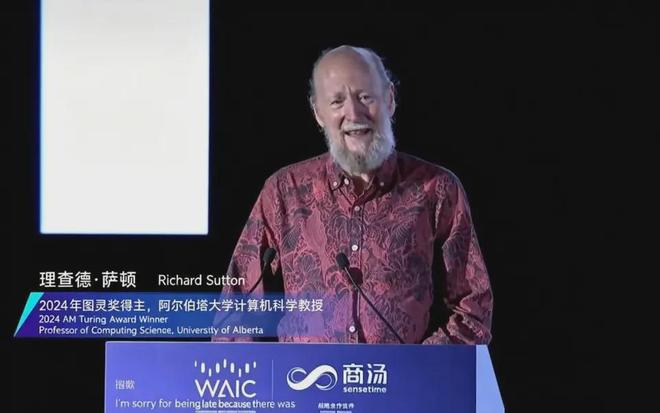
Image Source: WAIC
The problem is that Sutton doesn't believe this limitation will persist. AI is moving from a static "era of human data" to an "era of experience," where it can learn through action. Once machines can predict, act, obtain feedback, and adjust on their own, the advantages ordinary people hold by merely memorizing knowledge and executing processes proficiently (proficiently) will continue to diminish.
At this point, the most valuable ability for humans to train shifts one step further: first decide what problem to solve, what conditions the outcome should meet, what costs are unacceptable, and then determine whether the answers provided by machines are meaningful.
This also explains why, at the same panel, Nobel laureate in Chemistry Omar M. Yaghi acknowledged that AI has significantly accelerated some chemical research that used to take weeks or months, while also expressing concern that if scientists don't actively experiment and verify, they may end up being told by intelligent agents "how science should be done."
AI provides more answers, but it also shifts the difficulty to choice: what is worth asking, which direction is worth investing in, and which results should enter the real world.
Wang Jian, an academician of the Chinese Academy of Engineering, founder of Alibaba Cloud, and director of the Zhejiang Lab, described a similar shift from another perspective. Today's large models have read vast numbers of papers, books, and web pages, but much of the knowledge in the natural world is hidden in spectra, remote sensing data, seismic waves, gene sequences, and experimental data.
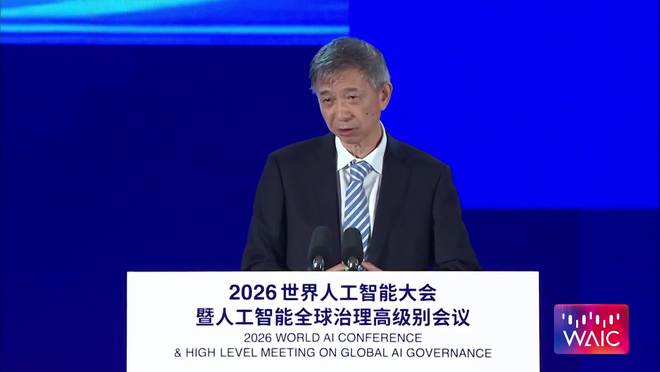
Wang Jian, Image Source: WAIC
If the next generation of scientific foundational models can directly understand this data, AI won't just be repeating conclusions written by humans—it may also discover new questions from old data.
On that day, humans may no longer monopolize discovery. However, for a considerable time to come, questions like which discoveries are worth pursuing, how to verify them, and where they should be applied will still require human answers.
Therefore, the first way ordinary people should adapt to AI is to let go of the anxiety of training themselves to be faster machines and move from "Can I do this?" to "Why should this be done?" Being able to write a proposal is useful, but defining the real problem the proposal should solve is even more important. Having AI generate ten answers is easy; knowing what the eleventh question should be is increasingly rare.
"The mission of physical intelligence is to return humans to being human," said Su Hao, dean of Fudan University's Institute for General Physical Intelligence.
In his vision, robots would handle tasks like turning over elderly individuals, lifting heavy objects, and performing dangerous operations in high-altitude, underground, or high-temperature environments; humans would step back to safety and continue to provide companionship, care, judgment, and creativity. This division of labor is ideal and easily agreed upon.
However, in today's offices, things often go in another direction. If AI saves an hour of work, organizations don't necessarily give that hour back to life—they're more likely to assign two additional tasks. If an individual, with the help of intelligent agents, can produce as much as a former team, companies might Reverse questioning (ask in return) why they still need the original team.
This is the other, often overlooked side of "AI liberating humans." Technology can eliminate some repetitive labor, but it won't automatically decide who gets the saved time, nor will it guarantee that workers end up better off.
Yin Qi, chairman of StepFun, predicts that in the future, engineers, designers, and researchers may all have dedicated intelligent agents, "enabling one person to have the capabilities of an entire team." As a business leader, he sees the opportunity for personal capabilities to be amplified tenfold. However, from an ordinary person's perspective, this prediction needs an important addition:
When personal output is amplified tenfold, how will the benefits be distributed, and will work intensity also increase tenfold?
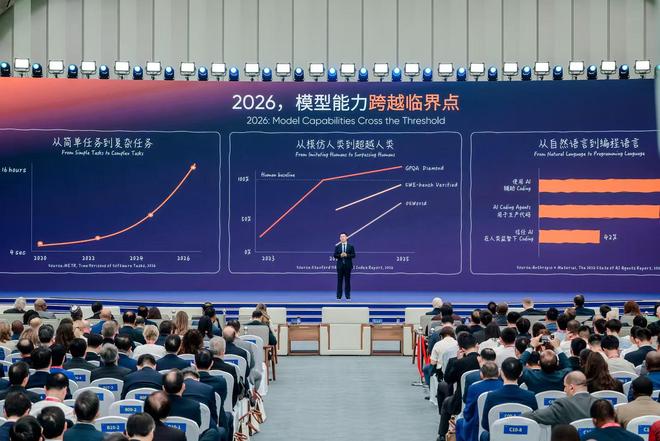
Image Source: StepFun
Good AI should enhance human capabilities, expand human boundaries, and enable people to gain knowledge, skills, and growth through use, rather than creating dependency on the product. This standard applies not only to judging products but also to judging one's own work. After using AI for a while, you can ask three specific questions:
Without this tool, do I understand the original problem better? Have I acquired a transferable methodology as a result? Has the time saved been turned into new creativity, relationships, and rest, or has it only brought more tasks?
If the answer is always the latter, then AI has indeed improved efficiency, but it hasn't returned humans to being human.
Turing Award winner John Hopcroft also mentioned education at the event, stating that the fundamental mission of universities is to help students discover their interests and find career paths that allow them to realize their self-worth. In an era where the next technological shift cannot be accurately predicted, a more stable strategy than chasing short-term popular skills is to cultivate people who can adapt to change.
Interest here is not just a romantic notion. It means that when a skilled task is rapidly automated, you still have the motivation to keep asking questions, learning, and reorganizing your work. AI can complete more and more processes for humans, but where a person chooses to focus their long-term attention will still determine what they ultimately accumulate.
If large models primarily change "who answers," intelligent agents change "who executes." In his speech, Yin Qi proposed that computers, phones, cars, and robots will become the "bodies" of the same intelligent agent in different contexts. Intelligent agents will not only call upon tools but may also possess identities, capabilities, and credit, autonomously seeking partners, organizing collaborations, and even completing transactions.
The question is: Who does the intelligent agent act on behalf of? Who bears the consequences? Is its identity trustworthy? Can its permissions be controlled? Can its actions be traced?
These questions may sound like industry governance, but they are not far from ordinary people. If AI edits a piece of text, mistakes can be corrected; if it sends an email, operates an account, submits an application, or arranges medical advice on your behalf, errors can enter real relationships, finances, and systems—and may even be hard to retract.
Xue Lan, dean of Tsinghua University's Schwarzman College and director of the Tsinghua University Institute for AI International Governance, put it more bluntly at the main forum: "Problems involving value judgments cannot be handed over to AI."
When humans make mistakes, we can distinguish between intentional and unintentional actions, and we can be held accountable and punished. AI, however, lacks a subjective personality capable of bearing legal and moral consequences. In the event of an accident, responsibility will ultimately fall back on specific individuals and organizations along the complete chain of development, deployment, operation, and use.
Therefore, for ordinary people using intelligent agents, how well you craft prompts is less important than whether you set boundaries. When it comes to public dissemination, identity, privacy, finances, medical matters, and legal issues, permissions should be as limited as possible, key steps should require confirmation, processes should be viewable, and actions should be reversible.
This is not excessive caution toward technology. As President Xi Jinping pointed out in his opening speech at the conference, intelligent agents are a new form of AI products and services. Their decision-making permissions and behavioral boundaries should be clearly defined, mechanisms for behavioral tracing and risk warnings should be established, and the intrinsic safety capabilities of intelligent agents should be enhanced to mitigate application-derived risks.
Ultimately, authorization means only handing over a task to a machine—not casually throwing in judgment and responsibility as well. The more AI acts like a partner that can handle things for you, the clearer humans must be about when they must personally step in.
Always Leave Yourself a Path to Pivot
Of course, ordinary people should still learn AI.
But what truly deserves learning is not the buttons of a specific model, a particular prompt format, or even just the most popular workflow of the moment. Tools iterate faster and faster, and tying yourself to a single platform or process may mean you've just mastered it before the next redo arrives.
"All existing inertia and reliance on raw experience are now diminishing," said Cao Yue, a researcher at the Beijing Academy of Artificial Intelligence and founder of Sand.ai, summarizing the traits of the new generation as being more adept at abandoning old experiences. Young people's depth and capability in using new tools largely depend on whether they "are willing to believe and dare to believe."
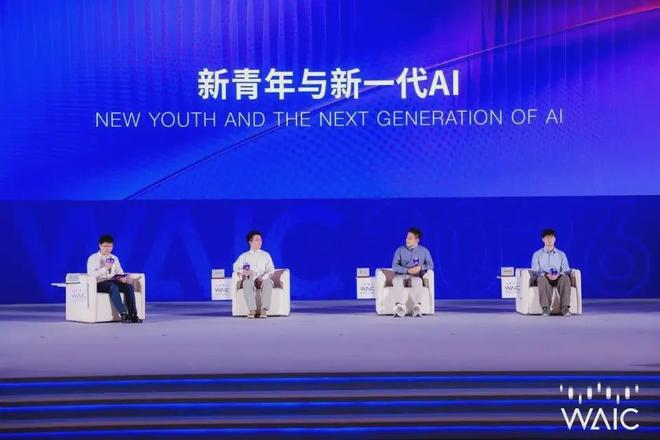
Young Scientists Dialogue, Image Source: WAIC
During the WAIC Young Scientists Dialogue, Liu Ziming, assistant professor at Tsinghua University's School of AI and chief scientist at Yuanhuan Intelligence, added: "Being 'new generation' has nothing to do with age—it's about whether you mechanically apply outdated experience to new problems." Zhuge Mingchen, a founding member of Recursive, also pointed out that AI five years ago is completely different from today's AI. "Always keep a new path open for yourself," he advised, rather than waiting passively for new developments to impact you.
Keeping a new path open doesn't necessarily mean quitting your job to change careers. It could mean actively integrating AI into a real job to see where it works and where it doesn't; maintaining a capacity for continuous learning outside your main profession; or not locking all your materials, processes, and personal knowledge into a single platform, leaving yourself room to switch tools.
More importantly, don't just learn AI in a chatbox. Sutton views experience as the source of intelligence, and Su Hao calls the physical world "the most honest examiner"—behind this lies the same principle: any seemingly polished output must ultimately be tested by reality.
Whether a proposal is willing to be used, whether code can run, whether content withstands factual verification, whether decisions harm specific individuals—these feedback loops cannot be fully replaced by asking the model a few more rounds of questions.
In the AI era, ordinary people's sense of security won't come from mastering all new tools—which is impossible anyway. It's more likely to come from a set of capabilities that don't expire easily: the ability to ask questions, verify results, learn from real-world trial and error, know which judgments cannot be outsourced, and choose a new path when old experiences fail.",
-
DRAM, A Disruptive Technological Breakthrough!
-
Robot Army Mobilizes for Action
-
![]()
Electric Vehicle Penetration Soars Past 60%, Yet Seven of Top Ten Brands Hail from Traditional Fuel Vehicle Sector, Casting Doubt on Their Longevity
-
![]()
Conant Optics Clinches R&D and Procurement Framework Deals with Top Tech Firms!
-
![]()
Over 87% Surge in Net Profit for H1 Anticipated! Dongtian Micro Leads in AI Optical Communication
-
![]()
Tech Titans Offload AI Ventures, Tencent Shifts Stakes to Capitalize on Artificial Intelligence Surge
-
![]()
WAIC 2026 Observations: Mapless, Brain-Powered, and Task-Ready—Is Physical AI Taking Off?
-
![]()
Self-driving Technology Hits the Road: NVIDIA's Structural Adjustment, the Emergence of a First Mover... The Second Half of the Autonomous Driving Race Begins