The 'Wall' of Large Models Has Been Pushed Down by Biren
 07/20 2026
 535
535
2026 is hailed as the 'first year of domestic super-nodes.'
This year's WAIC made it especially clear that domestic super-nodes are no longer just PPT concepts but are being showcased in real machines and clusters.
Huawei's Ascend Atlas 950 SuperPoD made a real-machine appearance as the 'crown jewel,' displaying 1,024 Ascend cards on-site; Biren Technology officially launched its NPO optical interconnect, distributed decoupled architecture, and a maximum 1,024-card super-node solution; Sugon debuted its scaleX 100,000-card super-intelligent fusion cluster system; Enflame Technology showcased its 'Cloud Blaze' series super-nodes and NPO optical interconnect prototype; and Maxio Technology unveiled its 'Xijing' S-series super-nodes.
Ding Yunfan, Vice President of AI Framework Architecture at Biren Technology, told us that two clear trends are emerging behind the scenes: First, as model parameters expand into the trillions, mainstream electrical interconnect super-nodes face physical scalability ceilings, making the NPO (Near-Package Optics) optical interconnect route increasingly favored by vendors; second, the competitive dimension of domestic computing power is gradually shifting from single-chip performance to system-level solutions.
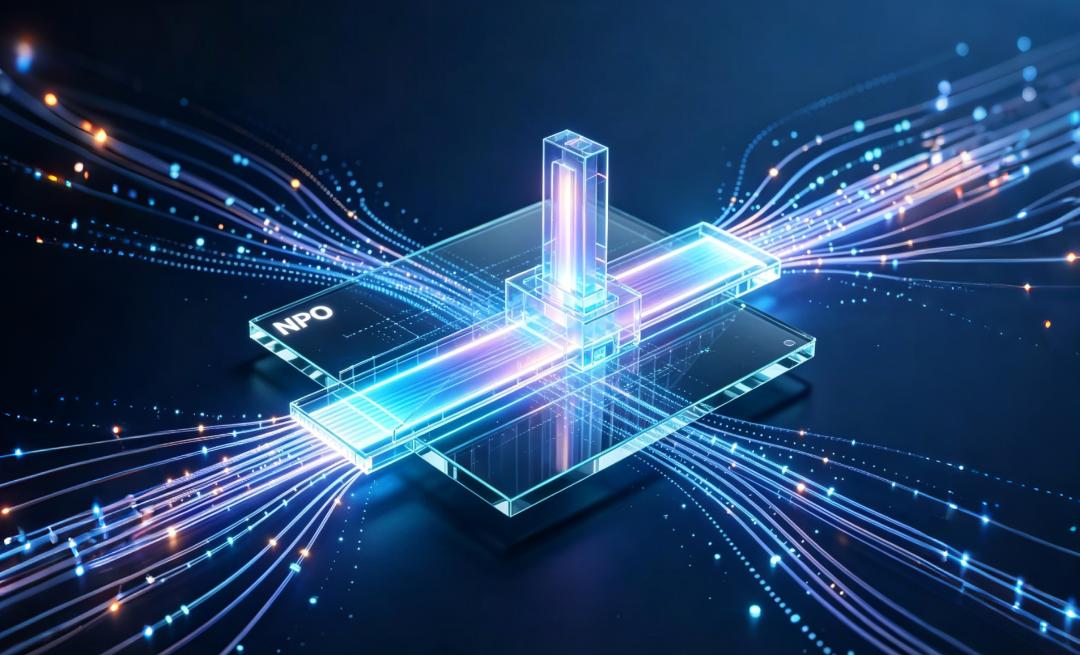
Biren Technology proactively bet on the optical interconnect route early on, evolving from its 'Guangyue' series as a testbed, iterating from 'electrical interconnects' to 'NPO optical interconnects,' and ultimately achieving an architectural leap from 'electrical' to 'optical' and from 'whole cabinets' to 'distributed decoupling.'
Recently, many domestic giants, considering future market competition, have one after another unveiled NPO optical interconnect super-node solutions, but overall, they are still in the technical tackle key problems (breakthrough) and prototype development stages.
Biren Technology stated that NPO optical interconnect super-nodes are expected to begin commercial deployment in 2027. By then, they will enter a small-scale commercial verification phase, marking a 0-to-1 leap in the industrialization of optical interconnect super-nodes.
Ding Yunfan predicts that 'by 2028, NPO optical interconnect super-nodes may achieve large-scale deployment.'
Huatai Securities estimates that the market space for domestic super-nodes could reach RMB 341.4 billion in 2028, with a CAGR (Compound Annual Growth Rate) of 194% from 2026 to 2028.
Ultra-large parameters, ultra-long text, and ultra-large clusters are the fundamental driving forces behind the emergence of super-nodes.
In terms of parameter scale, models are advancing from the hundred-billion level to the trillion level. Kimi K3 has 2.8 trillion parameters, and industry estimates suggest Fable 5 has between 5T and 10T parameters. Ding Yunfan predicts, 'A 5-trillion-parameter model is likely to emerge domestically next year.'
In terms of text length, applications like Agents require million-level context. In terms of cluster scale, both inference and training require tens of thousands of GPUs to work collaboratively.
The combination of these factors means that massive GPUs must be efficiently coordinated to function as a single integrated supercomputer. No matter how strong a single card's computing power is, it cannot overcome the communication walls and collaboration bottlenecks caused by scale.
Changes in model architecture further amplify reliance on high-speed interconnects. Currently, mainstream large models widely adopt MoE (Mixture of Experts) architectures, which contain numerous 'experts' internally and require expert parallelism during runtime, necessitating frequent communication between any two GPUs.
This high-density real-time data exchange demands far more from interconnect bandwidth and low-latency communication than traditional cluster networks can provide. Ordinary data center networks cannot support this all-to-all efficient communication mode, which can only be achieved through high-speed interconnects within super-nodes. A change in model architecture transforms interconnect needs from a nice-to-have into a must-have.
Moreover, all technologies must return to their commercial essence, pursuing cost-effectiveness and ROI.
On the training side, training with 10,000-card clusters takes months, demanding extremely high cluster stability and communication efficiency. Ultra-large super-nodes can effectively reduce cross-domain communication losses and increase the proportion of effective computing power. On the inference side, with the explosion of Agents, inference computing power demand has even surpassed training, and inference is extremely sensitive to latency, accompanied by large amounts of KV Cache (intermediate computation results). If super-node scale is insufficient, cross-node communication latency becomes too high, not only slowing AI responses but also failing to efficiently share caches, resulting in massive computing power waste.
While demand is upgrading, a more severe (critical) issue is that existing technical routes have hit physical limits. Current mainstream electrical interconnect super-nodes (copper cables) face triple constraints.
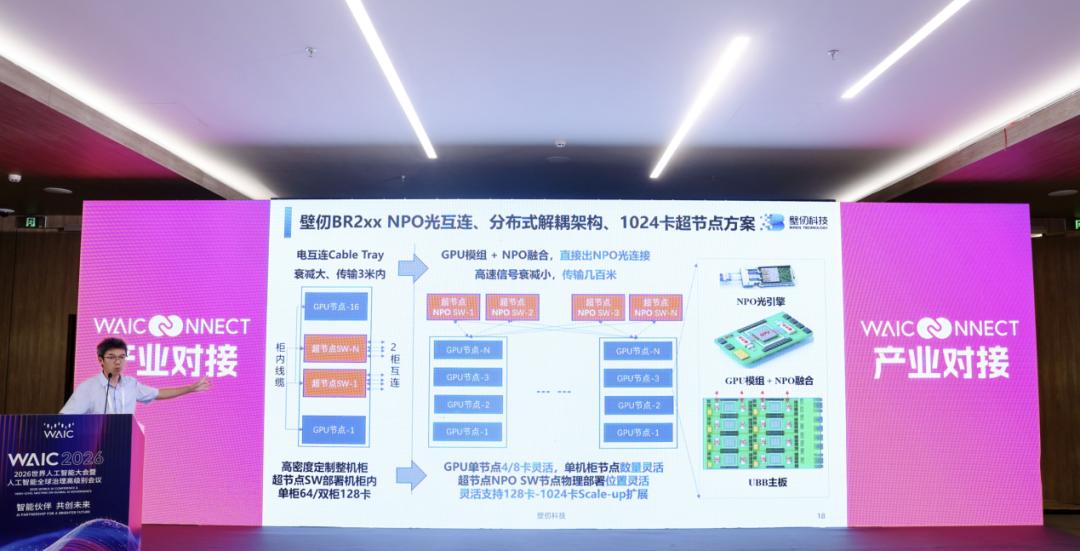
First, transmission distance is limited; when port speeds reach 224Gbps, copper cable electrical signals severely attenuate within 3 meters and cannot be extended further. Second, scalability is capped; whether using Cable Tray or orthogonal backplane architectures, they generally support only 64 or 128 cards. Finally, operations and maintenance are extremely difficult; high-density cable production yields are low, and a single broken cable can affect the entire system.
After electrical interconnects hit their physical ceilings, optical interconnect super-nodes have become the optimal path for computing power breakthroughs.
Currently, there are four main technical routes for optical interconnects: traditional pluggable (FRO), linear direct drive (LPO), near-package optics (NPO), and co-packaged optics (CPO).
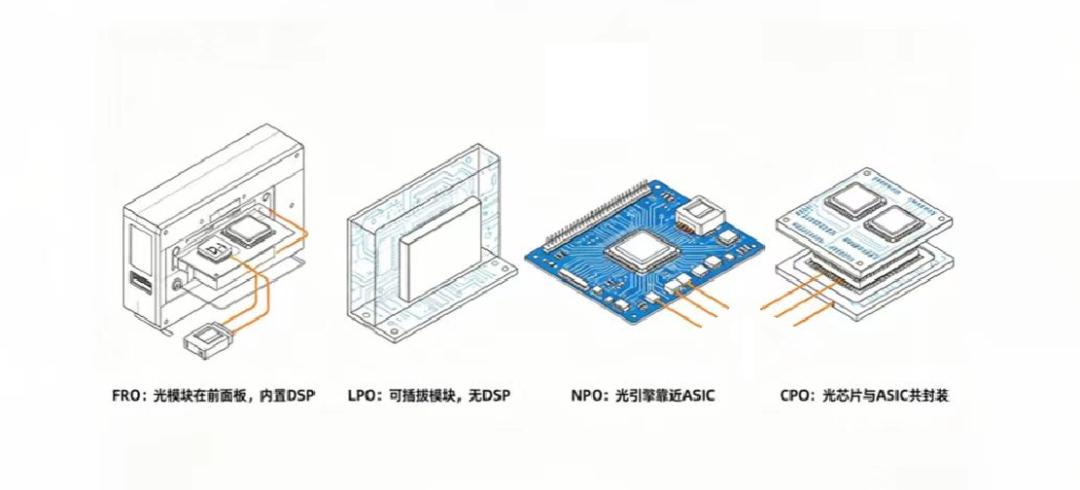
Traditional pluggable (FRO) involves using optical modules as independent pluggable components inserted into panels at the edge of chassis, with a DSP (Digital Signal Processor) inside each optical module. A single 400Gb optical module can consume around 10 watts, causing overall power consumption and heat dissipation pressures to surge when module quantities are large in super-nodes. Another obvious pain point is that DSP chips introduce additional latency during signal processing, ultimately reducing processing efficiency.
Linear direct drive (LPO) also uses pluggable module forms but simplifies them by removing high-power-consuming DSP chips, significantly reducing power consumption and latency. However, this brute-force removal brings strong limitations; the flip side of low power consumption and latency is degraded signal quality. Thus, this solution heavily relies on system-level joint customization and tuning. In industry deployments, it often becomes exclusive to large internet companies. These giants possess fully customized switches, servers, and optical modules, allowing them to compensate for signal defects through full-stack tuning, whereas ordinary customers and small-to-medium vendors cannot directly use it, making replication extremely difficult.
Near-package optics (NPO) is currently a technological hotspot, involving direct integration of optical engines with GPU modules and removing high-power-consuming DSP chips. Optical signals no longer travel through PCB copper traces on the motherboard but are directly pulled out of the chassis edge via optical fibers, greatly shortening electrical signal transmission distances with virtually no signal attenuation while supporting long-distance transmission over hundreds of meters. Based on these advantages, NPO has become the optimal solution for vendors balancing performance, power consumption, cost, and engineering feasibility.
Co-packaged optics (CPO) represents the next evolutionary stage of NPO, encapsulating optical engines and GPUs directly within the same chip package. Theoretically, it achieves a perfect state where optical signals do not travel through any PCB but are directly transmitted within the chip, minimizing loss, maximizing signal quality and bandwidth density, and optimizing performance and power consumption. Unfortunately, CPO's manufacturing difficulty is extreme, with vendors facing huge challenges in packaging technology and yield rates, making it currently unfeasible for industrialization.
Ding Yunfan told Photon planet (Photon Planet) that the current industry focus in optical interconnect technical routes no longer centers on the relatively mature FRO and LPO solutions. Industry attention and resources have fully shifted toward the future-oriented NPO and CPO solutions.
'Especially NPO, it is becoming the core of collaborative industry chain tackle key problems (breakthroughs).'
The optical interconnect industry chain comprises multiple players, including optical module vendors, GPUs, servers, and large internet companies, with the future direction being to build an open ecosystem.
In this open ecosystem, each party plays its role. Large internet companies, as core customers, primarily define architectural specifications and wield strong influence but do not engage in specific switch or optical module manufacturing. GPU vendors like Biren Technology focus on GPU R&D, adopt third-party NPO optical engines, and define their own super-node architectures but do not build whole cabinets, instead collaborating with server partners. Switch and optical module vendors become open suppliers, providing products to different customers, including Biren Technology.
Biren Technology, one of the 'Four Little Dragons of Domestic GPUs,' has taken the lead in demonstrating a complete optical interconnect evolution path for the industry.
Based on the BR166 and BLink 1.0 interconnect protocols, Biren Technology built its first super-node product. Using distributed optical switching (dOCS) technology and based on 8-card standard servers, a single super-node domain can support up to 32 cards.
The representative product of this phase was the domestic first optical interconnect optical switching GPU super-node—'Guangyue LightSphere X'—jointly released by Biren Technology, Shanghai Instrumentation, Xizhi Technology (Xizi Technology), and ZTE at last year's WAIC, winning the 2025 WAIC top award, the 'SAIL Award.'
Notably, Biren Technology adopted an optical interconnect solution in its first-generation product rather than starting with electrical interconnects. This allowed it to accumulate earlier practical experience in the optical interconnect super-node field than the industry.
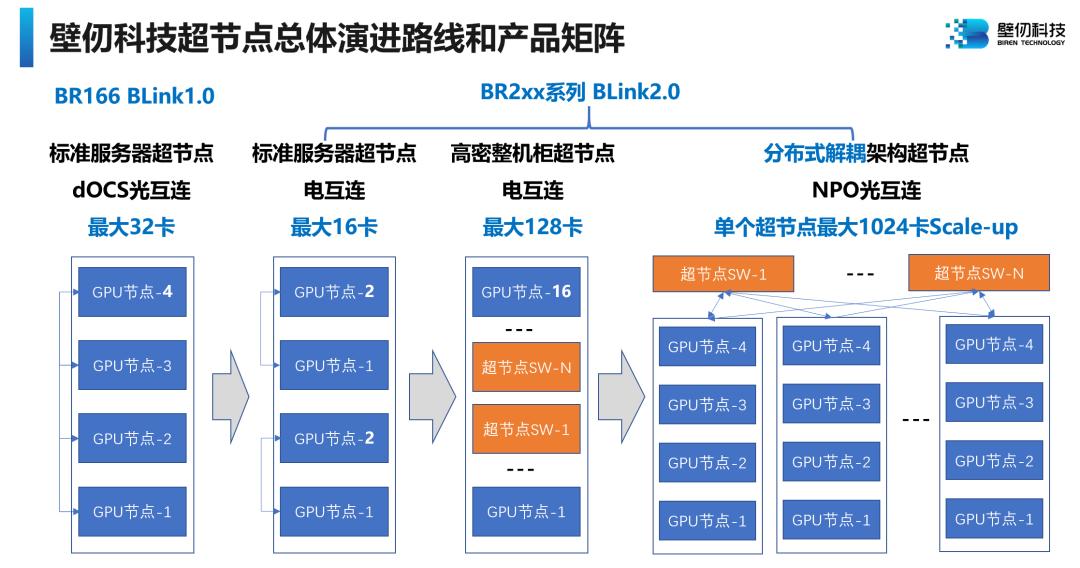
After the 'Guangyue' series successfully validated the feasibility of optical interconnects, Biren Technology officially released its next-generation NPO optical interconnect, distributed decoupled architecture, and maximum 1,024-card super-node solution at this year's WAIC, marking its technical route's formal evolution to NPO.
It must be emphasized that Biren Technology is not offering a single-point technological breakthrough but an end-to-end super-node solution covering chips, protocols, systems, and applications.
Biren Technology pioneered the Chiplet architecture for high-computing-power chips, akin to assembling multiple small building blocks into a giant Lego structure. By combining multiple compute chiplets into a single high-computing-power chip, it breaks through the physical size limitations of single-chip manufacturing. The new-generation BR2xx series GPUs support FP8/FP4 low-precision high-computing-power calculations, feature larger memory bandwidth, and natively integrate super-node interconnect capabilities, forming the computing power foundation of the entire solution.
Biren Technology's self-developed BLink 2.0 super-node interconnect protocol serves as the 'nervous system' connecting all GPUs, with four core capabilities: First, memory-semantic interconnects allow up to 1,024 GPUs to share a unified memory space, functioning as a single 'super GPU'; second, in-network computing offloads communication operations to switches, reducing GPU burden; third, intelligent congestion control prevents network bottlenecks; fourth, multi-layer link self-healing provides Step by step protection (gradual protection) from the physical to the framework layer, ensuring uninterrupted training and inference.
Based on BR2xx and BLink 2.0, Biren Technology has built a three-tier super-node product matrix, allowing customers to choose flexibly and scale elastically based on needs: 16-card standard server super-nodes (electrical interconnects) and 128-card high-density whole-cabinet super-nodes (electrical interconnects) for small-to-medium customers and scenarios with hundred-billion to trillion-parameter models; and a flagship 1,024-card distributed decoupled architecture super-node (NPO optical interconnect) for large customers and scenarios with trillion-parameter models.
On the application side, Biren Technology offers the 'Token Factory' solution.
Through a five-level hierarchical caching architecture, Biren achieves over 95% KV Cache hit rates, significantly reducing redundant computation overhead. Meanwhile, Biren Technology and China Telecom jointly pioneered a cross-vendor heterogeneous mixed-inference solution, fully leveraging heterogeneous computing power advantages and boosting effective throughput by 20%. In fault tolerance, even if a single GPU fails, the framework layer can automatically isolate the faulty node, perceive super-node topology, and reconfigure the network, ensuring uninterrupted service and providing ultimate fundamental guarantees for the engineering deployment and long-term stable operation of large-scale super-node clusters.
Internally, Biren Technology has established a clear verification path: first deploy and verify solution effectiveness in its own business scenarios, then optimize performance to the fullest through deep tuning while accumulating engineering experience, and finally provide customers with mature, verified solutions.
This strategy's efficiency is further amplified by Biren Technology's self-developed SUPACODE GPU programming agent. If a customer's model undergoes minor changes, the agent can automatically identify and adapt, without the customer even needing to specify the modifications, greatly reducing application deployment costs.
Through Biren Technology's case, the future trends of super-nodes become increasingly clear:
Technologically, NPO optical interconnects will replace electrical interconnects as the mainstream Scale-up solution; architecturally, distributed decoupling will replace whole-cabinet customization as the standard super-node form; competitively, full-stack system capabilities will replace single-chip performance as vendors' core barriers; and ecologically, open collaboration will replace closed monopolies as the industry's dominant model.
Thus, super-nodes are not just a product but a computing paradigm; not just an upgrade but a revolution.
The rules of the AI computing power competition game are quietly being rewritten, shifting from single-point performance contests to system efficiency competitions.
For China's AI industry, this represents a rare strategic opportunity. As global computing power competition moves from 'process node wars' to 'system wars,' China's complete industry chain, rich application scenarios, and strong engineering capabilities have become advantageous competitive edges.
This is not just an opportunity for Biren Technology but a shared opportunity for domestic GPUs.
-
![]()
AI Memory Race Unveils a Stunning Dark Horse: RedBear AI Raises 6 Rounds of Funding in 15 Months, Valuation Soars Close to RMB 3 Billion
-
![]()
WAIC Concludes: The Three-Year Competition for Large Model Parameters Ends, AI Fully Enters the Industrialization and Implementation Phase for Intelligent Agents
-
DRAM, A Disruptive Technological Breakthrough!
-
Robot Army Mobilizes for Action
-
![]()
Electric Vehicle Penetration Soars Past 60%, Yet Seven of Top Ten Brands Hail from Traditional Fuel Vehicle Sector, Casting Doubt on Their Longevity
-
![]()
Conant Optics Clinches R&D and Procurement Framework Deals with Top Tech Firms!
-
![]()
Over 87% Surge in Net Profit for H1 Anticipated! Dongtian Micro Leads in AI Optical Communication
-
![]()
Tech Titans Offload AI Ventures, Tencent Shifts Stakes to Capitalize on Artificial Intelligence Surge