Report | 2026 China Third-Party Computing Power Center Service Provider Development Research Report
 07/20 2026
 363
363
Currently, artificial intelligence (AI) stands as a pivotal force propelling the digital and intelligent transformation of the economy and society.
The relentless evolution of large-scale models, generative AI, and intelligent agent applications not only fuels the escalating demand for computing power but also instigates systemic shifts in the service targets, construction standards, and operational prerequisites of computing power infrastructure. As pivotal builders and operators of this infrastructure, computing power center service providers act as a vital bridge, connecting upstream foundational resources with a diverse array of downstream clients. They play an indispensable role in ensuring the seamless operation of computing facilities and bolstering the deployment of digital applications.
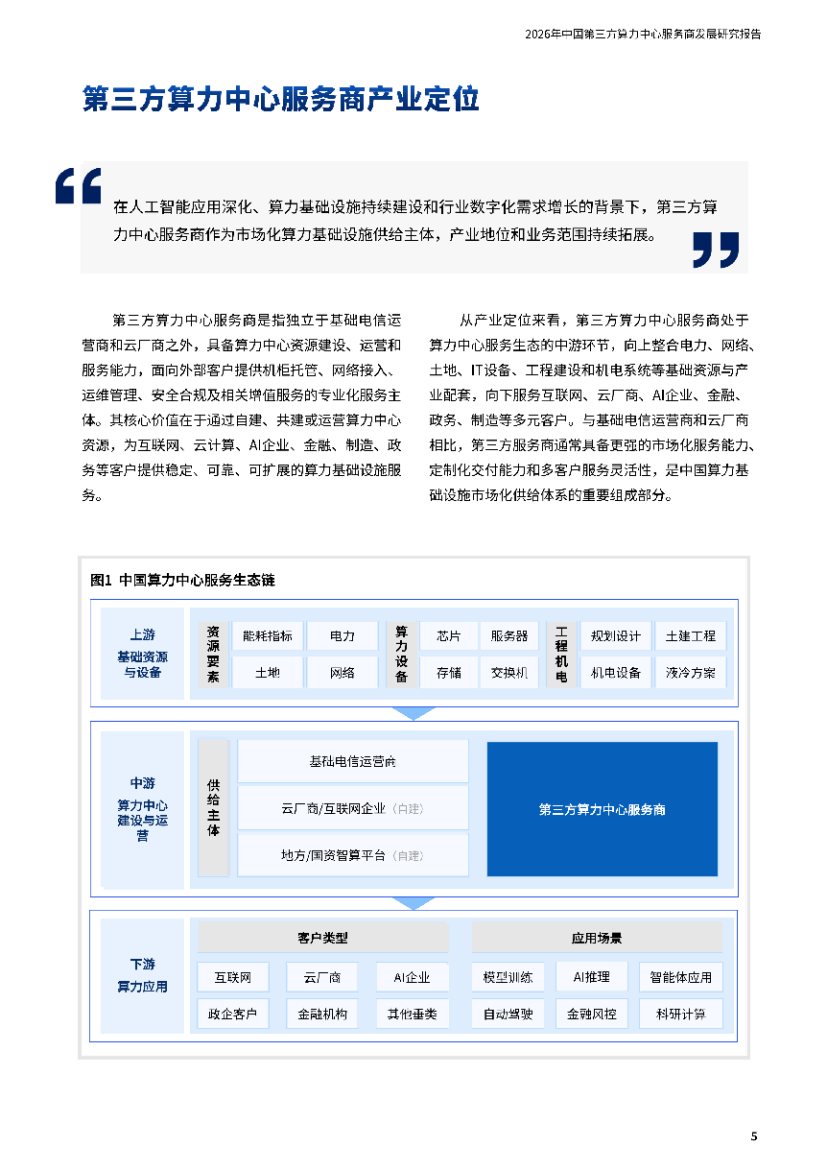
The domestic computing power center service ecosystem is structured across three hierarchical tiers. Computing power center service providers, renowned for their expertise in constructing and operating computing power centers, occupy the midstream position within this ecosystem. Upstream, they integrate foundational resources and industrial support, encompassing electricity, networks, land, IT equipment, engineering construction, and electromechanical systems. Downstream, they cater to a wide spectrum of clients, including internet firms, cloud service providers, AI enterprises, financial institutions, government bodies, manufacturing entities, and beyond. In contrast to basic telecom operators and cloud providers, third-party service providers (as illustrated in the figure below) typically boast superior market-oriented service capabilities, bespoke delivery solutions, and the agility to serve multiple clients, thereby constituting an integral facet of the domestic market-oriented supply system for computing power infrastructure.
Third-party computing power center service providers: Five core competencies form the crux of resource competition. The burgeoning demand for AI computing power further elevates the industry's delivery standards. Large-scale model training and inference operations necessitate not only high-power-density cabinets, stable power supply and distribution systems, and liquid cooling capabilities but also mandate that projects be accomplished and handed over within the client's anticipated timeframe to facilitate cluster deployment. Delivery capability transcends mere engineering construction speed; it encompasses a holistic suite of competencies, including resource procurement, regulatory compliance, power supply assurance, electromechanical system delivery, client coordination, and operational readiness. Leading service providers, armed with robust financial resources, a solid client base, and extensive project execution experience, are more inclined to forge a closed loop of 'resource acquisition—client engagement—rapid delivery.' Conversely, some small and medium-sized service providers, despite possessing certain planned resources, may grapple with protracted implementation cycles, inadequate client conversion, and low delivery certainty, thereby exacerbating the divergence in industry resource value.
The full-chain delivery capability of computing power center service providers is composed of six stages. In recent years, as the complexity of AI business deployment escalates, traditional delivery models undergo redefinition. The requisites for high-power cabinets, liquid cooling deployment, GPU cluster support (Note: 'bear' has been replaced with the more natural 'support' in this context), and high-performance networks in AI training and inference vastly surpass those of conventional businesses. Simultaneously, the large-scale customization demands of leading pan-internet enterprises, cloud providers, and AI companies continue to surge, with single order sizes generally escalating from less than 20MW in the past to over 100MW. The tempo of resource delivery is intricately linked to business deployment timelines, and data centers have transcended their role as mere supporting elements for client computing power deployment to become a prerequisite step for computing power expansion. Against this backdrop, clients are no longer content with merely procuring standardized cabinet resources; they now demand that service providers intervene early in project planning, data center design, power supply and distribution schemes, cooling architectures, network connectivity, equipment deployment, and operational support, thereby significantly advancing the service boundary.
The following is the report content:


-
![]()
AI Memory Race Unveils a Stunning Dark Horse: RedBear AI Raises 6 Rounds of Funding in 15 Months, Valuation Soars Close to RMB 3 Billion
-
![]()
WAIC Concludes: The Three-Year Competition for Large Model Parameters Ends, AI Fully Enters the Industrialization and Implementation Phase for Intelligent Agents
-
DRAM, A Disruptive Technological Breakthrough!
-
Robot Army Mobilizes for Action
-
![]()
Electric Vehicle Penetration Soars Past 60%, Yet Seven of Top Ten Brands Hail from Traditional Fuel Vehicle Sector, Casting Doubt on Their Longevity
-
![]()
Conant Optics Clinches R&D and Procurement Framework Deals with Top Tech Firms!
-
![]()
Over 87% Surge in Net Profit for H1 Anticipated! Dongtian Micro Leads in AI Optical Communication
-
![]()
Tech Titans Offload AI Ventures, Tencent Shifts Stakes to Capitalize on Artificial Intelligence Surge